

How to Measure Carbon Footprint for Small Businesses in India (Complete Guide 2026)
By United Carbon Technologies | Climate Knowledge Hub India
Published: April 23, 2026 • Updated: July 2026
Follow United Carbon Technologies for practical guides on Carbon Accounting, ESG Reporting, Climate Technology, Net Zero, and Sustainability for Indian businesses.
Every business leaves an environmental footprint. Whether you operate a manufacturing unit, retail store, office, logistics company, startup, or MSME, understanding your carbon emissions is becoming an essential part of modern business management. Measuring your carbon footprint is the foundation of sustainability, ESG reporting, operational efficiency, and long-term competitiveness.
Across the world, customers, investors, multinational buyers, and regulators increasingly expect businesses to understand and manage their greenhouse gas emissions. Indian MSMEs that begin measuring emissions today will be better prepared for tomorrow's business opportunities and reporting requirements.
How can small businesses measure their carbon footprint?
Small businesses measure their carbon footprint by collecting data on electricity consumption, fuel usage, transportation, business travel, waste generation, water use, and supply chain activities. These activities are converted into greenhouse gas emissions using internationally accepted emission factors such as the GHG Protocol.
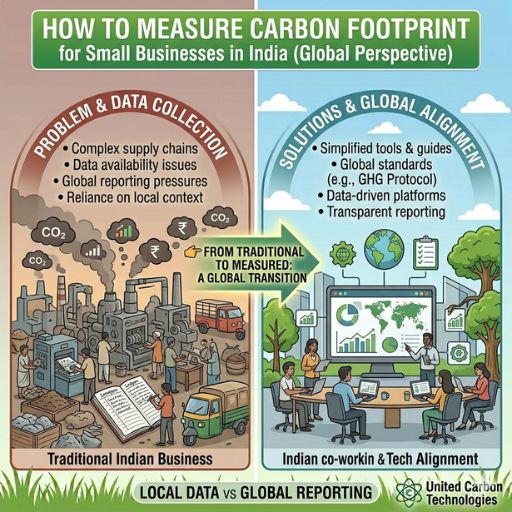
Climate change is no longer only an environmental issue—it is now a business issue. Energy prices, customer expectations, ESG regulations, international supply chains, and investor preferences are increasingly influenced by sustainability performance.
For many Indian MSMEs, carbon measurement appears complicated. In reality, businesses already possess most of the required information in their electricity bills, fuel invoices, logistics records, travel expenses, procurement data, and waste disposal records. The challenge lies in organizing this information and converting it into measurable greenhouse gas emissions.
Once emissions are measured, businesses can identify inefficiencies, reduce operating costs, improve environmental performance, strengthen ESG reporting, and prepare for future sustainability regulations.
Measure Before You Manage
United Carbon Technologies is developing carbon intelligence solutions that simplify carbon accounting, ESG reporting, sustainability education, and climate compliance for Indian businesses. Measuring emissions is the first step toward reducing them.
Many organizations discover significant cost-saving opportunities while measuring carbon emissions because the same data also highlights inefficient electricity use, fuel consumption, logistics, and waste generation.
What Is a Business Carbon Footprint?
A business carbon footprint represents the total greenhouse gases generated directly and indirectly through business activities. These emissions are generally expressed as carbon dioxide equivalent (CO₂e), allowing different greenhouse gases to be compared using a common unit.
For a small business, emissions may originate from office electricity, diesel generators, company vehicles, employee commuting, purchased materials, logistics operations, business travel, manufacturing processes, waste disposal, and even cloud computing services.
- Electricity consumption
- Fuel usage
- Company-owned vehicles
- Business travel
- Purchased goods and services
- Waste generation
- Water consumption
- Supply chain emissions
Understanding Scope 1, Scope 2 and Scope 3 Emissions
The internationally accepted Greenhouse Gas Protocol divides emissions into three categories called emission scopes. Understanding these scopes helps businesses organize carbon accounting correctly.
Scope 1 — Direct Emissions
These emissions come directly from assets owned or controlled by your business.
- Diesel generators
- Company vehicles
- Boilers
- Industrial processes
- Refrigerant leakage
Scope 2 — Purchased Energy
These emissions result from purchased electricity, heating, cooling, or steam used by your business.
- Office electricity
- Factory electricity
- Warehouse electricity
Scope 3 — Value Chain Emissions
These are indirect emissions generated throughout the supply chain and often represent the largest portion of a company's total carbon footprint.
- Purchased materials
- Employee commuting
- Business travel
- Logistics
- Waste disposal
- Supplier emissions
- Product transportation
Calculate Your Business Emissions
The most successful sustainability programs begin with reliable data. Start by gathering your electricity bills, fuel purchases, transport records, procurement invoices, and waste information before calculating emissions.
Carbon Intelligence for Growing Businesses
United Carbon Technologies helps MSMEs, startups, manufacturers, educational institutions, and enterprises build carbon inventories, improve ESG readiness, and prepare for a low-carbon economy through practical climate intelligence solutions.
Step 4: Measure Waste-Related Emissions
Waste generated during business operations also contributes to greenhouse gas emissions, particularly when organic waste decomposes in landfills and releases methane. Measuring waste streams helps businesses identify opportunities to reduce emissions while lowering disposal costs.
Businesses should track the quantity of waste produced, the proportion recycled, composted, reused, or sent to landfill, and work with waste management partners that provide transparent reporting.
- Track general waste generated each month.
- Separate recyclable, organic, hazardous, and electronic waste.
- Measure recycling and diversion rates.
- Estimate emissions from landfill disposal.
- Review packaging waste generated by products.
Step 5: Include Supply Chain (Scope 3) Emissions
For many businesses, the largest share of emissions comes from activities outside their direct operations. These indirect emissions, known as Scope 3 emissions, include purchased goods, transportation, business travel, employee commuting, and waste handled by third parties.
Although Scope 3 calculations are more complex, businesses should begin collecting supplier information early. Even simple estimates provide valuable insights and help organizations prepare for future ESG reporting requirements.
- Collect sustainability information from suppliers.
- Track purchased raw materials and packaging.
- Measure logistics and freight emissions.
- Estimate employee commuting emissions.
- Review business travel and accommodation impacts.
Build Your Carbon Inventory with Confidence
Whether you're an MSME, startup, manufacturer, exporter, or service company, creating a structured carbon inventory is the foundation of sustainability reporting and future ESG compliance.
United Carbon Technologies is developing India-focused Carbon Intelligence tools that simplify carbon measurement, ESG reporting, and climate data management for growing businesses.
Popular Carbon Footprint Standards Used Worldwide
Using internationally recognized standards ensures consistency and improves credibility. Even if your organization is not legally required to report emissions today, following global methodologies prepares your business for future regulations and customer expectations.
| Framework | Purpose |
|---|---|
| GHG Protocol | Global standard for measuring organizational greenhouse gas emissions. |
| ISO 14064 | International standard for greenhouse gas accounting and verification. |
| BRSR Framework | India's ESG reporting framework for listed companies. |
| CDP Reporting | Global disclosure platform for climate and environmental data. |
Common Mistakes Small Businesses Should Avoid
Many organizations delay carbon accounting because they believe it requires expensive consultants or advanced software. In reality, the biggest challenge is often inconsistent data collection rather than calculation itself.
- Ignoring indirect emissions completely.
- Not keeping monthly utility records.
- Using estimates without documentation.
- Collecting data only once a year.
- Not assigning responsibility to a team member.
- Waiting until reporting becomes mandatory.
- Failing to set reduction targets after measurement.
Why Carbon Measurement Is Becoming Essential in India
India's sustainability ecosystem is evolving rapidly. Large corporations are increasingly requesting carbon data from suppliers, exporters must comply with international environmental expectations, and financial institutions are integrating ESG considerations into lending and investment decisions.
For MSMEs, measuring emissions is no longer just an environmental initiative—it is becoming a business advantage. Companies that understand their emissions are better positioned to improve operational efficiency, reduce costs, win contracts, access green finance, and prepare for future climate-related regulations.
Businesses that begin measuring emissions today will be significantly better prepared for future ESG disclosures, supply chain requirements, export expectations, and Net Zero commitments.
Measure Your Business Carbon Footprint with Confidence
Carbon accounting doesn't have to be complicated. United Carbon Technologies is building India-focused Carbon Intelligence solutions that help MSMEs, startups, manufacturers, exporters, and growing businesses understand, measure, and manage their greenhouse gas emissions.
From carbon footprint measurement and ESG readiness to future compliance and sustainability reporting, our solutions are designed specifically for Indian businesses.
Measure • Report • Reduce • Grow Sustainably
Related Climate Knowledge Hub Articles
- What Is a Carbon Footprint? Complete Beginner's Guide
- ESG Reporting Explained for Indian Businesses
- Net Zero Explained: What Every Business Should Know
- How Climate Technology Is Transforming Businesses
- Carbon Accounting: A Practical Guide for Companies
Quick Summary
- Carbon footprint measures the greenhouse gas emissions generated by business activities.
- Start by identifying organizational boundaries and emission sources.
- Measure electricity, fuel, transportation, waste, and supply chain emissions.
- Follow internationally accepted frameworks such as the GHG Protocol and ISO 14064.
- Maintain accurate records and update calculations regularly.
- Carbon measurement supports ESG reporting, cost reduction, investor confidence, and future compliance.
- Indian MSMEs that begin carbon accounting today will gain a competitive advantage in domestic and global markets.
Key Takeaways
- ✔ You cannot reduce emissions unless you first measure them.
- ✔ Even small businesses can start carbon accounting using available operational data.
- ✔ Carbon footprint measurement improves operational efficiency and identifies cost-saving opportunities.
- ✔ Customers, investors, regulators, and global buyers increasingly expect emissions transparency.
- ✔ Starting today prepares your business for future ESG reporting and Net Zero commitments.
Frequently Asked Questions
1. What is a business carbon footprint?
A business carbon footprint is the total greenhouse gas emissions generated directly and indirectly by an organization's operations, energy use, transportation, purchased goods, and other business activities.
2. Why should small businesses measure carbon emissions?
Measuring emissions helps identify inefficiencies, reduce operating costs, improve sustainability performance, and prepare for future ESG and regulatory requirements.
3. What information is needed to calculate a carbon footprint?
Businesses typically need electricity bills, fuel consumption records, transportation data, waste generation information, and supplier-related activity data.
4. What are Scope 1, Scope 2, and Scope 3 emissions?
Scope 1 covers direct emissions, Scope 2 includes purchased electricity emissions, and Scope 3 represents indirect emissions across the value chain.
5. Which carbon accounting framework is most widely used?
The Greenhouse Gas (GHG) Protocol is the world's most widely accepted framework for organizational carbon accounting.
6. How often should businesses calculate their carbon footprint?
Most organizations measure emissions annually while reviewing operational data monthly or quarterly for better management.
7. Is carbon accounting mandatory in India?
Not for every business today. However, ESG regulations, BRSR reporting, export requirements, and supply chain expectations are increasing the demand for emissions reporting.
8. Can MSMEs benefit from carbon accounting?
Yes. MSMEs can improve operational efficiency, reduce energy costs, strengthen customer trust, and become preferred suppliers for larger organizations.
9. What tools help calculate carbon emissions?
Businesses can use carbon calculators, ESG software platforms, emission management systems, spreadsheets, and specialized carbon accounting solutions.
10. What should businesses do after measuring emissions?
The next step is to identify emission hotspots, implement reduction strategies, monitor progress, and set realistic sustainability or Net Zero goals.
Start Measuring Today. Build a Low-Carbon Business Tomorrow.
Every successful sustainability journey begins with one simple step—understanding your emissions.
Whether you're a startup, MSME, manufacturer, exporter, consultant, or growing enterprise, measuring your carbon footprint today will help you reduce costs, improve ESG performance, strengthen customer trust, and prepare for tomorrow's regulations.
United Carbon Technologies is building practical Carbon Intelligence solutions designed to make carbon accounting simpler, smarter, and accessible for Indian businesses.
Measure today. Reduce tomorrow. Build a sustainable business for the future.