

How Every Citizen Contributes to Climate Change in India (Simple Guide)
By United Carbon Technologies | Climate Knowledge Hub India
Join 1,500+ readers exploring climate & ESG insights
Climate change is not only driven by industries and governments. Everyday choices made by citizens—such as transportation, electricity usage, food consumption, and waste generation—also contribute significantly to carbon emissions.
How do citizens contribute to climate change?
Citizens contribute to climate change through daily activities such as using fossil fuel-based transport, consuming electricity, purchasing products, and generating waste that produce greenhouse gas emissions.
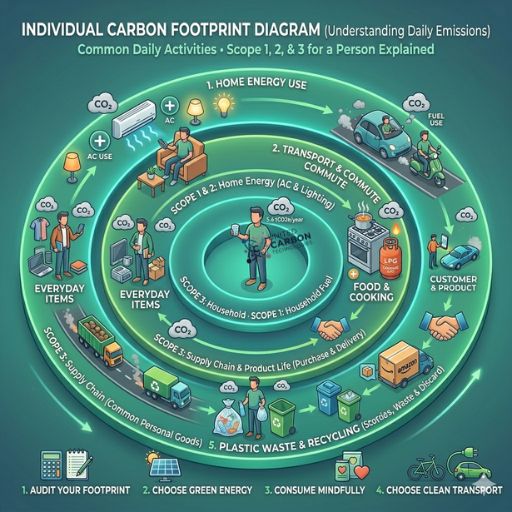
Climate change may appear to be a large-scale global issue, but the combined impact of billions of individual actions plays a major role in increasing greenhouse gas emissions.
Understanding how daily habits affect the environment is the first step toward building a more sustainable future for India and the world.
How Everyday Activities Create Greenhouse Gas Emissions
Everyday activities require energy, transportation, products, and services that consume natural resources. When fossil fuels such as coal, oil, and natural gas are used to generate electricity, manufacture goods, transport products, or power vehicles, greenhouse gases are released into the atmosphere. Although a single activity may generate only a small amount of emissions, the combined actions of millions of people significantly contribute to climate change.
- ⚡ Electricity is generated using energy resources.
- 🚗 Vehicles burn fuel for transportation.
- 🏭 Products require manufacturing and packaging.
- 🚚 Goods are transported across supply chains.
- 🗑 Waste produces greenhouse gases during disposal.
- 🌍 Millions of similar activities together increase atmospheric greenhouse gas concentrations.
Did you know? A large share of global emissions is linked to household consumption and lifestyle choices, making individual action an important climate solution.
Transportation and Fuel Use
Transportation is one of the largest contributors to carbon emissions worldwide.
- Frequent use of personal vehicles
- Dependence on petrol and diesel transport
- Air travel and long-distance commuting
- Traffic congestion increasing fuel consumption
Daily Activities and Their Climate Impact
| Daily Activity | Environmental Impact |
|---|---|
| Driving a petrol or diesel vehicle | Releases carbon dioxide and other greenhouse gases. |
| Using electricity | May generate indirect emissions depending on the electricity source. |
| Buying new products | Requires manufacturing, packaging, and transportation. |
| Food waste | Can contribute to methane emissions in landfills. |
| Frequent air travel | Produces relatively high greenhouse gas emissions per journey. |
Start optimizing your home energy usage today and see immediate reductions in your electricity bill.
Get expert support for ESG and sustainability.
Direct and Indirect Emissions
Not all emissions are created in the same way. Some emissions come directly from activities you control, while others occur indirectly through the products and services you use.
| Direct Emissions | Indirect Emissions |
|---|---|
|
Fuel used in personal vehicles Cooking fuel Home generators |
Electricity consumption Purchased products Online shopping deliveries Public services |
Household Energy Consumption
Electricity use creates indirect emissions, especially when power is generated using fossil fuels.
- High electricity consumption
- Use of inefficient appliances
- Excessive air conditioning and cooling
- Wasting electricity unnecessarily
Food Choices and Agriculture
Food systems also contribute significantly to climate change.
- Livestock farming produces methane emissions
- Transportation of food increases fuel use
- Food waste creates landfill emissions
- Unsustainable farming practices impact ecosystems
Consumption and Waste Generation
Modern consumption habits increase emissions through manufacturing, packaging, and disposal.
- Fast fashion and overconsumption
- Single-use plastic waste
- Electronic waste (e-waste)
- Frequent product replacement
Simple Climate-Friendly Habits
Small actions taken consistently by millions of people can collectively reduce greenhouse gas emissions and support India's sustainability goals.
- Choose public transportation whenever practical.
- Switch off unused electrical appliances.
- Reduce food waste.
- Carry reusable bags and bottles.
- Repair and reuse products before replacing them.
- Support sustainable and locally produced goods.
- Plant and care for trees in your community.
- Learn about carbon footprints and climate action.
The Power of Individual Responsibility
Although individual emissions may seem small, millions of people making similar choices create a major cumulative impact.
- Reduce unnecessary energy use
- Choose sustainable transport options
- Adopt conscious consumption habits
- Reduce waste generation
Citizen Action and Climate Change in India
India is experiencing increasing climate-related challenges, including heatwaves, changing rainfall patterns, water stress, and urban air pollution. As cities continue to grow and energy demand increases, individual choices related to transportation, electricity use, waste management, and consumption become increasingly important. Alongside government initiatives and business sustainability efforts, informed citizens play a vital role in supporting India's transition toward a more sustainable and climate-resilient future.
Built as part of ongoing climate-tech research and innovation initiatives supported by early-stage incubation and grant programs.
Related Climate Insights
Explore carbon footprint guides, climate action insights, and ways households can reduce emissions.
Related Reads
- What Is Climate Intelligence in Business?
- How Climate Data Helps Businesses Make Decisions
- Carbon Reporting Software: What Businesses Should Look For
- Sustainability KPIs Every Company Should Track
- How Businesses Collect Scope 3 Data
- What Is a Carbon Disclosure Report?
- Carbon Accounting Process Step by Step
- What Is a Carbon Baseline Assessment?
Climate action is not limited to governments and industries. Individuals, households, educational institutions, and businesses all contribute to greenhouse gas emissions. Understanding these contributions is the foundation for building a more sustainable future.
- Daily activities contribute to climate change
- Transportation and electricity are major emission sources
- Food and waste also affect the environment
- Individual actions collectively create significant impact
Frequently Asked Questions
1. How do citizens contribute to climate change?
Citizens contribute to climate change through everyday activities such as using fossil fuel-powered transportation, consuming electricity, purchasing goods, generating waste, and making lifestyle choices that produce greenhouse gas emissions.
2. What daily activities produce greenhouse gases?
Common activities that produce greenhouse gases include driving petrol or diesel vehicles, using electricity generated from fossil fuels, cooking with conventional fuels, flying, buying manufactured products, and disposing of waste in landfills.
3. Does electricity consumption affect climate change?
Yes. Electricity consumption can contribute to climate change when it is generated from coal, oil, or natural gas. Reducing unnecessary electricity use and improving energy efficiency can help lower greenhouse gas emissions.
4. Why does food waste contribute to greenhouse gas emissions?
When food waste decomposes in landfills, it produces methane, a greenhouse gas that has a much higher warming potential than carbon dioxide over the short term. Reducing food waste helps lower these emissions.
5. How can households reduce their climate impact?
Households can reduce their climate impact by conserving electricity, using energy-efficient appliances, choosing public transportation, reducing waste, recycling, minimizing food waste, and adopting more sustainable consumption habits.
6. What is a carbon footprint?
A carbon footprint is the total amount of greenhouse gas emissions associated with an individual, household, organization, product, or activity. It is commonly measured in carbon dioxide equivalent (CO₂e).
7. Do small individual actions really make a difference?
Yes. While one person's actions may have a small impact, millions of people making sustainable choices together can significantly reduce greenhouse gas emissions and support climate action.
8. What is sustainable living?
Sustainable living means making choices that reduce environmental impact by conserving natural resources, minimizing waste, improving energy efficiency, and supporting environmentally responsible products and practices.
9. How can students support climate action?
Students can support climate action by learning about climate science, conserving energy, reducing waste, participating in environmental initiatives, promoting sustainability within their schools and communities, and encouraging responsible consumption.
10. Why is climate education important?
Climate education helps people understand the causes and impacts of climate change, enabling individuals, businesses, and communities to make informed decisions that support sustainability and reduce greenhouse gas emissions.
Start Your Climate Learning Journey
Learn ESG, sustainability, and climate strategies.
Join early learners building climate intelligence.