

Complete Guide to Climate Technology in India (2026)
By United Carbon Technologies | Climate Knowledge Hub India
Stay updated on localized climate innovation & ESG frameworks.
Climate technology is transforming how industries measure, mitigate, and report environmental impact. In India, the climate tech ecosystem is rapidly evolving from a niche sector into a critical infrastructure layer driven by rigorous ESG compliance, manufacturing shifts, and data-backed carbon intelligence.
What is Climate Technology?
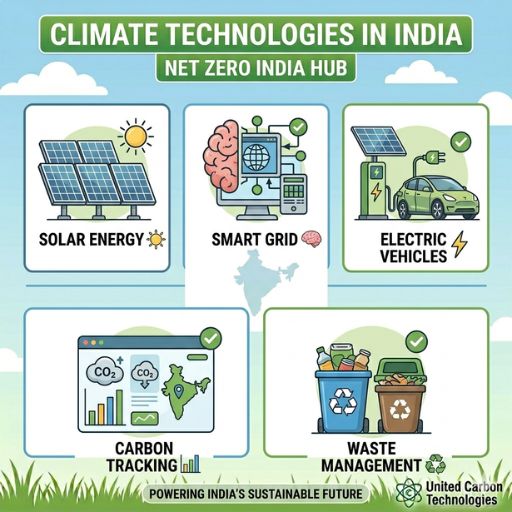
Climate technology encompasses platforms, specialized software hardware, and biological innovations engineered to reduce greenhouse gas emissions, optimize resource lifecycles, and bring total transparent traceability to corporate sustainability data.
With SEBI expanding mandatory **BRSR (Business Responsibility and Sustainability Reporting)** frameworks, accurate carbon tracking tech is no longer optional—it is a core operational requirement for top-tier Indian companies and their supply chains.
Core Segments of Indian Climate Tech
The landscape is split across four pillars addressing specific regulatory and decarbonization challenges:
| Technology Segment | Primary Application |
|---|---|
| Carbon Tracking & Accounting | Digital tools mapping Scope 1, 2, and 3 emissions for corporate auditing. |
| Renewable Infrastructure | Smart grid management, distributed commercial solar, and storage integration. |
| Industrial Energy Efficiency | IoT monitoring loops helping MSMEs cut power leaks and reduce energy costs. |
| Data Ledgers & ESG Hubs | Cloud dashboards providing auditable metrics for international green capital. |
Driving Forces Behind Adoption
⚡ Radical Cost Reductions: Optimized energy analytics cut waste, yielding direct balance-sheet savings for manufacturing facilities.
📈 Global Supply Chain Mandates: Indian manufacturing hubs exporting to international markets must share reliable, software-verified emission baselines.
🌱 Investment Inflows: Institutional venture funds are shifting funding pipelines towards startups offering auditable, localized climate architectures.
Are you managing an Indian Enterprise or MSME?
Align your operations with upcoming carbon frameworks, prevent supply-chain disruptions, and deploy data-backed ESG models seamlessly.
Key Barriers to Ecosystem Acceleration
- Integration Friction: Retrofitting legacy operational frameworks with modern cloud-based data tracking tags.
- Skill Caps: A localized deficit in technical practitioners specializing in precise greenhouse gas (GHG) accounting standards.
- Capex Justification: Convincing mid-tier enterprises to allocate budgets toward multi-year carbon mitigation systems.
This resource is continually updated by United Carbon Technologies' research division, incorporating insights gained from running real-world field pilots and regional bio-sequestration monitoring frameworks.
Related Climate Insights
Explore our deep dives: Carbon Footprint India Guide | Strategic ESG Blueprints | Domestic Carbon Markets
Explore More in This Topic
- Complete Climate Tech Reference Guide
- Top Technical Paradigms Transforming Local Infrastructure
- Leveraging Auditable Carbon Data for Strategic Business Operations
- Climate tech coordinates auditable corporate carbon visibility frameworks.
- Adoption is structurally accelerated by BRSR and export requirements.
- India remains a primary growth incubation hub for scalable mitigation systems.
Frequently Asked Questions
What makes climate technology different from traditional clean energy?
While traditional clean energy focuses primarily on power generation (like solar panels), climate technology covers a broader digital and structural domain—including AI analytics engines, carbon ledger registries, and Scope emissions software.
How does software tracking protect businesses against greenwashing accusations?
By linking all environmental assertions directly to tamper-proof data endpoints, transparent software tracking changes broad corporate statements into verifiable metrics ready for external auditing.
Is localized climate data tracking relevant for non-listed MSMEs?
Yes. Major tier-1 entities and multi-national corporations are auditing their suppliers to satisfy Scope 3 value-chain mandates, making early tracking clear business protection for smaller enterprises.
Start Your Climate Learning Journey
Build expertise in modern ESG metrics, carbon verification, and mitigation strategies.
Join proactive learners standardizing climate tech knowledge under UCT Academy.