

Climate Action in India: Policies, Progress & Global Impact (2026 Guide)
Search Description (150 characters):
Learn how India's climate policies, renewable energy, Net Zero goals, and global commitments are driving sustainability and shaping climate action in 2026.
By United Carbon Technologies | Climate Knowledge Hub India
Get practical climate insights, ESG updates, carbon accounting guides, sustainability resources, and Net Zero strategies delivered regularly.
Climate action has become one of the defining priorities of the 21st century, and India is emerging as a major force in the global transition toward a low-carbon economy. Through ambitious renewable energy targets, climate policies, clean technology investments, and international cooperation, India is balancing economic growth with environmental responsibility. This guide explains India's climate policies, achievements, challenges, and what they mean for businesses, students, policymakers, and citizens.
What is climate action in India?
Climate action in India includes government policies, renewable energy expansion, energy efficiency initiatives, carbon reduction strategies, sustainable infrastructure, and international climate commitments aimed at reducing greenhouse gas emissions while supporting economic development and achieving long-term Net Zero goals.
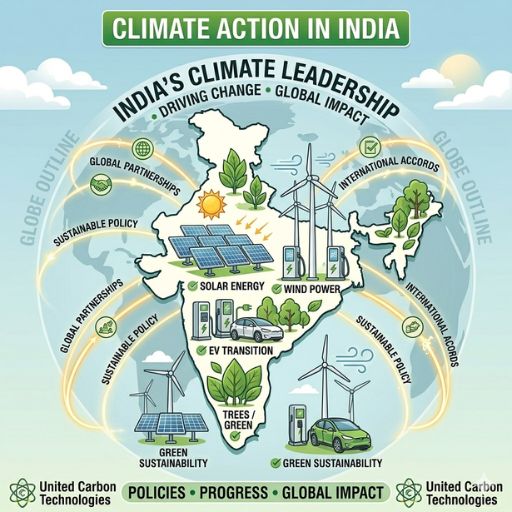
India is home to nearly one-fifth of the world's population, making its climate decisions globally significant. As energy demand continues to rise alongside rapid urbanization and industrial growth, the country faces the challenge of reducing emissions while maintaining economic development.
Over the last decade, India has accelerated investments in renewable energy, electric mobility, green hydrogen, sustainable infrastructure, and climate-resilient development. These initiatives not only strengthen domestic sustainability but also contribute to international climate goals established under the Paris Agreement.
For businesses, understanding India's climate policies is increasingly important as ESG reporting, carbon disclosure, supply-chain sustainability, and green finance become central to long-term competitiveness.
🌿 Build Climate Intelligence with UCT
United Carbon Technologies helps businesses, MSMEs, sustainability professionals, and climate learners understand carbon emissions, ESG reporting, Net Zero planning, and climate regulations through practical educational resources and upcoming digital tools.
India is among the world's fastest-growing renewable energy markets and has committed to achieving Net Zero emissions by 2070 while expanding clean energy capacity and climate resilience initiatives.
Why Climate Action Matters for India
Climate change affects nearly every aspect of India's economy and society. Rising temperatures, changing rainfall patterns, heatwaves, floods, cyclones, droughts, glacier retreat, and coastal erosion are already impacting agriculture, infrastructure, biodiversity, public health, and water security.
Climate action focuses on reducing greenhouse gas emissions while preparing communities and businesses to adapt to unavoidable climate impacts.
- Reducing greenhouse gas emissions
- Increasing renewable energy adoption
- Strengthening climate resilience
- Improving energy efficiency
- Supporting sustainable economic development
- Protecting ecosystems and biodiversity
India's National Climate Vision
India's climate strategy aims to achieve sustainable growth without compromising development needs. Rather than choosing between economic growth and environmental protection, national policies increasingly integrate both objectives.
Major priorities include expanding clean electricity generation, promoting electric mobility, improving industrial efficiency, encouraging sustainable agriculture, conserving forests, and supporting circular economy practices.
These efforts also position India as an important contributor to global climate negotiations and international sustainability initiatives.
Understand Climate Policy Before It Becomes Compliance
Businesses that understand climate regulations today are better prepared for ESG reporting, investor expectations, carbon accounting, sustainable supply chains, and future environmental regulations.
For Businesses & MSMEs
Climate regulations are increasingly influencing finance, procurement, exports, and corporate reporting. Building climate intelligence today helps organizations stay competitive in tomorrow's low-carbon economy.
Major Climate Policies Driving India's Sustainability Journey
India's climate progress is supported by a combination of national policies, missions, and international commitments. These initiatives aim to reduce greenhouse gas emissions while ensuring economic growth, energy security, and climate resilience.
1. National Action Plan on Climate Change (NAPCC)
Launched in 2008, the National Action Plan on Climate Change provides the overall framework for India's climate strategy. It consists of several national missions focused on clean energy, water conservation, sustainable agriculture, Himalayan ecosystem protection, energy efficiency, sustainable habitats, strategic knowledge, and forest conservation.
2. India's Net Zero Target
India has pledged to achieve Net Zero emissions by 2070 while continuing economic development. The roadmap includes expanding renewable energy, improving industrial efficiency, increasing forest cover, promoting green hydrogen, and encouraging low-carbon technologies.
3. Renewable Energy Expansion
India continues investing heavily in solar parks, rooftop solar systems, wind energy projects, battery storage, and modern electricity transmission networks. These investments reduce dependence on fossil fuels while improving long-term energy security.
4. Green Hydrogen Mission
Green hydrogen is expected to become an important fuel for industries that are difficult to decarbonize, including steel, fertilizers, shipping, and heavy transportation. India aims to become one of the world's largest producers of green hydrogen.
5. Electric Mobility Policies
Government incentives are encouraging the adoption of electric two-wheelers, passenger vehicles, buses, and commercial fleets. Investment in charging infrastructure continues to support India's transition toward cleaner transportation.
India's Progress in Climate Action
Climate action is producing measurable results across multiple sectors. Although challenges remain, India's sustainability journey has accelerated significantly during the past decade.
- Rapid expansion of renewable electricity generation
- Growing adoption of electric vehicles
- Improved industrial energy efficiency
- Increasing ESG adoption among businesses
- Greater climate awareness among citizens
- Growth in sustainable finance and green investments
- Expansion of climate-tech startups and innovation
- Digital transformation supporting carbon measurement
Indian startups and technology companies are also developing carbon accounting software, ESG platforms, climate analytics tools, renewable energy solutions, and AI-powered sustainability systems that support businesses worldwide.
The Role of Businesses in India's Climate Transition
Businesses have become central to India's climate strategy. Large corporations, exporters, MSMEs, financial institutions, and technology companies are increasingly expected to understand, measure, report, and reduce their environmental impact.
Climate action creates opportunities beyond regulatory compliance. Organizations that invest in sustainability often experience operational efficiencies, stronger investor confidence, improved brand reputation, and better access to international markets.
Key business priorities include:
- Carbon footprint measurement
- Energy efficiency improvements
- Renewable electricity adoption
- Supply chain sustainability
- ESG reporting
- Waste reduction and circular economy practices
- Water conservation
- Climate risk assessment
Climate Technology Accelerating India's Progress
Technology is transforming climate action by making sustainability measurable, scalable, and data-driven. Artificial intelligence, IoT sensors, satellite monitoring, digital twins, blockchain, and cloud platforms are helping organizations monitor emissions in real time and improve environmental performance.
Some of the fastest-growing climate technologies include:
- Carbon accounting software
- ESG reporting platforms
- Renewable energy monitoring systems
- Smart grids
- Battery storage technologies
- Electric mobility infrastructure
- Precision agriculture
- Climate risk analytics
These innovations help governments, businesses, and citizens make informed sustainability decisions based on reliable environmental data.
Challenges India Still Faces
Despite remarkable progress, India's climate journey remains complex because development priorities must be balanced with environmental protection.
Major challenges include:
- Rapid urbanization
- Growing electricity demand
- Industrial expansion
- Air pollution in major cities
- Water scarcity
- Climate-resilient agriculture
- Financing green infrastructure
- Supporting MSMEs during sustainability transition
Addressing these challenges requires collaboration between governments, industries, financial institutions, researchers, startups, educational institutions, and citizens.
Why India's Climate Leadership Matters Globally
India's climate decisions influence global sustainability because of its population, manufacturing capacity, economic growth, and renewable energy potential. As international supply chains increasingly prioritize low-carbon products, India's transition toward sustainable development can strengthen both domestic prosperity and global climate goals.
By investing in clean energy, climate technology, circular economy practices, and sustainable infrastructure, India has the opportunity to become one of the world's leading green economies while improving resilience against future climate risks.
Why You Can Trust This Guide
This article has been prepared by United Carbon Technologies (UCT) as part of its Climate Knowledge Hub to simplify climate policies, sustainability concepts, ESG reporting, and carbon intelligence for businesses, students, professionals, and climate-conscious individuals. The content reflects widely accepted climate science, publicly available policy information, and global sustainability frameworks.
Continue Your Climate Learning
- Climate Action Guides
- India Climate
- Climate Technology
- Carbon Footprint
- Net Zero
- ESG & Sustainability
Quick Summary
- Climate action combines policies, technology, finance, and community participation to reduce greenhouse gas emissions.
- India has committed to achieving Net Zero emissions by 2070 while supporting sustainable economic growth.
- Renewable energy, electric mobility, green hydrogen, and energy efficiency are central pillars of India's climate strategy.
- Businesses are increasingly adopting carbon accounting, ESG reporting, and sustainability practices.
- Climate technology and digital innovation are making emissions measurement and reporting more accessible.
- India's climate decisions influence global sustainability because of its population, economy, and manufacturing capacity.
- Individuals, businesses, governments, and educational institutions all have important roles in climate action.
- Early adoption of sustainable practices creates long-term environmental and economic benefits.
Key Takeaways
- Climate action is no longer optional—it is becoming a business, economic, and environmental necessity.
- India is emerging as one of the world's most influential countries in the global sustainability transition.
- Renewable energy and clean technology continue to accelerate India's low-carbon economy.
- Businesses that begin measuring and reducing emissions today will be better prepared for future regulations and international markets.
- Climate awareness combined with practical action creates meaningful long-term impact.
Frequently Asked Questions (FAQs)
1. What does climate action mean?
Climate action includes activities that reduce greenhouse gas emissions, improve climate resilience, promote sustainable development, and protect ecosystems.
2. Why is climate action important for India?
India is highly vulnerable to climate impacts such as heatwaves, floods, droughts, and changing rainfall patterns. Climate action helps protect communities, agriculture, infrastructure, and economic growth.
3. What is India's Net Zero target?
India has announced its goal of achieving Net Zero greenhouse gas emissions by the year 2070 while continuing sustainable economic development.
4. What are India's major climate policies?
Key initiatives include the National Action Plan on Climate Change (NAPCC), renewable energy programs, electric mobility policies, energy efficiency initiatives, and the National Green Hydrogen Mission.
5. How does renewable energy support climate action?
Renewable energy sources such as solar and wind produce electricity with significantly lower greenhouse gas emissions than fossil fuels, helping reduce the country's carbon footprint.
6. How can businesses contribute to climate action?
Businesses can measure emissions, improve energy efficiency, adopt renewable energy, implement ESG reporting, reduce waste, and build sustainable supply chains.
7. What role does climate technology play?
Climate technologies such as carbon accounting software, AI analytics, smart grids, IoT monitoring, and ESG platforms help organizations monitor and reduce environmental impact.
8. Can small businesses participate in climate action?
Yes. MSMEs can reduce emissions through efficient operations, renewable energy adoption, waste reduction, and carbon footprint measurement while improving competitiveness.
9. How do individuals support climate action?
People can conserve energy, reduce waste, use sustainable transportation, consume responsibly, plant trees, and encourage climate awareness within their communities.
10. Why is India's climate leadership important globally?
Because of its large population, expanding economy, and growing clean energy sector, India's climate policies have a significant influence on global emission reduction and sustainable development efforts.
Build Climate Intelligence with United Carbon Technologies
Understanding climate policies is only the first step. The future belongs to organizations and individuals who can measure emissions, understand ESG requirements, adopt sustainable technologies, and make informed climate decisions.
United Carbon Technologies is building practical climate knowledge, carbon intelligence solutions, ESG resources, and sustainability tools to help businesses, students, professionals, and climate leaders prepare for the low-carbon economy.
Learn • Measure • Reduce • Report • Build a Sustainable Future