

ESG Compliance vs Sustainability: Key Differences Explained (India Guide 2026)
By United Carbon Technologies | Climate Knowledge Hub India
Published: April 20, 2026 |
Last Updated: July 19, 2026
Receive practical guides on ESG Reporting, BRSR, Carbon Accounting, Net Zero, Climate Technology and Sustainability for Indian businesses.
Many people use the terms ESG and sustainability interchangeably, but they are not the same. Sustainability represents a company's long-term commitment to creating environmental, social, and economic value, while ESG compliance provides the measurable framework used by investors, regulators, and stakeholders to evaluate that commitment. Understanding the distinction is increasingly important for Indian businesses as ESG regulations, BRSR reporting, investor expectations, and supply chain requirements continue to evolve.
What is the difference between ESG compliance and sustainability?
ESG compliance focuses on meeting measurable environmental, social, and governance reporting requirements set by regulators, investors, and customers. Sustainability is a broader long-term business strategy focused on creating positive environmental, social, and economic impact. ESG measures performance, while sustainability defines the overall vision and direction.
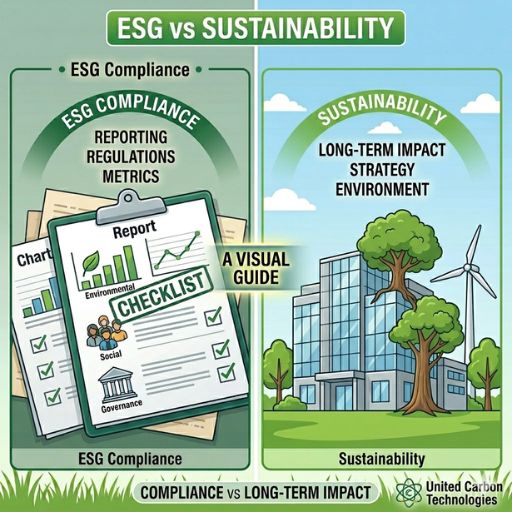
Over the past few years, ESG has become one of the most discussed topics in corporate India. Investors increasingly evaluate ESG performance before investing, regulators expect better disclosures, customers prefer responsible brands, and multinational companies require sustainability information from suppliers.
At the same time, sustainability has evolved from being a corporate social responsibility initiative into a core business strategy. Companies now integrate climate action, resource efficiency, employee well-being, governance, innovation, and long-term resilience into their decision-making processes.
Although ESG and sustainability are closely connected, confusing the two can lead to poor strategy. Businesses that only focus on compliance may satisfy reporting requirements without creating meaningful impact, while companies that pursue sustainability without measuring ESG performance may struggle to communicate progress to investors and regulators.
Build a Practical ESG Strategy
Understanding the difference between ESG compliance and sustainability helps businesses prioritize reporting, reduce risks, improve operational performance, and prepare for future climate regulations.
A company can be fully compliant with certain ESG reporting requirements while still lacking a comprehensive sustainability strategy. The strongest organizations integrate both reporting and long-term sustainability planning into everyday business operations.
What Is ESG Compliance?
ESG compliance refers to the process of measuring, documenting, and reporting a company's environmental, social, and governance performance using recognized standards, regulations, and reporting frameworks. It helps organizations demonstrate transparency and accountability to investors, regulators, lenders, customers, and other stakeholders.
ESG compliance typically includes:
- Environmental performance measurement
- Carbon emissions accounting
- Climate risk disclosures
- Energy and resource efficiency reporting
- Governance and ethics reporting
- Employee health and safety metrics
- Board diversity and governance practices
- BRSR and other sustainability disclosures
What Is Sustainability?
Sustainability is a broader business philosophy that focuses on creating long-term value while balancing environmental protection, social well-being, and economic growth. Rather than concentrating only on reporting, sustainability guides how an organization designs products, manages operations, develops supply chains, and creates lasting positive impact.
A sustainability strategy often includes:
- Reducing greenhouse gas emissions
- Improving energy efficiency
- Responsible sourcing
- Circular economy initiatives
- Water conservation
- Waste reduction
- Employee development
- Community engagement
- Long-term climate resilience
UCT helps Indian organizations measure emissions, prepare ESG reports, understand BRSR requirements, and develop practical sustainability strategies aligned with business growth.
Helping Indian Businesses Move Beyond Compliance
United Carbon Technologies develops Carbon Intelligence solutions that help businesses measure emissions, prepare ESG reports, understand BRSR requirements, strengthen sustainability strategies, and build investor confidence through better climate data and reporting.
ESG Compliance vs Sustainability: A Detailed Comparison
Although ESG compliance and sustainability are closely connected, they serve different purposes within an organization. ESG provides a structured framework for measuring and reporting environmental, social, and governance performance, while sustainability represents the broader vision of creating long-term value for people, the planet, and the business itself.
| Aspect | ESG Compliance | Sustainability |
|---|---|---|
| Primary Goal | Meet regulations and reporting requirements | Create long-term environmental and social value |
| Focus | Disclosure, governance, measurable metrics | Business transformation and responsible growth |
| Time Horizon | Short- to medium-term compliance | Long-term resilience and competitiveness |
| Measurement | KPIs, audits, ESG reports | Broader business outcomes and environmental impact |
| Main Drivers | Regulators, investors, stock exchanges | Leadership vision, innovation, customer expectations |
How ESG Supports Sustainability
Rather than competing concepts, ESG and sustainability complement one another. Sustainability defines an organization's long-term purpose, while ESG provides measurable indicators that demonstrate progress toward those goals.
- ESG converts sustainability objectives into measurable performance indicators.
- It improves transparency for investors, lenders, customers, and regulators.
- Regular reporting helps identify operational risks and opportunities.
- Companies with mature ESG programs often implement sustainability initiatives more effectively.
- Strong ESG governance ensures sustainability commitments are backed by accountability.
Understand your emissions, strengthen governance, and prepare your business for India's evolving ESG reporting landscape with United Carbon Technologies.
UCT Carbon Intelligence for Indian Businesses
Whether you're an MSME, startup, manufacturer, exporter, or enterprise, United Carbon Technologies helps organizations move beyond compliance by building practical sustainability strategies supported by measurable ESG data.
- Carbon Footprint Assessment
- Scope 1, 2 & 3 Emissions Measurement
- BRSR & ESG Reporting Support
- Supplier Sustainability Programs
- Climate Risk & Decarbonization Strategy
- Carbon Intelligence Dashboard
Measure. Report. Improve. Build a resilient business for the future.
ESG Compliance and Sustainability in India
India's corporate sustainability landscape is evolving rapidly through frameworks such as Business Responsibility and Sustainability Reporting (BRSR), increasing investor expectations, and growing awareness of climate-related risks. While many listed companies now focus on ESG disclosures, organizations that integrate sustainability into their long-term strategy are better positioned for innovation, resilience, and global competitiveness.
For Indian MSMEs, exporters, startups, and manufacturers, understanding the distinction between ESG compliance and sustainability can help prepare for future regulations, strengthen stakeholder confidence, and unlock new business opportunities.
United Carbon Technologies (UCT) develops practical climate intelligence resources that simplify ESG, carbon accounting, climate reporting, and sustainability for Indian businesses. Our educational content is designed to help organizations understand evolving regulations and make informed sustainability decisions.
Related Reads
- What is ESG? Complete Beginner's Guide
- BRSR Reporting Explained
- How to Measure Your Business Carbon Footprint
- Net Zero Roadmap for Businesses
- ESG compliance focuses on measurable reporting and governance.
- Sustainability is a broader long-term business strategy.
- Both are essential for modern businesses in India.
- ESG helps organizations demonstrate sustainability performance.
- Companies combining both approaches improve resilience and investor confidence.
Frequently Asked Questions
Is ESG the same as sustainability?
No. ESG is a measurable reporting framework, while sustainability is a broader business philosophy focused on long-term environmental, social, and economic impact.
Why is ESG compliance becoming important in India?
Growing regulatory expectations, BRSR reporting requirements, investor interest, and global supply chain demands are encouraging companies to improve ESG performance.
Can a company be sustainable without formal ESG reporting?
Yes. A business may adopt sustainable practices without publishing formal ESG reports, although reporting improves transparency and stakeholder trust.
Does ESG improve investor confidence?
Many investors consider ESG performance when evaluating long-term business resilience, governance quality, and climate-related risks.
What industries benefit most from ESG?
Manufacturing, infrastructure, energy, finance, IT, pharmaceuticals, FMCG, logistics, and export-oriented businesses all benefit from stronger ESG practices.
Is ESG mandatory for all Indian businesses?
No. Mandatory reporting currently applies to specified listed companies under SEBI's BRSR framework, but ESG expectations are expanding across supply chains.
How does ESG support sustainability?
ESG provides measurable metrics and reporting systems that help organizations track progress toward broader sustainability objectives.
Where should MSMEs begin?
Start by measuring carbon emissions, identifying material sustainability issues, strengthening governance practices, and building a practical ESG roadmap.
Build a Future-Ready Business with ESG & Sustainability
Learn how carbon accounting, ESG reporting, and sustainability strategy work together to improve business resilience and long-term growth.
Join thousands of climate learners and business leaders building a more sustainable India.