

ESG Reporting Explained: What Indian Companies Must Know (Complete Guide)
By United Carbon Technologies | Climate Knowledge Hub India
Join thousands of readers exploring ESG reporting, carbon accounting, climate intelligence, sustainability regulations, and environmental innovation across India.
ESG reporting is rapidly becoming a business necessity in India. Investors, regulators, customers, lenders, and global supply chains increasingly expect companies to disclose measurable Environmental, Social, and Governance (ESG) performance. Understanding ESG reporting helps organizations improve transparency, manage climate risks, strengthen stakeholder trust, and prepare for a more sustainable future.
Part of the Climate Knowledge Hub by United Carbon Technologies — building India's carbon intelligence ecosystem through ESG education, climate technology, sustainability research, and AI-powered climate solutions.
What is ESG reporting?
ESG reporting is the structured process of measuring, managing, and publicly disclosing an organization's environmental, social, and governance performance. It includes information such as carbon emissions, energy consumption, water usage, workforce practices, governance systems, climate risks, and sustainability initiatives, helping stakeholders evaluate long-term business resilience and responsible corporate performance.
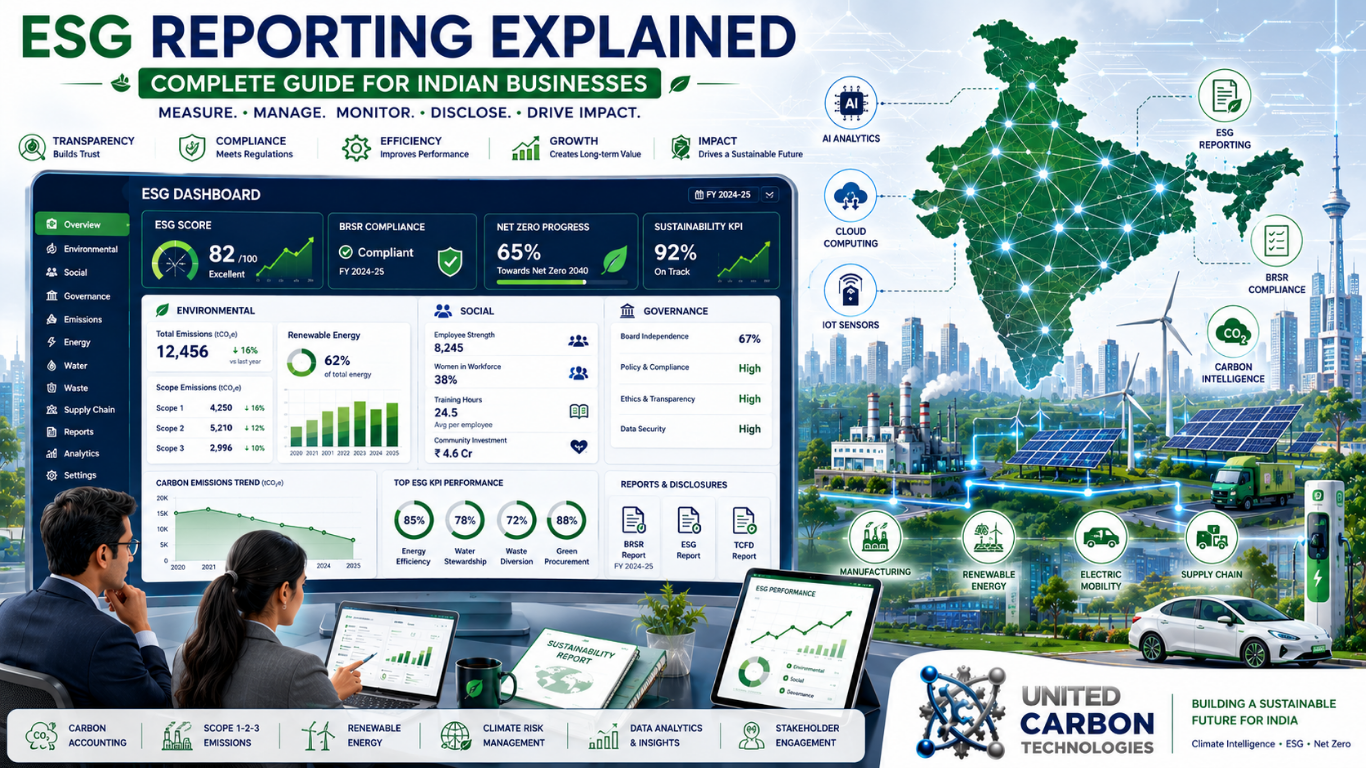
Businesses are no longer judged solely by their financial performance. Today, investors, regulators, customers, employees, and financial institutions also evaluate how responsibly companies manage environmental impact, social responsibilities, and corporate governance. ESG reporting has become one of the most important tools for communicating this information in a transparent, standardized, and measurable way.
Across India, sustainability reporting is gaining momentum due to evolving regulations, growing investor expectations, climate-related risks, and the country's commitment to achieving long-term sustainable development. Companies that establish strong ESG reporting practices are often better positioned to improve operational efficiency, attract investment, strengthen stakeholder confidence, and prepare for future compliance requirements.
Whether you are a listed company, MSME, startup, consultant, sustainability professional, or student, understanding ESG reporting provides valuable insights into how modern businesses measure non-financial performance and integrate sustainability into strategic decision-making.
India's sustainability reporting landscape has evolved significantly in recent years. Through initiatives such as the Business Responsibility and Sustainability Report (BRSR), organizations are increasingly expected to disclose environmental, social, and governance information alongside traditional financial reporting, making ESG data an important component of corporate transparency.
Why ESG Reporting Matters More Than Ever
The global business environment is changing rapidly. Climate change, resource scarcity, responsible investing, supply chain transparency, and stakeholder expectations are transforming how organizations create long-term value. ESG reporting enables companies to demonstrate how they manage these challenges while identifying opportunities for sustainable growth.
Rather than being viewed as an additional compliance exercise, ESG reporting has become an important business management tool. Organizations use ESG disclosures to monitor risks, improve operational performance, identify sustainability opportunities, and communicate progress toward environmental and social commitments.
- Improves transparency and corporate accountability
- Builds investor and lender confidence
- Supports compliance with emerging sustainability regulations
- Strengthens corporate reputation and brand value
- Helps identify climate-related business risks
- Supports long-term business resilience and competitiveness
- Enhances stakeholder trust and customer confidence
Who Needs ESG Reporting in India?
Although ESG reporting requirements vary depending on company size, industry, and regulatory obligations, sustainability disclosures are becoming increasingly relevant across the Indian economy.
Large listed companies are already required to follow structured sustainability reporting frameworks such as BRSR, while many private companies, exporters, startups, MSMEs, financial institutions, and multinational suppliers are voluntarily adopting ESG reporting to meet investor expectations and global supply chain requirements.
- Listed companies subject to regulatory reporting requirements
- Manufacturing and industrial businesses
- Infrastructure and energy companies
- Export-oriented businesses serving global customers
- Large private enterprises
- Financial institutions and banks
- Startups seeking sustainable investment
- MSMEs participating in ESG-focused supply chains
The Three Pillars of ESG Reporting
Every ESG report is built around three interconnected pillars—Environmental, Social, and Governance. Together, these pillars provide a holistic view of how an organization manages sustainability risks, creates long-term value, and operates responsibly. Rather than focusing only on profits, ESG reporting evaluates how businesses impact the environment, people, and corporate governance.
Understanding these three pillars helps companies identify improvement opportunities, establish measurable sustainability goals, and communicate performance transparently to investors, regulators, customers, and other stakeholders.
1. Environmental (E)
The Environmental pillar focuses on how a company's operations affect the natural environment. It examines greenhouse gas emissions, energy consumption, water use, waste management, pollution control, biodiversity conservation, and resource efficiency.
Environmental reporting has become increasingly important as businesses work toward climate action, Net Zero targets, and compliance with evolving environmental regulations.
- Carbon footprint and greenhouse gas emissions
- Scope 1, Scope 2, and Scope 3 emissions
- Electricity and energy consumption
- Renewable energy adoption
- Water consumption and conservation
- Waste generation and recycling
- Air pollution and environmental compliance
- Climate-related risks and adaptation strategies
2. Social (S)
The Social pillar evaluates how organizations manage relationships with employees, customers, suppliers, communities, and other stakeholders. It reflects a company's commitment to employee well-being, diversity, inclusion, human rights, workplace safety, and community development.
Strong social performance often leads to improved employee engagement, stronger customer trust, better talent retention, and enhanced organizational resilience.
- Employee health and workplace safety
- Diversity, equity, and inclusion
- Training and employee development
- Human rights and ethical labor practices
- Customer satisfaction and product responsibility
- Community development initiatives
- Supply chain responsibility
- Data privacy and customer protection
3. Governance (G)
Governance focuses on how an organization is directed, managed, and controlled. Good governance ensures ethical leadership, regulatory compliance, transparency, accountability, effective risk management, and responsible decision-making.
Investors increasingly evaluate governance practices because strong governance reduces business risks while improving long-term organizational performance.
- Board composition and independence
- Corporate ethics and integrity
- Anti-corruption policies
- Regulatory compliance
- Risk management systems
- Cybersecurity and data governance
- Executive accountability
- Transparent business practices
Major ESG Reporting Frameworks Used Worldwide
Organizations across the world follow different ESG reporting frameworks depending on regulatory requirements, investor expectations, and industry practices. While each framework has a unique focus, they all aim to improve transparency, consistency, and comparability of sustainability information.
Business Responsibility and Sustainability Report (BRSR)
BRSR is India's primary ESG reporting framework introduced by the Securities and Exchange Board of India (SEBI). It guides listed companies in reporting environmental, social, and governance performance using standardized disclosures aligned with India's National Guidelines on Responsible Business Conduct (NGRBC).
Global Reporting Initiative (GRI)
The Global Reporting Initiative (GRI) is one of the world's most widely adopted sustainability reporting standards. It helps organizations disclose their economic, environmental, and social impacts while promoting transparency and accountability.
SASB Standards
The Sustainability Accounting Standards Board (SASB) focuses on financially material sustainability issues that are most relevant to investors. Its industry-specific standards help companies disclose ESG risks that may affect financial performance.
IFRS Sustainability Disclosure Standards
Developed by the International Sustainability Standards Board (ISSB), the IFRS Sustainability Standards establish globally consistent sustainability disclosure requirements, enabling investors to compare ESG information across organizations and markets.
TCFD Recommendations
The Task Force on Climate-related Financial Disclosures (TCFD) provides guidance for reporting climate-related risks, opportunities, governance, strategy, risk management, and climate metrics. Many organizations continue to align their climate reporting with TCFD recommendations.
BRSR vs ESG Reporting: What's the Difference?
Although the terms are often used interchangeably, BRSR and ESG reporting are not the same. ESG reporting is a broad concept describing how organizations disclose sustainability performance, while BRSR is India's specific regulatory reporting framework for eligible listed companies.
| Aspect | ESG Reporting | BRSR |
|---|---|---|
| Purpose | General sustainability reporting | India-specific regulatory reporting |
| Coverage | Global organizations | Eligible Indian listed companies |
| Framework | Various international standards | SEBI BRSR Framework |
| Focus | Environmental, Social & Governance performance | Structured ESG disclosures under Indian regulations |
| Users | Investors, lenders, customers, regulators | SEBI, investors, listed companies |
For many Indian businesses, BRSR serves as the foundation of ESG reporting. However, organizations working with international investors or operating across global markets often align with additional frameworks such as GRI, IFRS Sustainability Standards, or SASB to meet broader stakeholder expectations.
Whether you're building your first ESG report or preparing for BRSR compliance, developing reliable sustainability data today makes future reporting faster, more accurate, and more valuable.
United Carbon Technologies is developing India's next-generation Climate Intelligence Platform to help businesses simplify carbon accounting, ESG reporting, BRSR compliance, sustainability analytics, and climate data management through intelligent digital solutions.
How Companies Prepare ESG Reports
Preparing an ESG report is no longer just an annual reporting exercise. It requires continuous collection, verification, analysis, and disclosure of sustainability data across the organization. Companies increasingly treat ESG reporting as an ongoing management process that supports better decision-making, regulatory compliance, and long-term business resilience.
The process typically begins by identifying the ESG frameworks and reporting requirements relevant to the organization. Businesses then establish governance structures, define sustainability goals, collect operational data, measure key performance indicators (KPIs), evaluate climate-related risks, and prepare standardized disclosures for investors, regulators, customers, and other stakeholders.
Organizations that integrate ESG reporting into everyday operations often produce more accurate reports while identifying opportunities to reduce emissions, improve efficiency, lower operational costs, and strengthen stakeholder confidence.
A Typical ESG Reporting Process
- Identify applicable ESG frameworks and reporting requirements
- Define sustainability goals and material topics
- Collect environmental, social, and governance data
- Measure carbon emissions and sustainability KPIs
- Validate data quality and completeness
- Prepare disclosures and management reports
- Review performance with leadership teams
- Publish ESG or BRSR reports
- Monitor progress throughout the year
- Continuously improve sustainability performance
ESG Data Collection: Building the Foundation of Reporting
High-quality ESG reporting depends on reliable, consistent, and verifiable data. One of the biggest challenges organizations face is collecting sustainability information from multiple departments, facilities, suppliers, and business units.
Unlike financial reporting, ESG data often comes from numerous operational systems, making data integration and validation essential for accurate reporting.
Typical Sources of ESG Data
- Electricity consumption records
- Fuel purchase and usage data
- Water consumption records
- Waste generation and recycling data
- Employee health and safety information
- Human resources and diversity metrics
- Procurement and supply chain data
- Travel and logistics information
- Governance and compliance records
- Risk management systems
Many organizations are replacing spreadsheets with centralized ESG platforms that automatically collect, organize, and analyze sustainability data from multiple business functions.
Carbon Accounting: Understanding Scope 1, Scope 2 & Scope 3 Emissions
Carbon accounting is one of the most important components of ESG reporting. Organizations measure greenhouse gas emissions to understand their climate impact, identify emission hotspots, and develop effective decarbonization strategies.
International reporting frameworks commonly classify emissions into three categories known as Scope 1, Scope 2, and Scope 3 emissions.
Scope 1 — Direct Emissions
These emissions come directly from sources owned or controlled by the organization, including company vehicles, manufacturing equipment, generators, industrial processes, and fuel combustion.
Scope 2 — Indirect Energy Emissions
Scope 2 emissions result from purchased electricity, steam, heating, or cooling consumed during business operations. Although generated externally, these emissions are associated with an organization's energy use.
Scope 3 — Value Chain Emissions
Scope 3 includes indirect emissions occurring across the entire value chain, such as purchased goods, transportation, business travel, employee commuting, product usage, waste disposal, and supplier activities. For many companies, Scope 3 represents the largest share of total emissions.
Although Scope 3 emissions are often the most difficult to measure, they usually account for the largest portion of an organization's carbon footprint. Improving supplier engagement and collecting reliable value-chain data has therefore become a major priority for businesses pursuing Net Zero and comprehensive ESG reporting.
Key ESG Metrics Companies Commonly Track
Every organization reports different sustainability indicators depending on its industry, operations, and reporting framework. However, several ESG metrics are commonly disclosed across most sectors.
Environmental KPIs
- Total greenhouse gas emissions
- Scope 1, Scope 2, and Scope 3 emissions
- Energy consumption
- Renewable energy usage
- Water withdrawal and consumption
- Waste generation and recycling rate
- Air emissions and pollution indicators
- Climate risk management initiatives
Social KPIs
- Employee health and safety
- Gender diversity
- Workforce training hours
- Employee engagement
- Human rights compliance
- Community investment
- Customer satisfaction
Governance KPIs
- Board independence
- Ethics and anti-corruption compliance
- Cybersecurity governance
- Risk management practices
- Executive accountability
- Regulatory compliance
- Data privacy controls
ESG Software, Dashboards & Digital Reporting Platforms
As sustainability reporting becomes more complex, organizations are increasingly adopting ESG software platforms to automate data collection, improve reporting accuracy, and simplify compliance.
Modern ESG platforms provide centralized dashboards that consolidate sustainability information from multiple business units while generating reports aligned with frameworks such as BRSR, GRI, and IFRS Sustainability Standards.
Benefits of ESG Software
- Centralized sustainability data management
- Automated carbon calculations
- Real-time ESG dashboards
- BRSR and ESG reporting support
- Audit-ready documentation
- Performance benchmarking
- Executive reporting and analytics
- Reduced manual effort and reporting errors
Common Challenges in ESG Reporting
Although ESG reporting delivers significant business value, many organizations face practical challenges during implementation. These challenges become even greater when sustainability data is scattered across multiple departments or managed manually.
- Incomplete or inconsistent sustainability data
- Manual spreadsheet-based reporting
- Difficulty calculating Scope 3 emissions
- Changing regulatory requirements
- Lack of standardized internal processes
- Supplier data collection challenges
- Limited ESG expertise within organizations
- Difficulty integrating sustainability and financial reporting
Addressing these challenges requires not only better processes but also modern digital tools capable of collecting, validating, and analyzing ESG information efficiently.
The Role of AI, Automation & Climate Intelligence in ESG Reporting
The future of ESG reporting is moving beyond static annual reports toward intelligent, real-time sustainability management. Artificial Intelligence (AI), automation, cloud computing, IoT devices, and climate intelligence platforms are transforming how organizations collect data, calculate emissions, monitor ESG performance, and generate sustainability reports.
Instead of spending months gathering information manually, businesses are beginning to automate ESG workflows, detect anomalies, monitor emissions continuously, and generate actionable sustainability insights through intelligent digital platforms.
At United Carbon Technologies, we are building ACIS (Advanced Carbon Intelligence System)—an India-focused Climate Intelligence Platform designed to simplify carbon accounting, ESG reporting, BRSR compliance, climate analytics, sustainability dashboards, and environmental decision-making through intelligent automation. Our vision is to help organizations move from periodic reporting to continuous climate intelligence.
Tomorrow's ESG reporting will be powered by AI, automated carbon accounting, IoT-enabled data collection, predictive climate analytics, digital twins, and real-time sustainability dashboards. Climate Intelligence Platforms such as ACIS aim to transform ESG reporting from a compliance requirement into a strategic business advantage.
Benefits of ESG Reporting for Modern Businesses
ESG reporting delivers far more than regulatory compliance. Organizations that actively measure and disclose sustainability performance are often better prepared to manage risks, improve operational efficiency, attract investment, strengthen stakeholder trust, and remain competitive in an increasingly sustainability-driven economy.
As environmental and social expectations continue to evolve, ESG reporting has become a strategic business tool that supports long-term value creation rather than simply fulfilling reporting obligations.
1. Stronger Investor Confidence
Institutional investors increasingly evaluate ESG performance alongside financial performance before making investment decisions. Transparent ESG reporting demonstrates that a company understands climate risks, governance practices, and long-term sustainability opportunities.
- Builds investor trust
- Supports responsible investment decisions
- Demonstrates long-term resilience
- Improves corporate transparency
- Enhances market credibility
2. Better Access to Sustainable Finance
Banks and financial institutions increasingly incorporate ESG factors into lending decisions. Organizations with strong sustainability reporting may find it easier to access green finance, sustainability-linked loans, and favorable financing opportunities.
- Supports sustainable financing
- Improves lender confidence
- Strengthens risk assessment
- Enhances financial transparency
3. Greater Customer Trust
Consumers are becoming more conscious of how products are manufactured and how companies manage environmental and social impacts. ESG reporting demonstrates accountability and helps build stronger customer relationships through transparency.
- Strengthens brand reputation
- Builds customer loyalty
- Supports responsible purchasing decisions
- Enhances corporate credibility
4. Stronger Supply Chain Relationships
Large multinational companies increasingly expect suppliers to provide sustainability information. ESG reporting enables organizations to participate in global supply chains while demonstrating responsible business practices.
- Supports supplier qualification
- Improves procurement opportunities
- Enhances supply chain transparency
- Strengthens international competitiveness
5. Attracting and Retaining Talent
Employees increasingly prefer organizations that demonstrate environmental responsibility, ethical leadership, diversity, and social impact. Strong ESG performance helps companies attract skilled professionals while improving employee engagement and workplace culture.
- Improves employee satisfaction
- Supports talent acquisition
- Strengthens workplace culture
- Encourages innovation and collaboration
6. Better Regulatory Readiness
Governments around the world are introducing new sustainability regulations, climate disclosure requirements, and carbon reporting frameworks. Organizations with mature ESG reporting systems are better prepared to adapt to future compliance obligations.
- Supports regulatory compliance
- Improves reporting readiness
- Reduces compliance risks
- Strengthens governance practices
The Future of ESG Reporting
ESG reporting is evolving rapidly from annual, spreadsheet-based disclosures toward intelligent, real-time sustainability management. Future reporting systems will integrate operational data continuously, enabling organizations to monitor environmental performance, identify emerging risks, and make faster, data-driven decisions.
Rather than preparing reports once a year, businesses are moving toward continuous sustainability monitoring supported by digital technologies, automation, and climate intelligence.
Digital ESG Reporting
Cloud-based ESG platforms are replacing manual reporting processes by centralizing sustainability data, improving collaboration, and reducing reporting time.
Climate Intelligence
Climate intelligence platforms combine carbon accounting, ESG analytics, climate risk assessment, and predictive insights to help organizations move beyond compliance toward strategic sustainability management.
Artificial Intelligence (AI)
AI can automatically identify reporting gaps, validate ESG data, detect anomalies, generate sustainability insights, and support faster decision-making.
Internet of Things (IoT)
Smart meters, environmental sensors, industrial monitoring systems, and connected devices continuously collect operational data, improving the accuracy of carbon accounting and ESG reporting.
Continuous Reporting
Instead of publishing sustainability information once every year, organizations are gradually adopting continuous ESG monitoring through live dashboards and automated reporting systems that provide near real-time sustainability insights.
Future ESG reporting will combine AI, IoT, cloud computing, climate intelligence, predictive analytics, and automated carbon accounting to create smarter, faster, and more reliable sustainability reporting ecosystems.
How ACIS Can Simplify ESG Reporting
As ESG reporting becomes increasingly data-intensive, businesses require intelligent platforms that simplify sustainability management rather than adding complexity. This is where climate intelligence platforms represent the next evolution of ESG reporting.
United Carbon Technologies is developing ACIS (Advanced Carbon Intelligence System), an India-focused Climate Intelligence Platform designed to help organizations measure emissions, manage ESG performance, simplify BRSR reporting, and transform sustainability data into actionable business intelligence.
Rather than relying on disconnected spreadsheets and manual calculations, ACIS is being designed to centralize environmental data, automate carbon accounting, visualize ESG KPIs, and provide real-time climate intelligence for organizations of every size.
Vision for ACIS
- Carbon footprint measurement
- Scope 1, Scope 2 & Scope 3 accounting
- BRSR reporting support
- ESG dashboards
- Climate risk analytics
- AI-powered sustainability insights
- Carbon reduction planning
- Future-ready climate intelligence platform
Related Climate & ESG Guides
- What Is BRSR in India? Complete Guide
- What Is Carbon Footprint? Complete Beginner Guide
- Carbon Accounting Explained
- Understanding Scope 1, Scope 2 & Scope 3 Emissions
- Net Zero Explained for Businesses
- India's Carbon Intelligence Platform Explained
- Why Every Business Needs an ESG Dashboard
- ESG reporting measures Environmental, Social, and Governance performance.
- It helps businesses improve transparency, manage risks, and strengthen stakeholder trust.
- Indian companies increasingly align ESG reporting with BRSR and global sustainability frameworks.
- Carbon accounting, ESG KPIs, and sustainability data form the foundation of effective reporting.
- AI, IoT, automation, and climate intelligence are transforming the future of ESG reporting.
- Digital platforms simplify ESG data collection, reporting, and compliance.
- Climate Intelligence Platforms like ACIS represent the next generation of ESG management in India.
In the next section, we'll answer the most frequently asked questions about ESG reporting, explain common misconceptions, and provide practical guidance for businesses beginning their sustainability reporting journey.
Frequently Asked Questions (FAQs)
1. What is ESG reporting?
ESG reporting is the process of measuring and disclosing an organization's Environmental, Social, and Governance performance. It helps businesses communicate sustainability initiatives, climate risks, governance practices, and social impact to investors, regulators, customers, and other stakeholders.
2. Is ESG reporting mandatory in India?
ESG reporting is mandatory for the top 1,000 listed companies in India through SEBI's Business Responsibility and Sustainability Report (BRSR) framework. Many other organizations voluntarily adopt ESG reporting to meet investor expectations and strengthen sustainability performance.
3. What is the difference between ESG reporting and BRSR?
ESG reporting is a broad concept covering environmental, social, and governance disclosures across different international frameworks. BRSR is India's specific ESG reporting framework introduced by SEBI for eligible listed companies.
4. What information is included in an ESG report?
An ESG report typically includes greenhouse gas emissions, energy consumption, water usage, waste management, employee welfare, diversity, workplace safety, governance practices, ethics, risk management, and sustainability goals.
5. Why is ESG reporting important for investors?
Investors use ESG reports to evaluate long-term business resilience, climate risks, governance quality, operational efficiency, and sustainability performance before making investment decisions.
6. What are Scope 1, Scope 2, and Scope 3 emissions?
Scope 1 emissions come from direct business operations, Scope 2 emissions result from purchased electricity and energy, while Scope 3 emissions include indirect emissions across the entire value chain, including suppliers, transportation, and product use.
7. How do companies collect ESG data?
Organizations collect ESG data from electricity bills, fuel consumption records, water meters, HR systems, procurement data, waste management records, supply chain information, and operational monitoring systems. Increasingly, digital ESG platforms automate this process.
8. How can ESG software simplify reporting?
Modern ESG software centralizes sustainability data, automates carbon accounting, tracks ESG KPIs, generates dashboards, supports BRSR compliance, and reduces manual reporting effort through intelligent automation.
9. How will AI change ESG reporting?
Artificial Intelligence is transforming ESG reporting by automating data collection, improving reporting accuracy, detecting anomalies, generating sustainability insights, supporting predictive analytics, and enabling continuous ESG monitoring.
10. Why is ESG reporting important for India's sustainable future?
ESG reporting helps Indian businesses improve transparency, strengthen investor confidence, reduce environmental impact, support climate goals, enhance global competitiveness, and contribute to sustainable economic development while preparing for future regulatory requirements.
Start Your Climate Knowledge Journey
Build practical expertise in ESG, carbon accounting, BRSR, Net Zero, climate technology, and sustainability through India's growing Climate Knowledge Hub.
Whether you're a student, sustainability professional, business leader, startup founder, consultant, or policymaker, developing climate intelligence today will prepare you for tomorrow's low-carbon economy.
- ✔ ESG Reporting & BRSR Compliance
- ✔ Carbon Footprint & Carbon Accounting
- ✔ Scope 1, Scope 2 & Scope 3 Emissions
- ✔ Net Zero Strategies
- ✔ Climate Technology & AI
- ✔ Sustainability Reporting
- ✔ Climate Intelligence Systems
- ✔ India's Emerging Green Economy
Your Action. Our Innovation. Together, We Empower a Greener Future.
Join the growing community exploring India's next generation of climate intelligence, sustainability, and ESG innovation.
This guide is part of the United Carbon Technologies Climate Knowledge Hub and supports our mission to build India's Carbon Intelligence Ecosystem through climate education, ESG innovation, AI-powered sustainability solutions, and the development of the Advanced Carbon Intelligence System (ACIS).