

Air Pollution and Carbon Emissions: Understanding the Connection in India and Around the World (2026 Guide)
By United Carbon Technologies | Climate Knowledge Hub India
Published: April 24, 2026 | Last Updated: July 24, 2026
Follow United Carbon Technologies for practical guides on climate change, carbon emissions, ESG, sustainability, and emerging climate technologies.
Air pollution and carbon emissions are often discussed together, but they are not the same. They originate from many of the same activities—such as burning fossil fuels—but affect the environment in different ways. Air pollution directly impacts human health, while carbon emissions accelerate global climate change. Understanding this relationship helps individuals, businesses, and policymakers develop solutions that improve both public health and environmental sustainability.
How are air pollution and carbon emissions connected?
Air pollution and carbon emissions are connected because they frequently come from the same sources, including vehicles, coal-fired power plants, factories, and fossil fuel combustion. While carbon dioxide (CO₂) contributes primarily to climate change, pollutants like PM2.5, nitrogen oxides (NOₓ), sulfur dioxide (SO₂), and ozone directly affect air quality and human health. Reducing fossil fuel use often lowers both greenhouse gas emissions and harmful air pollutants simultaneously.
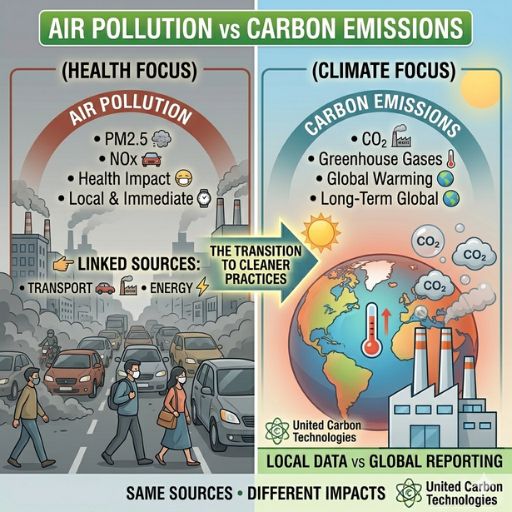
Every day, millions of vehicles travel on roads, factories produce goods, and power plants generate electricity. These activities support economic growth but also release gases and particles into the atmosphere. Some of these emissions contribute to climate change, while others directly pollute the air we breathe.
For India, balancing economic development with clean air has become one of the country's biggest sustainability challenges. Rapid urbanization, industrial expansion, and increasing energy demand have improved living standards but also increased pollution levels in many cities.
Fortunately, many climate solutions—such as renewable energy, cleaner transportation, energy efficiency, and improved industrial technologies—can reduce both carbon emissions and air pollution together. Understanding how these issues are connected is the first step toward building healthier communities and a more sustainable future.
UCT Climate Intelligence
Climate knowledge begins with understanding the science behind emissions. United Carbon Technologies develops educational resources, carbon intelligence solutions, and ESG awareness tools that help individuals and businesses make informed sustainability decisions.
Did You Know?
Although carbon dioxide is the largest contributor to long-term global warming, it is not the pollutant that causes most immediate health problems. Fine particulate matter (PM2.5), nitrogen oxides, sulfur dioxide, and ground-level ozone are responsible for many respiratory and cardiovascular illnesses worldwide.
Air Pollution vs. Carbon Emissions: What's the Difference?
People often use these terms interchangeably, but they describe different environmental problems.
| Air Pollution | Carbon Emissions |
|---|---|
| Directly affects human health and local air quality. | Mainly contributes to global climate change. |
| Includes PM2.5, PM10, NOₓ, SO₂, ozone and carbon monoxide. | Primarily includes carbon dioxide (CO₂) and other greenhouse gases. |
| Causes respiratory diseases and poor visibility. | Causes rising temperatures, changing weather patterns, and sea-level rise. |
While their impacts differ, both problems frequently originate from the same fossil fuel-based activities, making integrated climate policies highly effective.
Major Sources That Produce Both Air Pollution and Carbon Emissions
Several human activities release greenhouse gases and harmful pollutants simultaneously.
- Road Transportation: Cars, buses, trucks, and motorcycles emit CO₂ along with nitrogen oxides and particulate matter.
- Coal-Based Electricity: Coal-fired power plants release large amounts of carbon dioxide while also producing sulfur dioxide and ash particles.
- Industrial Manufacturing: Steel, cement, chemicals, and manufacturing facilities emit greenhouse gases and industrial pollutants.
- Construction Activities: Dust emissions combine with diesel-powered machinery to reduce urban air quality.
- Agricultural Burning: Crop residue burning contributes to seasonal smog while releasing carbon emissions into the atmosphere.
- Household Cooking Fuels: Traditional biomass cooking continues to affect indoor and outdoor air quality in some regions.
Understand Your Carbon Impact
Want to learn how emissions affect climate change, ESG reporting, and sustainable business? Explore practical climate education from United Carbon Technologies and begin your carbon intelligence journey.
Health Impacts of Air Pollution
Air pollution is one of the world's leading environmental health risks. Unlike carbon dioxide, which primarily affects the climate over time, pollutants such as PM2.5, PM10, nitrogen oxides (NOₓ), sulfur dioxide (SO₂), ozone (O₃), and carbon monoxide (CO) can have immediate effects on human health. Long-term exposure increases the risk of chronic diseases and reduces overall quality of life.
Children, older adults, pregnant women, and people with existing heart or lung conditions are particularly vulnerable. In densely populated urban areas, poor air quality can also reduce productivity, increase healthcare costs, and negatively affect economic growth.
Common Health Effects Include:
- Respiratory illnesses such as asthma and bronchitis.
- Reduced lung function in children and older adults.
- Heart disease and increased risk of stroke.
- Eye irritation, throat irritation, and allergies.
- Higher risk of premature death from long-term exposure.
- Reduced workplace productivity due to pollution-related illnesses.
Improving air quality is therefore not only an environmental objective but also a major public health priority.
How Carbon Emissions Drive Climate Change
Carbon emissions mainly consist of carbon dioxide released through burning coal, oil, natural gas, industrial production, transportation, and land-use changes. Unlike many air pollutants that remain in the atmosphere for days or weeks, carbon dioxide can persist for decades or even centuries, making it a major driver of long-term global warming.
As greenhouse gases accumulate, they trap heat within Earth's atmosphere, resulting in rising global temperatures and widespread climate impacts.
Major Climate Impacts Include:
- Increasing average global temperatures.
- More frequent and intense heatwaves.
- Irregular rainfall and changing monsoon patterns.
- More severe floods, droughts, and cyclones.
- Melting glaciers and rising sea levels.
- Threats to agriculture, biodiversity, and food security.
Reducing carbon emissions is therefore essential for achieving India's Net Zero ambitions and supporting international climate goals under the Paris Agreement.
India's Air Pollution Challenge
India has made significant progress in expanding renewable energy and improving environmental policies, yet air pollution remains a major challenge for many cities. Rapid urbanization, industrial growth, increasing vehicle ownership, construction activities, and seasonal agricultural burning all contribute to declining air quality.
The challenge is particularly complex because India must balance economic development, energy security, industrial expansion, and environmental protection simultaneously.
Key Sources of Urban Air Pollution
- Heavy road traffic and diesel vehicles.
- Coal-fired thermal power generation.
- Industrial manufacturing and processing.
- Construction dust and infrastructure projects.
- Crop residue burning in agricultural regions.
- Open waste burning and unmanaged landfill emissions.
Government initiatives such as the National Clean Air Programme (NCAP), Bharat Stage VI vehicle emission standards, renewable energy expansion, electric mobility incentives, and improved waste management are helping address these challenges.
Businesses Have a Critical Role in Cleaner Air
Organizations can significantly reduce both carbon emissions and local air pollution by improving energy efficiency, transitioning to renewable electricity, modernizing industrial equipment, measuring carbon footprints, and strengthening ESG reporting practices.
Forward-looking companies are increasingly integrating sustainability into business strategy to reduce operational risks, improve efficiency, strengthen investor confidence, and remain competitive in a low-carbon economy.
United Carbon Technologies is building practical carbon intelligence solutions to help Indian businesses measure emissions, improve ESG performance, and accelerate their sustainability journey.
Solutions That Reduce Both Air Pollution and Carbon Emissions
Many climate solutions deliver dual benefits by simultaneously improving air quality and reducing greenhouse gas emissions. These "co-benefits" make sustainability investments even more valuable for governments, businesses, and communities.
High-Impact Solutions
- Expand renewable energy such as solar and wind power.
- Increase adoption of electric vehicles and public transportation.
- Improve industrial energy efficiency.
- Modernize manufacturing technologies.
- Reduce fossil fuel dependence wherever possible.
- Improve waste segregation, recycling, and methane management.
- Increase urban green spaces and tree plantations.
- Adopt cleaner cooking fuels and efficient appliances.
Implementing these measures helps create healthier cities while contributing to national climate commitments.
Climate Technologies Supporting Cleaner Air
Technology is becoming one of the most powerful tools for reducing emissions and improving environmental monitoring. Digital climate intelligence enables organizations to make data-driven sustainability decisions.
Emerging Climate Technologies Include:
- AI-powered air quality monitoring systems.
- Carbon accounting and emissions management platforms.
- IoT-based industrial emission monitoring.
- Smart energy management systems.
- Remote sensing and satellite-based pollution tracking.
- Carbon capture and utilization technologies.
- Electric mobility and battery innovations.
- Digital ESG reporting platforms.
These innovations help governments, businesses, researchers, and communities better understand environmental performance while accelerating the transition toward a cleaner, low-carbon future.
India Context
India's journey toward cleaner air is closely connected with its climate ambitions. Investments in renewable energy, electric mobility, green hydrogen, sustainable infrastructure, smart cities, and cleaner industrial technologies are creating opportunities to improve both environmental quality and economic growth.
As one of the world's fastest-growing economies, India's decisions on energy, transportation, manufacturing, and sustainability will significantly influence global climate outcomes. Businesses, policymakers, educational institutions, and citizens all have an important role in reducing emissions while improving public health.
Solutions That Reduce Both Air Pollution and Carbon Emissions
Many climate solutions also improve air quality. By reducing dependence on fossil fuels, improving energy efficiency, and adopting cleaner technologies, governments, businesses, and individuals can simultaneously reduce greenhouse gas emissions and harmful air pollutants.
- Expand renewable energy such as solar and wind.
- Improve public transportation and electric mobility.
- Adopt cleaner industrial technologies.
- Improve waste management and eliminate open burning.
- Increase urban green spaces and tree plantations.
- Promote energy-efficient buildings and appliances.
These integrated solutions create healthier cities while supporting long-term climate goals.
What Businesses Can Do to Reduce Emissions and Improve Air Quality
Businesses increasingly recognize that reducing emissions is not only an environmental responsibility but also a strategic business decision. Customers, investors, regulators, and global buyers now expect organizations to measure and manage their environmental impacts.
- Measure Scope 1, Scope 2 and relevant Scope 3 emissions.
- Improve energy efficiency across operations.
- Transition toward renewable electricity.
- Optimize logistics and transportation.
- Reduce waste generation and improve recycling.
- Use ESG reporting and carbon accounting platforms.
Build a Cleaner, Low-Carbon Business
United Carbon Technologies helps organizations understand carbon emissions, ESG reporting, sustainability strategies, and carbon intelligence for future-ready businesses.
Whether you are beginning your ESG journey or preparing for global sustainability requirements, understanding emission sources is the first step toward meaningful climate action.
India Context: Why This Topic Matters
India is rapidly urbanizing while simultaneously expanding manufacturing, transportation, and energy infrastructure. These developments create economic opportunities but also increase environmental pressures if emissions are not managed effectively.
Cities across India frequently experience high particulate pollution during certain seasons due to vehicle emissions, industrial activity, construction dust, biomass burning, and unfavorable weather conditions. At the same time, India continues investing heavily in renewable energy, cleaner mobility, green hydrogen, sustainable infrastructure, and improved environmental regulations.
For Indian businesses, understanding the relationship between carbon emissions and air pollution is becoming increasingly important because sustainability performance now influences exports, investment decisions, ESG reporting, supply-chain requirements, and long-term competitiveness.
Why Trust United Carbon Technologies?
United Carbon Technologies (UCT) is building Carbon Intelligence solutions that simplify climate knowledge for businesses, students, sustainability professionals, and policymakers.
Our Climate Knowledge Hub explains complex topics—including carbon accounting, ESG reporting, climate policy, sustainability, and environmental technologies—in practical language suitable for Indian organizations and global audiences.
Related Climate Guides
- What Is a Carbon Footprint?
- Climate Change Explained
- Climate Action in India
- ESG Reporting Explained
- Climate Technology & Carbon Intelligence
Quick Summary
- Air pollution and carbon emissions are related but not identical.
- Many pollution sources also emit greenhouse gases.
- Reducing fossil fuel use benefits both climate and public health.
- Renewable energy and clean transportation improve air quality.
- Businesses should measure emissions as part of ESG strategies.
- India's clean energy transition offers significant environmental benefits.
Frequently Asked Questions
Is carbon dioxide considered air pollution?
Carbon dioxide is a greenhouse gas rather than a traditional air pollutant. While it does not directly affect local air quality like particulate matter or nitrogen oxides, increasing CO₂ concentrations contribute to global climate change.
Why do fossil fuels create both pollution and carbon emissions?
Burning coal, oil, and natural gas releases carbon dioxide along with pollutants such as nitrogen oxides, sulfur dioxide, and particulate matter, which affect both climate and human health.
What is the biggest source of air pollution in Indian cities?
Major contributors include transportation, industrial activities, coal-fired power generation, construction dust, biomass burning, and waste burning. The contribution varies by location and season.
Will reducing carbon emissions improve air quality?
In many cases, yes. Policies that reduce fossil fuel consumption often lower both greenhouse gas emissions and harmful air pollutants simultaneously.
Why should businesses monitor carbon emissions?
Emission measurement supports ESG reporting, improves operational efficiency, strengthens investor confidence, prepares companies for evolving regulations, and helps identify cost-saving opportunities.
How does renewable energy help?
Solar, wind, hydro, and other renewable sources generate electricity with much lower greenhouse gas emissions and significantly reduce pollutants associated with fossil fuel combustion.
Can individuals help improve air quality?
Yes. Using public transport, conserving electricity, avoiding waste burning, planting trees, reducing vehicle use, and supporting clean energy all contribute to healthier air and lower emissions.
Why is this topic important for India's future?
India's continued economic growth makes sustainable development essential. Cleaner technologies and lower emissions can improve public health, strengthen energy security, and support long-term climate commitments.
Learn Carbon Intelligence with UCT Academy
Understanding the relationship between air pollution and carbon emissions is the first step toward building healthier cities and a more sustainable future.
Explore climate education, ESG reporting, carbon accounting, sustainability insights, and practical carbon management resources designed for India and global businesses.
Join thousands of learners building climate awareness through the United Carbon Technologies Climate Knowledge Hub.