

Carbon Credit Market in India: How It Works (Complete 2026 Guide)
By United Carbon Technologies | Climate Knowledge Hub India
Published: April 19, 2026 | Last Updated: July 19, 2026
India is rapidly building a modern carbon market as part of its transition toward a low-carbon economy. Understanding how carbon credits work is becoming increasingly important for MSMEs, startups, manufacturers, exporters, and large corporations preparing for ESG reporting, carbon accounting, and future climate regulations.
How does the carbon credit market work in India?
The carbon credit market allows organizations that reduce or remove greenhouse gas emissions to generate carbon credits. These credits can be traded or purchased by organizations seeking to compensate for part of their emissions while supporting verified climate projects.
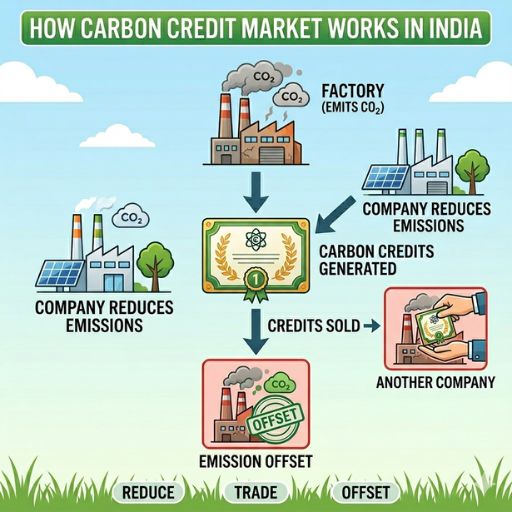
Carbon markets are becoming one of the world's most important financial tools for reducing greenhouse gas emissions. Rather than relying only on regulations, carbon markets create economic incentives that reward organizations for reducing emissions and investing in cleaner technologies.
For Indian businesses, understanding carbon credits is no longer limited to large corporations. Export-oriented companies, manufacturers, renewable energy developers, startups, MSMEs, and supply-chain partners are increasingly being asked to measure emissions and participate in climate initiatives. As sustainability expectations continue to grow, carbon markets can create both environmental benefits and new business opportunities.
UCT Carbon Intelligence
Measure your business emissions, understand carbon accounting, prepare for ESG reporting, and build your Net Zero roadmap with practical climate intelligence solutions from United Carbon Technologies.
One carbon credit generally represents the reduction, removal, or avoidance of one metric tonne of carbon dioxide equivalent (tCO₂e). Carbon credits are generated only after projects follow approved methodologies and independent verification processes.
What Is a Carbon Credit?
A carbon credit is a tradable environmental certificate representing one metric tonne of greenhouse gas emissions that has been reduced, avoided, or removed from the atmosphere through an eligible climate project.
Projects capable of generating carbon credits may include:
- Solar power installations
- Wind energy projects
- Energy efficiency improvements
- Methane capture systems
- Afforestation and reforestation
- Waste-to-energy projects
- Industrial emission reduction initiatives
After successful verification under recognized standards or regulatory frameworks, these emission reductions can become carbon credits that may be traded or used for climate commitments.
How Does Carbon Trading Work?
Although different carbon markets operate under different rules, the basic process generally follows these steps:
- A project reduces or removes greenhouse gas emissions.
- The emission reductions are measured using approved methodologies.
- Independent verification confirms the results.
- Carbon credits are issued.
- The credits may be bought, sold, or retired by organizations.
- Revenue generated can help finance additional climate projects.
This market-based approach encourages businesses to reduce emissions because environmental performance can create measurable financial value.
Before participating in carbon markets, businesses should calculate Scope 1, Scope 2, and Scope 3 emissions, identify reduction opportunities, and establish a credible emissions baseline.
Prepare Your Business for India's Low-Carbon Economy
United Carbon Technologies helps organizations understand carbon accounting, ESG reporting, sustainability strategy, emissions measurement, and climate intelligence through practical, India-focused solutions.
India's Carbon Credit Market: Current Landscape
India is one of the world's fastest-growing economies and among the largest energy consumers. As industries expand, reducing greenhouse gas emissions while maintaining economic growth has become a national priority. Carbon markets are expected to play an increasingly important role in achieving this balance.
India has historically participated in international carbon markets through renewable energy, energy efficiency, methane reduction, and forestry projects. Today, the country is also developing a stronger domestic framework that encourages industries to reduce emissions while supporting climate innovation.
For Indian businesses, this means carbon management is gradually shifting from being a voluntary sustainability initiative to becoming an important component of long-term business strategy, export competitiveness, and ESG preparedness.
Industries Most Likely to Participate
- Renewable energy developers
- Manufacturing companies
- Cement and steel industries
- Power generation companies
- Chemical manufacturers
- Waste management firms
- Agriculture and bioenergy projects
- Large infrastructure developers
Who Can Benefit from Carbon Credits?
Carbon markets are no longer relevant only to multinational corporations. Businesses of different sizes can benefit depending on their operations, supply chains, and sustainability initiatives.
| Business Type | Potential Opportunity |
|---|---|
| Manufacturers | Improve efficiency and reduce production emissions. |
| Renewable Energy Companies | Generate verified emission reductions through clean energy projects. |
| MSMEs | Become stronger suppliers for ESG-focused corporations. |
| Startups | Develop innovative climate technologies and sustainability solutions. |
| Export Businesses | Prepare for increasing global sustainability expectations. |
Benefits of Participating in Carbon Markets
Participating in carbon markets can create both environmental and commercial value. Organizations that actively reduce emissions often become more resilient, efficient, and attractive to investors and customers.
- Encourages continuous emission reductions
- Supports Net Zero strategies
- Improves ESG performance
- Strengthens investor confidence
- Creates opportunities for climate finance
- Enhances international business credibility
- Promotes clean technology adoption
- Supports sustainable economic growth
Common Challenges Businesses Should Understand
Although carbon markets offer significant opportunities, participation requires careful planning and accurate emissions management.
- Collecting reliable emissions data
- Understanding verification requirements
- Measuring Scope 1, Scope 2, and Scope 3 emissions
- Developing internal sustainability expertise
- Managing project documentation
- Keeping pace with evolving regulations
For many MSMEs, the first practical step is not trading carbon credits—it is understanding their carbon footprint and building a reliable emissions inventory.
Why Carbon Markets Matter for India's Future
India has committed to ambitious climate goals while continuing its economic development. Carbon markets can help achieve both objectives by encouraging industries to invest in cleaner technologies without slowing growth.
As Indian exporters increasingly supply global companies with strict sustainability requirements, carbon accounting and emissions transparency are becoming competitive advantages. Businesses that begin measuring emissions today will be better prepared for tomorrow's ESG expectations, customer requirements, and investment opportunities.
Whether an organization operates in manufacturing, logistics, agriculture, renewable energy, or technology, understanding carbon markets is becoming an essential part of future-ready business planning.
Why Trust United Carbon Technologies?
United Carbon Technologies (UCT) develops practical climate intelligence resources focused on Indian businesses. Our mission is to simplify carbon accounting, ESG reporting, climate education, and sustainability through practical guidance, research, and technology designed for MSMEs, startups, educational institutions, and enterprises.
Related Climate Knowledge Hub Articles
- What Is a Carbon Footprint?
- Carbon Accounting Explained
- Net Zero Explained
- ESG Reporting for Businesses
- Climate Technology in India
Quick Summary
- Carbon credits represent one metric tonne of verified greenhouse gas reductions.
- Carbon markets reward organizations that reduce emissions.
- India is strengthening its carbon market ecosystem.
- Carbon accounting is becoming increasingly important for Indian businesses.
- Carbon markets support ESG reporting and Net Zero strategies.
- Manufacturers, exporters, startups, and MSMEs should begin measuring emissions early.
Frequently Asked Questions (FAQs)
1. What is a carbon credit?
A carbon credit is a tradable certificate representing one metric tonne of carbon dioxide equivalent (tCO₂e) that has been reduced, removed, or avoided through a verified climate project.
2. How does the carbon credit market work?
Organizations that successfully reduce greenhouse gas emissions can generate carbon credits after verification. These credits may then be sold or transferred to organizations seeking to compensate for part of their emissions as part of broader climate strategies.
3. Is India developing its own carbon market?
Yes. India is strengthening its carbon market ecosystem as part of its long-term climate and sustainability objectives while encouraging industries to improve emissions performance and energy efficiency.
4. Who can participate in carbon markets?
Large corporations, manufacturers, renewable energy developers, infrastructure companies, agricultural projects, and, in some cases, MSMEs and startups involved in eligible emission reduction initiatives can participate depending on applicable market rules and project requirements.
5. What industries benefit the most from carbon credits?
Renewable energy, manufacturing, cement, steel, chemicals, waste management, transportation, forestry, agriculture, and energy-efficient infrastructure are among the sectors with significant opportunities.
6. Are carbon credits the same as carbon offsets?
Not exactly. A carbon credit is the verified unit representing one tonne of emissions reduced or removed. A carbon offset generally refers to the use of those credits to compensate for emissions that cannot currently be eliminated.
7. Why should MSMEs understand carbon markets?
Many MSMEs supply larger companies that increasingly request emissions data and sustainability information. Understanding carbon accounting helps businesses remain competitive and prepare for evolving ESG expectations.
8. What is the first step before participating in carbon markets?
Businesses should begin by measuring their Scope 1, Scope 2, and Scope 3 emissions, establishing a carbon baseline, identifying reduction opportunities, and improving emissions data quality.
9. Do carbon credits replace emission reductions?
No. Most sustainability experts recommend reducing emissions as much as possible first. Carbon credits are generally considered a complementary tool for addressing emissions that cannot yet be eliminated.
10. How can United Carbon Technologies help?
United Carbon Technologies supports organizations with carbon footprint measurement, ESG reporting, climate intelligence, sustainability education, and practical guidance for building long-term decarbonization strategies.
Start Your Climate Intelligence Journey
Whether you're an entrepreneur, sustainability professional, student, MSME, or corporate leader, understanding carbon markets is becoming an essential business capability.
Learn how to measure emissions, understand carbon accounting, prepare ESG reports, and build a practical Net Zero roadmap with United Carbon Technologies.
Join thousands of climate learners exploring India's transition toward a sustainable future.