

How ESG Helps Businesses Attract Investors in India (2026 Guide)
By United Carbon Technologies | Climate Knowledge Hub India
Published: April 18, 2025 | Last Updated: July 19, 2026
Environmental, Social, and Governance (ESG) has become one of the most influential factors shaping investment decisions worldwide. Investors are no longer evaluating companies solely on revenue, profitability, or market share—they increasingly assess how businesses manage environmental risks, social responsibilities, corporate governance, and long-term resilience. For Indian startups, MSMEs, and corporates, adopting ESG practices is rapidly becoming a competitive advantage that can unlock funding opportunities, strengthen stakeholder confidence, and position businesses for sustainable growth.
This guide explains why ESG matters to investors, how it influences investment decisions in India, and practical steps businesses can take to become more attractive to banks, venture capital firms, private equity investors, institutional investors, and global supply chain partners.
How does ESG help businesses attract investors?
ESG helps businesses attract investors by demonstrating responsible management, reducing long-term business risks, improving transparency, strengthening governance, and preparing companies for future sustainability regulations. Businesses with strong ESG performance often gain greater investor confidence, improved access to funding, stronger brand reputation, and higher long-term business value.
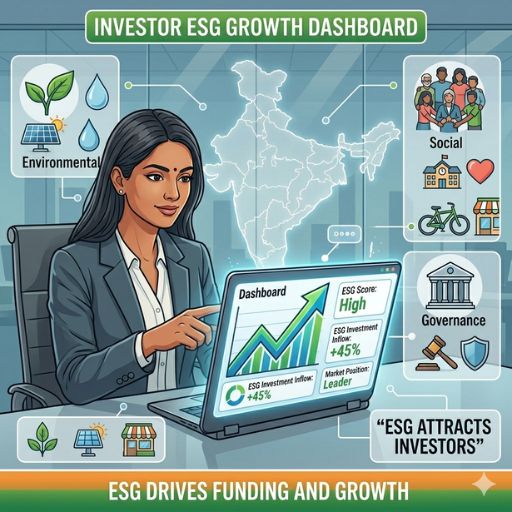
Featured Image: ESG performance is increasingly becoming a key factor in investment decisions across startups, MSMEs, and large enterprises.
Introduction
Investment decisions have evolved significantly over the past decade. While financial performance remains essential, investors increasingly want to understand whether a business can remain profitable in a rapidly changing world shaped by climate risks, evolving regulations, technological disruption, and changing consumer expectations.
This shift has placed Environmental, Social, and Governance (ESG) at the center of investment analysis. Today, institutional investors, venture capital firms, banks, multinational corporations, and even customers expect businesses to operate responsibly while managing environmental and social impacts effectively.
For Indian businesses, ESG is no longer just a reporting requirement for listed companies. It is becoming an important business strategy that improves operational efficiency, strengthens risk management, enhances corporate reputation, and increases access to capital. Companies that begin integrating ESG today are often better prepared for future regulations, global supply chain requirements, and sustainability-focused investment opportunities.
Whether you operate a manufacturing company, technology startup, service business, or MSME, understanding how ESG influences investor confidence can help position your business for long-term growth and resilience.
UCT Climate Intelligence for Investor-Ready Businesses
United Carbon Technologies helps Indian startups, MSMEs, and corporates strengthen their sustainability journey through carbon footprint assessments, ESG readiness, climate intelligence, BRSR guidance, emissions measurement, and sustainability awareness resources designed for India's evolving business landscape.
Preparing for investors starts with understanding your environmental impact, identifying climate risks, and building transparent ESG practices that create long-term business value.
Did You Know?
- Many institutional investors now evaluate ESG performance alongside financial performance before making investment decisions.
- Businesses with stronger governance and sustainability practices often experience lower operational risks and improved investor confidence.
- Global supply chains increasingly require suppliers to demonstrate ESG commitments and carbon management capabilities.
- Indian ESG reporting requirements continue to expand, encouraging businesses to improve sustainability disclosures and transparency.
Why ESG Has Become Important for Investors
Investors seek businesses capable of generating consistent returns over many years rather than focusing only on short-term profits. ESG provides valuable insights into how a company manages operational risks, environmental responsibilities, workforce wellbeing, ethical governance, and long-term strategic planning.
Strong ESG performance often signals that management is proactive rather than reactive. Companies monitoring carbon emissions, improving resource efficiency, maintaining transparent governance structures, and investing in employee wellbeing generally demonstrate stronger operational discipline and resilience during periods of economic uncertainty.
As climate-related regulations become more common and consumer expectations continue to evolve, investors increasingly view ESG as an indicator of future competitiveness instead of merely a sustainability initiative.
Investors increasingly evaluate:
- Climate-related business risks
- Energy efficiency initiatives
- Carbon emission reduction strategies
- Supply chain sustainability
- Corporate governance practices
- Data transparency
- Ethical leadership
- Employee health and safety
- Business resilience and long-term planning
How ESG Improves Investor Confidence
Businesses with structured ESG programs often provide investors with greater confidence because they demonstrate measurable progress, accountability, and transparency. Instead of relying solely on financial reports, investors gain a broader understanding of how the company manages future risks and opportunities.
For example, a manufacturing company that measures greenhouse gas emissions, tracks energy consumption, improves waste management, and publishes sustainability goals demonstrates stronger operational maturity than a similar company with no ESG framework.
Likewise, startups that establish responsible governance, data security practices, ethical leadership, and sustainable growth strategies often appear better prepared for scaling operations and attracting institutional capital.
Strong ESG practices can increase investor confidence by:
- Reducing operational uncertainty.
- Improving corporate transparency.
- Strengthening governance structures.
- Building customer and stakeholder trust.
- Demonstrating long-term strategic planning.
- Preparing businesses for future ESG regulations.
- Supporting stronger brand reputation.
- Improving resilience against environmental and market risks.
Start optimizing your home energy usage today and see immediate reductions in your electricity bill.
Learn how United Carbon Technologies helps organizations with carbon accounting, ESG reporting, climate intelligence, and sustainability strategy.
ESG Can Improve Business Valuation
One of the biggest misconceptions about ESG is that it is merely an expense. In reality, well-planned ESG initiatives can strengthen a company's long-term value by improving operational efficiency, reducing business risks, and enhancing investor confidence.
When investors evaluate a company, they don't only assess current profits—they also estimate future growth potential and resilience. Businesses that actively manage climate risks, improve resource efficiency, and maintain strong governance often appear more stable and attractive compared to competitors that ignore sustainability issues.
ESG contributes to higher business value by:
- Reducing operational and compliance risks.
- Lowering long-term energy and resource costs.
- Building stronger customer trust.
- Increasing supply chain resilience.
- Enhancing brand reputation.
- Supporting long-term profitability.
- Improving investor confidence during due diligence.
- Preparing businesses for future regulations.
How ESG Supports Startup Funding in India
India's startup ecosystem has matured significantly over the past decade. Investors now expect founders to demonstrate not only innovation and scalability but also responsible business practices.
Climate technology, clean energy, electric mobility, circular economy, sustainable agriculture, and ESG software are among the fastest-growing investment sectors. Even startups outside these industries benefit by incorporating ESG principles early in their growth journey.
A startup with transparent governance, ethical operations, and measurable sustainability initiatives often appears better prepared for long-term scaling than one focused solely on rapid growth.
ESG helps startups by:
- Building investor trust.
- Improving governance from day one.
- Reducing future operational risks.
- Strengthening brand credibility.
- Supporting international expansion.
- Meeting customer sustainability expectations.
- Preparing for institutional funding rounds.
Why ESG Matters for MSMEs
Micro, Small, and Medium Enterprises (MSMEs) are the backbone of India's economy, contributing significantly to employment, manufacturing, exports, and innovation. Although ESG reporting requirements primarily apply to larger listed companies, MSMEs are increasingly influenced through supply chains, customer expectations, and financing requirements.
Large corporations often require suppliers to disclose environmental information, improve energy efficiency, and demonstrate responsible business practices. MSMEs that begin building ESG capabilities today can strengthen relationships with larger clients while improving access to financing.
Benefits for MSMEs include:
- Improved business reputation.
- Better supplier relationships.
- Greater eligibility for sustainability-focused funding.
- Lower operating costs through resource efficiency.
- Preparation for future ESG expectations.
- Competitive differentiation.
ESG and BRSR: Preparing for India's Sustainability Future
India is steadily strengthening its sustainability reporting ecosystem. The Business Responsibility and Sustainability Reporting (BRSR) framework has increased awareness about ESG reporting across industries, encouraging businesses to improve transparency and accountability.
Although many MSMEs are not currently required to publish BRSR reports, businesses working with listed companies may increasingly receive requests for emissions data, supplier sustainability information, and governance disclosures.
Preparing early allows businesses to respond more efficiently as ESG expectations continue evolving.
Common ESG Mistakes Businesses Make
Many organizations delay ESG implementation because they assume sustainability programs require large budgets or specialized teams. In reality, successful ESG strategies usually begin with understanding existing operations and making continuous improvements.
Common mistakes include:
- Treating ESG as only a compliance exercise.
- Ignoring carbon emissions data.
- Not involving senior leadership.
- Collecting inconsistent sustainability data.
- Failing to set measurable ESG goals.
- Overlooking governance improvements.
- Not communicating ESG progress transparently.
- Waiting until investors request ESG information.
How Businesses Can Start Their ESG Journey
Every organization can begin ESG implementation regardless of size. The key is to establish a practical roadmap based on business priorities rather than attempting to solve everything simultaneously.
A practical ESG roadmap includes:
- Measure your carbon footprint.
- Identify major environmental impacts.
- Improve energy efficiency.
- Strengthen governance practices.
- Develop sustainability policies.
- Track ESG metrics consistently.
- Publish transparent progress updates.
- Engage employees and stakeholders.
- Prepare for future ESG reporting.
India Context: ESG Is Becoming a Competitive Advantage
India's sustainability landscape is evolving rapidly. Businesses are increasingly expected to understand climate risks, improve resource efficiency, reduce emissions, and strengthen governance. Investors, customers, regulators, multinational corporations, and financial institutions are all placing greater emphasis on responsible business practices.
Companies that begin their ESG journey today are better positioned to participate in global supply chains, attract responsible investment, improve operational resilience, and compete in international markets.
Why Trust United Carbon Technologies?
United Carbon Technologies (UCT) is building climate intelligence solutions designed specifically for Indian businesses. Through practical climate education, ESG awareness, carbon accounting resources, sustainability research, and technology-driven solutions, UCT helps organizations understand environmental impacts and prepare for the future of sustainable business.
Our Climate Knowledge Hub is created to simplify complex sustainability concepts into practical guidance for founders, MSMEs, corporates, sustainability professionals, and climate-conscious individuals.
Related Reading
- Why ESG Matters for Startups and MSMEs in India
- Scope 3 Emissions Explained with Indian Examples
- What Is Renewable Energy and Why It Matters
- How Carbon Footprints Affect Business Decisions
- BRSR Core vs BRSR Comprehensive Explained
- ESG vs BRSR: Understanding the Difference
Quick Summary
- ESG has become an important factor in investment decisions.
- Strong ESG practices improve investor confidence.
- Businesses with good governance often appear less risky.
- ESG supports long-term growth and resilience.
- Indian startups and MSMEs can benefit by starting early.
- BRSR and sustainability reporting are increasing ESG awareness.
- Measuring carbon emissions is an important first step.
- Transparent ESG practices strengthen business credibility.
Frequently Asked Questions
1. Why do investors care about ESG?
Investors use ESG information to understand long-term risks, governance quality, sustainability performance, and future business resilience beyond financial statements.
2. Does ESG increase business valuation?
Strong ESG practices can improve investor confidence, reduce operational risks, strengthen reputation, and contribute to long-term business value.
3. Can startups benefit from ESG?
Yes. Startups adopting ESG early often build stronger governance, improve investor trust, and prepare for sustainable scaling.
4. Is ESG only for large companies?
No. MSMEs and startups increasingly benefit from ESG as customers, supply chains, investors, and lenders place greater emphasis on sustainability.
5. How does ESG reduce business risk?
It helps businesses identify environmental, operational, regulatory, governance, and reputational risks before they become major challenges.
6. Does ESG help attract international investors?
Yes. Many global investors consider ESG performance during investment evaluations and due diligence.
7. What is the first ESG step for businesses?
Measuring your carbon footprint and understanding your environmental impact provide a strong starting point.
8. How is ESG connected with BRSR?
BRSR is India's sustainability reporting framework that encourages businesses to disclose ESG-related information in a structured manner.
9. Can ESG improve customer trust?
Yes. Transparent sustainability initiatives often strengthen customer loyalty and brand reputation.
10. Why should Indian businesses start ESG now?
Early adoption improves competitiveness, prepares businesses for future regulations, strengthens investor confidence, and supports long-term growth.
Build an Investor-Ready Sustainable Business
Whether you're a startup, MSME, or growing enterprise, ESG is becoming a critical part of business success. Understanding carbon emissions, improving governance, and developing sustainability strategies today can create stronger opportunities tomorrow.
Continue exploring the UCT Climate Knowledge Hub for practical guides on ESG, carbon accounting, BRSR, climate intelligence, and sustainable business transformation.
© United Carbon Technologies Pvt. Ltd.
Carbon Intelligence • Climate Innovation • Sustainable Systems