

How Transportation Impacts Carbon Emissions in India (2026 Guide)
By United Carbon Technologies | Climate Knowledge Hub India
Published: April 19, 2026 |
Last Updated: July 19, 2026
Receive practical guides on Carbon Accounting, ESG Reporting, Climate Technology and Sustainable Living designed for Indian businesses and climate-conscious citizens.
Transportation is one of the fastest-growing sources of greenhouse gas emissions in India. Every journey—whether by motorcycle, car, truck, train, aircraft, or bus—requires energy, and most of that energy still comes from fossil fuels. Understanding how transportation contributes to carbon emissions helps individuals, businesses, and policymakers make smarter mobility decisions while supporting India's transition toward a low-carbon economy.
How does transportation affect carbon emissions in India?
Transportation contributes to carbon emissions by burning petrol, diesel, aviation fuel, and other fossil fuels. Private vehicles generally emit more carbon per passenger than buses or metro systems, while electric vehicles can significantly reduce emissions when powered by cleaner electricity. Sustainable transport choices are essential for India's Net Zero ambitions.
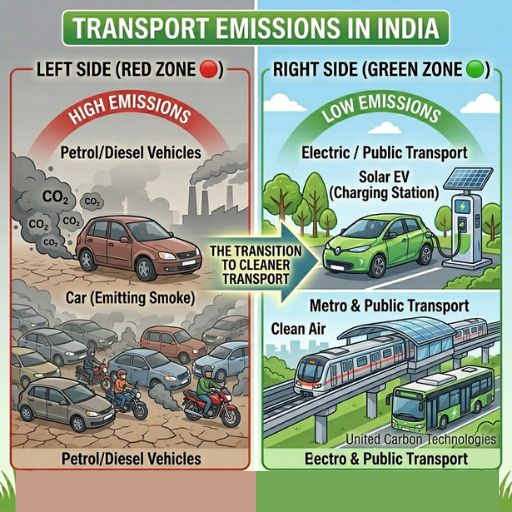
India operates one of the world's largest transportation networks. Millions of people travel daily using motorcycles, cars, buses, trains, auto-rickshaws, metro systems, ships, and airplanes. While transportation enables economic growth and improves connectivity, it also contributes significantly to greenhouse gas emissions and urban air pollution.
Rapid urbanization, increasing vehicle ownership, expanding logistics networks, and rising demand for goods have all increased fuel consumption across the country. As India's economy continues to grow, reducing transport-related emissions has become an important part of national climate strategies.
Fortunately, reducing transportation emissions does not always require expensive technology. Public transport, better urban planning, cleaner fuels, electric mobility, and smarter logistics can dramatically lower emissions while improving public health and reducing fuel costs.
Understand Your Carbon Footprint
Transportation is often one of the largest contributors to personal and business carbon emissions. Measuring travel-related emissions is the first step toward meaningful climate action.
Road transportation contributes a substantial share of India's transport-sector greenhouse gas emissions. As cities expand and vehicle ownership rises, improving transport efficiency has become one of the country's biggest climate opportunities.
Why Transportation Matters in Climate Change
Every litre of petrol or diesel burned releases carbon dioxide into the atmosphere. Over millions of vehicles and billions of kilometres travelled annually, these emissions become a major contributor to climate change.
Transportation emissions are particularly important because they continue growing alongside economic development. Freight movement, e-commerce deliveries, tourism, aviation, and daily commuting all increase fuel demand.
Major contributors include:
- Private cars
- Motorcycles and scooters
- Heavy commercial trucks
- Buses
- Domestic aviation
- Shipping and logistics
- Construction and industrial transport
Which Modes of Transport Produce the Most Emissions?
Not every transport mode produces the same amount of carbon emissions. Emissions depend on fuel type, occupancy, vehicle efficiency, and travel distance.
| Transport Mode | Typical Carbon Impact |
|---|---|
| Private petrol car | High per passenger |
| Motorcycle | Moderate |
| Bus | Low per passenger |
| Metro Rail | Very Low |
| Cycling | Almost Zero |
| Walking | Zero Direct Emissions |
| Electric Vehicle | Lower depending on electricity source |
Fleet emissions, employee commuting and logistics can represent a major portion of an organization's carbon footprint. Measuring these emissions is the first step toward ESG reporting and carbon reduction.
Helping Indian Businesses Reduce Transport Emissions
United Carbon Technologies develops Carbon Intelligence solutions that help organizations understand transportation emissions, calculate fleet carbon footprints, improve ESG reporting, and identify practical decarbonization opportunities across operations and supply chains.
Private Vehicles vs Public Transport: Which Is Better for the Climate?
One of the biggest factors influencing transport emissions is how many people share a vehicle. A private car carrying one person produces far more emissions per passenger than a bus, metro, or train carrying hundreds of commuters.
India's expanding metro rail systems, Bus Rapid Transit (BRT), suburban railways, and city bus networks demonstrate how public transportation can reduce congestion while lowering greenhouse gas emissions.
- 🚗 Private cars generally have the highest emissions per passenger.
- 🏍 Two-wheelers consume less fuel but still contribute significantly because of their large numbers.
- 🚌 Buses carry many passengers, reducing emissions per person.
- 🚆 Metro and suburban rail systems offer some of the lowest-emission urban transport options.
- 🚶 Walking and cycling produce virtually zero direct carbon emissions.
How Electric Vehicles Are Changing Transportation in India
Electric Vehicles (EVs) are becoming one of India's most important tools for reducing transportation emissions. Unlike conventional petrol and diesel vehicles, EVs produce zero tailpipe emissions and can become even cleaner as India's electricity grid incorporates more renewable energy.
Government initiatives, state subsidies, and expanding charging infrastructure are accelerating EV adoption across passenger vehicles, two-wheelers, commercial fleets, and public transport.
Benefits of Electric Vehicles include:
- Lower greenhouse gas emissions
- Reduced dependence on imported fossil fuels
- Lower operating and maintenance costs
- Improved urban air quality
- Support for India's clean energy transition
Freight and Logistics: A Growing Source of Carbon Emissions
Transportation emissions are not limited to passenger travel. Freight movement across India—including trucks, delivery vans, shipping, and warehousing—forms a significant share of business-related emissions.
The rapid growth of e-commerce has increased demand for last-mile deliveries, making logistics companies increasingly important participants in India's decarbonization journey.
Businesses can reduce logistics emissions by:
- Optimizing delivery routes using technology
- Reducing empty return trips
- Improving warehouse efficiency
- Using cleaner fuels and electric delivery vehicles
- Partnering with low-carbon logistics providers
Air Travel vs Rail Travel
Domestic aviation has expanded rapidly in India, making air travel accessible to millions of people. While flying saves time, it generally produces considerably higher emissions per passenger than rail travel over similar distances.
India's extensive railway network remains one of the country's most energy-efficient transport systems, particularly as railway electrification continues to expand.
| Travel Mode | General Carbon Impact |
|---|---|
| Domestic Flight | High |
| Private Car | High |
| Bus | Moderate to Low |
| Railway | Low |
| Metro | Very Low |
Transportation and India's Climate Goals
India has committed to reducing the emissions intensity of its economy while expanding clean energy and sustainable infrastructure. Transportation is a priority sector because it directly affects climate change, urban air quality, fuel imports, and public health.
National initiatives promoting electric mobility, railway electrification, ethanol blending, cleaner fuels, public transportation, and smart city development are helping reduce transport-related emissions while supporting economic growth.
Why This Matters for Businesses
Transportation emissions often form an important part of an organization's carbon footprint through employee commuting, company fleets, logistics operations, supplier transportation, and business travel. Measuring and managing these emissions supports ESG reporting, operational efficiency, and long-term sustainability planning.
Related Climate Guides
- Understanding Carbon Footprints for Individuals and Businesses
- Scope 1, Scope 2 and Scope 3 Emissions Explained
- Electric Vehicles and India's Net Zero Future
- Sustainable Living Tips for Urban India
- How Businesses Can Reduce Carbon Emissions
- Carbon Accounting for Indian Companies
Quick Summary
- Transportation is a major contributor to India's greenhouse gas emissions.
- Private vehicles generally emit more carbon per passenger than public transport.
- Electric vehicles are helping reduce emissions across passenger and commercial transport.
- Freight and logistics emissions are becoming increasingly important for businesses.
- Metro systems and railways remain among the most sustainable transport options.
- Individuals and businesses can significantly reduce emissions through smarter mobility choices.
Frequently Asked Questions (FAQs)
1. Why does transportation contribute so much to carbon emissions?
Most vehicles still rely on petrol, diesel, or aviation fuel. Burning these fossil fuels releases carbon dioxide (CO₂), making transportation one of the largest sources of greenhouse gas emissions worldwide.
2. Which transport option has the lowest carbon footprint?
Walking and cycling produce virtually zero direct emissions. Among motorized transport, metro rail, electric trains, and buses generally have much lower emissions per passenger than private cars.
3. Are electric vehicles completely carbon-free?
Electric vehicles have zero tailpipe emissions, but their total carbon footprint depends on how the electricity used for charging is generated. As India's renewable energy share grows, EVs become even cleaner.
4. How much do private cars contribute to emissions?
Private cars generally produce significantly higher emissions per passenger than shared transportation because they often carry only one or two people.
5. Why is public transport considered more sustainable?
Buses, metro systems, and trains transport many passengers simultaneously, reducing emissions per person while easing road congestion and improving fuel efficiency.
6. How does freight transportation affect businesses?
Freight movement through trucks, shipping, and logistics contributes substantially to a company's Scope 3 emissions, making supply chain optimization an important ESG strategy.
7. What is the role of transportation in ESG reporting?
Organizations often report emissions from business travel, employee commuting, logistics, and company-owned vehicles as part of their carbon accounting and ESG disclosures.
8. Can businesses reduce transportation emissions?
Yes. Route optimization, electric fleets, hybrid vehicles, virtual meetings, employee shuttle services, and efficient logistics planning can significantly reduce transportation-related emissions.
9. Is India's transportation sector becoming greener?
Yes. India is investing in electric mobility, metro rail expansion, railway electrification, cleaner fuels, and smart transportation infrastructure to support sustainable growth.
10. How can individuals reduce their travel carbon footprint?
Using public transport, walking, cycling, carpooling, maintaining vehicles properly, and choosing electric vehicles where practical are effective ways to reduce personal transport emissions.
11. Why is reducing transportation emissions important for India?
Lower transport emissions improve air quality, reduce dependence on imported fossil fuels, support India's climate commitments, and contribute to healthier cities and communities.
12. How can United Carbon Technologies help businesses?
United Carbon Technologies helps organizations understand transportation-related emissions, calculate carbon footprints, strengthen ESG reporting, and identify practical decarbonization opportunities through Carbon Intelligence solutions.
Move Toward Low-Carbon Transportation
Transportation emissions affect individuals, businesses, and entire supply chains. Understanding where emissions originate is the first step toward smarter mobility, stronger ESG performance, and long-term sustainability.
Whether you're measuring fleet emissions, reducing employee commuting impacts, or beginning your carbon accounting journey, United Carbon Technologies provides practical Carbon Intelligence solutions designed for Indian businesses.