

Scope 3 Emissions Explained: Complete Guide with Indian Business Examples (2026)
By United Carbon Technologies Pvt. Ltd. |
Climate Knowledge Hub India
Published: April 17, 2025
|
Last Updated:
July 18, 2026
Receive practical guides on Carbon Accounting, ESG Reporting, Net Zero, Climate Technology, Sustainability, and India's evolving climate regulations.
Scope 3 emissions are often the largest source of greenhouse gas emissions for businesses, yet they are also the most difficult to measure. Unlike emissions generated directly by a company, Scope 3 emissions occur across the entire value chain—from suppliers and logistics to product use and disposal. Understanding Scope 3 emissions is becoming increasingly important for Indian businesses pursuing ESG reporting, BRSR compliance, investor transparency, and Net Zero commitments.
What are Scope 3 emissions?
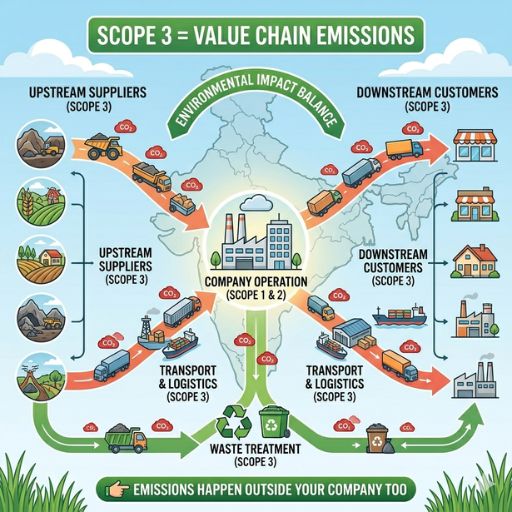
Scope 3 emissions are indirect greenhouse gas emissions generated throughout a company's value chain that are not included in Scope 1 or Scope 2 emissions. They include supplier emissions, transportation, employee commuting, business travel, purchased goods and services, product use, waste disposal, investments, and end-of-life treatment of products.
Introduction
Most businesses begin measuring their climate impact by calculating fuel consumption or electricity use. While these emissions are important, they often represent only a small portion of a company's total environmental footprint.
For many industries—including manufacturing, retail, pharmaceuticals, automotive, logistics, FMCG, IT services, textiles, and food processing—the majority of greenhouse gas emissions occur outside their direct operations. These indirect emissions are known as Scope 3 emissions.
As India accelerates its transition toward a low-carbon economy, companies are expected to better understand emissions throughout their supply chains. Investors, multinational customers, regulators, and sustainability frameworks increasingly evaluate businesses based on how effectively they identify and manage Scope 3 emissions.
Whether you operate a startup, MSME, large enterprise, or multinational organization, understanding Scope 3 emissions is becoming essential for carbon accounting, ESG reporting, climate risk management, and long-term competitiveness.
UCT Carbon Intelligence
Understanding Scope 3 emissions is one of the biggest challenges in carbon accounting. United Carbon Technologies is developing practical Climate Intelligence solutions to help Indian businesses understand emissions, improve ESG reporting, and prepare for future sustainability requirements.
Did You Know?
For many organizations, Scope 3 emissions account for more than 70–90% of their total greenhouse gas emissions. Industries with extensive supply chains—including manufacturing, consumer goods, retail, construction, and technology—often find that indirect emissions far exceed emissions generated from their own facilities.
Understanding the Three Emission Scopes
Greenhouse gas accounting follows the internationally recognized Greenhouse Gas (GHG) Protocol, which divides business emissions into three categories. This framework allows organizations worldwide to measure, compare, and report emissions consistently.
Scope 1 — Direct Emissions
Scope 1 includes emissions from sources that are owned or directly controlled by the company.
Examples:
- Diesel generators
- Company-owned vehicles
- Manufacturing equipment
- Industrial boilers
- Fuel combustion
- Refrigerant leakage
Scope 2 — Purchased Energy
Scope 2 covers indirect emissions generated from purchased electricity, heating, cooling, or steam consumed by the organization.
Examples:
- Office electricity
- Factory power consumption
- Purchased steam
- District cooling systems
Scope 3 — Value Chain Emissions
Scope 3 includes all other indirect emissions generated throughout the company's value chain. Although they occur outside direct business operations, they are associated with products, services, suppliers, transportation, customers, investments, and waste.
For most businesses, Scope 3 represents the largest opportunity for emission reductions and supply chain transformation.
Why Scope 3 Emissions Matter
Until recently, many businesses focused primarily on reducing emissions from their own facilities. Today, sustainability expectations have expanded significantly. Investors, customers, financial institutions, and regulators increasingly recognize that a company's true environmental impact extends across its entire value chain.
Managing Scope 3 emissions helps organizations:
- Understand their complete carbon footprint.
- Improve ESG reporting quality.
- Prepare for evolving BRSR expectations.
- Strengthen supplier relationships.
- Identify operational efficiencies.
- Reduce long-term climate risks.
- Support Net Zero transition strategies.
- Meet customer sustainability requirements.
- Increase investor confidence.
- Enhance corporate reputation.
Many multinational companies now request emissions data from suppliers before awarding contracts. As a result, even MSMEs are beginning to participate in supply chain carbon reporting.
Measure Beyond Your Office Walls
Most emissions occur outside your organization's direct control. Understanding Scope 3 emissions gives businesses a complete picture of their environmental impact and creates opportunities for smarter procurement, better supplier engagement, and stronger ESG performance.
Build Better ESG Reporting with Carbon Intelligence
Whether you're an MSME, startup, manufacturer, exporter, or corporate enterprise, understanding Scope 3 emissions is becoming essential for ESG reporting, investor readiness, and future compliance.
United Carbon Technologies is building practical Climate Intelligence solutions designed specifically for Indian businesses navigating carbon accounting and sustainability reporting.
The 15 Categories of Scope 3 Emissions
The Greenhouse Gas (GHG) Protocol divides Scope 3 emissions into 15 categories. Not every category applies to every organization, but together they provide a complete picture of emissions generated across a company's value chain.
Upstream Activities
- Purchased Goods and Services – Raw materials, office supplies, professional services, and outsourced activities.
- Capital Goods – Machinery, factory equipment, buildings, and infrastructure purchased by the company.
- Fuel and Energy-Related Activities – Emissions associated with producing fuels and electricity before they reach your business.
- Upstream Transportation and Distribution – Logistics provided by third-party transport companies.
- Waste Generated in Operations – Disposal, recycling, composting, and treatment of operational waste.
- Business Travel – Air travel, train journeys, hotels, taxis, and rental vehicles used by employees.
- Employee Commuting – Daily travel between employees' homes and workplaces.
- Upstream Leased Assets – Emissions from leased buildings, warehouses, or equipment not included in Scope 1 or Scope 2.
Downstream Activities
- Downstream Transportation and Distribution
- Processing of Sold Products
- Use of Sold Products
- End-of-Life Treatment of Sold Products
- Downstream Leased Assets
- Franchises
- Investments
Depending on the industry, one or two categories may contribute the majority of emissions. For example, manufacturers typically have significant purchased goods emissions, while software companies often have higher business travel and data centre-related emissions.
Scope 3 Emissions: Indian Business Examples
Scope 3 emissions vary considerably between industries. Below are examples illustrating how indirect emissions appear in different Indian businesses.
Manufacturing Company
- Steel purchased from suppliers
- Transportation of raw materials
- Packaging materials
- Employee commuting
- Waste disposal
- Product distribution across India
IT Services Company
- Employee air travel
- Cloud hosting services
- Purchased laptops and equipment
- Office waste
- Employee commuting
- Third-party consulting services
Retail Business
- Supplier manufacturing emissions
- Imported products
- Warehousing
- Customer delivery logistics
- Packaging waste
- Product disposal
Food Processing Company
- Agricultural raw materials
- Cold-chain logistics
- Packaging materials
- Retail distribution
- Food waste
Why Scope 3 Is Difficult to Measure
Unlike Scope 1 and Scope 2 emissions, Scope 3 data often comes from suppliers, contractors, logistics partners, and customers. This makes data collection far more challenging.
Common challenges include:
- Limited supplier data availability.
- Large and complex supply chains.
- Different reporting methodologies.
- Lack of emissions expertise.
- Insufficient digital reporting tools.
- Difficulty obtaining customer usage data.
- Changing supplier networks.
For many Indian MSMEs, supplier engagement is currently the biggest challenge in measuring Scope 3 emissions accurately.
How Indian Companies Can Measure Scope 3 Emissions
Businesses do not need perfect data on day one. Most organizations begin with estimates using available procurement, logistics, and operational data before improving accuracy over time.
A practical approach:
- Identify all major suppliers.
- Map your value chain.
- Collect purchasing data.
- Estimate transportation emissions.
- Track employee commuting.
- Measure business travel.
- Estimate waste disposal emissions.
- Use recognised emission factors.
- Improve supplier reporting annually.
- Review and verify calculations regularly.
Reducing Scope 3 Emissions
Although Scope 3 emissions occur outside direct operations, businesses can still influence them through procurement decisions, supplier engagement, product design, and customer education.
Effective reduction strategies include:
- Select suppliers with lower carbon footprints.
- Source materials locally where feasible.
- Improve transportation efficiency.
- Reduce unnecessary packaging.
- Encourage hybrid or remote work.
- Increase recycling throughout the supply chain.
- Design products with longer life cycles.
- Improve product energy efficiency.
- Collaborate with suppliers on emission reduction targets.
Scope 3 Emissions and BRSR Reporting
India's sustainability reporting landscape is evolving rapidly. While not every company is currently required to disclose detailed Scope 3 emissions, many listed companies, exporters, and multinational suppliers are increasingly expected to understand and manage emissions throughout their value chains.
Businesses preparing for BRSR reporting, ESG disclosures, or international sustainability frameworks benefit from early investment in Scope 3 measurement capabilities.
Scope 3 and Net Zero Strategies
Organizations cannot realistically achieve Net Zero by focusing only on electricity and fuel consumption. Because Scope 3 often represents the majority of total emissions, meaningful climate strategies require collaboration across suppliers, customers, logistics providers, and business partners.
Companies that understand their value chain emissions are better positioned to set science-based targets, improve resilience, and respond to investor expectations.
Why Scope 3 Matters for Indian Businesses
India is becoming a global manufacturing and services hub. International customers increasingly request emissions information from suppliers before awarding contracts. As ESG expectations continue to grow, businesses that understand Scope 3 emissions will be better prepared for global markets, sustainable finance opportunities, and future regulatory developments.
For Indian MSMEs, early adoption of carbon accounting practices can strengthen competitiveness within domestic and international supply chains.
Why Trust United Carbon Technologies?
United Carbon Technologies (UCT) develops Carbon Intelligence solutions, climate education resources, and ESG knowledge tailored for Indian businesses. Through our Climate Knowledge Hub, we simplify complex carbon accounting concepts into practical guidance for MSMEs, startups, enterprises, sustainability professionals, and future climate leaders.
Related Climate & ESG Guides
- Understanding Carbon Footprints for Businesses
- Scope 1 vs Scope 2 vs Scope 3 Emissions
- Why ESG Matters for Startups and MSMEs in India
- BRSR Core vs BRSR Comprehensive Explained
- ESG vs BRSR: Key Differences
- How to Build a Corporate Carbon Inventory
- What Is Net Zero?
- Carbon Accounting Explained
Quick Summary
- Scope 3 includes indirect emissions across the value chain.
- It is often the largest source of business emissions.
- The GHG Protocol defines 15 Scope 3 categories.
- Supplier engagement is essential for accurate reporting.
- Scope 3 supports ESG reporting and Net Zero planning.
- Indian businesses are increasingly expected to understand value chain emissions.
- Carbon accounting improves business resilience and investor confidence.
- Early adoption provides a competitive advantage.
Frequently Asked Questions
1. What are Scope 3 emissions?
Scope 3 emissions are indirect greenhouse gas emissions that occur across a company's value chain, including suppliers, transportation, product use, waste, and investments.
2. Why are Scope 3 emissions important?
They often represent the largest share of a company's total carbon footprint and are increasingly considered in ESG reporting and Net Zero strategies.
3. How are Scope 3 emissions different from Scope 1 and Scope 2?
Scope 1 covers direct emissions, Scope 2 covers purchased electricity, while Scope 3 includes all other indirect value chain emissions.
4. Are Scope 3 emissions mandatory in India?
Requirements vary depending on applicable reporting frameworks and company obligations. However, many businesses are voluntarily measuring Scope 3 to strengthen ESG reporting and meet customer expectations.
5. Which industries have the highest Scope 3 emissions?
Manufacturing, retail, FMCG, automotive, construction, logistics, food processing, pharmaceuticals, and technology companies often have significant Scope 3 emissions.
6. Can MSMEs measure Scope 3 emissions?
Yes. MSMEs can begin with available procurement and operational data and gradually improve reporting as more information becomes available.
7. What is the largest source of Scope 3 emissions?
Purchased goods and services are often the largest contributor for many businesses, although this varies by industry.
8. How can businesses reduce Scope 3 emissions?
By engaging suppliers, improving logistics, reducing waste, sourcing sustainably, and designing more efficient products.
9. Does Scope 3 affect Net Zero commitments?
Yes. Because Scope 3 often represents most emissions, addressing it is essential for credible long-term Net Zero strategies.
10. Why should Indian companies prepare now?
Growing ESG expectations, global supply chain requirements, and sustainability reporting trends make early preparation a strategic advantage.
Start Measuring What Really Matters
Understanding Scope 3 emissions is the first step toward comprehensive carbon accounting, stronger ESG reporting, and a resilient Net Zero strategy. Businesses that measure their entire value chain today will be better prepared for tomorrow's sustainability expectations.
Explore more practical climate guides from United Carbon Technologies and stay informed about Carbon Intelligence, ESG reporting, and sustainability solutions built for Indian businesses.