

Top Climate Technologies Transforming India (2026 Guide)
By United Carbon Technologies | Climate Knowledge Hub India
Published: April 21, 2026 | Last Updated: July 19, 2026
Climate technology is reshaping India's transition toward a low-carbon economy. Rapid advances in artificial intelligence, renewable energy, battery storage, carbon accounting, electric mobility, and digital sustainability platforms are helping organizations reduce emissions while improving efficiency and competitiveness.
Whether you're an entrepreneur, sustainability professional, student, policymaker, or corporate leader, understanding today's climate technologies is essential for preparing for India's green economy.
What are the top climate technologies transforming India in 2026?
The most impactful climate technologies in India include solar power, battery storage, electric vehicles, carbon accounting software, ESG reporting platforms, AI-powered energy management, smart grids, green hydrogen, carbon capture, and circular economy innovations. Together, these technologies help reduce greenhouse gas emissions while improving business efficiency and sustainability.
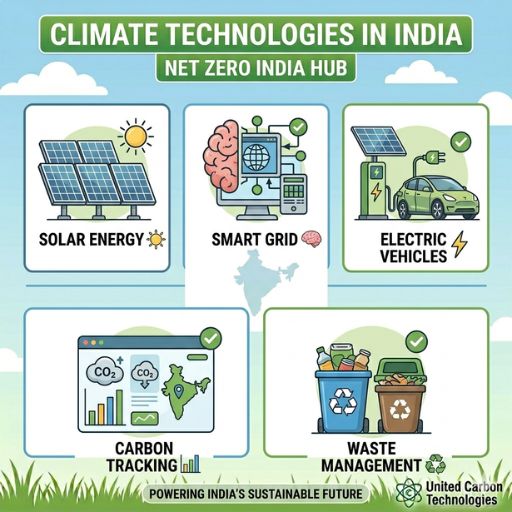
India has committed to ambitious climate goals while simultaneously becoming one of the world's fastest-growing economies. Meeting both objectives requires technologies that reduce emissions without slowing development.
Across industries—from manufacturing and logistics to agriculture, construction, finance, and information technology—organizations are investing in innovative climate solutions that lower costs, improve efficiency, strengthen ESG performance, and support regulatory compliance.
Many of these technologies are no longer experimental. They are already being adopted by Indian startups, MSMEs, large corporations, utilities, and government agencies.
Climate Technology Starts with Better Carbon Data
Whether you're deploying solar power, preparing ESG reports, or building a Net Zero roadmap, reliable carbon measurement is the foundation of every climate strategy.
United Carbon Technologies is developing practical Carbon Intelligence solutions that help organizations measure emissions, understand sustainability performance, and prepare for the evolving climate economy.
India has set a target of achieving Net Zero emissions by 2070 while rapidly expanding renewable energy capacity. Climate technologies will play a central role in achieving these national objectives.
1. Renewable Energy Technologies
Renewable energy remains the backbone of India's climate transition. Falling costs and improved efficiency have made clean electricity increasingly competitive with conventional energy sources.
- Large-scale solar power plants
- Commercial rooftop solar systems
- Wind farms
- Hybrid renewable projects
- Battery energy storage systems
- Microgrids for rural communities
Renewable electricity reduces greenhouse gas emissions while improving long-term energy security for businesses and households.
2. Electric Vehicles and Sustainable Mobility
Transportation is one of India's fastest-growing sources of carbon emissions. Electric mobility is transforming personal transport, logistics, and public transportation.
- Electric two-wheelers
- Electric buses
- Commercial EV fleets
- Battery swapping infrastructure
- Fast charging stations
- Fleet optimization software
Combined with cleaner electricity, EV adoption significantly lowers lifetime greenhouse gas emissions.
Explore Climate Technology for Your Business
Want to understand which climate technologies deliver the biggest impact for your organization? Learn how carbon accounting, ESG reporting, renewable energy, and digital sustainability tools work together.
Climate Innovation Creates Business Advantage
Organizations adopting climate technologies today are reducing operational costs, strengthening ESG performance, improving investor confidence, and preparing for future sustainability regulations.
United Carbon Technologies is building Carbon Intelligence solutions to support India's transition toward a smarter, data-driven, low-carbon economy.
3. AI-Powered Carbon Intelligence & ESG Platforms
Artificial Intelligence (AI) is rapidly becoming one of the most important climate technologies. Organizations now use AI to automate carbon accounting, analyze large sustainability datasets, identify emission hotspots, and generate ESG reports faster than traditional manual methods.
Instead of spending weeks collecting spreadsheets from multiple departments, businesses can now integrate operational data into carbon intelligence platforms that provide real-time sustainability insights.
- Automated carbon footprint calculations
- AI-assisted ESG reporting and disclosure
- Emission forecasting and trend analysis
- Supplier sustainability assessment
- Real-time environmental dashboards
- Climate risk monitoring
For Indian MSMEs and corporates, AI-powered carbon intelligence can reduce reporting time while improving the accuracy of sustainability data.
4. Smart Energy Management Systems
Energy efficiency remains one of the fastest and most affordable ways to reduce emissions. Smart energy management systems combine IoT sensors, cloud platforms, and AI to monitor electricity consumption and identify opportunities for savings.
- Smart electricity meters
- Building automation systems
- Industrial energy monitoring
- Predictive maintenance using AI
- Demand-response technologies
- Automated HVAC optimization
Many manufacturing facilities achieve significant energy savings simply by monitoring equipment performance continuously rather than relying on periodic inspections.
5. Green Hydrogen Technologies
Green hydrogen is emerging as a promising solution for sectors that are difficult to electrify, including steel, cement, chemicals, shipping, and heavy transportation.
Unlike conventional hydrogen produced from fossil fuels, green hydrogen is generated using renewable electricity, making it a cleaner alternative for industrial applications.
- Hydrogen production through electrolysis
- Industrial decarbonization
- Clean fuel for heavy transport
- Energy storage applications
India's National Green Hydrogen Mission is expected to accelerate investment and innovation in this rapidly growing sector.
The greatest climate impact often comes from combining multiple technologies. For example, renewable energy, AI-driven carbon accounting, smart buildings, and electric mobility together create a much larger emissions reduction than any single technology alone.
6. Carbon Capture, Utilization & Storage (CCUS)
Some industrial emissions cannot currently be eliminated completely. Carbon Capture, Utilization and Storage (CCUS) technologies capture carbon dioxide before it reaches the atmosphere and either store it safely or convert it into useful products.
- Industrial carbon capture systems
- Carbon mineralization
- Carbon utilization in manufacturing
- Long-term geological storage
Although still developing in India, CCUS is expected to become increasingly important for sectors such as cement, steel, and refining.
7. Circular Economy & Waste Technologies
Reducing emissions is not only about energy. Better resource management also plays a vital role. Circular economy technologies help businesses minimize waste while recovering valuable materials for reuse.
- Advanced recycling systems
- Waste-to-energy plants
- Industrial material recovery
- Plastic recycling innovations
- Organic waste composting
- Digital waste tracking platforms
These technologies reduce landfill waste, conserve natural resources, and lower greenhouse gas emissions throughout the product lifecycle.
Climate Technology Growth in India
India has become one of the world's fastest-growing climate innovation markets. Government initiatives supporting renewable energy, electric mobility, energy efficiency, green hydrogen, digital public infrastructure, and sustainable manufacturing are encouraging rapid adoption across industries.
At the same time, Indian startups are developing affordable climate solutions tailored for MSMEs, agriculture, manufacturing, logistics, and urban sustainability, making advanced climate technologies increasingly accessible to organizations of every size.
Why Climate Technology Matters
Climate technologies are no longer just environmental solutions—they are strategic business tools. Organizations that adopt these innovations can reduce operating costs, strengthen ESG performance, improve regulatory readiness, attract investors, and build long-term resilience in a rapidly changing economy.
Related Climate Guides
- Climate Technology
- ESG Reporting & Compliance
- Carbon Footprint Guides
- Net Zero Explained
- Climate Education
Quick Summary
- Climate technology is helping India reduce emissions while supporting economic growth.
- Renewable energy continues to lead India's clean energy transition.
- Artificial Intelligence is transforming carbon accounting and ESG reporting.
- Electric vehicles and smart mobility solutions are reducing transport emissions.
- Smart grids and energy management systems improve energy efficiency.
- Green hydrogen has significant potential for decarbonizing heavy industries.
- Carbon capture technologies will become increasingly important for hard-to-abate sectors.
- Circular economy innovations reduce waste while conserving valuable resources.
- Climate technology adoption improves business resilience and investor confidence.
- India is emerging as one of the world's fastest-growing climate innovation ecosystems.
Key Takeaways
- Climate technology is now a business necessity rather than a future trend.
- Digital carbon intelligence enables faster and more accurate ESG reporting.
- Renewable energy and storage solutions continue to become more affordable.
- Electric mobility is transforming India's transportation sector.
- AI is accelerating sustainability decision-making across industries.
- Climate technologies reduce costs while improving operational efficiency.
- Organizations adopting climate innovation today are better prepared for future regulations.
Frequently Asked Questions
1. What is climate technology?
Climate technology refers to products, services, and digital solutions that help reduce greenhouse gas emissions, improve energy efficiency, adapt to climate change, and support sustainable development.
2. Why is climate technology important in India?
India is balancing rapid economic growth with ambitious climate commitments. Climate technologies help reduce emissions while supporting industrial development and energy security.
3. Which climate technology has the biggest impact today?
Renewable energy, electric vehicles, battery storage, and AI-powered carbon management systems currently deliver some of the largest emission reductions.
4. How does AI support climate action?
AI analyzes environmental data, automates carbon accounting, predicts energy demand, improves efficiency, and simplifies ESG reporting.
5. What is carbon accounting software?
Carbon accounting software measures greenhouse gas emissions across business operations and helps organizations prepare sustainability and ESG reports.
6. What is a smart grid?
A smart grid uses digital technologies to improve electricity generation, transmission, distribution, and consumption, increasing efficiency and reliability.
7. What is green hydrogen?
Green hydrogen is hydrogen produced using renewable electricity through electrolysis, making it a low-carbon fuel for industries and transportation.
8. Can MSMEs benefit from climate technologies?
Yes. Many affordable climate technologies help MSMEs reduce operating costs, improve efficiency, and prepare for ESG requirements.
9. How do climate technologies support Net Zero goals?
They reduce emissions through cleaner energy, efficient operations, improved resource management, and accurate carbon measurement.
10. What is the future of climate technology in India?
The sector is expected to grow rapidly with continued investment in renewable energy, artificial intelligence, green hydrogen, battery technologies, carbon intelligence platforms, and sustainable manufacturing.
Explore the Future of Climate Innovation
Climate technology is transforming how businesses measure emissions, improve efficiency, and achieve sustainability goals. Start building your climate knowledge with practical guides, ESG resources, and carbon intelligence insights from United Carbon Technologies.
✓ Climate Technology Guides • ✓ ESG Learning Resources • ✓ Carbon Intelligence Insights • ✓ Free Climate Education