

What Are Carbon Credits in India? (Simple Guide)
Carbon credits help organizations and countries finance verified climate projects while balancing greenhouse gas emissions. In India, carbon credits are becoming increasingly important for ESG reporting, net-zero strategies, carbon markets, and sustainable business growth.
Part of the Climate Knowledge Hub by United Carbon Technologies — building India’s carbon intelligence ecosystem through ESG education, climate technology, and sustainability research.
What are carbon credits?
A carbon credit is a tradable certificate representing the reduction, removal, or avoidance of one metric ton of carbon dioxide (CO₂) or its equivalent greenhouse gases. Carbon credits support verified climate projects and help organizations offset unavoidable emissions.
Businesses across India are learning how carbon credits, carbon accounting, ESG reporting, climate finance, and net-zero commitments work together to support sustainable growth and environmental responsibility.
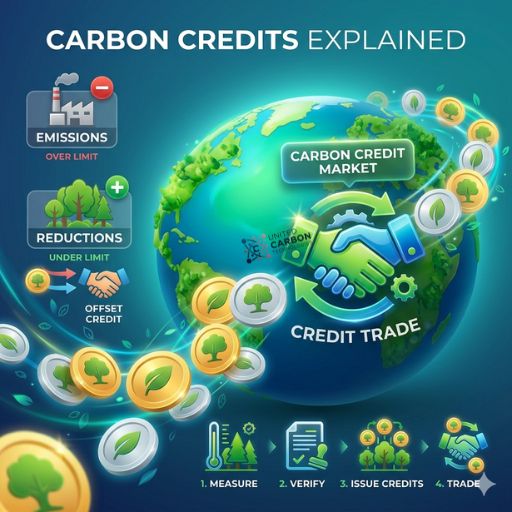
Carbon credits are designed to reduce global greenhouse gas emissions by encouraging investments in climate-positive projects. They allow organizations and individuals to compensate for their emissions by supporting verified environmental initiatives.
As climate awareness grows in India, carbon credits are becoming an important part of sustainability strategies for businesses and institutions.
Did you know? One carbon credit generally represents one metric ton of carbon dioxide (CO₂) or its equivalent that has been reduced, removed, or prevented through a verified climate project.
Why Carbon Credits Exist
Many industries cannot eliminate all greenhouse gas emissions immediately. Carbon credits encourage investment in projects that reduce or remove emissions elsewhere while organizations continue improving their own operations.
- Encourage global emission reductions
- Support renewable energy projects
- Protect forests and natural ecosystems
- Finance climate innovation
- Accelerate the transition to a low-carbon economy
Examples of Carbon Credit Projects
Carbon credits are generated through projects that reduce or remove emissions from the atmosphere.
- Wind and solar energy projects
- Forest protection and reforestation programs
- Methane capture from landfills
- Energy efficiency improvements
- Clean cooking technology initiatives
Who Uses Carbon Credits?
Carbon credits are used by governments, corporations, startups, educational institutions, and event organizers that want to reduce their environmental impact while supporting certified climate projects.
- Manufacturing companies
- Technology companies
- Airlines and logistics businesses
- Large infrastructure projects
- Organizations pursuing ESG goals
Why Carbon Credits Are Important
Carbon credits help direct financial resources toward climate solutions and support the transition to a low-carbon economy.
- Support climate mitigation projects
- Encourage investment in clean technologies
- Help organizations meet sustainability goals
- Promote global cooperation on climate action
How Carbon Credits Support ESG and Net Zero
Carbon credits are only one part of an effective climate strategy. Leading organizations first reduce emissions through operational improvements and renewable energy before using verified credits to address unavoidable emissions.
- Support ESG disclosures
- Complement carbon reduction strategies
- Help organizations progress toward net-zero goals
- Improve sustainability reporting
- Encourage investment in climate innovation
Start optimizing your home energy usage today and see immediate reductions in your electricity bill.
Get expert support for ESG and sustainability.
How Carbon Credits Work
Carbon credits follow a structured process. Organizations first measure their emissions, reduce them wherever possible, and then purchase verified carbon credits to compensate for remaining emissions.
- Measure greenhouse gas emissions.
- Reduce emissions through efficiency improvements.
- Purchase verified carbon credits for remaining emissions.
- Climate projects generate measurable environmental benefits.
- Independent verification ensures credibility.
Voluntary vs Compliance Carbon Markets
Carbon credits are traded in two primary types of markets, each serving different purposes.
- Compliance Markets: Created by government regulations requiring emission reductions
- Voluntary Markets: Organizations and individuals offset emissions by choice
Carbon Credits in India
India is expanding renewable energy, sustainable agriculture, afforestation, waste management, and industrial decarbonization initiatives that may generate high-quality carbon credits. As India's Carbon Credit Trading Scheme develops, businesses are expected to play an increasingly important role in domestic carbon markets.
Challenges in Carbon Markets
While carbon credits provide valuable climate finance, experts emphasize the importance of transparency, project verification, additionality, and long-term monitoring to ensure environmental integrity.
- Independent verification
- High-quality climate projects
- Avoiding double counting
- Transparent reporting
- Continuous monitoring
The Future of Carbon Markets in India
India is expected to play a growing role in global carbon markets due to renewable energy expansion, sustainability initiatives, and climate-focused policy development.
As climate regulations evolve, carbon accounting, ESG reporting, and climate intelligence systems may become increasingly important for businesses operating in India.
Related Climate & ESG Guides
- One carbon credit equals one metric ton of CO₂e reduced or removed.
- Carbon credits finance verified climate projects.
- Organizations should reduce emissions before purchasing offsets.
- Carbon credits support ESG and net-zero strategies.
- India is expanding its role in carbon markets.
Explore more about carbon footprint , net zero strategies , and carbon markets in India to better understand climate action and sustainability systems.
Digital Carbon Intelligence
Managing carbon credits effectively requires accurate emissions data. Climate intelligence platforms help organizations calculate emissions, monitor ESG performance, understand carbon footprints, and prepare for future reporting requirements.
United Carbon Technologies is developing India-focused climate intelligence solutions, including carbon calculators, ESG tools, and sustainability education initiatives that simplify carbon management for businesses and learners.
Frequently Asked Questions
What are carbon credits?
Carbon credits are tradable certificates representing the reduction, removal, or avoidance of one metric ton of carbon dioxide (CO₂) or its equivalent greenhouse gases through verified climate projects.
How do carbon credits work?
Organizations first measure and reduce their greenhouse gas emissions wherever possible. They can then purchase verified carbon credits to compensate for unavoidable emissions while supporting climate-positive projects.
What does one carbon credit represent?
One carbon credit generally represents one metric ton of carbon dioxide (CO₂) or an equivalent amount of another greenhouse gas that has been reduced, removed, or prevented from entering the atmosphere.
What is the difference between carbon credits and carbon offsets?
Carbon credits are verified units that can be traded in carbon markets, while carbon offsets refer to the broader process of compensating for emissions by supporting projects that generate those credits. The terms are often used together but are not always identical.
Who can buy carbon credits?
Businesses, governments, institutions, event organizers, and even individuals can purchase carbon credits to support verified climate projects and help compensate for emissions that cannot yet be eliminated.
Why are carbon credits important?
Carbon credits provide financial support for renewable energy, forest conservation, methane capture, and other climate projects while encouraging organizations to participate in global emission reduction efforts.
What is the voluntary carbon market?
The voluntary carbon market allows businesses and individuals to purchase carbon credits by choice as part of their sustainability, ESG, or net-zero commitments, even when they are not legally required to do so.
What is a compliance carbon market?
A compliance carbon market operates under government regulations that require certain industries or organizations to limit emissions or purchase carbon credits to meet legal obligations.
How are carbon credits used in India?
India is expanding its carbon market through renewable energy, afforestation, energy efficiency, and sustainable development initiatives. Carbon credits are expected to play an increasingly important role in ESG reporting, carbon accounting, and national climate goals.
Can carbon credits replace emission reductions?
No. Carbon credits are intended to complement—not replace—direct emission reductions. Organizations should first reduce their own emissions through efficiency improvements, renewable energy, and cleaner technologies before using carbon credits to address remaining unavoidable emissions.
Built as part of ongoing climate-tech research and sustainability education initiatives by United Carbon Technologies.
Start Your Climate Learning Journey
Learn ESG, sustainability, and climate strategies.
Join early learners building climate intelligence.