

What Are Scope 1, Scope 2, and Scope 3 Emissions? (India Guide)
By United Carbon Technologies | Climate Knowledge Hub India
Join 1,500+ readers exploring climate & ESG insights
Every business generates greenhouse gas emissions, but not all emissions come directly from company operations. To measure environmental impact consistently, businesses classify emissions into three categories known as Scope 1, Scope 2, and Scope 3 emissions. These categories form the foundation of carbon accounting, ESG reporting, sustainability strategies, and Net Zero planning across the world.
What are Scope 1, Scope 2, and Scope 3 emissions?
Scope 1 emissions are direct emissions from sources owned or controlled by a company. Scope 2 emissions are indirect emissions from purchased electricity, steam, heating, or cooling. Scope 3 emissions include all other indirect emissions that occur throughout a company's value chain, including suppliers, transportation, business travel, product use, and waste.
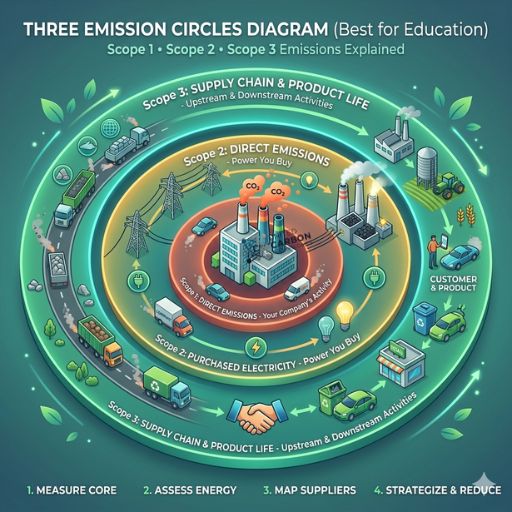
Understanding where emissions originate is the first step toward reducing a company's carbon footprint. Whether an organization is preparing an ESG report, complying with BRSR requirements, setting Net Zero targets, or simply improving sustainability performance, accurately identifying Scope 1, Scope 2, and Scope 3 emissions is essential.
Today, investors, regulators, customers, and supply chain partners increasingly expect organizations to disclose greenhouse gas emissions using internationally accepted reporting standards. Businesses that understand these emission categories are better equipped to identify reduction opportunities, improve operational efficiency, and strengthen long-term climate resilience.
For many organizations, Scope 3 emissions account for more than 70% of their total greenhouse gas emissions, making them the largest and often the most challenging category to measure and manage.
Why Are Greenhouse Gas Emissions Divided into Scopes?
Without a common classification system, businesses would report emissions differently, making comparisons nearly impossible. To solve this challenge, the internationally recognized Greenhouse Gas (GHG) Protocol introduced the Scope 1, Scope 2, and Scope 3 framework.
The framework provides a standardized method for measuring greenhouse gas emissions across organizations of every size and industry. It supports transparent reporting, enables benchmarking, and helps identify where emission reduction efforts will have the greatest impact.
Benefits of the Scope Framework
- Creates a common global reporting language.
- Improves consistency in carbon accounting.
- Supports ESG and sustainability reporting.
- Helps prevent double counting of emissions.
- Identifies major emission sources across operations.
- Supports science-based emission reduction strategies.
- Provides a foundation for Net Zero planning.
Scope 1 Emissions (Direct Emissions)
Scope 1 emissions are direct greenhouse gas emissions generated from sources that are owned or controlled by an organization. These emissions occur during day-to-day business operations and are usually the easiest to identify because they originate within the organization's own facilities or equipment.
Common Sources of Scope 1 Emissions
- Fuel burned in company-owned vehicles.
- Diesel generators.
- Boilers and industrial furnaces.
- Manufacturing processes.
- Natural gas combustion.
- Chemical process emissions.
- Refrigerant leakage from cooling systems.
- On-site electricity generation using fossil fuels.
A manufacturing company operates factory boilers, diesel generators, and company-owned delivery trucks. The greenhouse gases released from these assets are classified as Scope 1 emissions because the company directly owns and controls the emission sources.
Scope 2 Emissions (Indirect Energy Emissions)
Scope 2 emissions are indirect greenhouse gas emissions associated with the generation of purchased electricity, steam, heating, or cooling consumed by an organization. Although these emissions occur at the power plant rather than the company's facility, the organization is responsible because it purchases and uses the energy.
Typical Scope 2 Sources
- Purchased electricity for offices.
- Electricity used in manufacturing facilities.
- Purchased steam for industrial operations.
- District heating systems.
- Purchased cooling for commercial buildings.
Location-Based vs Market-Based Reporting
Many organizations report Scope 2 emissions using two approaches. A location-based method reflects the average emissions from the local electricity grid, while a market-based method considers electricity purchased through renewable energy contracts or certified green power programs. Reporting both provides greater transparency and helps organizations demonstrate progress toward cleaner energy use.
A software company purchases electricity from the local grid to power its offices and data centres. Even though the emissions occur at the power station, they are classified as Scope 2 emissions because the company consumes the electricity.
Many organizations begin their carbon reduction journey by improving energy efficiency and switching to renewable electricity because these actions can significantly reduce Scope 2 emissions while lowering operational costs.
Understanding Scope 1 and Scope 2 emissions is the first step toward accurate carbon accounting and ESG reporting. United Carbon Technologies helps organizations build practical greenhouse gas inventories, improve sustainability performance, and prepare for evolving climate disclosure requirements.
Scope 3 Emissions (Value Chain Emissions)
Scope 3 emissions include all indirect greenhouse gas emissions that occur throughout an organization's value chain but are not owned or directly controlled by the company. Although they are the most difficult to measure, Scope 3 emissions are often the largest contributor to a company's overall carbon footprint.
Unlike Scope 1 and Scope 2 emissions, Scope 3 extends beyond the company's own operations and includes activities performed by suppliers, logistics providers, customers, contractors, and other business partners.
Upstream Scope 3 Emissions
Upstream emissions occur before products or services reach the organization.
- Purchased goods and raw materials
- Capital goods and equipment
- Fuel and energy-related activities
- Transportation and distribution by suppliers
- Waste generated during operations
- Business travel
- Employee commuting
- Leased assets
Downstream Scope 3 Emissions
Downstream emissions occur after products leave the organization and continue throughout their lifecycle.
- Product transportation and distribution
- Processing of sold products
- Customer use of products
- Maintenance during product life
- Product disposal and recycling
- Investments
- Franchises
- Leased assets owned by the company
A smartphone manufacturer may have relatively small emissions from its own factories, but mining raw materials, producing electronic components, shipping products worldwide, customer electricity consumption, and end-of-life recycling together create a much larger Scope 3 footprint.
Scope 1 vs Scope 2 vs Scope 3
The three emission scopes work together to provide a complete picture of an organization's greenhouse gas emissions.
| Scope | Emission Type | Typical Example | Business Control |
|---|---|---|---|
| Scope 1 | Direct | Company vehicles, generators, boilers | High |
| Scope 2 | Purchased Energy | Electricity from the grid | Medium |
| Scope 3 | Value Chain | Suppliers, logistics, product use | Indirect |
Why Is Scope 3 the Most Challenging?
Most organizations depend on hundreds or even thousands of suppliers, distributors, contractors, and customers. Collecting accurate environmental data across this entire value chain requires collaboration, reliable data systems, and standardized reporting methods.
- Limited visibility into supplier operations.
- Different reporting standards across companies.
- Global supply chains spanning multiple countries.
- Incomplete or unavailable emissions data.
- Reliance on estimation and emission factors.
- Continuous changes in suppliers and products.
Why Scope 3 Is Often the Largest Source of Emissions
For many industries, most greenhouse gas emissions occur outside direct business operations. Manufacturing raw materials, transporting products, customer usage, and product disposal often generate significantly more emissions than the company's own facilities.
As a result, businesses focusing only on Scope 1 and Scope 2 may overlook the majority of their climate impact.
Industries Where Scope 3 Dominates
| Industry | Major Scope 3 Sources |
|---|---|
| Automobile Manufacturing | Steel, components, logistics, vehicle use |
| Retail | Purchased products, packaging, distribution |
| FMCG | Packaging materials, agriculture, transportation |
| IT & Technology | Purchased equipment, cloud services, business travel |
| Construction | Cement, steel, supplier emissions |
How Companies Calculate Scope Emissions
Carbon accounting follows a structured process to estimate greenhouse gas emissions accurately. Most organizations use internationally accepted emission factors and reporting methodologies to ensure consistency and transparency.
- Collect activity data (fuel, electricity, travel, purchases).
- Select appropriate emission factors.
- Calculate greenhouse gas emissions in CO₂e.
- Review and verify the calculations.
- Prepare ESG, sustainability, or BRSR reports.
- Identify emission reduction opportunities.
Scope Emissions and Carbon Accounting
Carbon accounting is the process of measuring greenhouse gas emissions generated by an organization. Scope 1, Scope 2, and Scope 3 provide the internationally recognized structure for organizing these calculations. Without identifying emissions by scope, businesses cannot produce reliable carbon inventories or meaningful sustainability reports.
Scope Emissions and BRSR Reporting in India
As ESG reporting becomes increasingly important in India, many organizations are strengthening their greenhouse gas reporting practices. Measuring Scope 1, Scope 2, and, where applicable, Scope 3 emissions helps businesses improve transparency, support sustainability reporting, respond to investor expectations, and prepare for evolving disclosure frameworks such as Business Responsibility and Sustainability Reporting (BRSR).
Scope Emissions and Net Zero
Organizations cannot build credible Net Zero strategies without first understanding their greenhouse gas emissions. Measuring emissions across all three scopes enables businesses to identify reduction opportunities, prioritize investments, monitor progress, and develop science-based climate action plans.
Common Mistakes Companies Make
- Measuring only electricity consumption.
- Ignoring supplier and value chain emissions.
- Using outdated emission factors.
- Collecting incomplete activity data.
- Overlooking refrigerant leakage.
- Treating carbon accounting as a one-time exercise.
- Failing to review data quality before reporting.
UCT Insight
Many organizations begin their sustainability journey by measuring only electricity consumption. While this is an important first step, it represents only a portion of a company's total greenhouse gas emissions. Businesses that understand Scope 1, Scope 2, and Scope 3 emissions gain a far more complete picture of their environmental impact.
At United Carbon Technologies, we believe carbon accounting should go beyond compliance. Accurate emissions data enables organizations to reduce operational costs, improve ESG performance, strengthen supply chain resilience, and prepare for future climate disclosure requirements.
How Carbon Intelligence Software Simplifies Scope Reporting
Collecting greenhouse gas data manually across multiple departments quickly becomes complex. Carbon accounting software helps organizations centralize activity data, automate calculations, and generate consistent reports aligned with recognized reporting frameworks.
- Centralized emissions database
- Automatic Scope classification
- Activity data collection
- Emission factor management
- Carbon footprint dashboards
- Reduction opportunity tracking
- ESG reporting support
- BRSR reporting assistance
Our upcoming ACIS (Automated Carbon Intelligence System) is being developed to simplify greenhouse gas accounting for Indian businesses. The platform will help organizations collect emissions data, classify Scope 1, Scope 2, and Scope 3 emissions, monitor sustainability performance, and generate reports that support ESG initiatives.
Why Scope Emissions Matter for Indian Businesses
India is experiencing rapid industrial growth while simultaneously strengthening sustainability initiatives. Investors, multinational customers, financial institutions, and regulators increasingly expect organizations to understand and disclose their greenhouse gas emissions.
Whether a business exports products, participates in global supply chains, prepares ESG disclosures, or aims to achieve Net Zero, understanding Scope 1, Scope 2, and Scope 3 emissions has become a strategic business capability rather than simply an environmental exercise.
Related Reads
- ESG Reporting Checklist for Businesses
- Carbon Reporting Software: What Businesses Should Look For
- How Climate Data Helps Businesses Make Decisions
- How AI Is Changing Climate Intelligence
- Sustainability KPIs Every Company Should Track
- How Businesses Collect Scope 3 Data
- What Is a Carbon Disclosure Report?
- Carbon Accounting Process Step by Step
- What Is Climate Intelligence in Business?
- What Is a Carbon Baseline Assessment?
Key Takeaways
- Scope 1 covers direct emissions from assets owned or controlled by a business.
- Scope 2 includes indirect emissions from purchased electricity, heating, cooling, or steam.
- Scope 3 includes emissions across the entire value chain and is often the largest category.
- Measuring all three scopes provides a complete picture of an organization's carbon footprint.
- Scope-based reporting supports ESG disclosure, carbon accounting, and sustainability planning.
- Reducing emissions requires collaboration across operations, suppliers, and customers.
- Accurate greenhouse gas inventories help businesses prepare for future climate regulations.
- Carbon accounting is becoming an important business capability for organizations operating in India.
- Scope 1 = Direct emissions.
- Scope 2 = Purchased energy emissions.
- Scope 3 = Value chain emissions.
- Scope 3 is usually the largest emission category.
- The GHG Protocol provides the international reporting framework.
- Scope reporting supports ESG, BRSR, and Net Zero planning.
- Carbon accounting helps identify emission reduction opportunities.
- Businesses that measure emissions make better sustainability decisions.
Frequently Asked Questions
What are Scope 1, Scope 2, and Scope 3 emissions?
Scope 1 includes direct emissions from owned operations, Scope 2 covers purchased electricity and energy, while Scope 3 includes indirect emissions across the value chain.
Why are Scope emissions important?
They help organizations measure greenhouse gas emissions consistently, improve carbon accounting, and support ESG reporting.
Which Scope is usually the largest?
For many businesses, Scope 3 emissions represent the largest share because they include suppliers, transportation, product use, and disposal.
Who created the Scope framework?
The Scope classification is defined by the internationally recognized Greenhouse Gas (GHG) Protocol.
What are examples of Scope 1 emissions?
Company vehicles, diesel generators, boilers, industrial furnaces, and refrigerant leakage are common Scope 1 emission sources.
What is included in Scope 2 emissions?
Purchased electricity, steam, heating, and cooling used by an organization are included under Scope 2.
What activities are included in Scope 3?
Supplier emissions, transportation, business travel, employee commuting, waste, product use, and product disposal are common Scope 3 categories.
Do Indian companies report Scope emissions?
Many organizations measure Scope emissions to support ESG reporting, sustainability initiatives, customer requirements, and evolving BRSR disclosures.
How can companies reduce Scope emissions?
Organizations can improve energy efficiency, adopt renewable energy, optimize logistics, engage suppliers, and implement sustainable procurement practices.
How do Scope emissions support Net Zero?
Measuring emissions across all three scopes establishes the baseline required to develop credible emission reduction targets and long-term Net Zero strategies.
Build Your Carbon Intelligence
Whether you're beginning carbon accounting or preparing for ESG reporting, understanding Scope 1, Scope 2, and Scope 3 emissions is the foundation of every sustainability journey.
Learn climate intelligence, ESG reporting, carbon accounting, and sustainability through the United Carbon Technologies Knowledge Hub.