

What Are Scope 1, Scope 2, and Scope 3 Emissions? Explained for Indian Businesses
By United Carbon Technologies | Climate Knowledge Hub India
Understanding Scope 1, Scope 2, and Scope 3 emissions is essential for businesses aiming to measure and reduce their carbon footprint. In India and globally, these emission categories are becoming critical for ESG reporting and sustainability strategies.
What are Scope 1, Scope 2, and Scope 3 emissions?
Scope 1, Scope 2, and Scope 3 emissions classify a company’s greenhouse gas emissions into direct emissions, indirect energy emissions, and value chain emissions, helping businesses understand their total carbon footprint.
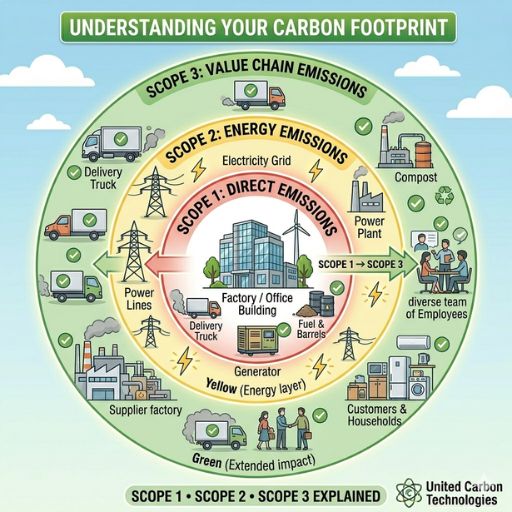
As climate awareness grows, businesses are increasingly required to measure their carbon emissions. A key framework used worldwide is the classification of emissions into Scope 1, Scope 2, and Scope 3.
These categories help organizations understand where emissions come from and how they can be reduced effectively.
Did you know? For many companies, Scope 3 emissions can account for up to 70–90% of total emissions.
What Is Scope 1 Emissions?
Scope 1 emissions are direct emissions from sources owned or controlled by a business.
- Fuel used in company vehicles
- Diesel generators
- Industrial processes
What Is Scope 2 Emissions?
Scope 2 emissions are indirect emissions from purchased electricity and energy.
- Electricity used in offices
- Power used in factories
- Grid-based energy consumption
Learn how emissions are calculated and reduced effectively.
What Is Scope 3 Emissions?
Scope 3 emissions include all indirect emissions across a company’s value chain.
- Supplier emissions
- Transportation and logistics
- Employee commuting
- Product usage by customers
Examples of Scope 1, 2, and 3 Emissions in India
- Scope 1: Fuel used in company-owned vehicles or generators
- Scope 2: Electricity purchased from the grid
- Scope 3: Supply chain emissions, employee travel, product usage
In India, Scope 3 emissions often form the largest share of total emissions, especially for manufacturing and service-based businesses.
How to Measure Scope 1, Scope 2, and Scope 3 Emissions
- Collect fuel and energy consumption data
- Use emission factors to convert usage into CO₂ emissions
- Track supply chain and indirect activities
- Use carbon accounting tools for accuracy
Measuring Scope 3 emissions is often the most complex because it involves suppliers and external activities across the value chain.
Why These Emissions Matter
- Helps businesses track carbon footprint
- Required for ESG reporting
- Improves sustainability strategy
- Attracts investors and global clients
India and Global Perspective
In India, businesses are increasingly adopting carbon reporting practices, while globally, emission tracking is becoming mandatory. Understanding Scope 1, 2, and 3 emissions gives companies a competitive advantage in sustainability and compliance.
Understanding Scope 1, Scope 2, and Scope 3 emissions in India helps businesses build strong ESG strategies and reduce their environmental impact.
- Scope 1 = Direct emissions
- Scope 2 = Energy-related emissions
- Scope 3 = Value chain emissions
- Scope 3 is often the largest contributor
Why Measuring Scope 3 Emissions Is Challenging
Scope 3 emissions are the hardest to measure because they involve indirect activities such as suppliers, logistics, and product usage.
To address this challenge, United Carbon Technologies is developing an India-specific Carbon Intelligence System (ACIS) designed to help businesses accurately measure Scope 1, 2, and 3 emissions.
- India-specific emission factors
- Designed for MSMEs and enterprises
- Supports ESG reporting and compliance
- Simplifies Scope 3 tracking
🚀 Coming Soon: A smarter way for Indian businesses to measure and manage emissions.
Learn more about carbon footprint, ESG, and climate technology.
Related Reads (Important)
- What Is Carbon Footprint in India
- Carbon Accounting Explained
- ESG Reporting Explained
- Green Supply Chains in India
Frequently Asked Questions
What is the difference between Scope 1, 2, and 3 emissions?
Scope 1 is direct emissions, Scope 2 is energy-related emissions, and Scope 3 covers indirect emissions across the value chain.
Which emission scope is the largest?
Scope 3 emissions are usually the largest, especially for businesses with complex supply chains.
Why are these emissions important in India?
With growing ESG requirements, Indian businesses need to measure and report emissions to stay competitive.
Start Your Climate Learning Journey
Understand your emissions and build a sustainable future.
Join early learners building climate awareness across India.