

What Is Carbon Footprint in India? (Complete Beginner Guide)
By United Carbon Technologies | Climate Knowledge Hub India
📖 9 min read • Updated 2026
Last Updated: June 2026
Join readers exploring sustainability, ESG, carbon accounting, and climate technology in India.
Carbon footprint refers to the total greenhouse gas emissions generated by individuals, households, businesses, or activities. In India, understanding carbon footprint is becoming increasingly important due to rising energy demand, urbanization, and climate-related challenges.
Carbon footprint is becoming one of the most searched climate topics in India as businesses adopt ESG reporting, governments strengthen climate policies, and citizens seek practical ways to reduce greenhouse gas emissions. Understanding your carbon footprint is the first step toward meaningful climate action and sustainable living.
What is carbon footprint?
A carbon footprint is the total amount of greenhouse gases released into the atmosphere through activities such as electricity use, transportation, manufacturing, food consumption, and waste generation.
- Carbon footprint measures total greenhouse gas emissions.
- Everyday activities contribute to emissions.
- Households and businesses can both reduce their footprint.
- Carbon accounting helps organizations measure emissions.
- Reducing carbon footprint supports India's climate goals.
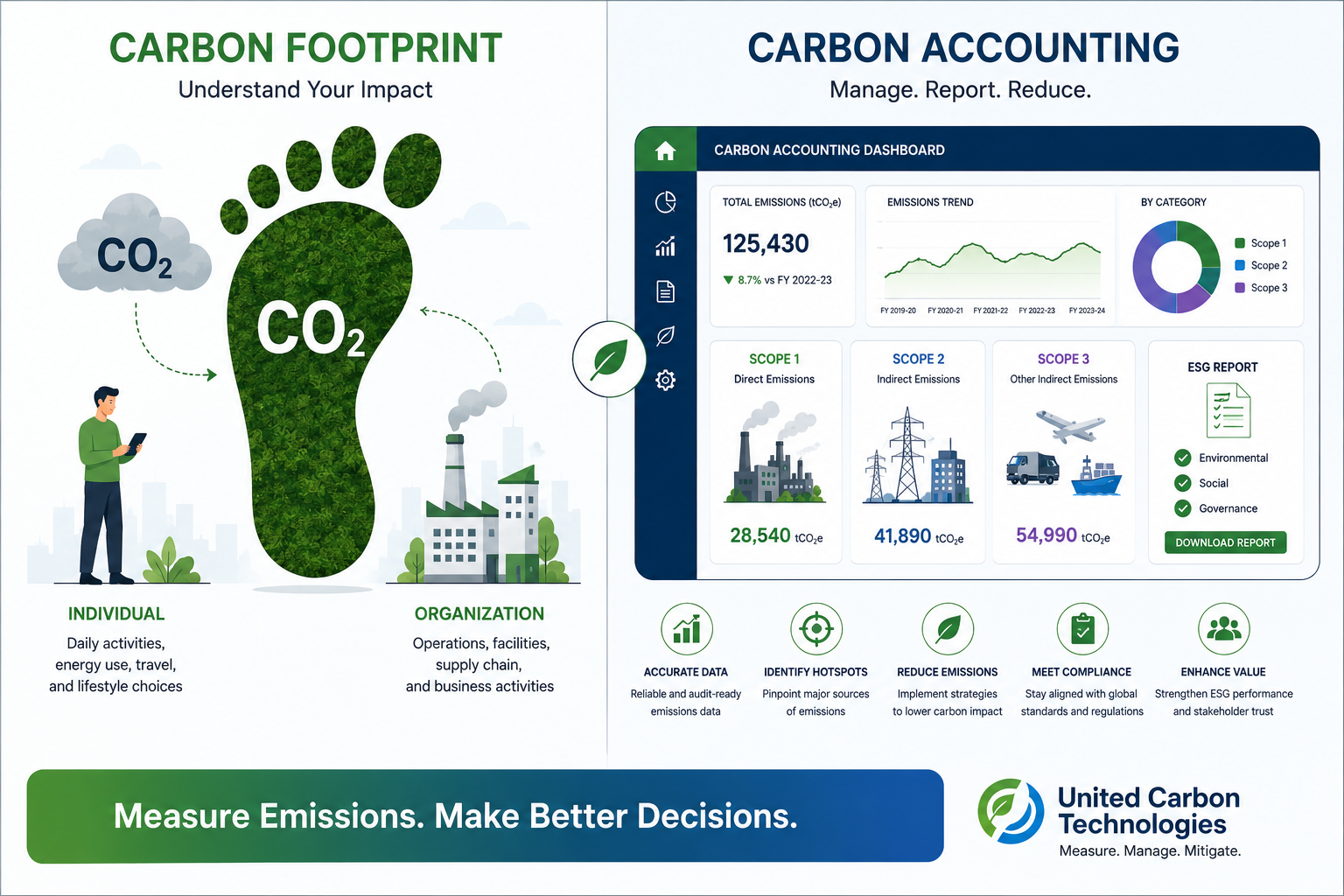
Climate change is closely connected to greenhouse gas emissions produced by human activities. One of the most widely used ways to measure environmental impact is through carbon footprint analysis.
Everyday activities such as driving vehicles, using electricity, operating factories, transporting goods, and consuming products contribute to carbon emissions. Understanding carbon footprint helps individuals and businesses identify where emissions come from and how they can be reduced.
In India, growing infrastructure, rising energy consumption, industrial development, and urban lifestyles are increasing the importance of carbon awareness and sustainability planning.
"You cannot reduce what you do not measure. Understanding your carbon footprint is the first step toward meaningful climate action."
Did you know?
India is among the world's largest emitters in total emissions, but its per-capita carbon emissions remain lower than many developed nations.
Main Sources of Carbon Footprint
Carbon emissions originate from nearly every aspect of modern life. Understanding these sources helps identify where emission reductions can have the greatest impact.
Transportation
Cars, motorcycles, trucks, aircraft, and ships burn fossil fuels that release carbon dioxide into the atmosphere. Personal vehicle use and freight transportation are major contributors to emissions.
Electricity Consumption
Electricity generated from coal, oil, or natural gas produces greenhouse gas emissions. Homes, offices, industries, and commercial buildings all contribute through daily energy consumption.
Industrial Activities
Manufacturing, cement production, steel plants, chemical industries, and other industrial processes generate large amounts of greenhouse gases through energy use and production activities.
Food Production
Agriculture, livestock farming, food transportation, refrigeration, and food waste all contribute to carbon emissions across the food supply chain.
Waste Management
Landfills produce methane—a greenhouse gas significantly more powerful than carbon dioxide. Poor waste segregation and open dumping increase emissions.
Construction and Infrastructure
Building materials such as cement and steel have high embodied carbon, while construction activities consume significant energy throughout their lifecycle.
Carbon Footprint of Individuals and Households
Household carbon footprint includes emissions generated through everyday lifestyle choices. Although individual emissions may seem small, millions of households collectively create a significant environmental impact.
- Electricity used for lighting, cooling, and appliances
- LPG and cooking fuel consumption
- Private vehicle usage and daily commuting
- Water consumption and pumping
- Food choices and food waste
- Online shopping and consumer products
- Household waste generation
Simple changes such as switching to LED lighting, reducing unnecessary electricity use, using public transportation, conserving water, and minimizing waste can substantially reduce household carbon emissions over time.
Climate awareness begins with understanding how everyday activities contribute to emissions and sustainability challenges.
Carbon Footprint of Businesses
Businesses generate emissions through operations, manufacturing, transportation, supply chains, and purchased energy. Measuring these emissions is essential for ESG reporting, carbon accounting, and sustainability planning.
Organizations typically classify emissions into Scope 1, Scope 2, and Scope 3 categories, helping identify emission sources across the entire value chain.
- Factory and manufacturing emissions
- Purchased electricity and energy use
- Transportation and logistics
- Supply chain emissions
- Business travel and employee commuting
- Waste management and resource consumption
- Purchased goods and services
Many Indian organizations are adopting carbon accounting systems and digital climate intelligence platforms to measure emissions, improve ESG performance, and prepare for Net Zero commitments.
Many organizations are now adopting carbon measurement systems and sustainability strategies to improve operational efficiency and environmental responsibility.
Carbon Footprint vs Carbon Emissions vs Carbon Accounting
| Term | Meaning | Used By |
|---|---|---|
| Carbon Footprint | Total greenhouse gas emissions generated by an activity, person, product, or organization. | Everyone |
| Carbon Emissions | Actual greenhouse gases released into the atmosphere. | Scientists, industries |
| Carbon Accounting | The process of measuring, reporting, and managing emissions. | Businesses & ESG teams |
What Increases Your Carbon Footprint?
Many everyday activities contribute to higher greenhouse gas emissions. Identifying these habits helps individuals and organizations make more sustainable choices.
- Using energy-inefficient appliances
- Frequent use of private vehicles
- Long-distance air travel
- Excessive electricity consumption
- Food waste and overconsumption
- Purchasing unnecessary products
- Poor waste segregation and recycling habits
- Heavy dependence on fossil fuels
Get support for ESG, carbon accounting, climate reporting, and sustainability strategy development.
Why Businesses Measure Carbon Footprint
Measuring carbon footprint is no longer just an environmental initiative—it has become a strategic business priority. Organizations across India are increasingly tracking greenhouse gas emissions to improve sustainability performance, strengthen ESG reporting, manage climate-related risks, and prepare for evolving regulations.
A clear understanding of carbon emissions enables businesses to identify inefficiencies, reduce operational costs, build stakeholder trust, and develop long-term climate strategies that support both business growth and environmental responsibility.
Supports ESG Reporting
Environmental, Social, and Governance (ESG) reporting requires businesses to disclose their environmental impact. Measuring carbon footprint provides reliable emissions data that helps organizations demonstrate transparency and meet sustainability reporting expectations.
Helps Meet BRSR Requirements
Many Indian companies are strengthening their sustainability disclosures through the Business Responsibility and Sustainability Reporting (BRSR) framework. Carbon footprint measurement supports more accurate environmental reporting and improved corporate governance.
Builds Investor Confidence
Investors increasingly consider climate performance when evaluating businesses. Companies that understand and manage their carbon footprint are often viewed as better prepared for future environmental regulations and long-term business resilience.
Improves Supply Chain Management
A significant share of business emissions often comes from suppliers, transportation, and purchased goods. Measuring emissions across the value chain helps organizations identify opportunities to improve efficiency and collaborate with suppliers on sustainability initiatives.
Supports Net Zero Strategies
Businesses cannot develop credible Net Zero roadmaps without first measuring their current emissions. Carbon footprint assessments establish a baseline that allows organizations to set reduction targets, monitor progress, and implement effective decarbonization strategies.
Strengthens Climate Risk Management
Understanding carbon emissions helps organizations identify climate-related risks associated with operations, energy use, regulations, and supply chains. This enables better strategic planning, improves resilience, and supports long-term sustainable growth.
Organizations that regularly measure and manage their carbon footprint are better positioned to improve operational efficiency, strengthen ESG performance, prepare for future climate regulations, and build long-term stakeholder confidence.
Why Carbon Footprint Matters
Carbon footprint analysis helps organizations and individuals understand environmental impact and identify opportunities for sustainability improvements.
- Supports climate action planning
- Improves environmental awareness
- Helps businesses meet ESG goals
- Encourages responsible consumption
- Supports sustainability reporting
- Improves long-term operational efficiency
How to Reduce Carbon Footprint
Reducing carbon footprint involves improving efficiency, adopting cleaner technologies, and making more sustainable daily decisions.
- Use energy-efficient appliances and LED lighting
- Reduce unnecessary electricity consumption
- Install rooftop solar or purchase renewable electricity
- Use public transport, cycling, or electric vehicles
- Reduce food waste and support local produce
- Practice recycling and compost organic waste
- Improve building energy efficiency
- Support environmentally responsible businesses
- Measure emissions regularly using carbon calculators
Climate Technology and Carbon Intelligence
Modern climate technology platforms help organizations measure emissions, analyze sustainability data, and improve ESG reporting through digital systems and carbon intelligence tools.
United Carbon Technologies is developing ACIS — an India-focused climate intelligence ecosystem designed to support carbon measurement, ESG analytics, sustainability awareness, and climate education.
How Carbon Footprints Are Calculated
Carbon footprints are calculated by combining activity data with standardized emission factors. Electricity consumption, fuel usage, transportation distances, purchased materials, and waste generation are converted into carbon dioxide equivalent (CO₂e).
- Collect activity data
- Apply verified emission factors
- Convert emissions into CO₂ equivalent
- Analyze emission hotspots
- Identify reduction opportunities
Businesses often use carbon accounting software, while households can estimate emissions using online carbon footprint calculators.
Common Misconceptions About Carbon Footprint
- Only factories create carbon footprints.
- Households have no impact on climate change.
- Carbon footprint only includes electricity.
- Planting trees alone removes all emissions.
- Only large businesses need carbon accounting.
The Future of Carbon Footprint Management
Carbon footprint management is evolving rapidly from manual calculations and spreadsheets to intelligent digital platforms that provide real-time environmental insights. As organizations face increasing sustainability expectations, technology is becoming essential for measuring, reporting, and reducing greenhouse gas emissions accurately.
Emerging digital tools are enabling businesses to move beyond compliance and make data-driven decisions that improve operational efficiency while supporting long-term climate goals.
Artificial Intelligence (AI)
Artificial Intelligence is helping organizations analyze large volumes of emissions data, identify hidden emission sources, predict future trends, and recommend practical carbon reduction strategies.
- Automated emissions analysis
- Predictive carbon forecasting
- Energy optimization recommendations
- AI-assisted sustainability reporting
Internet of Things (IoT)
IoT sensors continuously collect operational data from factories, buildings, vehicles, and equipment, making carbon monitoring far more accurate than traditional manual reporting.
- Real-time energy monitoring
- Equipment performance tracking
- Industrial emissions monitoring
- Smart facility management
Smart Meters and Connected Infrastructure
Smart electricity, gas, and water meters provide continuous consumption data, allowing organizations and households to identify inefficiencies and reduce unnecessary energy use.
- Real-time electricity tracking
- Improved energy efficiency
- Reduced operational waste
- Better resource management
Digital Twins
Digital twins create virtual models of buildings, factories, manufacturing plants, and infrastructure. These models allow organizations to simulate operational changes, estimate carbon impacts, and optimize processes before making real-world investments.
- Scenario-based carbon modelling
- Facility optimization
- Predictive maintenance
- Lower operational emissions
Climate Intelligence Platforms
The next generation of sustainability software combines carbon accounting, ESG reporting, climate risk assessment, and regulatory compliance into a single climate intelligence platform. These systems help organizations transform raw environmental data into actionable business insights.
- Carbon footprint dashboards
- ESG and BRSR reporting support
- Climate risk analytics
- Net Zero planning and progress tracking
- Decision-support through sustainability intelligence
Automation and Continuous Reporting
Manual carbon accounting is gradually being replaced by automated data collection and reporting systems. Automation improves accuracy, reduces reporting time, and enables businesses to monitor emissions continuously instead of relying on periodic assessments.
- Automated carbon calculations
- Continuous emissions monitoring
- Integrated ESG reporting
- Reduced reporting errors
- Faster compliance workflows
The future of sustainability lies in Climate Intelligence—bringing together AI, IoT, smart meters, digital twins, automation, and advanced analytics to help organizations measure, understand, and reduce their environmental impact in real time.
At United Carbon Technologies, we are developing ACIS (Advanced Climate Intelligence System), an India-focused climate intelligence ecosystem designed to simplify carbon measurement, ESG reporting, sustainability analytics, climate risk assessment, and decision-making for businesses, institutions, and governments.
Benefits of Reducing Carbon Footprint
Reducing your carbon footprint delivers benefits that go far beyond lowering greenhouse gas emissions. Whether you are an individual, household, business, or institution, taking steps to reduce emissions can improve financial performance, strengthen resilience, and contribute to a healthier environment.
In India, where energy demand, urbanization, and climate-related risks continue to grow, reducing carbon emissions also supports national sustainability goals and long-term economic development.
1. Lower Energy Costs
Improving energy efficiency is often the fastest way to reduce both emissions and operating costs.
- Lower electricity bills
- Reduced fuel consumption
- Efficient appliances and equipment
- Long-term operational savings
2. Cleaner Air and Better Public Health
Burning fewer fossil fuels reduces air pollution alongside greenhouse gas emissions. Cleaner air benefits communities by improving public health and reducing environmental degradation.
- Lower particulate pollution
- Improved urban air quality
- Healthier living environments
- Reduced environmental stress
3. Stronger Energy Security
Using energy efficiently and increasing the adoption of renewable energy reduces dependence on imported fossil fuels and strengthens national energy resilience.
- Greater use of renewable energy
- Reduced dependence on fossil fuels
- Improved energy reliability
- Enhanced long-term sustainability
4. Greater Climate Resilience
Lower emissions help slow climate change while encouraging investments in resilient infrastructure, efficient resource management, and sustainable development.
- Supports climate adaptation efforts
- Protects natural resources
- Encourages sustainable communities
- Builds resilience against future climate risks
5. Better Business Reputation
Organizations that actively reduce their carbon footprint demonstrate environmental responsibility, which can strengthen relationships with customers, employees, investors, and business partners.
- Improves brand credibility
- Builds stakeholder trust
- Enhances customer confidence
- Creates competitive advantage
6. Easier ESG and Regulatory Compliance
As sustainability reporting becomes more common, measuring and reducing carbon emissions helps organizations prepare for ESG disclosures, climate reporting, and evolving regulatory requirements.
- Supports ESG reporting
- Helps meet BRSR requirements
- Improves carbon accounting
- Contributes toward Net Zero strategies
- Strengthens long-term risk management
Reducing carbon footprint is not only an environmental responsibility—it also creates financial savings, healthier communities, stronger businesses, improved energy security, and better preparedness for India's transition toward a low-carbon economy.
Related Reads (Important)
- How Households Can Reduce Carbon Emissions in India
- What Are Carbon Credits in India?
- How Businesses Measure Operational Carbon
- Complete Carbon Footprint Guide India
- How AI Is Changing Climate Intelligence
- Future of Sustainability Careers in India
- Renewable Energy Careers in India
- What Is Climate Intelligence in Business?
- How Climate Data Helps Businesses Make Decisions
- How Plastic Pollution Contributes to Climate Change
- What Is Greenwashing?
- Life Cycle Assessment (LCA): A Beginner Guide
Carbon Footprint and Climate Action in India
India is rapidly expanding renewable energy, electric mobility, energy efficiency, and climate resilience initiatives to reduce greenhouse gas emissions while supporting economic growth.
As the country works toward its Net Zero 2070 target, understanding carbon footprint is becoming increasingly important for citizens, businesses, educational institutions, and policymakers. ESG reporting, carbon accounting, and sustainability strategies are also gaining momentum across Indian industries.
- Carbon footprint measures total greenhouse gas emissions.
- Transportation, electricity, food, and industry are major emission sources.
- Households and businesses both contribute significantly.
- Carbon footprint differs from individual carbon emissions.
- Carbon accounting supports ESG reporting.
- Renewable energy helps reduce emissions.
- Climate technology enables accurate carbon measurement.
- Reducing carbon footprint supports India's Net Zero journey.
Frequently Asked Questions
What is a carbon footprint?
A carbon footprint is the total amount of greenhouse gases (GHGs) released directly and indirectly by an individual, household, business, product, or activity. It is usually measured in carbon dioxide equivalent (CO₂e).
How is a carbon footprint measured?
Carbon footprint is measured by calculating greenhouse gas emissions from activities such as electricity consumption, fuel use, transportation, manufacturing, waste generation, and supply chains using internationally accepted carbon accounting methods.
What causes a carbon footprint?
Common sources include electricity generation, transportation, industrial production, heating and cooling, food production, waste disposal, and the consumption of goods and services.
Why is carbon footprint important?
Understanding carbon footprint helps individuals, businesses, and governments identify emission sources, improve energy efficiency, reduce environmental impact, and support climate action and sustainability goals.
What is the difference between carbon footprint and carbon emissions?
Carbon emissions refer to the greenhouse gases released from a specific source or activity, while a carbon footprint represents the total emissions generated by an individual, organization, product, event, or process over a defined period.
How can households reduce carbon footprint?
Households can reduce their carbon footprint by saving electricity, using energy-efficient appliances, adopting rooftop solar, reducing fuel consumption, using public transport, minimizing waste, recycling materials, conserving water, and choosing sustainable products.
How do businesses measure carbon footprint?
Businesses measure their carbon footprint by collecting data on fuel use, electricity consumption, industrial processes, transportation, waste, and supply chain activities. Many organizations follow the Greenhouse Gas (GHG) Protocol by calculating Scope 1, Scope 2, and Scope 3 emissions for ESG reporting and sustainability planning.
What is carbon footprint in ESG reporting?
In ESG reporting, carbon footprint is a key environmental metric used to disclose greenhouse gas emissions, evaluate climate-related risks, set emission reduction targets, and demonstrate progress toward sustainability and Net Zero commitments.
Can renewable energy reduce carbon footprint?
Yes. Renewable energy sources such as solar, wind, hydro, and biomass generate electricity with significantly lower greenhouse gas emissions than fossil fuels, helping households and businesses reduce their overall carbon footprint.
Why is carbon footprint important for India's climate goals?
Reducing carbon footprint supports India's transition toward a low-carbon economy by improving energy efficiency, expanding renewable energy adoption, strengthening ESG reporting, supporting sustainable development, and contributing to the country's long-term climate and Net Zero ambitions.
Built as part of ongoing climate-tech research, carbon intelligence development, and sustainability education initiatives by United Carbon Technologies.
Start Your Climate Learning Journey
Learn sustainability, ESG, carbon accounting, and climate intelligence through practical climate education programs.
YOUR ACTION, OUR PLANET, TOGETHER, WE EMPOWER A GREENER FUTURE