

How Climate Change Affects Agriculture in India
By United Carbon Technologies | Climate Knowledge Hub India
Join readers exploring climate impacts, ESG, and sustainable agriculture in India.
Climate change is increasingly affecting agriculture in India by altering rainfall patterns, increasing temperatures, and making extreme weather events more frequent. Since a large part of India’s population depends on farming, these changes directly impact food production, farmer income, and national food security.
How does climate change affect agriculture in India?
Climate change affects agriculture in India by changing monsoon patterns, increasing droughts and floods, raising temperatures, reducing crop yields, and increasing uncertainty in farming systems.
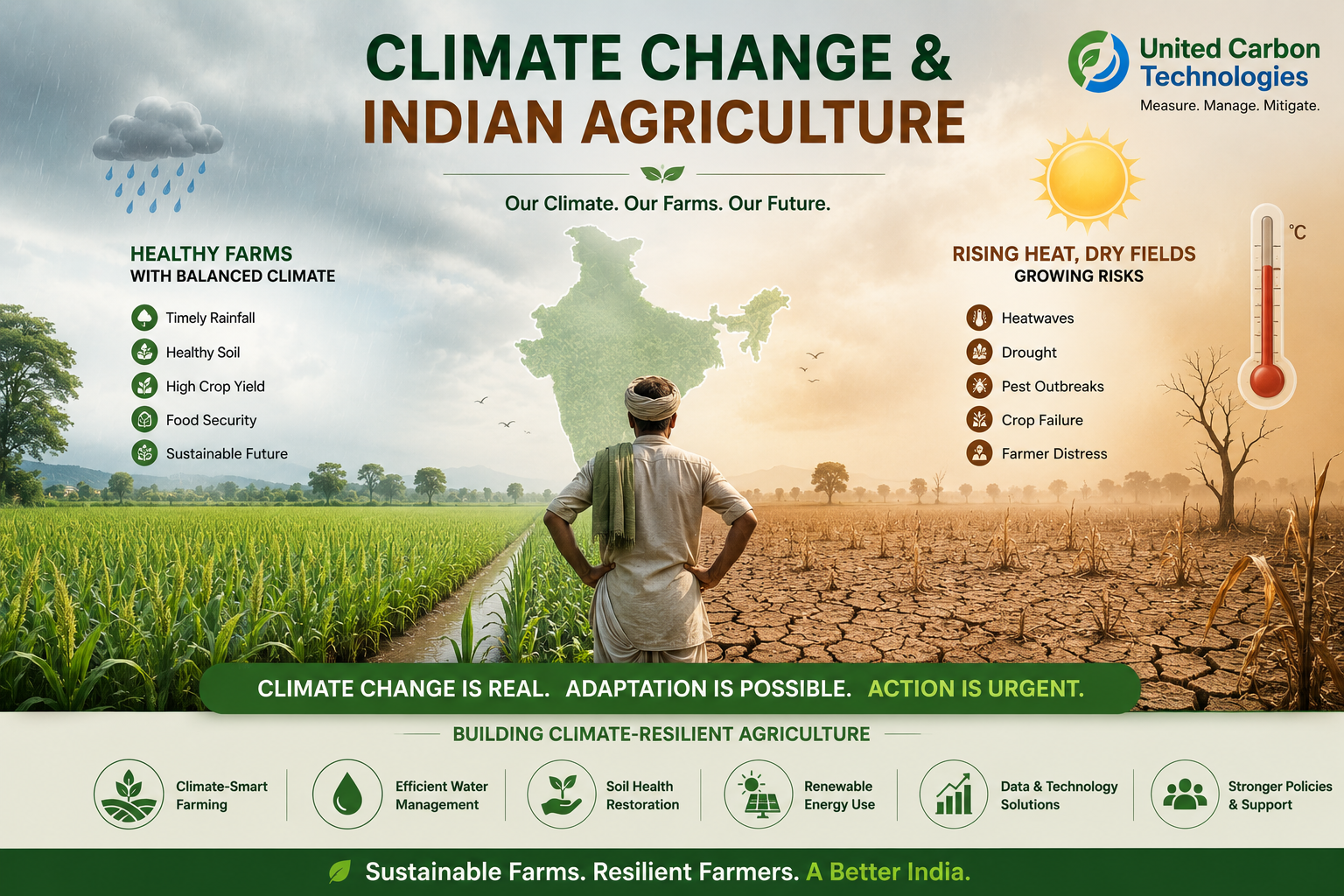
Agriculture in India is highly dependent on natural climate conditions such as rainfall, temperature, and soil moisture. Even small changes in these conditions can significantly affect crop productivity and farming income.
With climate change accelerating, farmers across India are experiencing more unpredictable weather patterns that make traditional farming practices increasingly difficult to rely on.
A large portion of Indian agriculture is rain-fed, meaning it depends directly on monsoon rainfall rather than irrigation systems, making it highly vulnerable to climate change.
Rising Temperatures and Heat Stress
Higher temperatures reduce crop productivity by affecting plant growth cycles and increasing water demand.
- Heat stress reduces wheat and rice yields
- Increased evaporation leads to soil moisture loss
- Higher irrigation demand increases water pressure
Changing Monsoon Patterns
The Indian monsoon is becoming less predictable, affecting sowing and harvesting cycles.
- Delayed monsoon onset
- Uneven rainfall distribution
- Long dry spells followed by heavy rainfall
Understanding these changes helps farmers, businesses, and policymakers prepare better for food security challenges.
We help organizations understand climate risks, emissions, and sustainability impacts across agricultural value chains.
Droughts and Water Scarcity
Increasing drought frequency is one of the most serious climate risks for Indian agriculture, directly affecting crop production and farmer livelihoods.
- Reduced groundwater recharge
- Crop failure in rain-fed regions
- Higher dependency on irrigation systems
- Increased competition for water resources
Flooding and Extreme Rainfall Events
While some regions face droughts, others experience intense rainfall and flooding, both of which damage agricultural productivity.
- Crop destruction due to waterlogging
- Soil erosion and nutrient loss
- Damage to farming infrastructure
- Disruption of harvesting cycles
Impact on Crop Yields and Food Security
Climate change is directly influencing the productivity of major crops such as wheat, rice, maize, and pulses.
- Reduced yields due to heat stress
- Unstable crop production patterns
- Increased risk of food price fluctuations
- Threats to national food security
Pests, Diseases, and Farming Risks
Warmer and more humid conditions create favorable environments for pests and crop diseases.
- Increased pest outbreaks
- Spread of crop diseases to new regions
- Higher pesticide usage costs
- Reduced soil productivity over time
Climate Change and Agriculture in India
India’s agriculture sector is highly climate-sensitive due to its dependence on monsoon rainfall and small landholdings. States such as Maharashtra, Rajasthan, Karnataka, and parts of central India are particularly vulnerable to droughts, while eastern and coastal regions face higher flood risks.
Government programs promoting irrigation expansion, climate-resilient crops, and sustainable farming practices are becoming increasingly important to reduce agricultural vulnerability.
This article is part of United Carbon Technologies Climate Knowledge Hub focused on ESG, sustainability, and climate intelligence for India.
Related Climate Insights
Explore more: What Is Climate Change? , What Is a Carbon Footprint? , and What Is Net Zero in India? .
- Climate change disrupts rainfall and temperature patterns in India.
- Droughts and floods are increasing agricultural risks.
- Crop yields and food security are directly affected.
- Pests and diseases are becoming more widespread.
- India needs climate-resilient farming systems.
Frequently Asked Questions
How does climate change affect farming in India?
It changes rainfall patterns, increases temperature stress, and causes extreme weather events like droughts and floods, reducing agricultural productivity.
Which crops are most affected in India?
Rice, wheat, maize, and pulses are highly affected due to their sensitivity to temperature and water availability changes.
Why is Indian agriculture vulnerable to climate change?
Because a large portion of farming depends on monsoon rainfall and small landholdings, making it highly sensitive to weather variability.
What can be done to reduce risks?
Explore how climate change connects to food systems, carbon emissions, and sustainability in India.
Start Your Climate Learning Journey
Understand how climate change impacts agriculture, food systems, and rural livelihoods in India.