

How ESG Ratings Are Calculated: Complete Guide for Indian Businesses
By United Carbon Technologies | Climate Knowledge Hub India
Join readers exploring ESG, carbon accounting, sustainability, climate technology, and Net Zero in India.
ESG ratings help investors, lenders, customers, and regulators evaluate how well a company manages environmental, social, and governance risks. Understanding how ESG ratings are calculated enables businesses to improve sustainability performance, strengthen investor confidence, and prepare for future ESG reporting requirements in India.
How are ESG ratings calculated?
ESG ratings are calculated by evaluating a company's environmental, social, and governance performance using publicly disclosed information, sustainability reports, regulatory filings, carbon emissions, governance practices, workforce policies, and risk management systems. Different ESG rating agencies apply their own methodologies, but all assess how effectively a business manages sustainability-related risks and opportunities.
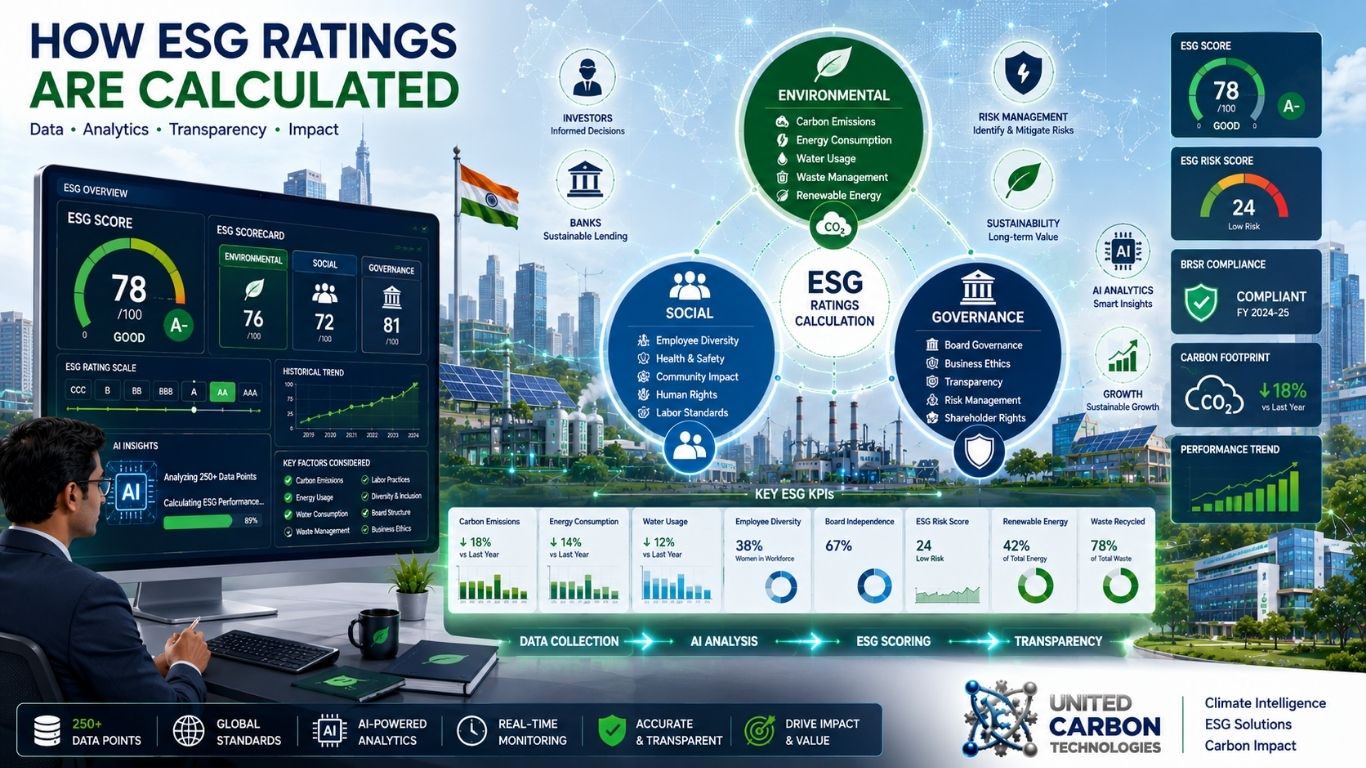
As sustainability becomes a strategic business priority, ESG ratings have become one of the most influential indicators of corporate performance. Investors increasingly use ESG scores alongside financial metrics to evaluate business resilience, long-term value creation, and exposure to environmental and social risks.
In India, ESG ratings are becoming increasingly important due to the growth of responsible investing, SEBI's sustainability initiatives, mandatory BRSR disclosures for listed companies, and expanding corporate Net Zero commitments. Organizations with stronger ESG performance are often better positioned to attract investment, strengthen stakeholder trust, and remain competitive in global markets.
Although many businesses focus on improving their ESG score, fewer understand how rating agencies actually calculate ESG ratings. Learning the underlying methodology helps organizations prioritize the initiatives that create the greatest sustainability impact while improving reporting accuracy.
A company can receive different ESG ratings from different rating agencies because each organization uses its own scoring methodology, weightings, industry benchmarks, and assessment criteria. This is why transparent ESG reporting and high-quality sustainability data are becoming increasingly important.
What Is an ESG Rating?
An ESG rating is an independent assessment of how effectively a company manages environmental, social, and governance issues that could influence its long-term performance. Rather than measuring profitability alone, ESG ratings evaluate how responsibly an organization operates, manages risk, and creates sustainable value for stakeholders.
ESG ratings combine quantitative data, qualitative disclosures, governance practices, climate strategies, regulatory compliance, and public information into an overall sustainability score. These ratings help investors compare companies across industries while identifying organizations that are better prepared for future environmental, regulatory, and social challenges.
Why ESG Ratings Matter
ESG ratings have become an essential decision-making tool for investors, banks, customers, insurers, governments, and supply chain partners. Strong ESG performance increasingly influences investment decisions, lending conditions, procurement opportunities, insurance assessments, and corporate reputation.
- Helps investors evaluate long-term business risks.
- Supports sustainable investment decisions.
- Strengthens access to capital and financing.
- Improves customer and stakeholder confidence.
- Enhances corporate reputation and brand value.
- Supports BRSR and ESG reporting initiatives.
- Demonstrates commitment to sustainability and responsible governance.
Who Calculates ESG Ratings?
ESG ratings are produced by specialized rating agencies and financial data providers that collect, verify, analyze, and score sustainability information. These organizations review company disclosures, annual reports, ESG reports, BRSR filings, climate disclosures, regulatory submissions, governance practices, and publicly available information before assigning ESG scores.
Although methodologies differ, most agencies evaluate the same three pillars—Environmental, Social, and Governance—while adjusting scores according to industry-specific risks, geographic considerations, regulatory requirements, and company size.
The Three Pillars Used to Calculate ESG Ratings
Every ESG rating is built around three core pillars: Environmental (E), Social (S), and Governance (G). Rating agencies evaluate hundreds of individual data points within these categories to understand how well a company manages sustainability risks and opportunities.
Although the methodology varies between rating providers, nearly every ESG score begins by assessing these three dimensions before combining them into an overall rating.
1. Environmental (E)
The environmental pillar measures how a company impacts the natural environment and manages climate-related risks. As climate regulations become stricter worldwide, environmental performance is receiving increasing attention from investors and regulators.
Typical environmental metrics include:
- Greenhouse gas (GHG) emissions
- Scope 1, Scope 2 & Scope 3 emissions
- Carbon footprint
- Energy consumption
- Renewable energy usage
- Water consumption
- Waste generation and recycling
- Air pollution control
- Biodiversity protection
- Climate risk management
- Net Zero commitments
Companies that actively reduce emissions, improve resource efficiency, and invest in clean technologies generally receive stronger environmental scores.
2. Social (S)
The social pillar evaluates how a company manages relationships with employees, customers, suppliers, communities, and society. Strong social performance often reflects a company's ability to attract talent, build customer trust, and maintain resilient operations.
Common social indicators include:
- Employee health and safety
- Training and skill development
- Diversity, equity & inclusion
- Gender diversity
- Employee engagement
- Labour practices
- Human rights policies
- Supply chain responsibility
- Customer privacy and data protection
- Community development initiatives
- Product quality and safety
Organizations with inclusive workplaces, ethical supply chains, and strong employee welfare programs generally perform better under the Social pillar.
Understanding how ESG ratings are calculated is the first step toward improving sustainability performance. Explore our guides on Carbon Accounting, Scope 1-2-3 Emissions, BRSR, and ESG Reporting to build a strong ESG foundation.
3. Governance (G)
Governance measures how a company is directed, managed, and controlled. Good governance demonstrates transparency, ethical leadership, accountability, and effective risk management—all of which are essential for long-term business resilience.
Governance indicators typically include:
- Board independence
- Board diversity
- Executive compensation
- Business ethics
- Anti-corruption policies
- Regulatory compliance
- Risk management systems
- Cybersecurity governance
- Shareholder rights
- Audit quality
- Transparency in disclosures
Companies with strong governance structures are generally viewed as lower-risk investments because they are more likely to manage sustainability challenges effectively.
How ESG Rating Agencies Actually Calculate Scores
After collecting sustainability data, ESG rating agencies evaluate each company using structured scoring models. While individual methodologies differ, the overall process is remarkably similar across the industry.
Step 1 — Collect Company Data
Rating agencies gather information from annual reports, sustainability reports, BRSR filings, company websites, regulatory disclosures, CDP responses, news reports, government databases, and other publicly available sources.
Step 2 — Identify Material ESG Issues
Not every ESG issue is equally important for every industry. Agencies identify the sustainability topics that are most financially material for a company's sector before assigning scores.
For example:
- Manufacturing companies receive greater emphasis on emissions, energy use, and waste management.
- Banks are evaluated more heavily on governance, responsible lending, and climate-related financial risks.
- Technology companies may receive greater scrutiny on data privacy, cybersecurity, and human capital management.
Step 3 — Score Individual Indicators
Each ESG indicator receives a score based on performance, transparency, policies, targets, historical improvements, and regulatory compliance. Strong disclosures supported by measurable data generally receive higher scores than broad policy statements without evidence.
Step 4 — Apply Industry Weightings
Most rating agencies assign different weightages to Environmental, Social, and Governance factors depending on the industry. This ensures companies are evaluated against the risks most relevant to their business operations.
Step 5 — Calculate the Overall ESG Rating
Finally, weighted scores from all ESG pillars are combined into a single overall ESG rating or score. Depending on the provider, the final result may be expressed as a numerical score, letter grade, percentile ranking, or risk rating.
Why ESG Ratings Differ Between Rating Agencies
Many business leaders are surprised to discover that the same company can receive significantly different ESG ratings from different providers. This is normal because there is currently no universal global ESG scoring methodology.
Differences arise because rating agencies may use:
- Different data sources
- Different industry weightings
- Different risk models
- Different scoring algorithms
- Different treatment of missing information
- Different definitions of ESG materiality
This makes accurate reporting, transparent disclosures, and high-quality sustainability data increasingly important for organizations seeking consistent ESG performance across multiple rating frameworks.
How Companies Collect ESG Data
Accurate ESG ratings begin with reliable data. Organizations cannot improve what they do not measure, which is why ESG data collection has become one of the most important aspects of sustainability management. Modern businesses collect ESG information from multiple departments, suppliers, operational facilities, and digital systems before consolidating it into sustainability reports.
Unlike financial reporting, ESG reporting requires information from across the organization. Environmental, social, and governance metrics are often owned by different teams, making collaboration essential for producing accurate disclosures.
Common Sources of ESG Data
- Electricity and utility bills
- Fuel consumption records
- Carbon emissions inventories
- Human Resources (HR) systems
- Health & Safety records
- Supply chain and procurement systems
- Waste management reports
- Water consumption records
- Environmental monitoring systems
- Governance and compliance records
- Board meeting disclosures
- Risk management documentation
Organizations that establish standardized ESG data collection processes typically produce more reliable sustainability reports and receive stronger evaluations from ESG rating agencies.
Carbon Accounting Plays a Major Role in ESG Ratings
Environmental performance is one of the most heavily weighted components of many ESG rating methodologies. As a result, carbon accounting has become a critical business capability for organizations seeking to improve ESG ratings and demonstrate climate leadership.
Carbon accounting measures greenhouse gas emissions generated by an organization's activities using internationally recognized methodologies such as the Greenhouse Gas (GHG) Protocol. Businesses use this information to identify emission hotspots, establish reduction targets, monitor progress, and support sustainability reporting.
Scope 1 Emissions
Direct emissions from company-owned or controlled assets, including factories, company vehicles, industrial equipment, generators, and fuel combustion.
Scope 2 Emissions
Indirect emissions resulting from purchased electricity, steam, heating, or cooling consumed by the organization. For many businesses, Scope 2 represents one of the largest contributors to their overall carbon footprint.
Scope 3 Emissions
Indirect emissions generated throughout the value chain, including purchased goods, logistics, business travel, employee commuting, product use, waste disposal, and supplier activities. Scope 3 is often the largest—and most complex—category of corporate emissions.
Organizations that accurately measure Scope 1, Scope 2, and Scope 3 emissions are better positioned to improve ESG ratings, comply with BRSR requirements, and achieve Net Zero objectives.
Strong ESG ratings depend on accurate, timely, and verifiable sustainability data. Digital ESG platforms simplify carbon accounting, automate reporting, monitor KPIs, and help organizations improve ESG performance with confidence.
Key ESG KPIs Companies Track
ESG rating agencies evaluate hundreds of indicators, but organizations typically monitor a set of core Key Performance Indicators (KPIs) to measure sustainability performance and demonstrate continuous improvement.
Environmental KPIs
- Total greenhouse gas emissions
- Carbon intensity
- Energy consumption
- Renewable energy percentage
- Water consumption
- Waste generated and recycled
- Air pollutant emissions
- Climate risk exposure
Social KPIs
- Employee health & safety incidents
- Training hours per employee
- Gender diversity
- Workforce diversity
- Employee turnover
- Community investment
- Human rights compliance
Governance KPIs
- Board independence
- Board diversity
- Ethics and compliance cases
- Cybersecurity governance
- Risk management effectiveness
- Regulatory compliance
- Executive accountability
Tracking ESG KPIs consistently helps organizations benchmark performance, identify improvement opportunities, and provide transparent disclosures to investors and regulators.
How ESG Software and AI Are Transforming ESG Ratings
Managing ESG data using spreadsheets is becoming increasingly difficult as reporting requirements grow more complex. Organizations are therefore adopting ESG software platforms that automate data collection, calculate emissions, monitor KPIs, and generate sustainability reports from a centralized system.
Artificial Intelligence is further transforming ESG management by analyzing large volumes of sustainability data, detecting reporting gaps, identifying emerging risks, forecasting ESG trends, and recommending actions that improve both operational performance and ESG scores.
Instead of reacting to reporting deadlines, businesses can now continuously monitor ESG performance throughout the year using intelligent dashboards and automated workflows.
How Climate Intelligence Platforms Will Improve ESG Ratings
The future of ESG reporting lies in climate intelligence. Rather than simply collecting sustainability data, organizations will increasingly use integrated platforms that combine carbon accounting, ESG reporting, energy management, climate risk assessment, and AI-powered analytics into a single digital ecosystem.
At United Carbon Technologies, we are developing ACIS (Advanced Carbon Intelligence System)—an India-focused climate intelligence platform designed to simplify ESG reporting, carbon accounting, sustainability analytics, and regulatory compliance for organizations of all sizes.
Future ACIS modules are designed to support businesses with:
- ESG dashboards and KPI monitoring
- Carbon footprint measurement
- Scope 1, Scope 2 & Scope 3 calculations
- BRSR reporting support
- Climate risk insights
- AI-powered sustainability recommendations
- Automated ESG reporting workflows
- Continuous performance monitoring
As ESG regulations continue to evolve, climate intelligence platforms will help organizations move beyond compliance toward data-driven sustainability leadership, enabling better business decisions, stronger ESG ratings, and long-term resilience in a low-carbon economy.
Benefits of Improving Your ESG Rating
A strong ESG rating is more than a sustainability achievement—it has become a strategic business advantage. Investors, financial institutions, customers, regulators, and supply chain partners increasingly use ESG ratings to assess how well an organization manages long-term risks and opportunities.
Companies that consistently improve their ESG performance are often better positioned to attract investment, strengthen stakeholder trust, reduce operational risks, and remain competitive in an economy that is rapidly transitioning toward sustainability.
Greater Investor Confidence
Institutional investors increasingly incorporate ESG ratings into their investment decisions. Higher ESG scores indicate stronger governance, better environmental management, and lower long-term risks, making companies more attractive to sustainable investment funds.
Improved Access to Finance
Banks and financial institutions are integrating ESG considerations into lending decisions. Businesses with strong sustainability performance may gain better access to green finance, sustainability-linked loans, and favorable financing conditions.
Competitive Supply Chain Advantage
Many multinational corporations now require suppliers to disclose ESG performance before awarding contracts. Companies with transparent sustainability reporting and stronger ESG ratings are increasingly preferred within global supply chains.
Enhanced Brand Reputation
Consumers are becoming more environmentally and socially conscious. Organizations that demonstrate responsible business practices often strengthen customer loyalty, improve brand reputation, and differentiate themselves in competitive markets.
Better Risk Management
Organizations with mature ESG programs are generally better equipped to identify climate risks, regulatory changes, supply chain disruptions, governance issues, and emerging sustainability challenges before they become significant business risks.
Regulatory Readiness
As ESG regulations continue to evolve across India and global markets, businesses that already maintain high-quality ESG data and reporting systems can adapt more efficiently to new compliance requirements, including BRSR and climate disclosure frameworks.
The Future of ESG Ratings
ESG ratings are evolving rapidly. Over the next decade, sustainability assessments will become more transparent, data-driven, and technology-enabled. Rather than relying primarily on annual disclosures, future ESG ratings will increasingly incorporate continuous monitoring and real-time sustainability intelligence.
Several trends are expected to shape the next generation of ESG ratings:
- Artificial Intelligence-powered ESG analysis
- Real-time sustainability dashboards
- Automated ESG reporting
- Climate risk integration
- Satellite and remote sensing data
- IoT-enabled environmental monitoring
- Digital supply chain transparency
- Continuous ESG performance measurement
- Greater standardization across reporting frameworks
- Integration with climate intelligence platforms
Organizations that invest in digital sustainability capabilities today will be better prepared for the future of ESG reporting and corporate climate governance.
Related Reads
- What Is ESG Reporting? Complete Guide for Indian Companies
- What Is BRSR? Complete Guide for Businesses
- Carbon Accounting Explained
- Scope 1, Scope 2 & Scope 3 Emissions Explained
- How Businesses Measure Carbon Footprint
- Net Zero Explained
- India's Carbon Intelligence Platform Explained
- Climate Technology Explained
- ESG ratings measure how effectively organizations manage environmental, social, and governance risks.
- Most rating agencies evaluate companies using Environmental, Social, and Governance performance indicators.
- Carbon accounting, climate strategy, governance quality, workforce practices, and transparency significantly influence ESG scores.
- Different ESG rating agencies use different methodologies, so ratings may vary between providers.
- Reliable ESG data collection is essential for improving sustainability performance and reporting accuracy.
- AI, automation, and digital ESG platforms are transforming how organizations measure and report ESG performance.
- Higher ESG ratings can improve investor confidence, financing opportunities, customer trust, and supply chain competitiveness.
- Climate intelligence platforms such as ACIS represent the future of ESG management by combining carbon accounting, sustainability analytics, AI, and automated reporting into one integrated solution.
Frequently Asked Questions (FAQs)
1. What is an ESG rating?
An ESG rating is an independent assessment of a company's Environmental, Social, and Governance performance. It helps investors, lenders, customers, and other stakeholders evaluate how effectively a business manages sustainability risks and long-term value creation.
2. How are ESG ratings calculated?
ESG ratings are calculated using publicly available information, sustainability reports, BRSR disclosures, carbon emissions data, governance practices, workforce policies, and other ESG metrics. Each rating agency applies its own methodology and scoring model.
3. Who provides ESG ratings?
ESG ratings are issued by specialized rating agencies and sustainability research organizations that evaluate corporate ESG performance using industry-specific frameworks, risk models, and publicly disclosed information.
4. Why do ESG ratings differ between rating agencies?
Different ESG rating providers use different methodologies, data sources, scoring systems, industry weightings, and materiality assessments. As a result, the same company may receive different ESG ratings from different agencies.
5. What factors improve an ESG rating?
Companies can improve ESG ratings by reducing carbon emissions, increasing renewable energy use, strengthening governance practices, improving employee well-being, enhancing transparency, managing supply chain risks, and publishing comprehensive sustainability reports.
6. How does carbon accounting affect ESG ratings?
Carbon accounting measures greenhouse gas emissions across Scope 1, Scope 2, and Scope 3. Accurate emissions measurement demonstrates environmental responsibility and is one of the most important factors influencing ESG ratings.
7. What is the relationship between ESG ratings and BRSR?
BRSR provides standardized sustainability disclosures for listed companies in India. Although BRSR itself is not an ESG rating, the information reported through BRSR is widely used by investors and rating agencies when evaluating ESG performance.
8. Why are ESG ratings important for investors?
Investors use ESG ratings to identify companies that effectively manage environmental, social, and governance risks. Higher ESG ratings often indicate stronger long-term resilience, better risk management, and improved sustainability performance.
9. Can Artificial Intelligence improve ESG reporting?
Yes. AI can automate ESG data collection, identify reporting gaps, monitor sustainability KPIs, analyze carbon emissions, predict climate risks, and generate insights that improve both ESG reporting and overall sustainability performance.
10. How can businesses improve their ESG ratings over time?
Organizations can improve ESG ratings by building robust ESG governance, measuring carbon emissions accurately, tracking sustainability KPIs, investing in renewable energy, improving transparency, adopting digital ESG platforms, and continuously monitoring ESG performance using climate intelligence tools.
Explore the Future of Climate Intelligence
Learn ESG, sustainability, carbon intelligence, and climate-tech concepts shaping the future of business and environmental strategy..
Join readers building climate intelligence knowledge for a sustainable future.
Join the Climate Knowledge Challenge
✔ Free Climate Learning Resources | ✔ ESG & Sustainability Insights | ✔ Early Access to ACIS Climate Intelligence Platform | ✔ Community of Future Climate Leaders