

How to Spot Fake Sustainability Claims
By United Carbon Technologies | Climate Knowledge Hub India
Join readers exploring sustainability, ESG reporting, climate intelligence, and responsible business practices.
As more companies promote environmentally friendly products and sustainability initiatives, it is becoming increasingly difficult to distinguish genuine environmental efforts from clever marketing. Knowing how to evaluate sustainability claims helps consumers, investors, and businesses make informed decisions based on evidence rather than advertising.
How can you spot fake sustainability claims?
You can spot fake sustainability claims by looking for measurable evidence, verified certifications, transparent ESG reporting, carbon emissions data, and clear sustainability targets instead of vague marketing language such as "eco-friendly" or "green."
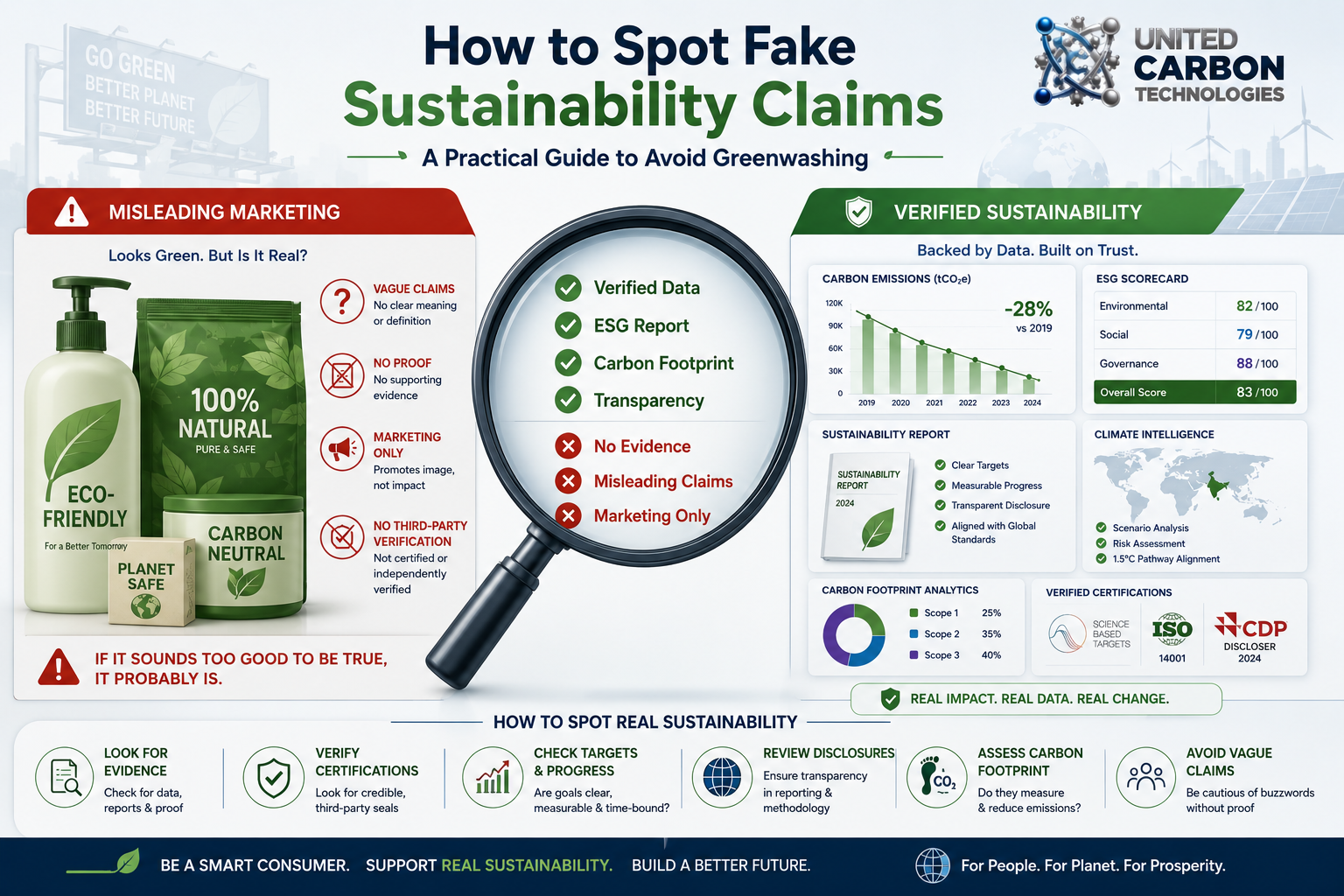
Sustainability has become an important factor in purchasing decisions. Businesses increasingly promote products as environmentally friendly, carbon neutral, recyclable, or sustainable. While many organizations genuinely invest in environmental improvements, others use vague or misleading claims that cannot be verified.
Learning how to identify fake sustainability claims protects consumers from misinformation while encouraging businesses to communicate honestly about their environmental performance.
Did you know?
Environmental claims supported by measurable data, transparent reporting, and independent verification are generally more reliable than broad marketing statements.
1. Watch for Vague Environmental Language
One of the most common signs of greenwashing is the use of broad environmental terms without supporting evidence.
Words such as "green," "eco-friendly," "natural," "planet safe," or "environmentally responsible" may sound impressive but often provide little useful information unless backed by measurable data.
- Eco-friendly
- Green product
- Environmentally safe
- Earth-friendly
- Sustainable choice
Ask yourself: What evidence supports this claim?
2. Look for Measurable Data
Credible sustainability claims usually include measurable environmental information rather than marketing slogans.
- Carbon footprint reductions
- Energy savings
- Renewable energy usage
- Waste reduction percentages
- Water conservation metrics
- Science-based climate targets
Companies that openly publish environmental metrics generally demonstrate greater transparency than those making unsupported claims.
Reliable sustainability claims are supported by measurable environmental performance, credible reporting, and continuous improvement—not marketing language alone.
3. Check for Independent Certifications
Independent certification can strengthen the credibility of environmental claims. While certification alone does not guarantee perfect sustainability, it provides greater confidence than self-declared marketing statements.
Look for certifications or reporting frameworks that explain what has been assessed rather than relying on company-designed symbols or logos.
- Independent verification
- Transparent reporting standards
- Public sustainability disclosures
- Recognized environmental certifications
Organizations that measure emissions, publish ESG reports, and use climate intelligence are better positioned to communicate genuine environmental progress.
4. Be Careful with Carbon Neutral Claims
Many businesses now advertise products or services as carbon neutral. Consumers should ask how those claims were achieved.
- Were emissions actually reduced?
- How were emissions measured?
- Were carbon offsets used?
- Is the methodology publicly available?
- Are progress reports published regularly?
Transparent explanations are generally more trustworthy than simple "carbon neutral" labels without supporting information.
5. Read the Sustainability Report
Businesses committed to sustainability often publish ESG reports, sustainability reports, carbon disclosures, or climate reports that explain their environmental performance in detail.
- Emissions data
- Climate targets
- Progress updates
- Environmental initiatives
- Governance practices
- Future sustainability goals
6. Check Whether the Company Acknowledges Challenges
No business is perfectly sustainable. Organizations making genuine progress usually acknowledge environmental challenges, ongoing improvement efforts, and areas where they still need to improve.
Be cautious of businesses that present themselves as having zero environmental impact without discussing limitations or future goals.
- Clear sustainability roadmap
- Published climate targets
- Progress updates over time
- Discussion of ongoing challenges
- Commitment to continuous improvement
7. Verify Whether Claims Match Business Operations
Sometimes companies highlight one environmentally friendly initiative while ignoring the overall environmental impact of their operations. This is known as focusing on a small positive while overlooking larger sustainability issues.
Ask questions such as:
- Does the company measure its total carbon footprint?
- Does it report Scope 1, Scope 2, or Scope 3 emissions?
- Is sustainability integrated into the overall business strategy?
- Are environmental commitments reflected across products and operations?
8. Look for Transparent ESG Reporting
Organizations that genuinely prioritize sustainability usually publish structured ESG reports or sustainability reports containing measurable environmental, social, and governance information.
- Carbon emissions data
- Energy consumption
- Water management
- Waste reduction
- Climate-risk assessments
- Governance practices
- Sustainability KPIs
Transparent reporting demonstrates accountability and helps stakeholders evaluate environmental performance objectively.
Questions Every Consumer Should Ask
- Can the company prove its environmental claims?
- Are sustainability reports publicly available?
- Are environmental targets measurable?
- Is there independent verification?
- Does the company publish regular progress updates?
- Are environmental claims specific rather than generic?
- Is climate data available for stakeholders?
Why Climate Intelligence Matters
Climate intelligence enables businesses to replace assumptions with measurable environmental data. Modern climate technology platforms help organizations monitor emissions, analyze sustainability performance, improve ESG reporting, and communicate environmental progress with greater transparency.
At United Carbon Technologies, we believe credible sustainability should be supported by reliable climate data, carbon measurement, and evidence-based reporting rather than marketing claims alone.
Related Reads
- What Is Greenwashing?
- ESG Reporting Checklist for Businesses
- What Is a Carbon Disclosure Report?
- Carbon Reporting Software: What Businesses Should Look For
- How Climate Data Helps Businesses Make Decisions
- How to Set Science-Based Climate Targets for Businesses
- Sustainability KPIs Every Company Should Track
- How AI Is Changing Climate Intelligence
- Carbon Accounting Process Step by Step
- What Is Climate Intelligence in Business?
Sustainability Claims in India
As ESG adoption continues to grow across India, businesses are increasingly expected to provide transparent sustainability disclosures supported by measurable environmental data. Consumers, investors, and supply-chain partners are becoming more aware of misleading environmental marketing, making transparency and accountability more important than ever.
- Question broad environmental claims.
- Look for measurable sustainability data.
- Read ESG or sustainability reports.
- Check for independent verification.
- Support businesses that demonstrate genuine environmental progress.
Frequently Asked Questions
How can I identify fake sustainability claims?
Look for measurable environmental data, transparent ESG reporting, credible certifications, and published sustainability targets instead of vague marketing language.
What are examples of greenwashing?
Examples include unverified carbon-neutral claims, vague terms like "eco-friendly," misleading packaging, or highlighting one environmental initiative while ignoring larger impacts.
Should I trust products labeled as "green"?
Not automatically. Consumers should look for evidence such as sustainability reports, certifications, emissions data, and independent verification before relying on environmental claims.
Why is ESG reporting important for consumers?
ESG reporting provides measurable information about a company's environmental, social, and governance performance, helping consumers and investors make informed decisions.
Build Your Climate Intelligence Knowledge
Explore practical guides on ESG reporting, climate intelligence, carbon accounting, and responsible sustainability practices with United Carbon Technologies.
Helping businesses and consumers make informed, evidence-based sustainability decisions.