
Top Sustainability KPIs for ESG Reporting and Carbon Management in 2026
United Carbon Technologies | Climate Knowledge Hub India
Join readers exploring ESG reporting, sustainability metrics, climate intelligence, and environmental performance.
Sustainability KPIs help organizations measure environmental, social, and governance performance. Tracking the right indicators enables businesses to monitor progress, improve efficiency, support ESG reporting, and achieve sustainability goals.
What gets measured gets managed. Sustainability KPIs transform environmental and ESG commitments into measurable business outcomes.
What sustainability KPIs should companies track?
Companies should track sustainability KPIs such as greenhouse gas emissions, energy consumption, water usage, waste generation, renewable energy adoption, and ESG performance indicators to measure progress and improve sustainability outcomes.
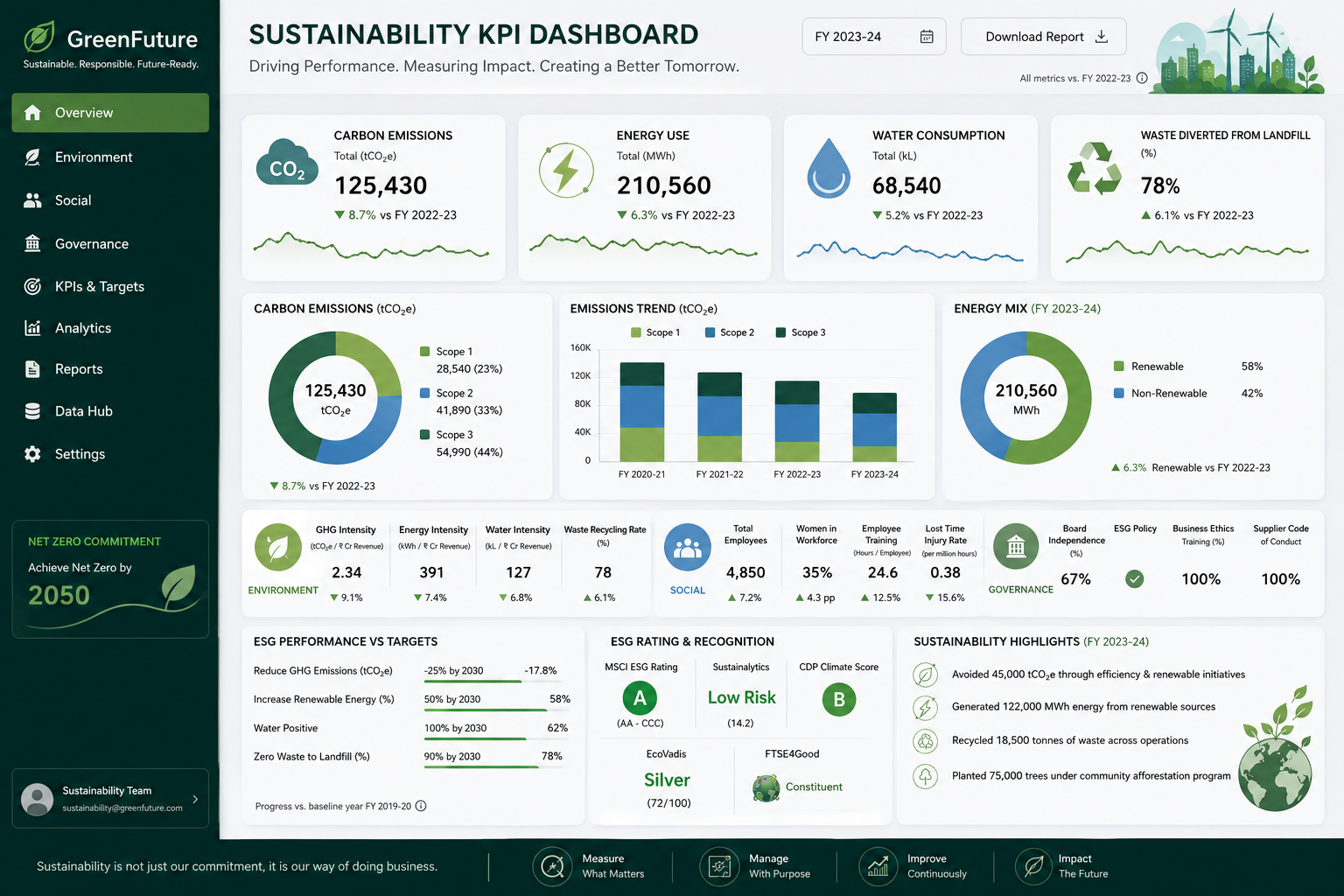
Many organizations set sustainability goals but struggle to measure progress effectively. Key Performance Indicators (KPIs) provide a structured way to monitor environmental performance and identify improvement opportunities.
Whether a company is focused on ESG reporting, carbon management, operational efficiency, or long-term sustainability, selecting the right KPIs is essential for informed decision-making.
Did you know?
Organizations with measurable sustainability targets are often better positioned to identify inefficiencies, reduce environmental impacts, and strengthen stakeholder confidence.
Why Sustainability KPIs Matter
The Five Core Sustainability KPI Categories
| Category | Example KPI |
|---|---|
| Carbon | Total CO₂e Emissions |
| Energy | Energy Intensity |
| Water | Water Consumption |
| Waste | Recycling Rate |
| ESG | Target Achievement Rate |
- Measure sustainability performance objectively
- Support ESG reporting initiatives
- Track environmental improvements over time
- Identify operational inefficiencies
- Strengthen stakeholder transparency
- Support sustainability strategy execution
Effective sustainability management begins with clear KPIs, reliable data, and continuous performance monitoring.
Build ESG readiness and climate intelligence capabilities with sustainability-focused support and environmental insights.
1. Greenhouse Gas Emissions
Tracking Scope 1, Scope 2, and Scope 3 emissions helps organizations understand their carbon footprint and climate impact.
- Total emissions (CO₂e)
- Scope 1 emissions
- Scope 2 emissions
- Scope 3 emissions
- Emissions intensity metrics
2. Energy Consumption
Energy usage is one of the most widely monitored sustainability indicators.
- Total electricity consumption
- Fuel consumption
- Energy intensity
- Energy efficiency improvements
- Renewable energy percentage
3. Water and Waste Management KPIs
- Total water consumption
- Water recycling rates
- Waste generated
- Waste diversion rates
- Recycling performance
4. ESG and Climate Intelligence Metrics
- ESG target achievement rate
- Supplier sustainability participation
- Climate risk assessments completed
- Sustainability training participation
- Environmental compliance performance
Sustainability KPI Adoption in India
Indian organizations are increasingly integrating sustainability KPIs into business reporting, ESG frameworks, and operational decision-making. Companies that measure environmental performance consistently are better equipped to respond to evolving sustainability expectations.
UNITED CARBON TECHNOLOGIES
Climate & ESG Platform
Building India’s Carbon Intelligence Ecosystem
YOUR ACTION, OUR PLANET, TOGETHER, WE EMPOWER A GREENER FUTURE
- Sustainability KPIs help measure ESG and environmental performance.
- Carbon emissions are among the most important KPIs.
- Energy, water, and waste metrics support operational sustainability.
- Climate intelligence metrics support long-term planning.
- Regular KPI tracking improves sustainability outcomes.
How Businesses Use Sustainability KPIs
Leading organizations use KPI dashboards to monitor environmental performance, identify inefficiencies, support ESG reporting, and measure sustainability progress across operations.
- Track carbon reduction targets
- Monitor energy efficiency projects
- Measure waste reduction programs
- Support climate risk assessments
- Improve ESG reporting quality
- Benchmark sustainability performance
Related Reads
- What Is a Carbon Disclosure Report?
- Carbon Reporting Software: What Businesses Should Look For
- What Is Scope 3 Emissions Reporting?
- Carbon Accounting Process Step by Step
- How Climate Data Helps Businesses Make Decisions
- What Is Climate Intelligence in Business?
- How Carbon Accounting Supports ESG Reporting
- Why Carbon Data Matters for ESG Reporting
Frequently Asked Questions
What are ESG KPIs?
ESG KPIs are measurable indicators used to track environmental, social, and governance performance.
Which sustainability KPI should businesses track first?
Carbon emissions, energy consumption, and waste generation are often the first sustainability KPIs businesses begin monitoring.
How do sustainability KPIs support ESG reporting?
KPIs provide measurable data that organizations use in ESG disclosures, sustainability reports, and climate-related reporting.
What is a sustainability KPI?
A sustainability KPI is a measurable indicator used to evaluate environmental, social, and governance performance.
Why are sustainability KPIs important?
They help organizations track progress, improve accountability, and support sustainability reporting.
Which sustainability KPI is most important?
Greenhouse gas emissions are often considered one of the most important sustainability KPIs because they directly measure climate impact.
How often should sustainability KPIs be monitored?
Many organizations review sustainability KPIs monthly, quarterly, or annually depending on reporting requirements and business objectives.
Climate Intelligence and KPI Management
Modern sustainability programs increasingly rely on carbon accounting, ESG reporting, climate intelligence, and performance dashboards to monitor sustainability KPIs and support data-driven decision making.
United Carbon Technologies is building climate intelligence solutions designed to help organizations understand environmental performance and sustainability metrics more effectively.
Explore the Future of Climate Intelligence
Learn ESG, sustainability, carbon intelligence, and climate-tech concepts shaping the future of business and environmental strategy..
Join readers building climate intelligence knowledge for a sustainable future.
Comments
Post a Comment