

Understanding Carbon Disclosure: What Companies Need to Report
By United Carbon Technologies | Climate Knowledge Hub India
Join readers exploring carbon accounting, ESG reporting, climate intelligence, and sustainable business practices.
Carbon disclosure has become an essential part of modern business reporting. Investors, regulators, customers, lenders, and supply-chain partners increasingly expect organizations to measure, manage, and communicate their greenhouse gas emissions transparently. Understanding what should be included in a carbon disclosure helps businesses improve ESG reporting, strengthen stakeholder trust, and prepare for evolving sustainability expectations.
What should companies report in a carbon disclosure?
A carbon disclosure typically includes greenhouse gas emissions, Scope 1, Scope 2, and Scope 3 emissions, energy consumption, climate-related risks, emissions reduction initiatives, sustainability targets, governance practices, and environmental performance metrics.
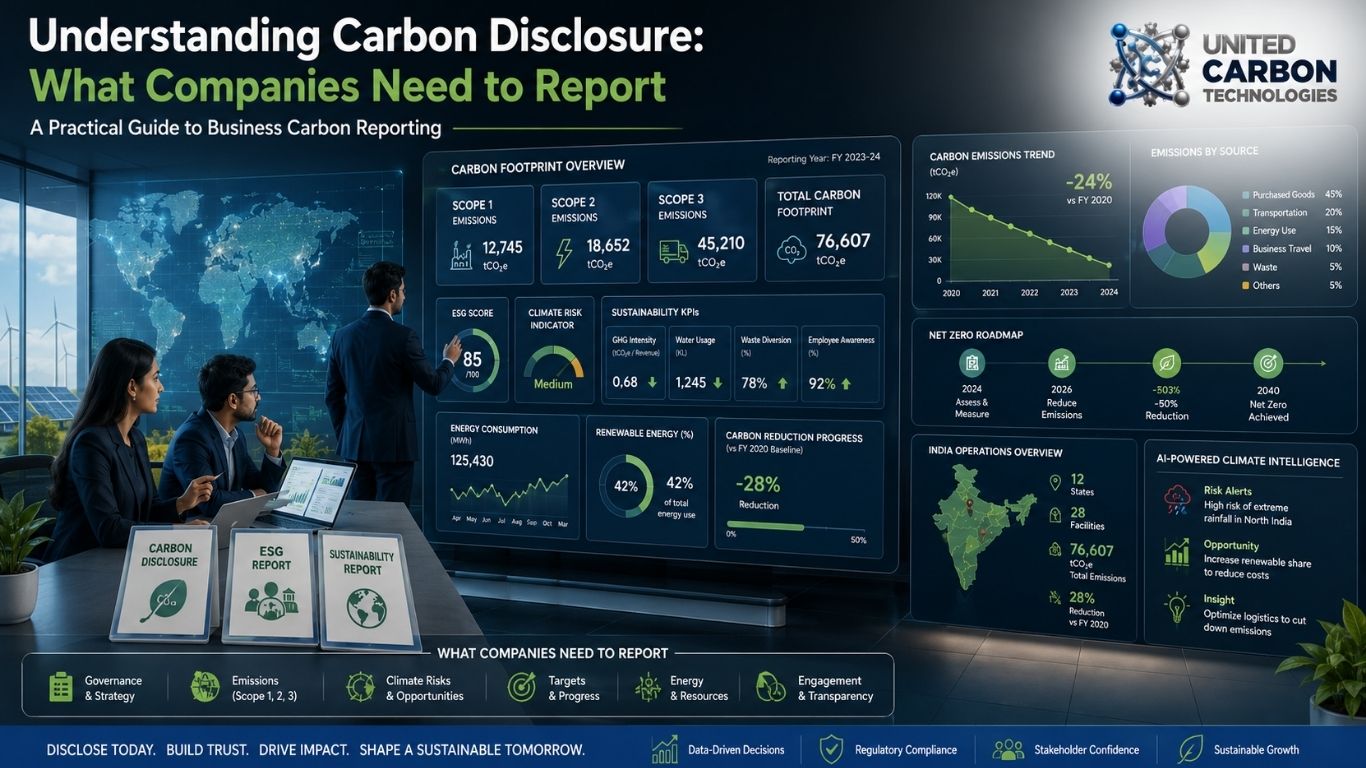
Businesses today operate in an environment where environmental transparency is increasingly important. Carbon disclosure enables organizations to explain how they measure emissions, manage climate risks, reduce environmental impacts, and progress toward sustainability goals.
Rather than being viewed simply as a compliance exercise, carbon disclosure is becoming a valuable business tool for improving decision-making, strengthening ESG performance, and building long-term stakeholder confidence.
Did you know?
Many investors now evaluate climate-related risks and carbon disclosures alongside financial performance when assessing long-term business resilience.
Why Carbon Disclosure Matters
Transparent carbon reporting helps businesses understand environmental impacts while providing investors, customers, and regulators with meaningful sustainability information.
- Improves environmental transparency
- Supports ESG reporting
- Builds stakeholder trust
- Strengthens climate-risk management
- Improves sustainability planning
- Supports better business decisions
Core Information Every Carbon Disclosure Should Include
- Scope 1 greenhouse gas emissions
- Scope 2 emissions from purchased electricity
- Scope 3 value-chain emissions
- Total carbon footprint
- Energy consumption data
- Renewable energy usage
- Climate-related risks
- Carbon reduction initiatives
- Sustainability targets
- Progress against previous goals
Providing consistent, measurable, and transparent information allows stakeholders to better understand an organization's environmental performance.
Reliable emissions measurement and climate intelligence help businesses produce accurate, transparent, and decision-ready sustainability reports.
Understanding Scope 1, Scope 2, and Scope 3 Emissions
Most carbon disclosures classify emissions into three categories to provide a comprehensive picture of an organization's environmental impact.
- Scope 1: Direct emissions from company-owned operations.
- Scope 2: Indirect emissions from purchased electricity, steam, heating, or cooling.
- Scope 3: Indirect emissions across the value chain, including suppliers, transportation, employee travel, product use, and waste.
For many organizations, Scope 3 emissions represent the largest share of their total carbon footprint, making comprehensive data collection increasingly important.
Climate intelligence and carbon accounting solutions can help businesses measure emissions, organize sustainability data, and strengthen ESG reporting readiness.
Climate Risks Companies Should Disclose
Carbon disclosure is no longer limited to reporting emissions. Organizations are increasingly expected to explain how climate-related risks may affect operations, supply chains, financial performance, and long-term strategy.
- Physical climate risks
- Transition risks
- Regulatory developments
- Energy price volatility
- Supply-chain disruption
- Business resilience planning
Why Data Quality Is Essential
Accurate disclosures depend on reliable environmental data collected across facilities, suppliers, logistics, operations, and energy systems.
- Consistent measurement methods
- Reliable data collection
- Documented calculations
- Transparent methodologies
- Regular performance reviews
- Continuous improvement
Common Challenges in Carbon Disclosure
Many businesses understand the importance of carbon disclosure but struggle to produce complete and reliable reports. Environmental data is often spread across departments, suppliers, and operational systems, making consistent reporting difficult.
- Incomplete emissions data
- Difficulty measuring Scope 3 emissions
- Manual spreadsheet-based reporting
- Limited supplier participation
- Changing ESG reporting expectations
- Lack of standardized data collection processes
- Limited climate analytics capabilities
Addressing these challenges requires strong governance, consistent methodologies, and technology that simplifies environmental data management.
How Technology Improves Carbon Disclosure
Modern carbon management platforms help organizations collect environmental data, automate calculations, improve reporting accuracy, and generate sustainability insights from a single platform.
Instead of relying on disconnected spreadsheets, businesses increasingly use climate intelligence systems to centralize carbon accounting, monitor sustainability KPIs, and prepare disclosure-ready reports.
- Automated emissions calculations
- Centralized sustainability data
- Supplier emissions management
- Interactive reporting dashboards
- Audit-ready documentation
- Real-time sustainability analytics
Preparing for Future Carbon Reporting Requirements
Carbon disclosure expectations continue to evolve worldwide. Businesses that establish structured reporting processes today will be better positioned to respond to future ESG requirements, investor expectations, and sustainability regulations.
Building strong reporting capabilities also helps organizations identify emissions reduction opportunities, improve operational efficiency, and strengthen long-term climate strategies.
United Carbon Technologies
We are building India's Climate Intelligence ecosystem through carbon accounting solutions, ESG analytics, sustainability technology, and AI-powered environmental intelligence designed to help organizations improve carbon reporting and sustainability decision-making.
Related Reads
- What Is a Carbon Disclosure Report?
- Carbon Reporting Software: What Businesses Should Look For
- Carbon Accounting Process Step by Step
- How Businesses Collect Scope 3 Data
- ESG Reporting Checklist for Businesses
- How Climate Data Helps Businesses Make Decisions
- What Is Climate Intelligence in Business?
- How AI Is Changing Climate Intelligence
- What Is a Carbon Baseline Assessment?
- How to Set Science-Based Climate Targets for Businesses
Carbon Disclosure in India
Indian businesses are placing greater emphasis on environmental transparency as sustainability expectations continue to grow across industries. Companies are strengthening carbon measurement, improving ESG reporting processes, and investing in climate intelligence to better understand emissions and support long-term sustainability strategies.
Organizations that establish structured carbon disclosure practices today are likely to be better prepared for evolving reporting expectations while strengthening stakeholder confidence and business resilience.
- Carbon disclosure improves environmental transparency.
- Organizations should report Scope 1, Scope 2, and Scope 3 emissions.
- Climate risks and sustainability targets are important disclosure elements.
- Reliable environmental data improves reporting quality.
- Climate intelligence platforms simplify carbon reporting and ESG readiness.
Frequently Asked Questions
What is carbon disclosure?
Carbon disclosure is the process of reporting an organization's greenhouse gas emissions, climate-related risks, sustainability initiatives, and environmental performance to stakeholders.
What should companies include in carbon disclosures?
Most disclosures include Scope 1, Scope 2, and Scope 3 emissions, energy consumption, carbon reduction initiatives, climate risks, sustainability targets, and environmental performance metrics.
Why is carbon disclosure important?
It improves transparency, strengthens ESG reporting, builds investor confidence, supports sustainability planning, and helps organizations identify emissions reduction opportunities.
How does carbon disclosure support ESG reporting?
Environmental data collected through carbon disclosure forms a key part of ESG reporting by helping organizations communicate sustainability performance and climate-related progress.
How can technology improve carbon disclosure?
Climate intelligence platforms automate data collection, improve emissions calculations, centralize sustainability information, and generate reporting-ready insights that simplify carbon disclosure.
Build Better Carbon Intelligence
Learn carbon accounting, ESG reporting, sustainability analytics, and climate intelligence through practical resources designed for businesses, professionals, and future sustainability leaders.
Join thousands of readers exploring the future of climate intelligence and sustainable business.