

What Is a Carbon Baseline Assessment?
United Carbon Technologies | Climate Knowledge Hub India
Join readers exploring ESG, sustainability, carbon accounting, and climate intelligence in India.
A Carbon Baseline Assessment helps organizations measure their current greenhouse gas emissions and establish a starting point for carbon management, ESG reporting, and sustainability planning.
Businesses cannot reduce emissions effectively without first understanding where emissions originate. A carbon baseline provides the foundation for informed climate action and long-term sustainability strategies.
What is a Carbon Baseline Assessment?
A Carbon Baseline Assessment is the process of measuring an organization's greenhouse gas emissions over a defined period to establish a reference point for future carbon reduction efforts, ESG reporting, climate risk management, and sustainability planning.
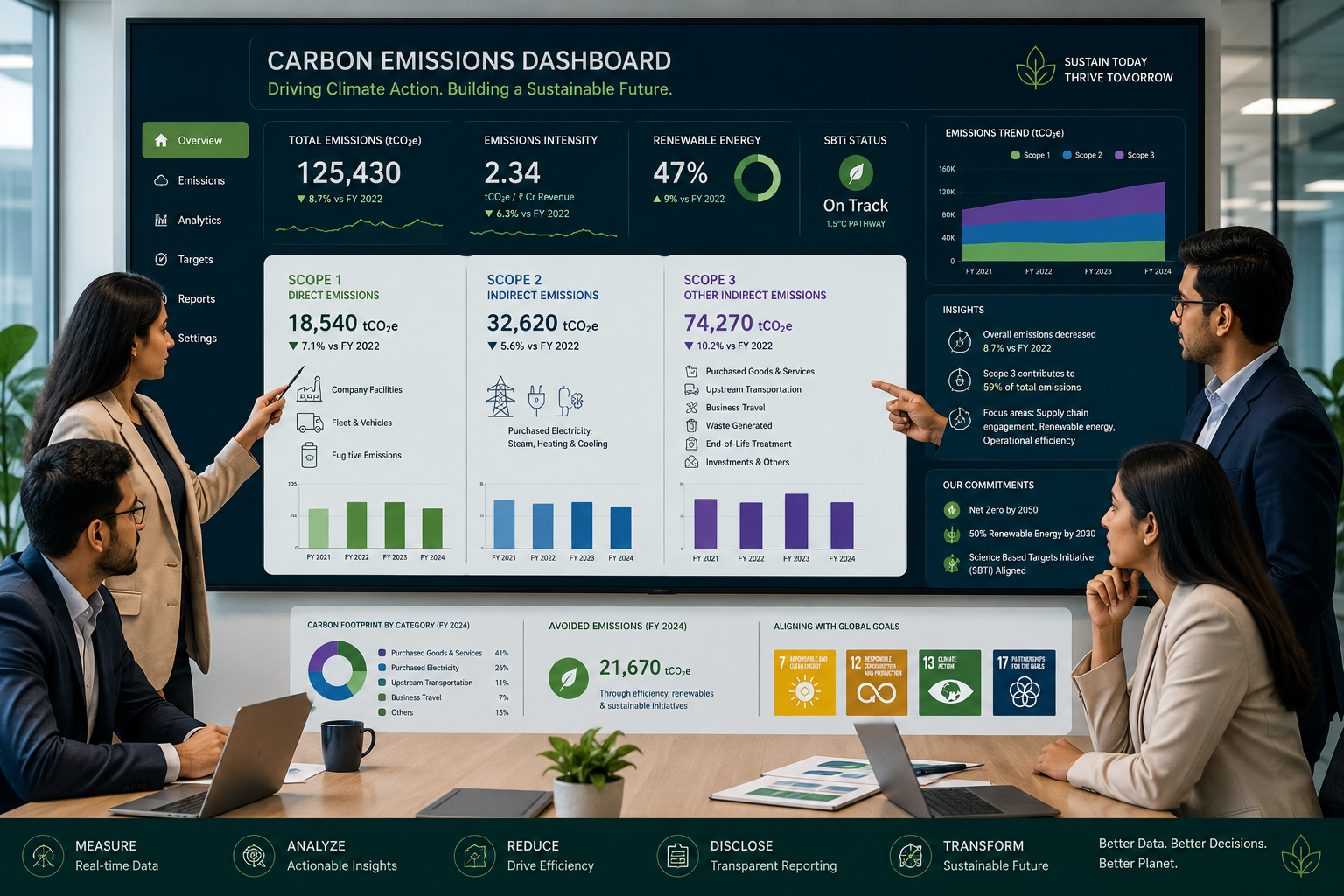
As organizations increasingly focus on sustainability, ESG compliance, and climate-related disclosures, understanding carbon emissions has become a business priority. Before companies can develop emission reduction plans, they need a clear understanding of their current environmental impact.
A Carbon Baseline Assessment provides this understanding by measuring emissions from business activities and creating a benchmark against which future performance can be evaluated.
Did you know?
Most carbon reduction targets, net-zero commitments, and ESG reporting initiatives begin with a carbon baseline assessment to establish measurable starting data.
Why Businesses Need a Carbon Baseline Assessment
- Identifies major sources of emissions
- Supports ESG reporting requirements
- Helps establish realistic reduction targets
- Improves climate-risk management
- Provides data for sustainability strategies
- Supports investor and stakeholder expectations
- Creates a foundation for carbon accounting programs
Understanding your emissions baseline is the first step toward effective carbon management, ESG readiness, and climate strategy development.
Build ESG readiness and climate intelligence capabilities with sustainability-focused support and environmental insights.
What Does a Carbon Baseline Assessment Measure?
A comprehensive assessment typically measures greenhouse gas emissions across multiple operational activities.
- Energy consumption
- Fuel usage
- Business travel
- Transportation and logistics
- Manufacturing operations
- Purchased electricity
- Waste generation
- Supply chain emissions
Organizations often classify these emissions into Scope 1, Scope 2, and Scope 3 categories for structured reporting and management.
Key Steps in Conducting a Carbon Baseline Assessment
- Define organizational boundaries
- Identify emission sources
- Collect operational and activity data
- Apply recognized emission factors
- Calculate greenhouse gas emissions
- Analyze major emission hotspots
- Establish baseline reporting metrics
- Create a future reduction roadmap
The quality of the baseline depends heavily on accurate data collection and appropriate calculation methodologies.
Benefits of Establishing a Carbon Baseline
- Supports ESG and sustainability reporting
- Improves environmental decision-making
- Enhances regulatory preparedness
- Helps track emissions over time
- Supports carbon reduction investments
- Strengthens stakeholder confidence
- Provides measurable sustainability performance indicators
Carbon Baseline Assessments in India
Indian businesses are increasingly adopting carbon measurement practices as ESG reporting expectations, sustainability disclosures, and climate-related regulations continue to evolve.
Organizations across manufacturing, logistics, infrastructure, technology, and financial services sectors are using carbon baseline assessments to better understand their emissions profiles and support long-term sustainability goals.
As climate intelligence becomes more important in business decision-making, carbon baseline assessments are expected to play a central role in corporate sustainability programs.
UNITED CARBON TECHNOLOGIES
Climate & ESG Platform
Building India’s Carbon Intelligence Ecosystem
YOUR ACTION, OUR PLANET, TOGETHER, WE EMPOWER A GREENER FUTURE
Related Sustainability & ESG Resources
- What Is Carbon Accounting?
- Carbon Accounting vs Carbon Footprint
- What Is Climate Intelligence?
- ESG Guide India
- BRSR Guide India
- Sustainability Guide India
- A Carbon Baseline Assessment measures an organization's current emissions.
- It provides the foundation for carbon reduction planning.
- It supports ESG reporting and sustainability initiatives.
- It identifies key emission sources and opportunities for improvement.
- It helps businesses track future environmental performance.
Frequently Asked Questions
What is a carbon baseline?
A carbon baseline is the measured level of greenhouse gas emissions during a specific period that serves as a reference point for future comparison and reduction efforts.
Why is a Carbon Baseline Assessment important?
It helps organizations understand their emissions profile, establish reduction targets, and support ESG reporting and sustainability planning.
What emissions are included in a Carbon Baseline Assessment?
Assessments may include Scope 1, Scope 2, and Scope 3 emissions depending on organizational boundaries and reporting objectives.
How often should a carbon baseline be updated?
Most organizations review and update emissions data annually to monitor progress and maintain reporting accuracy.
Explore the Future of Climate Intelligence
Learn ESG, sustainability, carbon intelligence, and climate-tech concepts shaping the future of business and environmental strategy..
Join readers building climate intelligence knowledge for a sustainable future.