

What Is a Circular Economy? (India Guide)
By United Carbon Technologies | Climate Knowledge Hub India
Join professionals learning climate intelligence and sustainable business.
A circular economy is an economic model designed to reduce waste by keeping products, materials, and resources in use for as long as possible. In India, circular economy practices are becoming increasingly important for businesses seeking greater resource efficiency, lower costs, and improved sustainability performance.
What is a circular economy?
A circular economy is a system where products and materials are reused, repaired, refurbished, and recycled instead of being discarded after use, reducing waste and conserving natural resources.
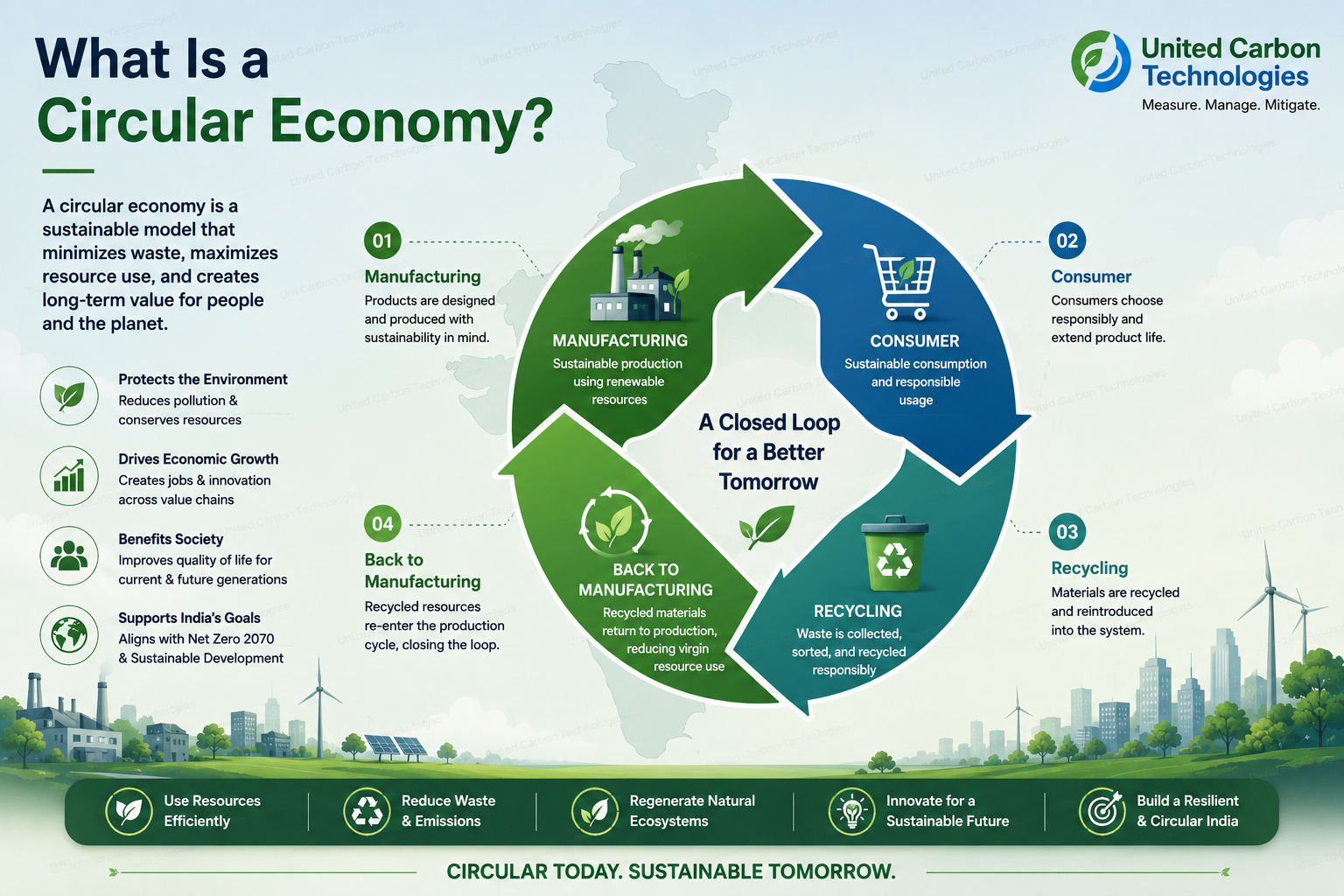
Traditional economies generally follow a "take, make, use, and dispose" approach. Raw materials are extracted, products are manufactured, consumed, and eventually thrown away as waste.
A circular economy replaces this linear model by extending product life, recovering valuable materials, and minimizing waste. Instead of treating used products as garbage, they become valuable resources that can be reused or recycled.
The circular economy can reduce raw material consumption, lower greenhouse gas emissions, and create new business opportunities through recycling, remanufacturing, and resource recovery.
How Does a Circular Economy Work?
A circular economy focuses on maximizing the value of resources throughout their entire lifecycle.
- Design products for durability
- Repair instead of replacing
- Reuse products whenever possible
- Recycle materials into new products
- Recover valuable resources from waste
Linear Economy vs Circular Economy
Understanding the difference between these two economic models helps explain why sustainability experts support circular systems.
| Linear Economy | Circular Economy |
|---|---|
| Extract resources | Use existing resources efficiently |
| Produce products | Design for reuse |
| Dispose after use | Repair, reuse and recycle |
Circular economy principles can reduce costs, improve ESG performance, and lower carbon emissions.
Our ESG experts help businesses measure emissions, improve resource efficiency, and prepare sustainability reports.
Benefits of a Circular Economy
A circular economy benefits businesses, consumers, and the environment by reducing waste, improving resource efficiency, and lowering greenhouse gas emissions.
- Reduces landfill waste
- Conserves natural resources
- Lowers carbon emissions
- Improves resource efficiency
- Creates new business opportunities
- Supports long-term sustainability
Real Examples of Circular Economy in India
Many organizations across India are already adopting circular economy practices to improve sustainability and reduce operating costs.
- Recycling plastic into new packaging products
- Using industrial waste as raw material for cement production
- Repairing and refurbishing electronic devices
- Collecting and recycling used batteries
- Rainwater harvesting and water reuse in manufacturing
- Textile recycling and upcycling initiatives
How Businesses Benefit from Circular Economy Practices
For businesses, a circular economy is more than an environmental initiative—it is a strategy for improving efficiency, reducing costs, and building resilience.
- Lower raw material costs
- Reduced waste disposal expenses
- Improved ESG performance
- Stronger brand reputation
- Better compliance with sustainability expectations
- Greater supply chain resilience
How Circular Economy Supports Climate Action
Producing new materials requires significant amounts of energy and natural resources. Reusing products and recycling materials reduces the demand for virgin resources, helping lower greenhouse gas emissions.
Circular economy principles also complement carbon accounting, Net Zero strategies, and responsible resource management by reducing emissions throughout the product lifecycle.
- Lower manufacturing emissions
- Reduced energy consumption
- Less waste sent to landfills
- Improved resource productivity
Challenges to Building a Circular Economy
Although the circular economy offers significant benefits, organizations may face challenges during implementation.
- Limited recycling infrastructure
- Higher initial investment
- Lack of consumer awareness
- Complex supply chains
- Difficulty tracking material flows
The Future of Circular Economy in India
India's growing economy presents an opportunity to adopt circular business models that reduce waste while supporting economic growth. Government initiatives, corporate sustainability programs, and increasing consumer awareness are encouraging industries to embrace circular economy practices.
Manufacturing, construction, textiles, electronics, automotive, packaging, and agriculture are among the sectors with the greatest potential to benefit from circular economy strategies.
This article is part of United Carbon Technologies' Climate Knowledge Hub, helping businesses and professionals understand sustainability, ESG reporting, and climate intelligence.
Related Climate Insights
Continue learning with our guides on What Is a Carbon Footprint? , How to Build a Carbon Inventory , and What Is Net Zero in India? .
- A circular economy keeps resources in use for longer.
- It focuses on reuse, repair, refurbishment, and recycling.
- It reduces waste and greenhouse gas emissions.
- Businesses benefit through lower costs and improved ESG performance.
- India is increasingly adopting circular economy practices across industries.
Frequently Asked Questions
What is the meaning of a circular economy?
A circular economy is an economic system that minimizes waste by keeping products and materials in use through reuse, repair, refurbishment, and recycling.
Why is a circular economy important?
It conserves natural resources, reduces pollution, lowers greenhouse gas emissions, and supports sustainable economic growth.
How does a circular economy help businesses?
Businesses can reduce material costs, improve operational efficiency, strengthen ESG performance, and meet growing sustainability expectations.
How is India adopting the circular economy?
Indian industries are increasingly investing in recycling, waste management, renewable materials, resource-efficient manufacturing, and sustainable product design to support long-term growth.
Build Your Climate Knowledge with United Carbon Technologies
Learn carbon accounting, ESG reporting, sustainability, and climate intelligence through practical guides designed for businesses, students, and professionals.
Join thousands of readers building climate awareness across India.