

What Is Life Cycle Assessment (LCA)? A Beginner Guide
By United Carbon Technologies | Climate Knowledge Hub India
Join readers learning about carbon accounting, climate intelligence, ESG reporting, and sustainability technologies shaping the future.
Every product leaves an environmental footprint long before it reaches the customer. Life Cycle Assessment (LCA) helps businesses understand these impacts across the entire product lifecycle—from raw material extraction to manufacturing, transportation, use, and disposal—making it a valuable tool for sustainability and carbon management.
What is Life Cycle Assessment (LCA)?
Life Cycle Assessment (LCA) is a scientific method used to measure the environmental impacts of a product, process, or service throughout its entire life cycle. It helps organizations identify carbon emissions, resource consumption, waste generation, and opportunities to improve sustainability.
Businesses today are expected to reduce environmental impacts while improving operational efficiency. However, making better sustainability decisions requires understanding where emissions and resource use actually occur.
Life Cycle Assessment (LCA) provides that visibility by evaluating every stage of a product's journey. Instead of focusing only on manufacturing emissions, LCA considers the complete environmental footprint—from sourcing raw materials to end-of-life disposal or recycling.
As climate regulations, ESG reporting, and consumer awareness continue to grow, Life Cycle Assessment has become an increasingly important tool for companies seeking to build sustainable products and reduce carbon emissions.
Two products that appear identical can have significantly different environmental impacts depending on their raw materials, manufacturing methods, transportation distances, packaging, and disposal processes.
Why Life Cycle Assessment Matters
Traditional environmental reporting often measures only direct operational impacts. Life Cycle Assessment goes much further by evaluating every stage that contributes to a product's environmental footprint.
- Measures total carbon footprint
- Identifies environmental hotspots
- Supports sustainable product design
- Improves resource efficiency
- Helps reduce greenhouse gas emissions
- Supports ESG reporting and sustainability goals
- Enables informed business decisions
The Five Main Stages of Life Cycle Assessment
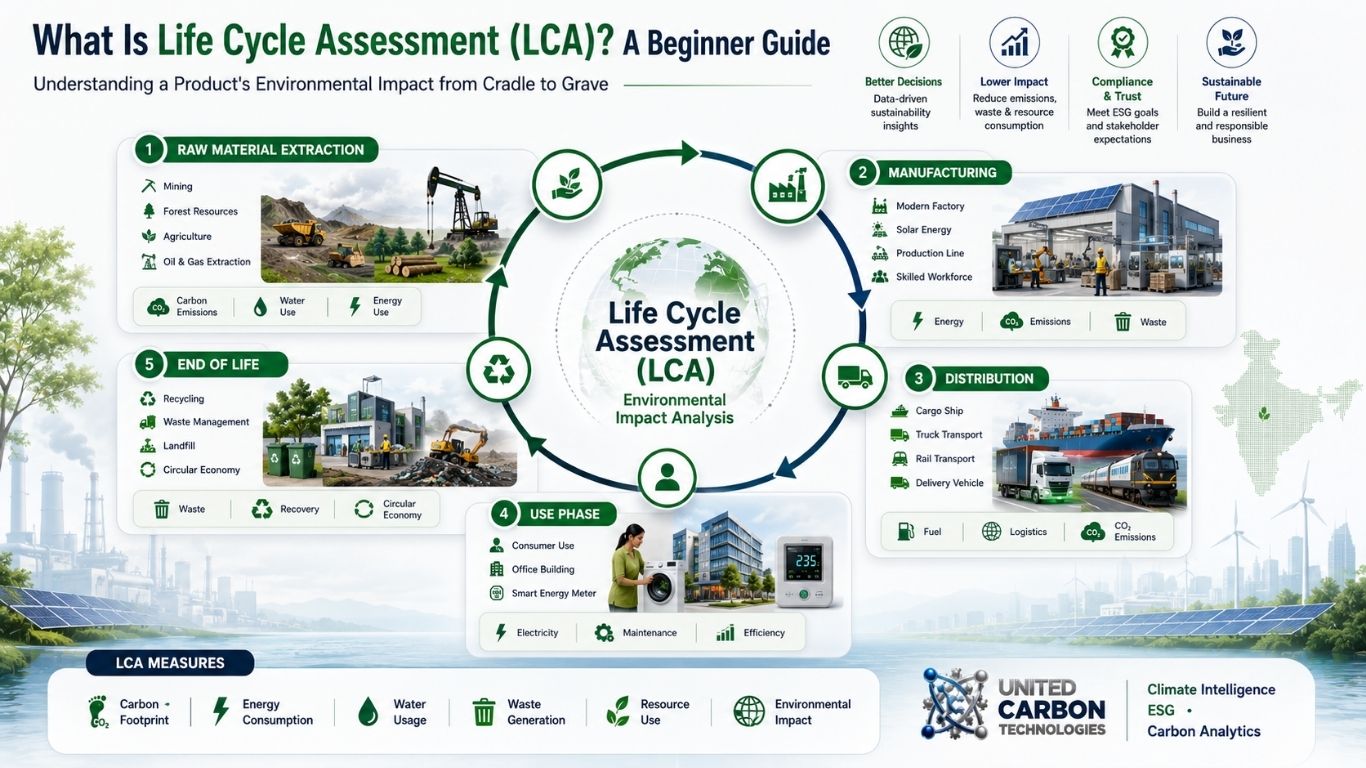
A complete Life Cycle Assessment typically evaluates environmental impacts across the following stages:
- Raw Material Extraction
Mining, agriculture, forestry, or other resource extraction activities. - Manufacturing and Processing
Energy use, emissions, waste generation, and production processes. - Transportation and Distribution
Environmental impacts from shipping, warehousing, and logistics. - Product Use
Energy consumption, maintenance, and emissions during the product's useful life. - End-of-Life Management
Reuse, recycling, landfill disposal, or incineration after the product reaches the end of its life.
Understanding the complete life cycle of products helps businesses reduce emissions, improve efficiency, and make more informed environmental decisions.
What Environmental Impacts Does LCA Measure?
Life Cycle Assessment evaluates much more than carbon emissions. It provides a comprehensive understanding of how products affect the environment.
- Greenhouse gas emissions
- Carbon footprint
- Energy consumption
- Water usage
- Air pollution
- Waste generation
- Natural resource depletion
- Ecosystem impacts
- Land use
- Recyclability and circularity
Climate intelligence platforms can help businesses analyze carbon footprints, organize sustainability data, and support Life Cycle Assessment initiatives for better environmental decision-making.
How Businesses Use Life Cycle Assessment
Life Cycle Assessment is used across industries to improve product sustainability, reduce environmental impacts, and make informed business decisions. Instead of relying on assumptions, organizations use LCA data to identify where emissions, waste, and resource consumption occur throughout a product's life cycle.
- Measure product carbon footprints
- Compare alternative materials
- Improve product design
- Reduce manufacturing emissions
- Optimize packaging
- Improve supply-chain sustainability
- Support eco-friendly product development
- Strengthen ESG reporting
Life Cycle Assessment and Carbon Footprint
Although the terms are sometimes used interchangeably, Life Cycle Assessment and carbon footprint analysis are not the same.
A carbon footprint focuses primarily on greenhouse gas emissions, while Life Cycle Assessment evaluates multiple environmental impacts, including energy use, water consumption, waste generation, resource depletion, pollution, and ecosystem effects.
Because carbon emissions are one of the most important environmental indicators, carbon footprint analysis is often included as a major component of an LCA study.
Benefits of Life Cycle Assessment
- Improves sustainability decision-making
- Identifies hidden environmental impacts
- Supports emissions reduction strategies
- Enhances product innovation
- Improves resource efficiency
- Strengthens ESG reporting
- Supports circular economy initiatives
- Builds stakeholder confidence
- Improves regulatory preparedness
Common Challenges When Conducting an LCA
While Life Cycle Assessment provides valuable environmental insights, conducting a comprehensive assessment can be challenging without reliable data and appropriate tools.
- Collecting accurate lifecycle data
- Managing complex supply chains
- Limited supplier information
- Large data requirements
- Selecting appropriate assessment boundaries
- Maintaining consistent methodologies
- Keeping environmental datasets up to date
Many organizations address these challenges by adopting sustainability software and climate intelligence platforms that simplify data collection and environmental analysis.
Life Cycle Assessment and Climate Intelligence
Modern climate intelligence platforms are transforming how organizations perform environmental assessments. Instead of manually collecting data from multiple departments and suppliers, businesses can centralize sustainability information and generate deeper environmental insights.
Life Cycle Assessment combined with climate intelligence enables organizations to identify emissions hotspots, monitor environmental performance, evaluate sustainability initiatives, and make data-driven decisions that support long-term climate goals.
At United Carbon Technologies, we are developing ACIS (Advanced Carbon Intelligence System), an India-focused climate intelligence platform designed to help businesses improve carbon measurement, sustainability analytics, ESG reporting, and environmental decision-making.
Related Reads
- What Is Climate Intelligence in Business?
- How Climate Data Helps Businesses Make Decisions
- Carbon Reporting Software: What Businesses Should Look For
- Sustainability KPIs Every Company Should Track
- How Businesses Collect Scope 3 Data
- What Is a Carbon Disclosure Report?
- Carbon Accounting Process Step by Step
- What Is a Carbon Baseline Assessment?
Life Cycle Assessment in India
As Indian businesses strengthen sustainability strategies and improve ESG reporting, Life Cycle Assessment is becoming an increasingly valuable tool for understanding environmental impacts across products and supply chains. Manufacturers, exporters, infrastructure companies, and consumer brands are using lifecycle thinking to improve resource efficiency, reduce emissions, and meet growing stakeholder expectations.
With India's focus on sustainable development, circular economy initiatives, and climate action, Life Cycle Assessment is expected to play a larger role in product innovation, carbon management, and environmental decision-making across industries.
- Life Cycle Assessment evaluates environmental impacts across a product's entire life cycle.
- It measures carbon emissions as well as energy, water, waste, and resource use.
- LCA helps businesses improve sustainability and product design.
- Climate intelligence platforms simplify lifecycle data analysis.
- LCA supports ESG reporting, carbon reduction, and circular economy initiatives.
Frequently Asked Questions
What is Life Cycle Assessment (LCA)?
Life Cycle Assessment is a scientific method used to evaluate the environmental impacts of a product, process, or service throughout its entire life cycle.
What is the purpose of Life Cycle Assessment?
Its purpose is to identify environmental impacts, improve sustainability, reduce carbon emissions, and support better product and business decisions.
Is Life Cycle Assessment the same as a carbon footprint?
No. Carbon footprint analysis focuses on greenhouse gas emissions, while Life Cycle Assessment evaluates multiple environmental impacts, including energy, water, waste, and resource consumption.
Which industries use Life Cycle Assessment?
Manufacturing, construction, automotive, packaging, food, consumer goods, energy, infrastructure, and many other industries use LCA to improve sustainability and environmental performance.
Why is Life Cycle Assessment important for ESG?
Life Cycle Assessment provides environmental data that supports ESG reporting, sustainability strategies, emissions reduction planning, and climate-related business decision-making.
Explore the Future of Climate Intelligence
Learn ESG, sustainability, carbon intelligence, and climate-tech concepts shaping the future of business and environmental strategy..
Join readers building climate intelligence knowledge for a sustainable future.