

What Is Scope 3 Emissions Reporting?
United Carbon Technologies | Climate Knowledge Hub India
Join readers exploring carbon accounting, ESG reporting, and climate intelligence.
Scope 3 emissions reporting helps businesses measure indirect carbon emissions across supply chains, transportation, purchased goods, employee travel, and product usage to improve ESG reporting and sustainability transparency.
What are Scope 3 emissions?
Scope 3 emissions are indirect greenhouse gas emissions generated across a company’s value chain, including suppliers, transportation, waste, business travel, and product use.
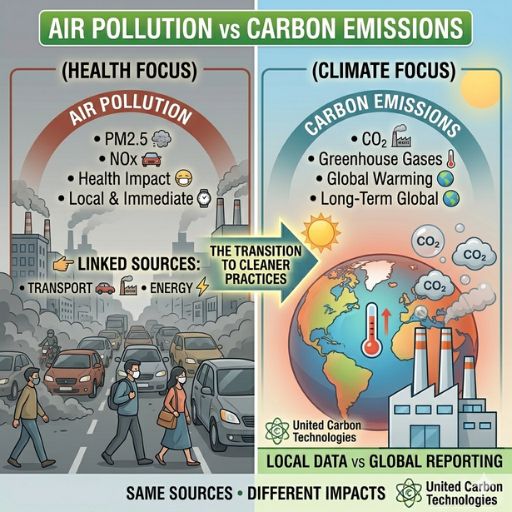
As businesses improve sustainability reporting and climate strategies, Scope 3 emissions are becoming one of the most important areas of carbon accounting.
Unlike direct operational emissions, Scope 3 emissions occur outside a company’s owned facilities but are still connected to business activities through suppliers, logistics, product usage, and operations.
Did you know?
For many businesses, Scope 3 emissions represent the largest portion of their total carbon footprint.
Understanding Scope 1, Scope 2, and Scope 3
Carbon emissions are commonly divided into three categories:
- Scope 1: Direct emissions from owned operations and facilities
- Scope 2: Indirect emissions from purchased electricity and energy
- Scope 3: All other indirect emissions connected to the value chain
Scope 3 emissions are often the most difficult to measure because they involve external partners and activities beyond direct company control.
Examples of Scope 3 Emissions
- Purchased goods and services
- Supplier manufacturing emissions
- Transportation and logistics
- Business travel emissions
- Employee commuting
- Waste management
- Product distribution
- Use of sold products
- End-of-life product disposal
- Cloud and digital infrastructure usage
Businesses worldwide are increasingly expected to understand and report emissions across their entire value chain.
Why Scope 3 Reporting Matters
1. Improves ESG Reporting
Scope 3 reporting provides deeper environmental transparency and strengthens sustainability disclosures.
2. Supports Investor Confidence
Investors increasingly evaluate climate risks and emissions performance before making decisions.
3. Helps Reduce Total Carbon Footprint
Businesses can identify major emissions hotspots across suppliers and logistics networks.
4. Strengthens Supply Chain Sustainability
Organizations can work with suppliers to improve energy efficiency and sustainability practices.
5. Prepares Businesses for Future Regulations
Climate disclosure frameworks are increasingly encouraging broader emissions transparency.
Challenges in Scope 3 Emissions Reporting
- Limited supplier data availability
- Complex global supply chains
- Manual sustainability reporting systems
- Inconsistent emissions measurement methods
- Difficulty tracking indirect operational emissions
- Managing large climate datasets
Modern businesses increasingly require carbon measurement systems, sustainability analytics, and ESG intelligence tools to improve reporting quality.
How Businesses Track Scope 3 Emissions
Organizations often use multiple approaches to estimate and measure Scope 3 emissions:
- Supplier sustainability surveys
- Carbon accounting software platforms
- Industry emissions databases
- Transportation and logistics tracking
- Lifecycle assessment models
- Energy consumption estimates
Climate technology platforms increasingly help automate emissions calculations and improve reporting accuracy.
Role of Climate Technology
Climate-tech platforms help businesses collect sustainability data, automate carbon calculations, and generate ESG-ready reports more efficiently.
Artificial intelligence and climate intelligence systems are also improving emissions forecasting and sustainability analytics.
UNITED CARBON TECHNOLOGIES
Climate & ESG Platform
Building India’s Carbon Intelligence Ecosystem
YOUR ACTION, OUR PLANET, TOGETHER, WE EMPOWER A GREENER FUTURE
Future of Scope 3 Reporting in India
As Indian businesses expand globally and sustainability expectations rise, Scope 3 emissions reporting is expected to become increasingly important across industries.
Supply chain sustainability, climate risk analysis, and ESG transparency are likely to shape future corporate reporting systems in India.
Related Climate & ESG Guides
- What Are Scope 1, Scope 2, and Scope 3 Emissions?
- How Carbon Accounting Supports ESG Reporting
- What Is Supply Chain Sustainability?
- Why Carbon Data Matters for ESG Reporting
- What Is Climate Intelligence?
- Scope 3 emissions are indirect value-chain emissions
- Often represent the largest part of a company’s carbon footprint
- Important for ESG reporting and sustainability transparency
- Includes suppliers, transportation, travel, and product usage
- Climate technology helps automate Scope 3 reporting
Frequently Asked Questions
What are Scope 3 emissions?
Scope 3 emissions are indirect greenhouse gas emissions generated across a company’s value chain.
Why is Scope 3 reporting important?
It improves ESG transparency and helps businesses understand their total environmental impact.
Are Scope 3 emissions difficult to measure?
Yes. They involve suppliers, transportation systems, and external operational activities.
Can small businesses track Scope 3 emissions?
Yes. MSMEs and startups can begin using carbon accounting systems and sustainability tracking methods.
Learn ESG & Carbon Intelligence
Explore sustainability reporting, carbon accounting, climate-tech systems, and future-focused ESG knowledge.
Join readers building climate intelligence awareness in India.