

Cloud Computing & Data Center Footprints: What Indian IT Hubs Need to Know
Search Description: Learn how cloud computing and data centers impact the environment and discover green computing strategies for sustainable IT operations in India.
By United Carbon Technologies | Published: August 2026 | Updated: August 2026
Stay updated with expert insights on carbon accounting, ESG reporting, climate technology, green computing, sustainability, and Net Zero solutions for businesses in India.
Every Click Has a Climate Impact
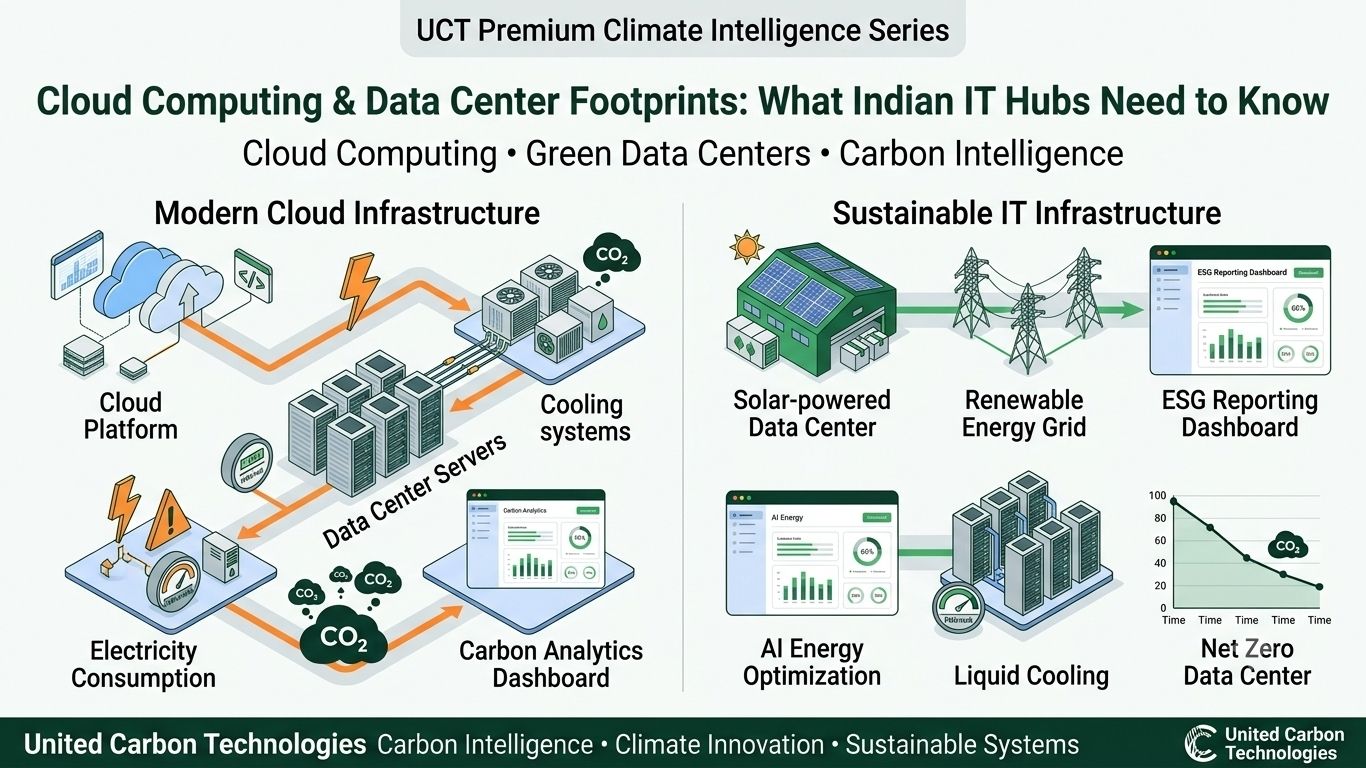
Cloud computing powers nearly every aspect of our digital lives. From video streaming and online banking to artificial intelligence, business software, and social media, almost every digital service depends on massive data centers operating around the clock. Although cloud services appear invisible to users, they require enormous amounts of electricity, cooling systems, networking infrastructure, and computing resources.
As India's digital economy continues to grow, cities such as Bengaluru, Hyderabad, Chennai, Mumbai, Pune, and Noida are rapidly becoming major data center hubs. While these facilities enable innovation and economic growth, they also contribute significantly to energy consumption and greenhouse gas emissions.
Understanding the environmental impact of cloud computing is becoming increasingly important for businesses pursuing ESG goals, improving energy efficiency, and preparing for future climate regulations. This guide explains how data centers generate emissions, what green computing means, and how organizations can build more sustainable digital infrastructure.
What is the environmental impact of data centers?
Data centers consume large amounts of electricity for servers, networking equipment, and cooling systems. Their environmental impact depends on energy efficiency, cooling technology, electricity sources, and the overall carbon intensity of the power grid.
Introduction
India is experiencing unprecedented digital growth. Government initiatives such as Digital India, expanding internet connectivity, cloud adoption by enterprises, artificial intelligence, fintech innovation, and e-commerce have significantly increased demand for computing power. Every application hosted online ultimately relies on physical servers housed inside data centers.
Modern data centers operate continuously to ensure uninterrupted digital services. Thousands of servers, storage devices, switches, cooling systems, backup power units, and security infrastructure work together every second. This continuous operation requires substantial electricity, making energy management one of the industry's biggest sustainability challenges.
Fortunately, advances in renewable energy, efficient cooling technologies, artificial intelligence, and carbon accounting are enabling organizations to reduce emissions while maintaining high-performance digital infrastructure. Businesses that understand these opportunities can improve operational efficiency, strengthen ESG performance, and reduce long-term operating costs.
🌍 Carbon Intelligence for Sustainable Digital Infrastructure
Measuring the carbon footprint of IT operations is becoming an essential component of corporate sustainability. Carbon accounting enables organizations to understand electricity consumption, identify emission hotspots, optimize infrastructure, and support ESG reporting.
Measure • Analyze • Optimize • Report
💡 Did You Know?
A large hyperscale data center may contain hundreds of thousands of servers operating 24 hours a day. Besides powering computing equipment, significant electricity is also required for cooling systems that maintain safe operating temperatures.
Why Data Centers Consume So Much Energy
Unlike traditional office buildings, data centers operate continuously without interruption. Every second, servers process transactions, store information, support cloud applications, analyze artificial intelligence workloads, and maintain internet connectivity for millions of users worldwide.
This continuous activity requires electricity not only for computing equipment but also for cooling, ventilation, networking devices, lighting, security systems, and backup infrastructure. As computing demand increases, so does the overall environmental footprint of digital infrastructure.
Major Sources of Energy Consumption
- Server processing and computing workloads.
- Cooling and air-conditioning systems.
- Network switches and telecommunications equipment.
- Backup power generators and UPS systems.
- Lighting, monitoring, and security infrastructure.
- Storage systems and cloud networking.
Understanding the Carbon Footprint of Cloud Computing
Although cloud computing often improves resource efficiency compared to individual on-premise servers, it still generates greenhouse gas emissions. The overall carbon footprint depends on several factors including electricity generation, hardware efficiency, workload optimization, cooling technology, and renewable energy adoption.
| Emission Source | Environmental Impact | Sustainability Opportunity |
|---|---|---|
| Electricity Consumption | Indirect carbon emissions | Renewable energy procurement |
| Cooling Systems | High energy demand | Liquid cooling and AI optimization |
| Hardware Manufacturing | Embodied carbon | Longer equipment lifecycle |
| Backup Generators | Direct fuel emissions | Battery storage and clean energy |
| IT Operations | Continuous power demand | Virtualization and workload optimization |
🎓 Learn Green Computing with UCT Academy
Discover how carbon accounting, ESG reporting, climate intelligence, and sustainable technology can help organizations reduce emissions while improving digital efficiency.
Measure Your IT Carbon Footprint
United Carbon Technologies helps businesses assess IT-related emissions, develop carbon inventories, strengthen ESG reporting, and create practical decarbonization strategies for digital operations.
What Is Green Computing?
Green computing refers to the design, operation, and disposal of information technology systems in ways that minimize environmental impact while maximizing efficiency. It focuses on reducing electricity consumption, extending hardware life, minimizing electronic waste, and powering digital infrastructure with cleaner energy sources.
For modern businesses, green computing is no longer just an environmental initiative—it has become a strategic business advantage. Organizations that improve the efficiency of their IT infrastructure often reduce operating costs, strengthen ESG performance, and improve resilience against rising energy prices.
Key Principles of Green Computing
- Improve server utilization through virtualization.
- Use renewable electricity whenever possible.
- Deploy energy-efficient hardware.
- Optimize cooling systems.
- Extend equipment life through responsible maintenance.
- Recycle electronic waste responsibly.
- Continuously monitor energy consumption.
How Carbon Accounting Supports IT Sustainability
Carbon accounting enables organizations to measure greenhouse gas emissions associated with digital operations. By collecting data on electricity usage, backup fuel consumption, cooling requirements, cloud services, and IT infrastructure, businesses gain a clear understanding of where emissions originate.
Once emissions are measured, organizations can identify improvement opportunities, establish reduction targets, and report progress through ESG disclosures and sustainability reports.
| Carbon Accounting Activity | Business Benefit |
|---|---|
| Electricity monitoring | Identifies energy-saving opportunities. |
| Emission calculations | Supports ESG reporting. |
| Carbon footprint analysis | Prioritizes reduction initiatives. |
| Performance benchmarking | Tracks sustainability improvements. |
| Annual reporting | Builds investor and stakeholder confidence. |
Technologies Making Data Centers More Sustainable
The world's leading technology companies are investing heavily in innovations that reduce the environmental impact of cloud infrastructure. These technologies improve energy efficiency while maintaining the reliability required for modern digital services.
Emerging Green Data Center Technologies
- Artificial intelligence for energy optimization.
- Liquid cooling systems.
- Free-air cooling in suitable climates.
- Solar and wind-powered facilities.
- Battery energy storage systems.
- High-efficiency power distribution.
- Advanced server virtualization.
- Waste heat recovery systems.
Together, these technologies reduce electricity consumption, lower operating costs, and decrease greenhouse gas emissions.
Corporate Carbon Calculations for IT Operations
Many organizations underestimate how much their digital infrastructure contributes to overall greenhouse gas emissions. Corporate carbon calculations increasingly include IT operations as part of Scope 2 electricity emissions and, in some cases, Scope 3 emissions related to cloud service providers and purchased digital services.
Typical emission sources include:
- Office IT infrastructure.
- Corporate cloud subscriptions.
- Private data centers.
- Networking equipment.
- Backup generators.
- Employee computing devices.
- Software hosting platforms.
Including these sources provides a more comprehensive understanding of an organization's carbon footprint.
What Businesses Can Do Today
Organizations do not need to build new data centers to improve sustainability. Many practical actions can significantly reduce emissions while improving operational efficiency.
- Measure IT-related emissions annually.
- Choose cloud providers committed to renewable energy.
- Retire inefficient legacy servers.
- Virtualize workloads where possible.
- Implement AI-driven energy monitoring.
- Purchase energy-efficient IT equipment.
- Establish responsible e-waste recycling programs.
- Integrate IT emissions into ESG reporting.
India's Growing Data Center Ecosystem
India has emerged as one of Asia's fastest-growing digital economies. Cities including Bengaluru, Hyderabad, Chennai, Mumbai, Pune, Noida, and Delhi NCR continue to attract major investments in hyperscale cloud infrastructure and enterprise data centers.
The rapid expansion of artificial intelligence, fintech, digital government services, online education, healthcare platforms, and e-commerce is increasing demand for reliable computing infrastructure. As this sector grows, improving energy efficiency and integrating renewable energy will become increasingly important for maintaining sustainable digital growth.
Organizations that begin measuring the environmental impact of their IT operations today will be better prepared for evolving ESG expectations, climate-related disclosures, and future carbon management requirements.
What's Next?
Cloud computing will continue driving India's digital transformation, but sustainable growth requires balancing technological innovation with environmental responsibility. Measuring emissions, improving energy efficiency, adopting renewable energy, and strengthening carbon accounting practices will help organizations build resilient digital infrastructure for the future.
Related Reads
- What Is Carbon Accounting? Complete Guide for Beginners
- Understanding Scope 1, Scope 2 & Scope 3 Emissions
- How AI Is Transforming Climate Intelligence
- The Hidden Carbon Cost of E-Commerce Logistics in India
- How to Build a Carbon Inventory
- What Is a Carbon Disclosure Report?
- ESG Reporting Checklist for Businesses
- Net Zero vs Carbon Neutral
Quick Summary
- Data centers power the digital economy but consume significant energy.
- Electricity and cooling systems are the largest emission sources.
- Green computing reduces environmental impact through efficient technology.
- Carbon accounting measures emissions from IT operations.
- Renewable energy and AI improve data center sustainability.
- Corporate carbon calculations increasingly include digital infrastructure.
- India's IT sector is investing in greener cloud infrastructure.
- Sustainable IT supports long-term ESG and Net Zero goals.
Frequently Asked Questions
1. Why do data centers consume so much electricity?
They operate continuously, powering servers, networking equipment, storage systems, and cooling infrastructure 24 hours a day.
2. What is green computing?
Green computing focuses on designing, operating, and managing IT systems in environmentally responsible and energy-efficient ways.
3. How do data centers contribute to carbon emissions?
Most emissions result from electricity consumption, cooling systems, backup generators, and hardware manufacturing.
4. Does cloud computing reduce emissions?
Cloud computing can improve efficiency compared to individual on-premise servers, especially when providers use renewable energy and optimized infrastructure.
5. What role does renewable energy play?
Renewable electricity significantly reduces the indirect emissions associated with data center operations.
6. Why is carbon accounting important for IT companies?
It measures emissions, identifies improvement opportunities, and supports ESG reporting and climate strategies.
7. Which Indian cities are major data center hubs?
Bengaluru, Hyderabad, Chennai, Mumbai, Pune, and Noida are among India's leading data center locations.
8. How can businesses improve IT sustainability?
They can adopt efficient hardware, renewable energy, virtualization, AI optimization, and responsible e-waste management.
9. What is the future of sustainable cloud computing?
Future cloud infrastructure will increasingly rely on renewable energy, AI-powered efficiency, advanced cooling, and comprehensive carbon management.
10. How can United Carbon Technologies help?
UCT supports organizations with carbon accounting, ESG reporting, carbon footprint assessments, and climate intelligence solutions for sustainable digital operations.
Key Takeaways
- Cloud computing depends on energy-intensive physical infrastructure.
- Efficient data centers reduce both emissions and operating costs.
- Green computing strengthens corporate sustainability.
- Carbon accounting enables informed climate action.
- India's digital future should be powered by sustainable technology.
Build a Sustainable Digital Future with UCT
United Carbon Technologies helps businesses measure IT-related carbon emissions, improve ESG reporting, develop carbon inventories, and create practical decarbonization strategies for modern digital infrastructure.