

How Forests Help Fight Climate Change
By United Carbon Technologies | Climate Knowledge Hub India
Join thousands of readers learning about climate change, carbon footprints, Net Zero, biodiversity, ESG, sustainability, and climate technology.
Forests are among Earth's most effective natural climate solutions. They absorb carbon dioxide from the atmosphere, regulate temperatures, conserve biodiversity, protect water resources, and help slow global climate change. Understanding the role of forests is essential for achieving climate goals and building a sustainable future.
How do forests help fight climate change?
Forests help fight climate change by absorbing carbon dioxide (CO₂) through photosynthesis, storing carbon in trees and soil, regulating rainfall and temperatures, protecting biodiversity, and reducing greenhouse gas concentrations in the atmosphere.
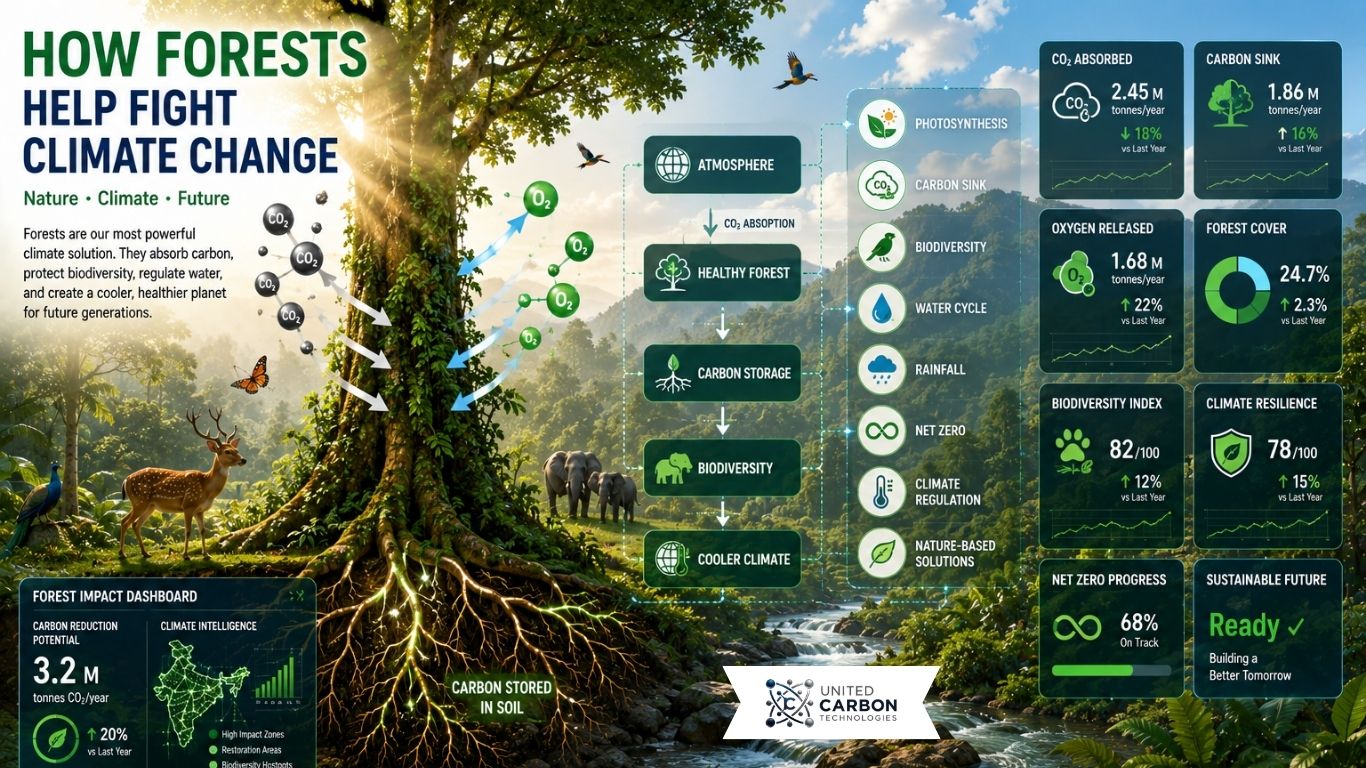
Climate change is driven largely by increasing greenhouse gas emissions, particularly carbon dioxide released through human activities such as burning fossil fuels, deforestation, and industrial development. While reducing emissions is essential, protecting and restoring forests is equally important because forests naturally remove carbon dioxide from the atmosphere.
Often called the "lungs of the Earth," forests perform far more than oxygen production. They regulate rainfall, cool surrounding regions, conserve water, protect wildlife habitats, prevent soil erosion, and store enormous amounts of carbon for decades or even centuries.
For countries like India, forests are vital not only for biodiversity conservation but also for climate resilience, sustainable livelihoods, and achieving long-term Net Zero ambitions. Every hectare of healthy forest contributes to a more stable climate and a healthier planet.
Forests cover about one-third of the Earth's land surface and store hundreds of billions of tonnes of carbon in trees, vegetation, and soils. Protecting existing forests is one of the fastest and most cost-effective ways to slow climate change.
Why Forests Matter for the Planet
Forests are among the most valuable natural ecosystems on Earth. They provide clean air, freshwater, food, medicines, timber, and habitat for millions of plant and animal species. Beyond these benefits, forests play a crucial role in maintaining the Earth's climate system by regulating carbon, water, and energy cycles.
Healthy forests support biodiversity, strengthen ecosystem resilience, reduce flood risks, improve soil quality, and help communities adapt to the growing impacts of climate change.
How Trees Remove Carbon Dioxide
Trees absorb carbon dioxide from the atmosphere through a natural process called photosynthesis. Using sunlight, water, and carbon dioxide, trees produce the energy they need to grow while releasing oxygen back into the atmosphere.
As trees grow, they store carbon in their trunks, branches, roots, leaves, and surrounding soil. This stored carbon is known as a carbon sink, helping reduce the amount of greenhouse gases in the atmosphere.
The larger and healthier a forest becomes, the greater its ability to capture and store carbon over time.
Forests as Natural Carbon Sinks
A carbon sink is any natural or artificial system that absorbs more carbon than it releases. Forests are among the world's largest natural carbon sinks because they continuously capture atmospheric carbon dioxide and store it for long periods.
When forests are protected, restored, and sustainably managed, they continue removing carbon from the atmosphere year after year. However, when forests are cleared or burned, much of this stored carbon is released back into the atmosphere, accelerating climate change.
Forests and the Carbon Cycle
The carbon cycle is the continuous movement of carbon between the atmosphere, oceans, land, living organisms, and the Earth's crust. Forests are one of the most important components of this cycle because they naturally remove carbon dioxide from the atmosphere and store it for decades or even centuries.
Through photosynthesis, trees absorb atmospheric carbon dioxide and convert it into biomass such as trunks, branches, leaves, and roots. As forests grow, they lock away increasing amounts of carbon, helping slow the accumulation of greenhouse gases responsible for global warming.
When forests are destroyed through deforestation, wildfires, or unsustainable land use, much of the stored carbon is released back into the atmosphere, accelerating climate change.
Why Photosynthesis Makes Forests Climate Heroes
Photosynthesis is nature's carbon capture technology. Every green leaf acts like a tiny solar-powered machine that removes carbon dioxide from the air while producing oxygen essential for life.
The simplified process is:
- Leaves absorb carbon dioxide (CO₂) from the atmosphere.
- Roots absorb water from the soil.
- Sunlight provides the energy for photosynthesis.
- The tree converts CO₂ into sugars that support growth.
- Oxygen is released back into the atmosphere.
This natural process continuously removes greenhouse gases while supporting biodiversity, food production, and ecosystem health.
Where Do Forests Store Carbon?
Many people think forests only store carbon in tree trunks, but healthy forests act as long-term carbon reservoirs throughout the entire ecosystem.
Carbon is stored in several places, including:
- Tree trunks and branches.
- Leaves and vegetation.
- Roots beneath the ground.
- Forest soils rich in organic matter.
- Deadwood and decomposing plant material.
In fact, forest soils often contain enormous carbon reserves that have accumulated over hundreds or even thousands of years. Protecting these ecosystems is therefore just as important as planting new trees.
Building a Sustainable Business Starts with Understanding Climate
Whether your organization is developing an ESG strategy, measuring carbon emissions, preparing for Net Zero, or improving sustainability reporting, understanding nature-based climate solutions is an important first step. Our experts can help you build a practical roadmap.
Different Types of Forests and Their Climate Role
Not all forests are the same. Different forest ecosystems store varying amounts of carbon, support different species, and influence regional climates in unique ways.
Tropical Forests
Found near the equator, tropical forests are among the world's largest carbon sinks. Their warm climate and rapid vegetation growth enable them to absorb significant amounts of carbon dioxide while supporting extraordinary biodiversity.
Temperate Forests
Temperate forests experience seasonal changes and continue storing large quantities of carbon in both vegetation and soils. They play an important role in regulating regional weather patterns.
Boreal Forests
Stretching across northern regions, boreal forests contain vast amounts of carbon locked within trees and frozen soils. As global temperatures rise, protecting these forests becomes increasingly important.
Why Rainforests Are Critical for Global Climate Stability
Rainforests are among the most productive ecosystems on Earth. They absorb billions of tonnes of carbon dioxide each year while regulating rainfall, maintaining humidity, and supporting millions of species.
Large tropical forests influence weather patterns far beyond their boundaries by recycling moisture into the atmosphere. Their destruction not only releases stored carbon but also disrupts rainfall patterns that agriculture and freshwater supplies depend upon.
Protecting rainforests is therefore one of the most effective natural strategies for slowing climate change.
India's Forests and Their Role in Climate Action
India's forests are essential for achieving national climate goals, protecting biodiversity, conserving water resources, and supporting the livelihoods of millions of people. From the Himalayan forests in the north to the Western Ghats and mangrove ecosystems along the coastline, these landscapes provide invaluable environmental services.
Healthy forests help India by:
- Absorbing atmospheric carbon dioxide.
- Protecting wildlife and biodiversity.
- Reducing soil erosion.
- Maintaining groundwater recharge.
- Supporting sustainable agriculture.
- Reducing flood and drought risks.
- Improving air quality.
- Strengthening climate resilience.
Expanding forest cover, restoring degraded landscapes, and preventing deforestation are critical components of India's long-term climate strategy and Net Zero ambitions.
How Forests Regulate Climate Beyond Carbon Storage
Forests do much more than absorb carbon dioxide. They influence the Earth's climate by regulating temperature, rainfall, humidity, and the movement of water through natural ecosystems. Scientists often describe forests as the planet's natural climate regulators because they help maintain environmental balance on both local and global scales.
Large forests cool the surrounding environment through shade and evapotranspiration—the process where trees release water vapor into the atmosphere. This natural cooling effect reduces extreme temperatures and contributes to more stable weather patterns.
Without healthy forests, many regions would experience higher temperatures, reduced rainfall, degraded soils, and more frequent climate extremes.
Forests Protect Biodiversity
Forests are home to nearly 80% of the world's terrestrial biodiversity. Millions of species—including plants, birds, insects, mammals, fungi, and microorganisms—depend on forest ecosystems for food, shelter, and survival.
Healthy biodiversity makes ecosystems more resilient to climate change, pests, diseases, and natural disasters. Every species plays a role in maintaining ecological balance, from pollinating crops to enriching soils and supporting nutrient cycles.
When forests disappear, countless species lose their habitats, reducing biodiversity and weakening ecosystems that humans also depend upon.
How Deforestation Accelerates Climate Change
Deforestation is one of the largest contributors to global greenhouse gas emissions. Every year, millions of hectares of forests are cleared for agriculture, mining, infrastructure, and urban expansion.
When trees are cut down or burned, the carbon stored over decades is released back into the atmosphere as carbon dioxide. At the same time, fewer trees remain to absorb future emissions, creating a double impact on the climate.
The consequences of deforestation include:
- Higher greenhouse gas emissions.
- Loss of natural carbon sinks.
- Reduced biodiversity.
- Soil degradation and erosion.
- Disrupted rainfall patterns.
- Greater flood and drought risks.
- Declining water quality.
- Loss of livelihoods for forest-dependent communities.
Protecting existing forests is often more effective than trying to replace them after they have been destroyed.
Turn Sustainability Data into Business Intelligence
United Carbon Technologies helps organizations simplify carbon accounting, ESG reporting, BRSR compliance, Net Zero planning, climate risk management, and sustainability reporting using practical consulting and next-generation digital solutions.
We're also developing ACIS (Advanced Carbon Intelligence System), an AI-powered climate intelligence platform designed to automate emissions measurement, ESG reporting, energy analytics, Scope 1, Scope 2 & Scope 3 tracking, and sustainability dashboards.
Nature-Based Climate Solutions
Nature-based climate solutions are actions that protect, restore, and sustainably manage natural ecosystems to address climate change while providing social and environmental benefits. Forest conservation is one of the most effective examples of these solutions.
Examples include:
- Protecting existing forests.
- Afforestation (planting forests where none existed before).
- Reforestation (restoring degraded forests).
- Mangrove restoration.
- Agroforestry.
- Watershed restoration.
- Urban forestry.
- Sustainable forest management.
These approaches not only reduce atmospheric carbon dioxide but also improve biodiversity, strengthen water security, support local communities, and increase resilience to climate change.
How Individuals Can Help Protect Forests
Fighting climate change isn't only the responsibility of governments and businesses. Individuals can also make a meaningful contribution by supporting sustainable practices that reduce pressure on forests.
- Choose products certified as sustainably sourced.
- Reduce paper waste and recycle whenever possible.
- Support tree planting and forest restoration projects.
- Avoid products linked to illegal deforestation.
- Reduce your overall carbon footprint.
- Support organizations working to conserve forests.
- Educate others about biodiversity and climate change.
- Participate in local environmental initiatives.
Small individual actions, when multiplied across millions of people, can contribute significantly to protecting forests and supporting global climate action.
Related Reads
- What Is Climate Intelligence in Business?
- How Climate Data Helps Businesses Make Decisions
- Carbon Reporting Software: What Businesses Should Look For
- Sustainability KPIs Every Company Should Track
- How Businesses Collect Scope 3 Data
- What Is a Carbon Disclosure Report?
- Carbon Accounting Process Step by Step
- What Is a Carbon Baseline Assessment?
- Forests are among the world's largest natural carbon sinks.
- Trees absorb carbon dioxide through photosynthesis and store carbon in biomass and soil.
- Healthy forests regulate temperature, rainfall, and the global carbon cycle.
- Forests protect biodiversity and support millions of plant and animal species.
- Deforestation releases stored carbon and accelerates climate change.
- Nature-based climate solutions such as afforestation and reforestation help restore ecosystems.
- India's forests are essential for biodiversity, water security, and achieving long-term climate goals.
- Protecting forests is one of the most effective and affordable strategies for combating climate change.
Frequently Asked Questions (FAQs)
1. How do forests help fight climate change?
Forests absorb carbon dioxide from the atmosphere through photosynthesis and store it in trees, vegetation, and soil. This reduces greenhouse gases, regulates temperatures, supports biodiversity, and helps slow global climate change.
2. Why are forests called carbon sinks?
Forests are called carbon sinks because they absorb more carbon dioxide than they release. They naturally capture atmospheric carbon and store it for years or even centuries in trees and forest soils.
3. What is the role of forests in the carbon cycle?
Forests play a vital role in the carbon cycle by removing carbon dioxide from the atmosphere, storing carbon in biomass and soil, and helping maintain the natural balance of greenhouse gases on Earth.
4. How does deforestation contribute to climate change?
Deforestation releases the carbon stored in trees back into the atmosphere while reducing the planet's ability to absorb future emissions. This increases greenhouse gas concentrations and accelerates global warming.
5. Why are tropical forests important for climate regulation?
Tropical forests absorb enormous amounts of carbon dioxide, regulate rainfall patterns, maintain biodiversity, and influence regional and global weather systems, making them essential for climate stability.
6. How do forests benefit India?
India's forests help conserve biodiversity, regulate water resources, reduce soil erosion, improve air quality, support millions of livelihoods, and contribute to the country's climate action and Net Zero goals.
7. Can planting trees help reduce climate change?
Yes. Afforestation and reforestation increase carbon storage, restore ecosystems, improve biodiversity, and support long-term climate mitigation. However, protecting existing mature forests remains equally important.
8. What are nature-based climate solutions?
Nature-based climate solutions involve protecting, restoring, and sustainably managing ecosystems such as forests, wetlands, and mangroves to reduce greenhouse gas emissions while improving biodiversity and climate resilience.
9. How can individuals help protect forests?
Individuals can support forest conservation by reducing paper waste, choosing sustainably sourced products, participating in tree planting initiatives, supporting conservation projects, and lowering their own carbon footprint.
10. Why are forests important for achieving Net Zero?
Healthy forests remove carbon dioxide from the atmosphere, making them one of the world's most effective natural carbon removal systems. They complement emission reductions and play a critical role in achieving Net Zero targets.
Start Your Climate Knowledge Journey Today
Climate change is one of the defining challenges of our generation—but understanding it is the first step toward solving it. Whether you're a student, professional, business owner, sustainability practitioner, investor, or simply someone who wants to make a difference, building climate knowledge empowers better decisions for yourself, your organization, and the planet.
Join thousands of learners exploring practical topics such as climate change, forests, biodiversity, carbon footprints, Net Zero, renewable energy, ESG, carbon accounting, climate technology, and sustainable living through India's growing Climate Knowledge Hub.
The transition to a sustainable future depends on informed individuals and responsible organizations. The knowledge you gain today can help you make smarter decisions, reduce your environmental impact, advance your career, and contribute to a healthier planet for future generations.
Learn Today. Protect Forests. Shape a Sustainable Tomorrow.
✔ Free Climate Learning Resources | ✔ Weekly Sustainability Insights | ✔ Early Access to ACIS Climate Intelligence Platform | ✔ Join India's Next Generation of Climate Leaders