

How to Collect Supplier Carbon Data: A Practical Guide for Businesses (2026)
Learn how businesses collect supplier carbon data for Scope 3 emissions. Discover practical methods, supplier engagement strategies, ESG reporting tips, and best practices.
By United Carbon Technologies | Climate Knowledge Hub India
Published: July 2026 | Last Updated: July 2026 | 9 min read
Join readers exploring practical insights on Carbon Accounting, ESG Reporting, Climate Intelligence, Scope 3 Emissions, Sustainability Strategy, and India's transition toward a low-carbon economy.
For many businesses, supplier emissions represent the largest share of their total carbon footprint. Yet collecting reliable supplier carbon data remains one of the biggest challenges in carbon accounting and ESG reporting.
Whether your organization is preparing a greenhouse gas inventory, improving Scope 3 emissions reporting, responding to customer sustainability requirements, or building a Net Zero strategy, supplier engagement is essential for accurate environmental data.
This guide explains how businesses can collect supplier carbon data effectively, improve data quality, engage suppliers, and build a scalable process that supports long-term sustainability reporting and climate intelligence.
Featured Snippet
Businesses collect supplier carbon data by identifying key suppliers, requesting greenhouse gas information, using standardized questionnaires, reviewing emission factors where primary data is unavailable, validating submitted information, and integrating supplier emissions into Scope 3 carbon accounting and ESG reporting processes.
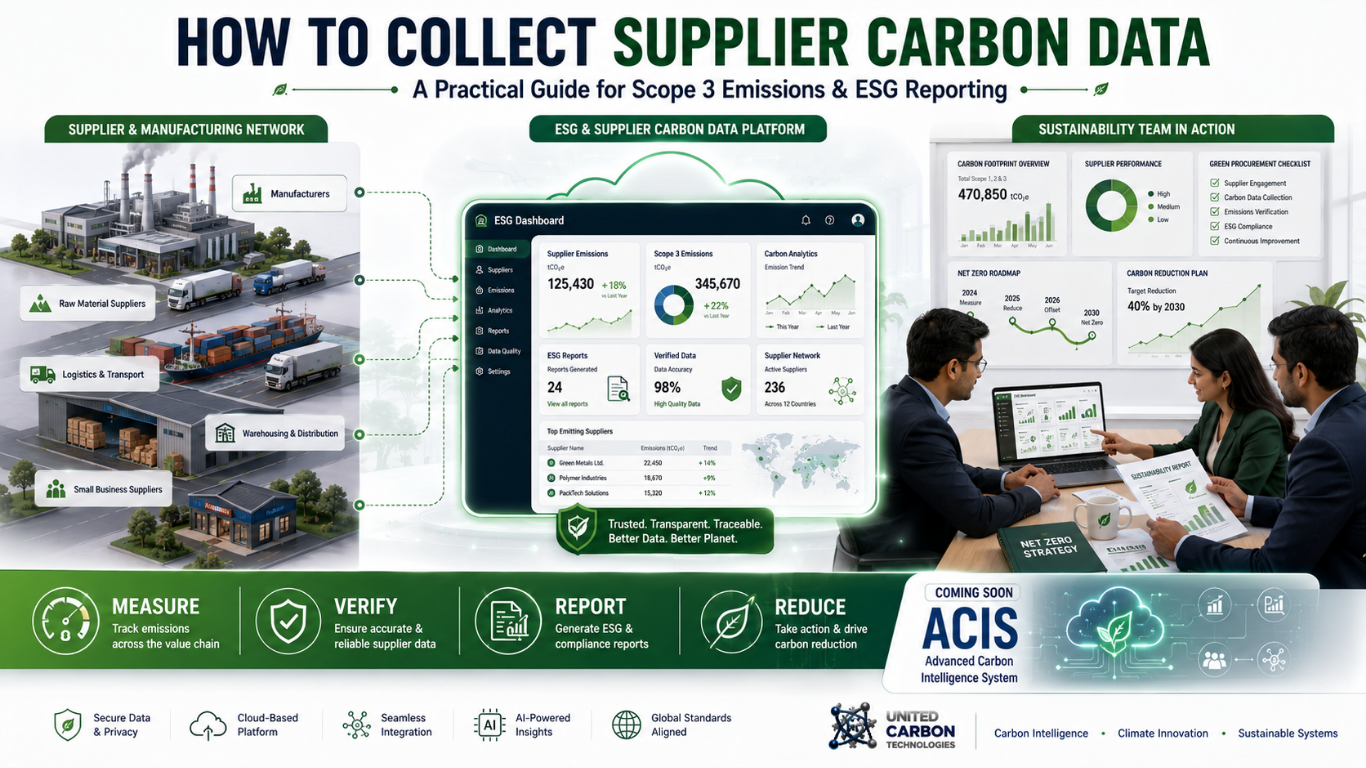
Introduction
Today's businesses are expected to understand not only the emissions generated within their own operations but also those created throughout their value chain. For many organizations, these indirect emissions—known as Scope 3 emissions—account for more than 70% of their total greenhouse gas footprint.
Because suppliers manufacture raw materials, transport products, provide services, and consume energy before goods ever reach a company, collecting supplier carbon data has become a critical part of modern carbon accounting. Investors, customers, regulators, and global supply chain partners increasingly expect businesses to measure these emissions accurately and demonstrate progress toward sustainability goals.
However, supplier data collection is often challenging. Suppliers may have different levels of sustainability maturity, use different reporting methods, or lack the resources to measure emissions consistently. Businesses therefore need structured processes that encourage collaboration while maintaining reliable and transparent data.
In this guide, we'll explore practical steps for collecting supplier carbon data, improving data quality, overcoming common challenges, and building a scalable reporting process that supports better business decisions.
Climate Intelligence • Scope 3 Reporting • ESG Analytics
Building India's Carbon Intelligence Ecosystem
United Carbon Technologies is developing digital climate solutions that help businesses measure emissions, streamline ESG reporting, analyze supplier sustainability performance, and build future-ready carbon intelligence systems.
💡 Did You Know?
- For many manufacturing companies, Scope 3 emissions contribute more than 70% of total greenhouse gas emissions.
- Supplier emissions are often the largest category within Scope 3 reporting.
- Many global companies now request carbon data from suppliers before awarding contracts.
- High-quality supplier data improves ESG reporting, climate risk management, and sustainability decision-making.
1. Why Supplier Carbon Data Matters
Every product or service purchased by a business carries an environmental footprint created long before it reaches the final customer. Raw material extraction, manufacturing, packaging, transportation, and energy consumption all contribute to greenhouse gas emissions across the supply chain.
Collecting supplier carbon data helps businesses understand these upstream impacts instead of focusing only on emissions generated within their own facilities. As sustainability expectations continue to increase, organizations that can measure supplier emissions are better prepared for ESG reporting, customer disclosures, procurement decisions, and future climate regulations.
Reliable supplier data also enables companies to identify emission hotspots, collaborate with vendors on reduction initiatives, prioritize sustainable procurement, and build more resilient supply chains.
Key Business Benefits
- Improves Scope 3 carbon accounting accuracy
- Strengthens ESG reporting quality
- Supports Net Zero planning
- Enhances investor confidence
- Improves procurement decisions
- Identifies supply chain climate risks
- Builds stronger supplier relationships
- Supports future regulatory compliance
2. Which Suppliers Should You Prioritize?
Attempting to collect emissions data from every supplier at once is rarely practical. Most organizations begin by focusing on suppliers that have the greatest influence on their overall carbon footprint.
A risk-based prioritization approach helps businesses allocate resources efficiently while improving reporting quality over time.
| Priority Level | Typical Suppliers | Reason |
|---|---|---|
| High | Raw material suppliers | Largest contribution to Scope 3 emissions |
| High | Manufacturing partners | Energy-intensive operations |
| Medium | Logistics providers | Transportation emissions |
| Medium | Packaging suppliers | Material-related emissions |
| Lower | Office service providers | Relatively smaller environmental impact |
By starting with suppliers that contribute the most emissions or business value, organizations can improve data quality quickly while creating a scalable supplier engagement program for future reporting cycles.
Building a structured supplier engagement process today makes future Scope 3 reporting faster, more accurate, and more valuable for your business.
United Carbon Technologies is building Carbon Intelligence solutions to help organizations streamline supplier emissions data collection, Scope 3 accounting, ESG reporting, and sustainability analytics.
3. How to Request Carbon Data from Suppliers
Collecting supplier carbon data begins with clear communication. Many suppliers are still developing their sustainability capabilities, so businesses should provide simple guidance instead of assuming suppliers already understand carbon accounting.
The objective is to build long-term collaboration rather than treat reporting as a one-time compliance exercise.
Information You Should Request
- Company sustainability contact details
- Total annual greenhouse gas emissions (if available)
- Product or service-specific emission data
- Electricity and fuel consumption
- Renewable energy usage
- Existing ESG or sustainability reports
- Carbon reduction targets
- Environmental certifications (ISO 14001, etc.)
- Calculation methodology used
- Reporting year
Providing standardized questionnaires ensures suppliers submit comparable information, making future reporting easier and more consistent.
4. Primary Data vs Secondary Data
Not every supplier can provide measured emissions. Businesses therefore use two main sources of carbon information.
| Data Type | Description | Accuracy |
|---|---|---|
| Primary Data | Supplier measures and reports its own emissions. | ★★★★★ |
| Secondary Data | Emission factors or industry averages are used. | ★★★☆☆ |
Organizations should always encourage suppliers to transition toward primary emissions data because it improves reporting accuracy and supports better sustainability decision-making.
5. Common Challenges in Supplier Data Collection
Supplier engagement is rarely straightforward. Different suppliers have different reporting capabilities, resources, and levels of sustainability awareness.
Typical Challenges
- Limited sustainability knowledge
- Incomplete emissions records
- Different reporting methodologies
- Poor data quality
- Lack of dedicated ESG teams
- Concerns about confidential business information
- Different reporting periods
- Manual spreadsheets causing errors
Recognizing these challenges early allows organizations to develop practical improvement plans rather than expecting perfect data from the beginning.
6. Best Practices for Improving Supplier Data Quality
High-quality supplier carbon data is built over several reporting cycles. Organizations that consistently engage suppliers typically see significant improvements in reporting accuracy year after year.
Best Practices
- Use standardized questionnaires.
- Provide supplier training.
- Share reporting guidance documents.
- Conduct periodic data reviews.
- Validate unusual emission values.
- Maintain clear reporting timelines.
- Encourage digital reporting tools.
- Recognize suppliers with strong sustainability performance.
Supplier engagement should be viewed as a partnership focused on continuous improvement instead of simply requesting data once a year.
7. How Digital ESG Platforms Simplify Supplier Reporting
As supplier networks expand, managing carbon information through spreadsheets becomes increasingly difficult. Digital ESG platforms centralize supplier information, automate data collection, improve consistency, and reduce manual work.
Modern carbon intelligence platforms can help businesses:
- Send supplier questionnaires automatically
- Track response status
- Store supplier emission records securely
- Calculate Scope 3 emissions
- Generate ESG reporting dashboards
- Monitor supplier sustainability performance over time
- Identify reporting gaps
- Create audit-ready documentation
Digital systems also enable organizations to scale sustainability reporting across hundreds or even thousands of suppliers.
8. Building Long-Term Supplier Partnerships
Supplier carbon reporting should not be viewed as a compliance burden. Instead, businesses can position sustainability as an opportunity for operational efficiency, innovation, and long-term competitiveness.
Organizations that support suppliers through training, shared best practices, and collaborative improvement initiatives often achieve higher reporting participation and stronger sustainability outcomes.
Long-term partnerships also encourage suppliers to invest in renewable energy, energy efficiency, waste reduction, and emissions monitoring, creating benefits across the entire value chain.
9. Future Trends in Supplier Carbon Data Collection
Supplier reporting is rapidly evolving. Global regulations, investor expectations, and technological innovation are transforming how businesses collect and verify emissions information.
Emerging Trends
- AI-assisted supplier assessments
- Automated ESG questionnaires
- Real-time carbon dashboards
- Blockchain-supported sustainability records
- Satellite-assisted environmental monitoring
- Supplier sustainability scorecards
- Integrated climate risk analysis
- Predictive emissions analytics
Businesses that begin developing structured supplier engagement programs today will be better prepared for tomorrow's reporting expectations.
10. Turning Supplier Data into Climate Intelligence
Collecting supplier carbon data is only the first step. The greatest value comes from transforming raw emissions information into meaningful business insights.
By combining supplier emissions with procurement, production, logistics, and operational data, organizations can identify carbon hotspots, evaluate sustainability initiatives, reduce climate-related risks, and improve long-term business resilience.
Supplier carbon data is becoming one of the most valuable components of modern ESG reporting and climate intelligence.
Build a Smarter Supplier Sustainability Program
United Carbon Technologies is developing Carbon Intelligence solutions that help organizations streamline supplier emissions reporting, Scope 3 accounting, ESG dashboards, sustainability analytics, and climate decision-making.
Whether you're beginning your ESG journey or improving supplier reporting, our future-ready solutions are designed to simplify carbon measurement and strengthen sustainability performance.
Use the website's global contact button to connect with our team and explore Carbon Intelligence, ESG Reporting, Scope 3 Management, and Sustainability Analytics solutions.
India Context: Why Supplier Carbon Data Is Becoming Essential
India's manufacturing, automotive, pharmaceutical, textile, infrastructure, FMCG, logistics, and export sectors are increasingly being asked to provide transparent sustainability information to global customers and investors.
As international ESG frameworks and supply chain disclosure requirements continue to evolve, Indian businesses that establish structured supplier carbon reporting systems today will gain a competitive advantage in domestic and international markets.
Building supplier engagement capabilities now helps organizations prepare for future regulations while strengthening operational resilience and investor confidence.
What's Next?
Once supplier carbon data is collected, the next step is improving data quality through emission factors, supplier engagement strategies, materiality assessments, and digital ESG platforms.
Related Reads
- How Businesses Collect Scope 3 Data
- Carbon Accounting Explained
- Carbon Reporting Software: What Businesses Should Look For
- How Climate Data Helps Businesses Make Better Decisions
- Understanding Scope 3 Emissions
- ESG Reporting Checklist for Businesses
Conclusion
Collecting supplier carbon data is no longer optional for businesses seeking to build credible ESG programs and prepare for a low-carbon future. As supply chains become increasingly transparent, organizations that establish structured supplier engagement processes today will be better positioned to improve Scope 3 reporting, strengthen sustainability performance, and respond to evolving stakeholder expectations.
Although supplier carbon data collection can seem challenging, businesses do not need to achieve perfect reporting immediately. Starting with key suppliers, improving data quality over time, and adopting digital carbon intelligence solutions can create a scalable and practical reporting system that delivers long-term value.
Ultimately, supplier carbon data is more than a reporting requirement—it is a strategic business asset that helps organizations reduce emissions, build resilient supply chains, make informed decisions, and advance toward their Net Zero and sustainability goals.
Quick Summary
- Supplier emissions often represent the largest share of Scope 3 emissions.
- Prioritize suppliers with the greatest environmental impact.
- Use standardized questionnaires for consistent reporting.
- Primary emissions data provides higher reporting accuracy.
- Digital ESG platforms simplify supplier engagement and reporting.
- Continuous collaboration improves supplier data quality over time.
- Supplier carbon data supports stronger ESG reporting and climate intelligence.
Frequently Asked Questions (FAQs)
1. What is supplier carbon data?
Supplier carbon data refers to greenhouse gas emissions generated by suppliers while producing goods or delivering services. This information helps businesses calculate Scope 3 emissions and improve sustainability reporting.
2. Why is supplier carbon data important?
It enables organizations to identify emission hotspots, improve ESG reporting, strengthen supply chain sustainability, and make better procurement decisions.
3. What are Scope 3 emissions?
Scope 3 emissions are indirect greenhouse gas emissions generated across a company's value chain, including purchased goods, transportation, business travel, waste, and supplier activities.
4. How do companies collect supplier carbon data?
Most organizations use supplier questionnaires, sustainability surveys, product carbon footprint reports, ESG disclosures, and direct engagement with suppliers to collect emissions data.
5. What if a supplier cannot provide emissions data?
Businesses can initially use recognized emission factors or industry-average data while encouraging suppliers to measure and report their own emissions in future reporting cycles.
6. Which suppliers should be contacted first?
Organizations should prioritize suppliers with the highest spending, largest purchased volumes, or greatest contribution to overall Scope 3 emissions.
7. How often should supplier carbon data be updated?
Supplier emissions data is typically updated annually, although organizations with mature ESG programs may monitor critical suppliers more frequently.
8. Can small businesses collect supplier carbon data?
Yes. Small and medium-sized businesses can begin with their top suppliers and gradually expand reporting as their sustainability programs mature.
9. How does technology improve supplier carbon reporting?
Digital ESG platforms automate supplier questionnaires, centralize emissions data, validate submissions, calculate Scope 3 emissions, and generate reporting dashboards.
10. How does supplier carbon data support Net Zero goals?
Accurate supplier emissions data helps organizations identify reduction opportunities, engage suppliers in decarbonization initiatives, track progress, and develop credible Net Zero transition strategies.
Key Takeaways
- Start with your highest-impact suppliers.
- Build long-term supplier partnerships.
- Standardize carbon data collection.
- Validate supplier information regularly.
- Use technology to improve reporting efficiency.
- Transform supplier emissions into actionable business intelligence.
Build Climate Intelligence Across Your Supply Chain
Learn how carbon accounting, supplier engagement, ESG reporting, and climate technology can help your organization build resilient and sustainable supply chains.
Join thousands of readers exploring Climate Intelligence, ESG, Carbon Accounting, and Sustainability through United Carbon Technologies.