

Top Climate Innovations to Watch in 2027
Discover the top climate innovations expected to shape 2027, from AI-powered carbon intelligence and clean energy to carbon removal, ESG technology, and sustainable manufacturing.
By United Carbon Technologies | Climate Knowledge Hub India
Published: July 2026 | Last Updated: July 2026 | 15 min read
Stay updated with emerging climate technologies, Carbon Accounting, ESG reporting, Net Zero strategies, and sustainable business innovation.
Climate innovation is accelerating at an unprecedented pace. Governments, startups, research institutions, and businesses are investing billions in technologies designed to reduce emissions, improve resource efficiency, strengthen climate resilience, and support the global transition toward a low-carbon economy.
As we approach 2027, the next generation of climate technologies is expected to move beyond research laboratories into commercial deployment. Artificial intelligence, carbon intelligence platforms, advanced batteries, carbon removal technologies, sustainable manufacturing, and climate-focused software are becoming essential tools for organizations worldwide.
For businesses, investors, policymakers, and sustainability professionals, understanding these emerging innovations is critical for making informed strategic decisions and remaining competitive in the rapidly evolving climate economy.
Featured Snippet
Some of the most important climate innovations expected to shape 2027 include AI-powered Carbon Intelligence, advanced battery storage, carbon capture and removal technologies, green hydrogen, sustainable aviation fuels, climate fintech, smart energy systems, ESG software, and digital climate analytics.
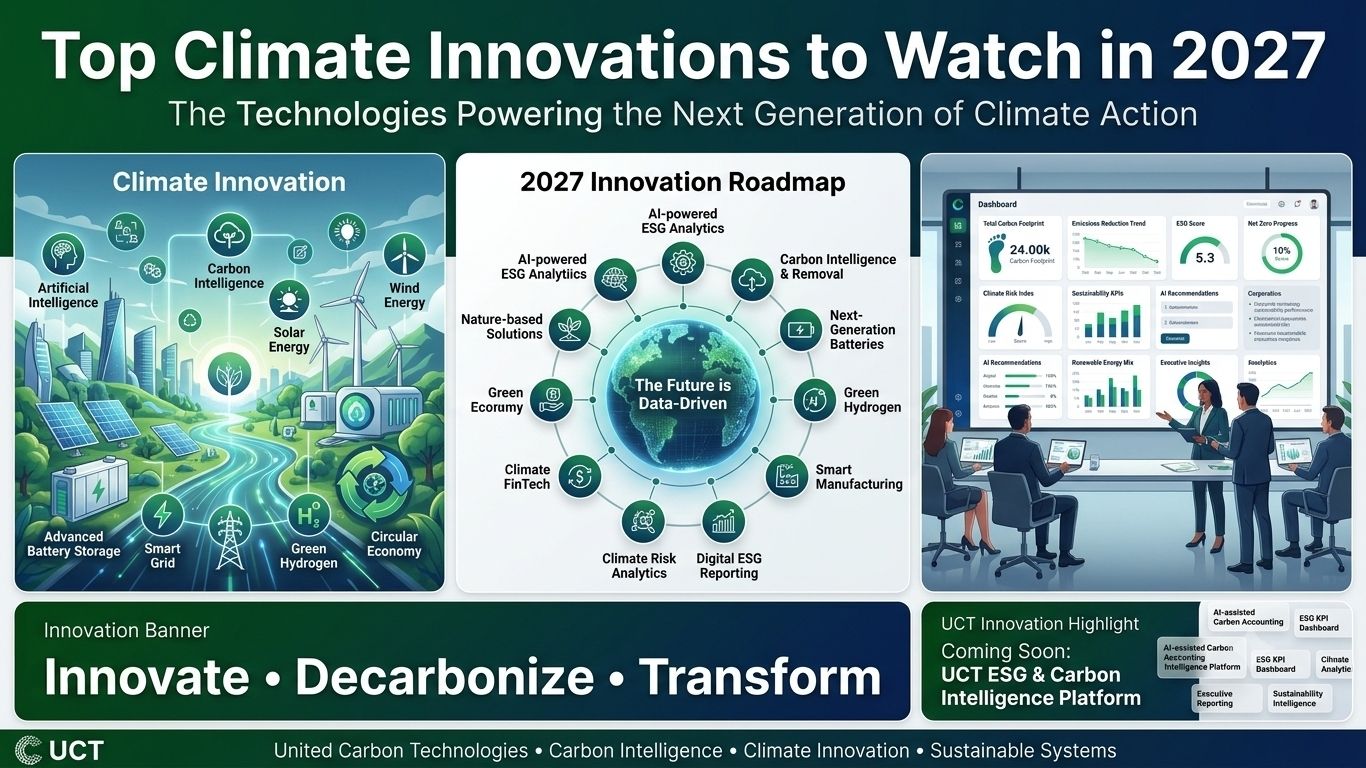
Introduction
The climate transition is no longer driven by policy alone—it is increasingly powered by innovation. Companies are developing technologies that help measure emissions more accurately, optimize energy use, decarbonize industries, improve ESG reporting, and create entirely new low-carbon business models.
Artificial intelligence is transforming Carbon Accounting. Digital twins are improving industrial efficiency. Climate-focused software platforms are simplifying ESG reporting. Meanwhile, breakthroughs in renewable energy, batteries, carbon removal, and sustainable materials continue to reshape global markets.
This article explores the most promising climate innovations expected to influence businesses and sustainability strategies in 2027.
💡 Did You Know?
- Climate technology has become one of the fastest-growing global innovation sectors.
- Artificial Intelligence is increasingly used to automate Carbon Accounting and ESG reporting.
- Digital sustainability platforms are helping organizations make faster, data-driven climate decisions.
- Many emerging climate innovations focus on improving both environmental performance and business efficiency.
1. AI-Powered Carbon Intelligence
Artificial Intelligence is transforming how organizations collect, analyze, and report sustainability data. AI-powered Carbon Intelligence platforms can automate emissions calculations, identify reduction opportunities, improve reporting accuracy, and provide predictive insights for decision-makers.
Applications Include
- Automated Carbon Accounting
- Emission forecasting
- ESG data analysis
- Supply chain emissions monitoring
- Climate risk analytics
- Executive sustainability dashboards
- Predictive Net Zero planning
- Automated compliance reporting
2. ESG Intelligence Platforms
Organizations increasingly require integrated platforms that combine Carbon Accounting, ESG reporting, sustainability KPIs, climate disclosures, and executive dashboards into one intelligent system.
This is one of the fastest-growing areas of climate technology because businesses are moving away from spreadsheets toward centralized digital sustainability management.
Organizations investing in digital climate intelligence today will be better positioned to measure performance, improve decision-making, and adapt to future sustainability requirements.
The Future of ESG Intelligence Starts Here
United Carbon Technologies is developing an ESG & Carbon Intelligence Platform designed to help organizations centralize Carbon Accounting, monitor ESG KPIs, visualize sustainability dashboards, and simplify climate reporting. Our vision is to make climate intelligence more accessible, actionable, and data-driven for businesses of all sizes.
Currently under development. Pilot implementations are planned to support organizations seeking better sustainability data management and executive decision-making.
3. Advanced Battery Storage Technologies
Renewable energy growth depends on efficient energy storage. Next-generation battery technologies are expected to improve energy density, charging speed, safety, lifecycle, and affordability, making renewable power more reliable for homes, businesses, and utilities.
Key Innovations
- Solid-state batteries
- Long-duration energy storage
- Sodium-ion batteries
- Grid-scale battery systems
- Battery recycling technologies
- AI-powered energy optimization
- Distributed energy storage
- Smart battery management systems
4. Carbon Capture, Utilization & Removal
While emissions reduction remains the highest priority, carbon removal technologies are expected to play an increasingly important role in addressing residual emissions that are difficult to eliminate.
Emerging Technologies
- Direct Air Capture (DAC)
- Carbon Capture & Storage (CCS)
- Carbon Capture, Utilization & Storage (CCUS)
- Biochar production
- Enhanced weathering
- Nature-based carbon removal
- Industrial carbon utilization
- Carbon mineralization
5. Green Hydrogen
Green Hydrogen is emerging as one of the most promising solutions for decarbonizing industries that are difficult to electrify. Produced using renewable electricity, it has the potential to reduce emissions across manufacturing, transportation, and heavy industry.
Potential Applications
- Steel production
- Chemical manufacturing
- Heavy transport
- Shipping
- Aviation fuels
- Industrial heat
- Energy storage
- Grid balancing
6. Climate FinTech & Sustainable Finance Platforms
Digital financial technologies are making climate investment more transparent and data-driven. Climate FinTech platforms help investors, lenders, and businesses evaluate sustainability performance, climate risks, and ESG metrics before making financial decisions.
Growing Solutions
- Green investment analytics
- Climate risk modeling
- Carbon credit marketplaces
- Sustainability-linked finance tools
- ESG investment dashboards
- Digital green bond management
- Climate portfolio analysis
- Automated sustainability disclosures
7. Smart Climate Intelligence Platforms
Businesses increasingly require a single source of truth for sustainability information. Modern Climate Intelligence platforms combine Carbon Accounting, ESG reporting, climate risk analysis, executive dashboards, AI insights, and compliance workflows into integrated business systems.
These platforms reduce manual reporting while improving transparency, decision-making, and operational efficiency across the organization.
United Carbon Technologies is developing an ESG & Carbon Intelligence Platform that aims to centralize Carbon Accounting, ESG metrics, sustainability dashboards, AI-assisted analytics, and executive reporting in one unified system. The pilot phase is planned to support organizations seeking practical, data-driven sustainability management and improved climate decision-making.
8. Sustainable Manufacturing Technologies
Manufacturers are adopting digital technologies that reduce waste, optimize energy use, improve resource efficiency, and lower emissions throughout production processes.
Examples Include
- Digital twins
- AI-powered process optimization
- Smart factories
- Low-carbon materials
- Circular manufacturing
- Industrial IoT sensors
- Waste heat recovery
- Predictive maintenance systems
9. AI-Powered Climate Risk Analytics
Organizations increasingly recognize climate risk as a strategic business risk. AI-powered analytics help evaluate physical risks, transition risks, supply chain vulnerabilities, and long-term climate scenarios using large datasets and predictive models.
These insights support stronger business continuity planning, investment decisions, insurance assessments, and sustainability governance.
10. Climate Innovation in India
India's rapidly growing startup ecosystem, expanding renewable energy capacity, digital public infrastructure, and strong engineering talent position the country as an important contributor to global climate innovation. Emerging opportunities include Carbon Accounting software, ESG platforms, renewable energy technologies, sustainable agriculture, electric mobility, and AI-powered climate solutions.
As businesses increasingly prioritize sustainability, innovation will become a key driver of competitiveness, resilience, and long-term economic growth.
Build the Future with Climate Intelligence
United Carbon Technologies is building an ESG & Carbon Intelligence Platform to help organizations measure emissions, centralize sustainability data, monitor ESG KPIs, and visualize executive dashboards. Our long-term vision is to make climate intelligence practical, affordable, and actionable for businesses across India and beyond.
India Context
India's ambition to expand clean energy, modernize industry, strengthen digital infrastructure, and build climate resilience is creating significant opportunities for climate innovation. From AI-powered sustainability software to advanced manufacturing and clean energy technologies, Indian companies are increasingly contributing to the global climate-tech ecosystem.
Related Reads
- Transition Finance Explained: Funding the Net Zero Economy
- Green Finance vs Sustainable Finance Explained
- Building an ESG Dashboard: Metrics Every Company Should Monitor
- How Businesses Improve Carbon Data Quality
- Materiality Assessment Explained for ESG Reporting
- IFRS S1 and IFRS S2 Explained
💡 Expert Insight
The next wave of climate leadership will belong to organizations that combine digital innovation with measurable sustainability outcomes. Technologies such as Artificial Intelligence, Carbon Intelligence platforms, climate analytics, and integrated ESG systems will increasingly become strategic business infrastructure rather than optional sustainability tools.
Conclusion
Climate innovation is moving beyond individual technologies toward connected ecosystems that combine artificial intelligence, sustainability data, clean energy, advanced materials, and digital decision-making. Businesses that understand and adopt these innovations will be better positioned to improve resilience, strengthen ESG performance, reduce emissions, and compete in the low-carbon economy of the future.
Quick Summary
- AI is transforming Carbon Accounting and ESG reporting.
- Battery storage will accelerate renewable energy adoption.
- Carbon removal technologies continue to evolve.
- Green Hydrogen supports industrial decarbonization.
- Climate FinTech is changing sustainable investment.
- Climate Intelligence platforms centralize sustainability data.
- India is emerging as a major climate innovation hub.
Frequently Asked Questions (FAQs)
1. What is Climate Innovation?
Climate innovation refers to new technologies, business models, and solutions that help reduce emissions, improve sustainability, and strengthen climate resilience.
2. Why is AI important for climate action?
AI improves emissions analysis, forecasting, ESG reporting, and operational decision-making.
3. What industries benefit most from climate innovation?
Energy, manufacturing, transportation, agriculture, finance, construction, and technology sectors all benefit.
4. What is Carbon Intelligence?
Carbon Intelligence combines emissions data, analytics, and digital tools to support informed climate decisions.
5. Why is battery innovation important?
Better batteries improve renewable energy reliability and accelerate electrification.
6. What role does Green Hydrogen play?
Green Hydrogen can help reduce emissions in industries that are difficult to electrify directly.
7. How do ESG platforms support businesses?
They centralize sustainability data, simplify reporting, and improve executive visibility.
8. Is India becoming a climate-tech leader?
India is expanding its climate-tech ecosystem through innovation, renewable energy, digital technologies, and entrepreneurship.
9. Why are Climate Intelligence platforms growing?
Organizations need integrated systems to manage ESG data, Carbon Accounting, and sustainability reporting efficiently.
10. What climate innovations should businesses watch beyond 2027?
AI-driven sustainability tools, advanced energy storage, carbon removal, circular manufacturing, digital climate analytics, and next-generation clean technologies are expected to continue evolving.
Key Takeaways
- Climate innovation is becoming a competitive business advantage.
- AI and Climate Intelligence will reshape sustainability management.
- Digital ESG platforms will replace fragmented reporting processes.
- Clean technologies support both business growth and emissions reduction.
- Organizations investing in innovation today will be better prepared for tomorrow's climate economy.
Stay Ahead of the Next Climate Innovation Wave
Follow United Carbon Technologies for practical insights on Climate Intelligence, Carbon Accounting, ESG reporting, sustainable finance, and emerging climate technologies. As we continue developing our ESG & Carbon Intelligence Platform, our goal is to help organizations transform sustainability data into smarter business decisions.