

The Carbon Footprint of AI: Managing Tech Emissions in Indian Enterprises
Search Description: Discover the carbon footprint of AI and how Indian enterprises can reduce tech emissions through green AI, carbon accounting, and sustainable computing.
By United Carbon Technologies | Published: August 2026 | Updated: August 2026
Join students, professionals, businesses, and sustainability leaders exploring carbon accounting, ESG reporting, climate intelligence, Net Zero strategies, and environmental innovation from United Carbon Technologies.
Artificial Intelligence Is Changing Business—But at What Environmental Cost?
Artificial Intelligence (AI) is transforming industries across India. From customer service chatbots and predictive analytics to generative AI and autonomous systems, organizations are adopting AI to improve productivity, reduce costs, and accelerate innovation. However, behind every AI model lies a significant amount of computing power, electricity consumption, and carbon emissions.
Training large AI models requires thousands of high-performance processors operating continuously inside energy-intensive data centers. As AI adoption accelerates, enterprises must begin considering not only financial costs but also the environmental impact of their digital transformation strategies.
This growing environmental challenge has given rise to Green AI—an approach that focuses on developing and deploying AI systems efficiently while minimizing energy consumption and greenhouse gas emissions. For Indian enterprises pursuing ESG goals, understanding the carbon footprint of AI is becoming an essential part of responsible business strategy.
What is the carbon footprint of AI?
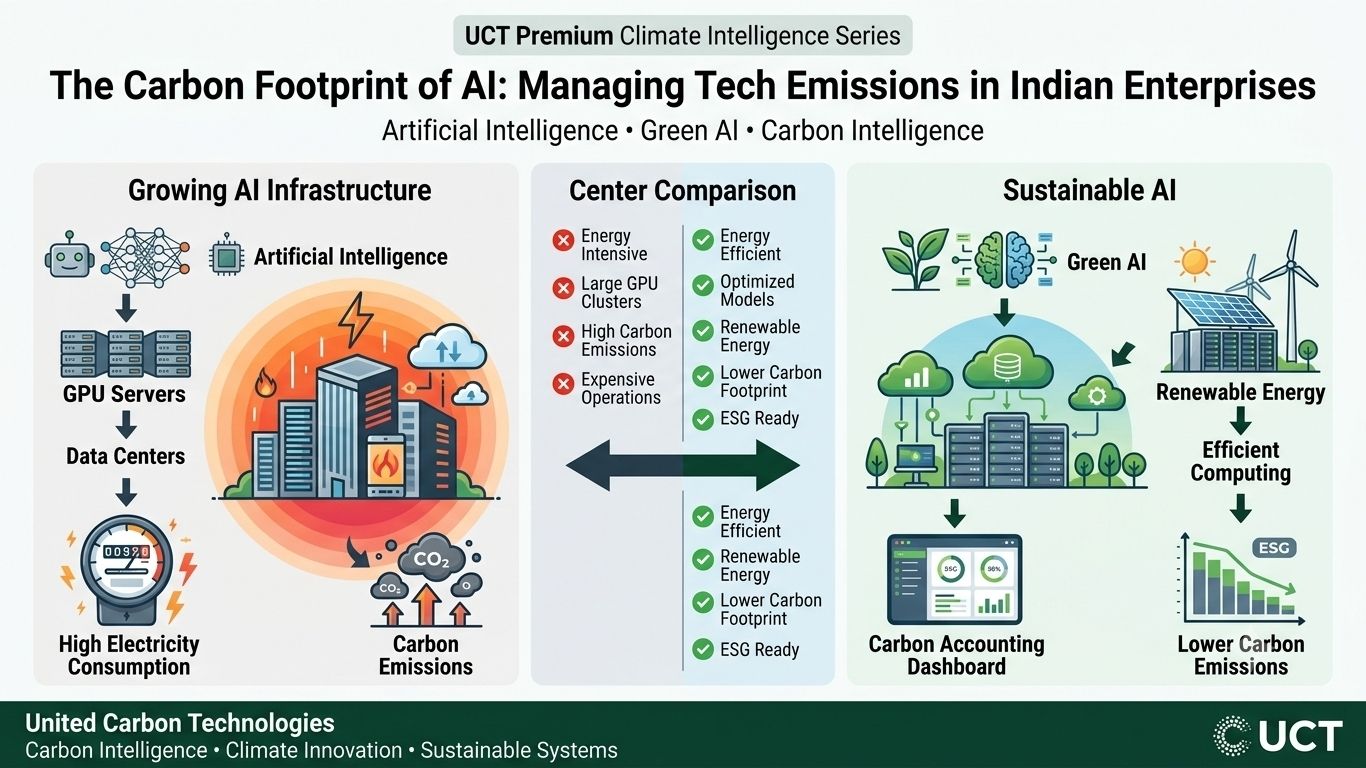
The carbon footprint of AI refers to the greenhouse gas emissions generated by developing, training, deploying, and operating artificial intelligence systems. These emissions primarily result from electricity consumed by data centers, cloud infrastructure, GPUs, and supporting digital technologies.
Introduction
Artificial Intelligence has become one of the defining technologies of the modern economy. Organizations across sectors—including manufacturing, healthcare, finance, retail, logistics, and government—are increasingly integrating AI into everyday operations. While these technologies deliver remarkable efficiency gains, they also increase demand for computing infrastructure and electricity.
Most AI workloads rely on cloud computing platforms, high-performance GPUs, and hyperscale data centers operating around the clock. As enterprises scale AI adoption, energy consumption grows rapidly, making digital operations a significant contributor to organizational carbon footprints.
For businesses committed to sustainability, measuring AI-related emissions is becoming as important as measuring emissions from manufacturing, transportation, or office operations. Carbon accounting now extends beyond physical assets into the digital world, helping organizations understand and manage the environmental impact of emerging technologies.
🌍 Measure Digital Emissions with Carbon Intelligence
Modern sustainability goes beyond factories and vehicles. Organizations must also understand the carbon impact of cloud computing, AI infrastructure, enterprise software, and digital operations. Carbon Intelligence helps businesses identify emission hotspots and develop smarter decarbonization strategies.
Measure • Analyze • Optimize • Decarbonize
💡 Did You Know?
Large AI models can require thousands of GPUs running continuously for days or even weeks during training. The electricity consumed by these systems contributes to greenhouse gas emissions, particularly when powered by fossil fuel-based energy grids.
Why Artificial Intelligence Has a Carbon Footprint
Although AI appears to operate entirely in the digital world, every AI application depends on physical infrastructure. Massive data centers house servers, networking equipment, storage devices, and cooling systems that require significant electricity to operate. As AI models become more advanced, computational requirements—and associated emissions—continue to increase.
Every stage of the AI lifecycle contributes to environmental impact, from collecting and storing training data to model development, deployment, continuous updates, and user interactions.
Major Sources of AI Emissions
- High-performance GPU clusters.
- Cloud computing infrastructure.
- Electricity consumed by data centers.
- Cooling systems for servers.
- Manufacturing of computing hardware.
- Continuous AI model training and updates.
- Large-scale data storage.
Understanding the AI Carbon Lifecycle
Managing AI emissions requires understanding where environmental impacts occur throughout the technology lifecycle. Carbon accounting enables organizations to identify these emission sources and prioritize improvements.
| AI Stage | Primary Resource Used | Environmental Impact |
|---|---|---|
| Model Training | GPU Computing | High electricity consumption |
| Cloud Storage | Data Centers | Continuous energy use |
| AI Inference | Enterprise Servers | Daily operational emissions |
| Hardware Production | Semiconductor Manufacturing | Embodied carbon emissions |
🎓 Learn Carbon Accounting for Emerging Technologies
Discover how AI, cloud computing, ESG reporting, and carbon accounting work together to build more sustainable digital enterprises through UCT Academy.
Measure the Carbon Footprint of Your Digital Operations
United Carbon Technologies helps organizations assess emissions from digital infrastructure, cloud computing, AI adoption, and enterprise operations through carbon accounting, ESG reporting, and Climate Intelligence solutions.
Green AI: Building Sustainable Artificial Intelligence
Green AI is an emerging approach that focuses on designing, training, and deploying artificial intelligence systems with lower energy consumption and reduced environmental impact. Rather than developing increasingly large models without considering resource requirements, Green AI encourages efficiency, transparency, and sustainability throughout the AI lifecycle.
Organizations can significantly reduce AI-related emissions by selecting efficient algorithms, optimizing model architectures, minimizing unnecessary computations, and using renewable-powered cloud infrastructure. These practices lower operational costs while supporting corporate ESG objectives.
Characteristics of Green AI
- Energy-efficient AI model design.
- Optimized training processes.
- Efficient GPU utilization.
- Renewable energy-powered cloud services.
- Lower computational waste.
- Transparent reporting of energy consumption.
- Integration with enterprise sustainability goals.
Carbon Accounting for AI Infrastructure
Traditional carbon accounting focused primarily on manufacturing plants, offices, logistics, and transportation. Today, digital infrastructure—including AI workloads, cloud computing, enterprise servers, and data centers—has become another important source of greenhouse gas emissions.
Organizations adopting AI should include digital operations within their carbon inventories to gain a complete understanding of enterprise emissions.
| Emission Source | Carbon Accounting Focus | Improvement Strategy |
|---|---|---|
| Cloud Computing | Electricity Consumption | Renewable-powered cloud providers |
| AI Training | GPU Utilization | Efficient model optimization |
| Enterprise Servers | Power Usage | Virtualization and consolidation |
| Hardware Lifecycle | Embodied Carbon | Responsible procurement and recycling |
How Indian Enterprises Can Reduce AI Emissions
As AI adoption accelerates across banking, healthcare, manufacturing, retail, IT services, and logistics, Indian enterprises have an opportunity to integrate sustainability into digital transformation from the beginning rather than treating it as an afterthought.
Practical Steps for Businesses
- Measure AI-related electricity consumption.
- Select energy-efficient cloud providers.
- Optimize AI models before deployment.
- Reduce unnecessary data storage.
- Improve server utilization rates.
- Adopt renewable energy where possible.
- Include AI infrastructure in ESG reporting.
- Track emissions using carbon accounting systems.
Why AI Sustainability Matters for ESG
Environmental, Social, and Governance (ESG) reporting is increasingly expanding beyond traditional operational emissions to include digital infrastructure and technology investments. Investors, regulators, and customers expect organizations to understand how emerging technologies affect sustainability performance.
Responsible AI adoption strengthens ESG disclosures by demonstrating that organizations are proactively measuring, managing, and reducing emissions associated with digital operations. Companies that integrate Green AI into their ESG strategies are better positioned for long-term resilience and stakeholder trust.
The Future of Sustainable AI
Artificial intelligence will continue transforming businesses over the coming decade. However, future AI systems must balance innovation with environmental responsibility. Advances in energy-efficient hardware, optimized algorithms, renewable-powered data centers, and carbon-aware computing will help reduce the environmental footprint of digital technologies.
Organizations that embrace sustainable AI today will benefit from lower operational costs, improved ESG performance, stronger regulatory readiness, and greater investor confidence while contributing to global climate goals.
AI and Climate Responsibility in India
India is rapidly becoming one of the world's largest AI markets, with growing investments in digital infrastructure, cloud computing, semiconductor manufacturing, and data centers. As AI adoption expands across enterprises and government initiatives, incorporating carbon accounting into digital transformation will become increasingly important.
Indian organizations can lead by adopting Green AI principles, investing in renewable-powered infrastructure, improving energy efficiency, and integrating digital emissions into ESG reporting frameworks.
What's Next?
The next generation of enterprise sustainability will extend beyond physical operations into digital ecosystems. Measuring emissions from AI, cloud computing, software platforms, and enterprise technology will become an essential part of comprehensive carbon management and climate intelligence.
Related Reads
- Cloud Computing & Data Center Footprints: What Indian IT Hubs Need to Know
- What Is Carbon Accounting? Complete Guide for Beginners
- How to Build a Carbon Inventory
- Understanding Scope 1, Scope 2 & Scope 3 Emissions
- ESG Reporting Checklist for Businesses
- What Is a Carbon Disclosure Report?
- The Hidden Carbon Cost of E-Commerce Logistics in India
- Climate Resilient Cities: How Urban Green Spaces Benefit Indian Real Estate
Quick Summary
- Artificial Intelligence has a measurable carbon footprint.
- Data centers and GPUs are major contributors to AI emissions.
- Green AI focuses on energy-efficient computing.
- Carbon accounting should include digital infrastructure.
- Indian enterprises can reduce AI emissions through smarter technology choices.
- AI sustainability strengthens ESG performance.
- Renewable-powered cloud computing supports decarbonization.
- Climate Intelligence enables sustainable digital transformation.
Frequently Asked Questions
1. What is the carbon footprint of AI?
It is the greenhouse gas emissions generated during the development, training, deployment, and operation of artificial intelligence systems.
2. Why does AI consume so much energy?
Large AI models require powerful GPUs, continuous data processing, cloud infrastructure, and cooling systems that consume significant electricity.
3. What is Green AI?
Green AI focuses on developing efficient AI systems that minimize energy consumption and environmental impact while maintaining performance.
4. How do data centers contribute to AI emissions?
Data centers consume large amounts of electricity to operate servers, storage systems, networking equipment, and cooling infrastructure.
5. Can AI support climate action?
Yes. AI can optimize energy systems, improve resource efficiency, support climate modeling, and enhance sustainability reporting while being managed responsibly.
6. Should AI emissions be included in carbon accounting?
Yes. Digital infrastructure is becoming an important source of enterprise emissions and should be incorporated into comprehensive carbon inventories.
7. How can organizations reduce AI emissions?
By optimizing models, improving server efficiency, using renewable-powered cloud providers, and implementing Green AI practices.
8. Why is AI sustainability important for ESG?
It demonstrates responsible technology management, improves environmental performance, and supports transparent sustainability reporting.
9. How is India addressing sustainable AI?
India is expanding AI, cloud infrastructure, and digital innovation while increasing focus on energy efficiency, renewable energy, and responsible technology adoption.
10. How can United Carbon Technologies help?
United Carbon Technologies helps organizations measure digital emissions, implement carbon accounting, strengthen ESG reporting, and develop Climate Intelligence strategies for sustainable technology adoption.
Key Takeaways
- AI innovation must be balanced with environmental responsibility.
- Digital operations contribute to enterprise carbon footprints.
- Green AI supports sustainable computing.
- Carbon accounting should extend to AI infrastructure.
- Indian enterprises can lead responsible AI adoption through Climate Intelligence and ESG integration.
Build Sustainable AI with Carbon Intelligence
United Carbon Technologies helps organizations measure technology emissions, implement carbon accounting, strengthen ESG reporting, and develop sustainable digital transformation strategies for the future.