

```html
Beyond Consumer Recycling: Why Indian Industries Must Shift to a Circular Economy
Search Description: Discover why India's industries must adopt a circular economy to reduce waste, strengthen ESG, meet EPR goals, and build sustainable manufacturing.
By United Carbon Technologies | Published: August 2026 | Updated: August 2026
Join professionals, students, manufacturers, and sustainability leaders exploring circular economy, ESG reporting, carbon accounting, Net Zero, and climate innovation from United Carbon Technologies.
India's Future Depends on Circular Manufacturing
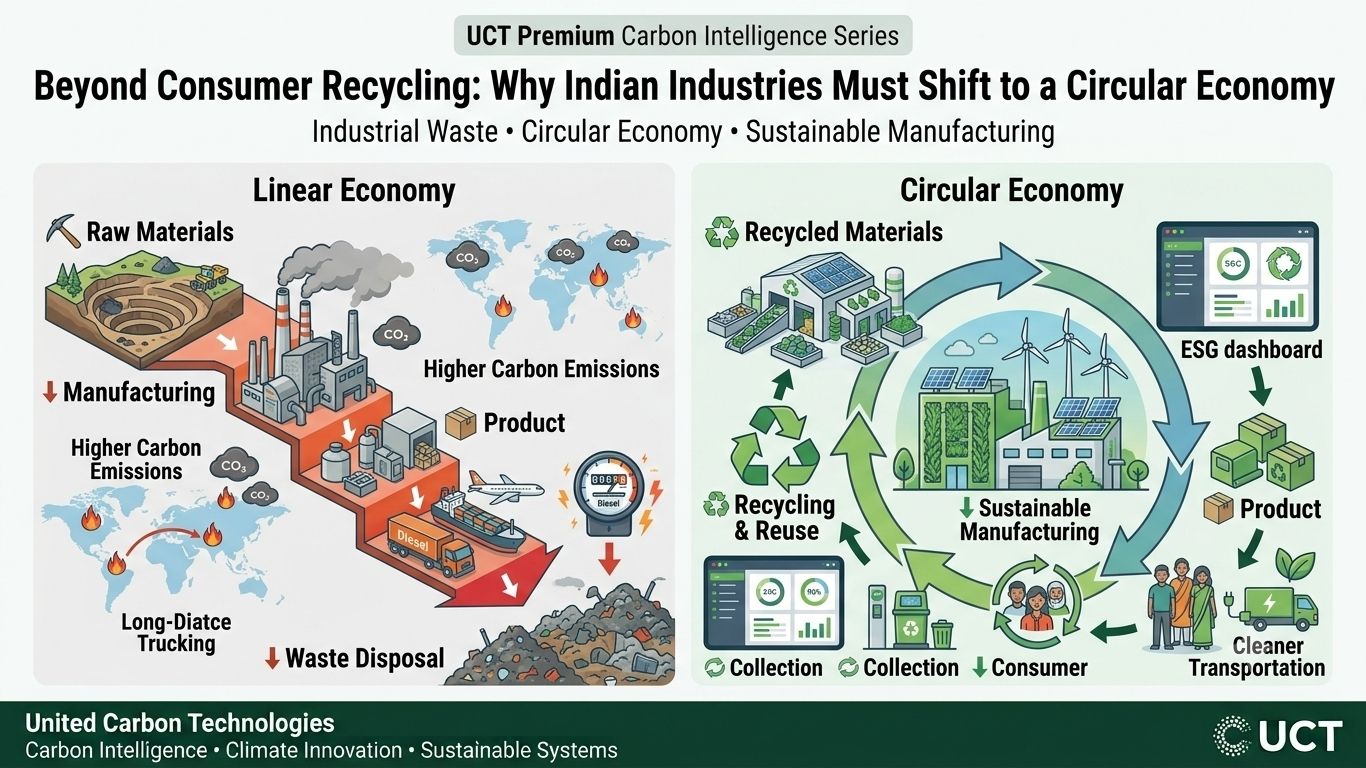
For decades, industries have operated on a simple model—extract resources, manufacture products, sell them, and dispose of waste. While this linear economy has driven economic growth, it has also accelerated resource depletion, pollution, greenhouse gas emissions, and landfill waste. As climate risks and resource constraints increase, businesses must rethink how products are designed, manufactured, used, and recovered.
A circular economy offers a more sustainable alternative. Instead of treating products as disposable, circular systems focus on designing out waste, extending product life, recovering valuable materials, and keeping resources in continuous use. For Indian industries, this transition is becoming essential for achieving ESG goals, reducing carbon emissions, complying with Extended Producer Responsibility (EPR) regulations, and improving long-term competitiveness.
This guide explains why recycling alone is no longer enough, how circular economy principles benefit Indian manufacturers, and how carbon accounting supports the transition toward sustainable industrial systems.
Why is a circular economy important for Indian industries?
A circular economy helps Indian industries reduce waste, improve resource efficiency, lower carbon emissions, meet Extended Producer Responsibility (EPR) requirements, strengthen ESG performance, and build more resilient manufacturing systems.
Introduction
Most people associate sustainability with recycling household waste. While consumer recycling is important, it addresses only a small part of the overall waste challenge. Industries generate enormous quantities of material waste during extraction, manufacturing, packaging, transportation, and end-of-life product management. Reducing this industrial waste requires systemic changes rather than isolated recycling initiatives.
The circular economy encourages businesses to rethink every stage of the product lifecycle. Products are designed for durability, repairability, reuse, remanufacturing, and recycling, allowing valuable materials to remain in circulation instead of becoming waste. This approach conserves natural resources while reducing environmental impacts throughout the value chain.
For Indian manufacturers and MSMEs, adopting circular economy principles also improves operational efficiency, reduces dependence on virgin materials, enhances supply chain resilience, and creates new business opportunities in sustainable manufacturing.
💡 Did You Know?
Manufacturing, construction, mining, and industrial production generate substantially more material waste than households. Improving industrial resource efficiency can therefore have a much larger impact on reducing emissions and conserving natural resources than consumer recycling alone.
From Recycling to a Circular Economy
Recycling is only one component of a circular economy. While recycling recovers materials after products become waste, circular economy principles begin much earlier—during product design, material selection, manufacturing, and supply chain planning. The objective is to eliminate waste before it is created rather than managing it after disposal.
Instead of following the traditional "take-make-dispose" model, circular systems prioritize designing products that can be repaired, upgraded, reused, refurbished, or remanufactured. Materials remain in circulation for as long as possible, reducing demand for virgin resources and lowering lifecycle carbon emissions.
Core Principles of a Circular Economy
- Design products for longer life.
- Reduce dependence on virgin raw materials.
- Promote repair and refurbishment.
- Reuse components wherever possible.
- Recycle materials back into production.
- Recover valuable resources from waste streams.
- Minimize landfill disposal.
- Improve resource efficiency across operations.
Why Indian Industries Must Move Beyond Waste Disposal
Industrial sustainability is no longer measured solely by how much waste is recycled. Investors, regulators, customers, and global supply chains increasingly evaluate how efficiently businesses use materials, reduce emissions, and minimize environmental impacts throughout their operations.
Indian industries that continue relying on linear production systems face rising raw material costs, resource scarcity, stricter environmental regulations, and increasing ESG expectations. Circular manufacturing helps businesses reduce these risks while creating long-term economic value.
| Linear Economy | Circular Economy |
|---|---|
| Extract → Produce → Dispose | Reduce → Reuse → Repair → Recycle |
| High resource consumption | Efficient resource utilization |
| Higher carbon emissions | Lower lifecycle emissions |
| Large waste generation | Minimal waste generation |
Industrial Waste Management Challenges in India
India's rapid industrialization has significantly increased the demand for raw materials, energy, and manufacturing capacity. While this growth supports economic development, it also generates large quantities of industrial waste. Manufacturing industries produce metal scrap, plastic waste, chemicals, packaging materials, construction debris, wastewater, and electronic waste, much of which still follows a linear "use and dispose" model.
Improving industrial waste management requires businesses to move beyond disposal and adopt strategies that reduce waste generation at its source. Recovering valuable materials, redesigning products, and improving production efficiency can simultaneously reduce operating costs and carbon emissions.
Major Sources of Industrial Waste
- Manufacturing process scrap.
- Packaging waste.
- Construction and demolition materials.
- Electronic waste (E-Waste).
- Chemical and hazardous waste.
- Textile and garment waste.
- Food processing by-products.
- Metal and plastic production waste.
Understanding Extended Producer Responsibility (EPR)
Extended Producer Responsibility (EPR) is transforming how businesses manage products after they reach the end of their useful life. Instead of placing the responsibility solely on consumers or local governments, EPR requires producers to take accountability for collecting, recycling, recovering, or safely disposing of products and packaging.
In India, EPR regulations have become increasingly important for sectors such as plastics, batteries, electronics, tyres, and packaging materials. Organizations that proactively integrate EPR into their business strategy can improve compliance while strengthening their environmental reputation.
| Traditional Approach | EPR Approach |
|---|---|
| Sell product | Manage full product lifecycle |
| Waste handled externally | Producer shares responsibility |
| Limited recycling | Resource recovery and recycling |
| Linear economy | Circular economy model |
Best Practices for Circular Manufacturing
Circular manufacturing begins long before a product reaches the customer. It starts with designing products that consume fewer resources, last longer, and can be repaired, upgraded, or recycled. Manufacturers that integrate circular principles throughout production reduce operational risks while improving profitability.
Practical Circular Manufacturing Strategies
- Design products for durability.
- Use recycled and renewable materials.
- Reduce production waste.
- Recover manufacturing scrap.
- Improve energy efficiency.
- Repair and refurbish returned products.
- Implement closed-loop manufacturing.
- Collaborate with recycling partners.
These strategies help businesses reduce resource dependency, improve supply chain resilience, and lower lifecycle greenhouse gas emissions.
How Carbon Accounting Supports the Circular Economy
A circular economy cannot be managed effectively without reliable data. Carbon accounting enables businesses to measure emissions associated with raw materials, manufacturing, transportation, waste generation, recycling, and resource recovery. This information helps organizations identify opportunities to reduce emissions while improving material efficiency.
Instead of treating waste management as a compliance activity, businesses can use carbon accounting to evaluate the environmental impact of procurement decisions, production processes, and product lifecycle management.
The organizations that will lead tomorrow's low-carbon economy are those that measure emissions, understand material flows, and use data to improve both environmental and business performance.
The Future of Circular Industries in India
India is increasingly positioning itself as a global manufacturing hub while pursuing sustainable economic growth. Circular economy practices will play a central role in achieving this balance. As ESG expectations rise, businesses adopting resource-efficient manufacturing, sustainable procurement, renewable energy, and circular product design will gain competitive advantages in both domestic and international markets.
Emerging technologies such as Artificial Intelligence, IoT, Digital Twins, advanced recycling technologies, and carbon accounting software will further accelerate the transition toward circular manufacturing ecosystems.
India Context: Circular Economy Is Becoming a Business Necessity
Government initiatives including Swachh Bharat Mission, National Resource Efficiency Policy, Extended Producer Responsibility (EPR), and sustainability reporting requirements are encouraging industries to adopt circular economy principles. Large corporations are increasingly asking suppliers to demonstrate responsible resource management and environmental performance, creating new opportunities for Indian MSMEs that invest in sustainable manufacturing.
What's Next?
The future of manufacturing will depend not only on production capacity but also on how efficiently organizations use resources. Businesses that integrate circular economy principles with carbon accounting and ESG reporting will be better prepared for future regulations, investor expectations, and changing customer preferences.
Related Reads
- What Is Carbon Accounting? Complete Guide for Beginners
- Decarbonizing the Supply Chain: Why Buying Local Matters for Indian MSMEs
- ESG Reporting Checklist for Businesses
- The Carbon Footprint of AI: Managing Tech Emissions in Indian Enterprises
- Cloud Computing & Data Center Footprints: What Indian IT Hubs Need to Know
- The Hidden Carbon Cost of E-Commerce Logistics in India
- Climate Resilient Cities: How Urban Green Spaces Benefit Indian Real Estate
- How to Build a Carbon Inventory
Quick Summary
- A circular economy goes beyond traditional recycling.
- Industrial waste reduction begins with better product design.
- EPR encourages producers to manage products throughout their lifecycle.
- Circular manufacturing improves resource efficiency.
- Carbon accounting measures emissions across material flows.
- ESG reporting increasingly includes resource efficiency indicators.
- Indian industries can improve resilience through circular business models.
- Climate Intelligence enables data-driven sustainability decisions.
Frequently Asked Questions
1. What is a circular economy?
A circular economy keeps products and materials in use for as long as possible through reuse, repair, refurbishment, remanufacturing, and recycling.
2. How is a circular economy different from recycling?
Recycling is one part of the circular economy. Circular systems focus on preventing waste through better product design and resource efficiency before recycling becomes necessary.
3. Why is industrial waste management important?
Effective industrial waste management reduces pollution, conserves natural resources, lowers costs, and supports sustainable manufacturing.
4. What is Extended Producer Responsibility (EPR)?
EPR requires producers to take responsibility for collecting, recycling, or safely managing products after their useful life.
5. Which industries are affected by EPR in India?
Plastic packaging, electronics, batteries, tyres, and several other sectors are increasingly covered by EPR regulations.
6. How does the circular economy reduce carbon emissions?
Using fewer virgin materials, recovering resources, and extending product life reduces energy consumption and greenhouse gas emissions.
7. What role does carbon accounting play?
Carbon accounting measures emissions associated with production, materials, waste, transportation, and recycling, helping businesses improve sustainability performance.
8. Why should MSMEs adopt circular manufacturing?
Circular manufacturing improves efficiency, lowers material costs, strengthens ESG performance, and increases competitiveness.
9. What technologies support a circular economy?
AI, IoT, digital twins, smart manufacturing systems, recycling technologies, and carbon accounting software help businesses optimize material use.
10. How can United Carbon Technologies support circular economy initiatives?
UCT provides Climate Intelligence, carbon accounting, ESG reporting support, sustainability consulting, and resource efficiency strategies for organizations transitioning toward circular manufacturing.
Key Takeaways
- Recycling alone cannot solve industrial sustainability challenges.
- Circular economy principles reduce waste while creating business value.
- EPR is reshaping industrial responsibility in India.
- Carbon accounting provides measurable insights into resource efficiency.
- Circular manufacturing supports long-term ESG and Net Zero goals.