

Climate Resilient Cities: How Urban Green Spaces Benefit Indian Real Estate
Search Description: Discover how urban green spaces improve climate resilience in India while increasing property value, sustainability, and healthier cities.
By United Carbon Technologies | Published: August 2026 | Updated: August 2026
Join students, professionals, businesses, and sustainability leaders exploring carbon accounting, ESG reporting, climate intelligence, Net Zero strategies, and environmental innovation from United Carbon Technologies.
Cities Must Adapt to a Changing Climate
Indian cities are growing faster than ever. Expanding infrastructure, rising populations, and rapid urbanization are driving economic development, but they are also increasing vulnerability to climate change. Heatwaves, urban flooding, deteriorating air quality, and water scarcity are becoming more frequent challenges across metropolitan regions.
Urban green spaces—including parks, urban forests, green roofs, roadside plantations, wetlands, and community gardens—are emerging as essential climate solutions. These nature-based assets not only improve the quality of life but also help cities adapt to changing environmental conditions while making neighborhoods healthier and more attractive for residents and investors.
For India's rapidly growing real estate sector, integrating green infrastructure is no longer just an aesthetic choice. It is becoming a strategic investment that supports climate resilience, improves ESG performance, enhances property value, and contributes to long-term sustainable urban development.
How do urban green spaces improve climate resilience?
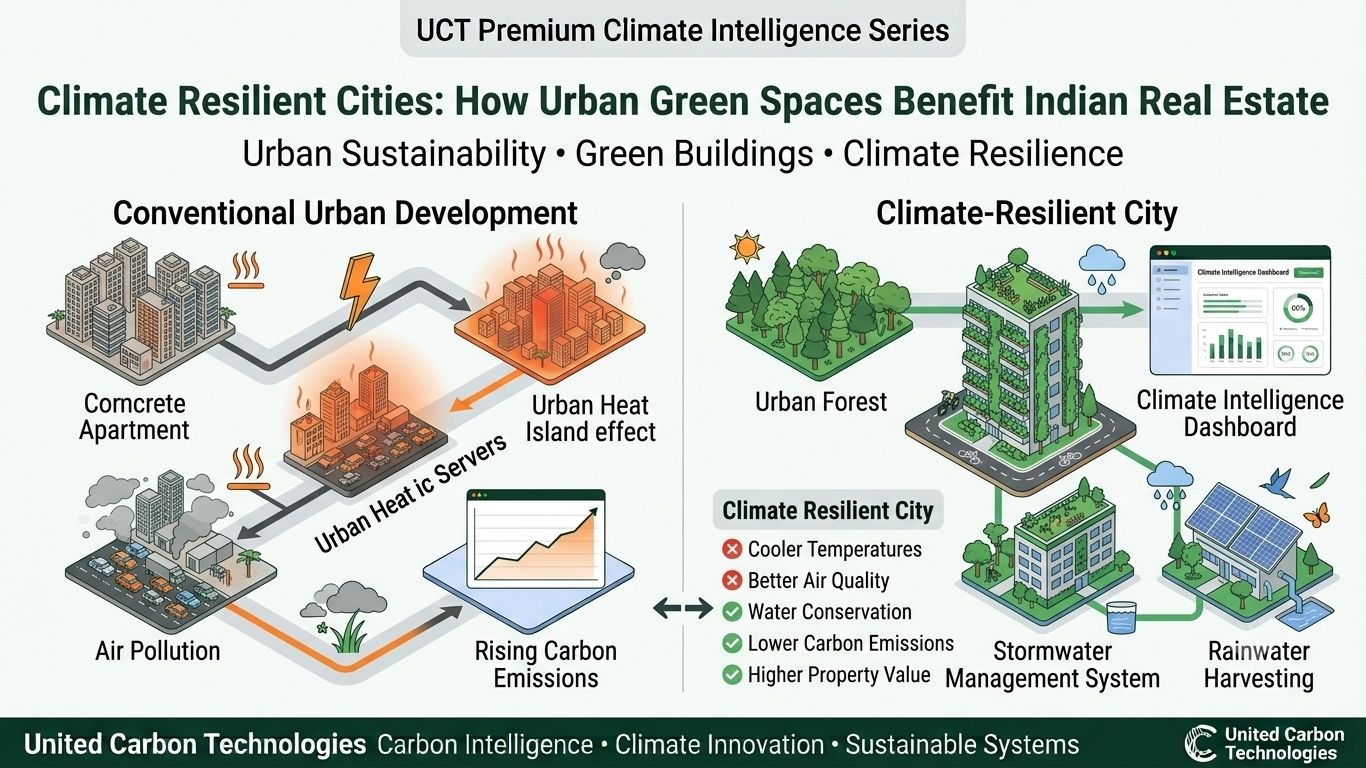
Urban green spaces reduce heat, improve air quality, absorb stormwater, increase biodiversity, and enhance public health, making cities more resilient to climate change while supporting sustainable real estate development.
Introduction
Climate resilience refers to the ability of cities to prepare for, respond to, and recover from climate-related events while continuing to support economic growth and community well-being. Traditionally, urban development prioritized roads, buildings, and commercial infrastructure, often at the expense of natural ecosystems.
Today, planners increasingly recognize that nature itself provides critical infrastructure. Trees reduce urban temperatures, wetlands absorb excess rainwater, parks improve mental health, and green corridors support biodiversity. Together, these nature-based solutions strengthen cities against both current and future climate risks.
As Indian cities continue expanding under initiatives such as Smart Cities Mission and sustainable urban development programs, integrating green spaces into planning has become an important component of building resilient communities and future-ready real estate.
🌍 Build Climate-Resilient Infrastructure with Carbon Intelligence
Understanding the environmental performance of buildings and urban developments begins with measuring emissions, evaluating climate risks, and integrating sustainability into planning decisions. Carbon intelligence enables organizations to create resilient infrastructure while meeting ESG objectives.
Measure • Plan • Adapt • Build Sustainably
💡 Did You Know?
Trees and urban vegetation naturally cool surrounding areas through shade and evapotranspiration, helping reduce the urban heat island effect. Well-designed green spaces can also improve stormwater management, reduce air pollution, and increase biodiversity within cities.
Why Climate Resilience Matters for Indian Cities
India is experiencing more frequent climate-related events, including prolonged heatwaves, intense rainfall, flooding, droughts, and declining air quality. As urban populations continue growing, these challenges place increasing pressure on infrastructure, public health, transportation systems, and housing.
Climate-resilient cities are designed to anticipate these risks while minimizing environmental impacts. Rather than relying solely on engineered infrastructure, resilient cities combine technology with natural ecosystems to create safer, healthier, and more sustainable urban environments.
Major Climate Challenges Facing Indian Cities
- Increasing urban heat island effect.
- Frequent flooding during heavy rainfall.
- Declining air quality and rising pollution.
- Loss of biodiversity due to urban expansion.
- Water scarcity during extended dry periods.
- Growing energy demand for cooling buildings.
How Urban Green Spaces Create Climate Resilience
Urban green spaces provide multiple environmental, economic, and social benefits simultaneously. Parks, green belts, street trees, wetlands, rooftop gardens, and urban forests act as natural climate infrastructure that helps cities adapt to changing weather conditions.
| Green Infrastructure | Climate Benefit | Real Estate Advantage |
|---|---|---|
| Urban Parks | Reduce urban temperatures | Improves neighborhood value |
| Street Trees | Cleaner air and shade | Better walkability |
| Green Roofs | Lower building temperatures | Reduced cooling costs |
| Wetlands | Flood mitigation | Greater climate resilience |
| Urban Forests | Carbon sequestration | Premium living environment |
🎓 Learn Sustainable Urban Development with UCT Academy
Understand climate resilience, carbon accounting, ESG reporting, green buildings, and sustainable infrastructure through practical learning designed for future climate leaders.
Develop Climate-Smart Infrastructure
United Carbon Technologies supports developers, infrastructure companies, and organizations with carbon accounting, ESG reporting, sustainability assessments, and climate intelligence solutions for resilient urban development.
Green Buildings and Sustainable Real Estate
Green buildings are designed to minimize environmental impact throughout their lifecycle while creating healthier and more efficient spaces for occupants. When integrated with urban green infrastructure, these buildings become an important part of climate-resilient cities.
Developers across India are increasingly incorporating sustainable features such as rooftop gardens, rainwater harvesting, solar energy, energy-efficient lighting, natural ventilation, and water recycling systems. These investments not only reduce environmental impacts but also improve long-term operational performance.
Benefits of Green Buildings
- Lower electricity and water consumption.
- Reduced greenhouse gas emissions.
- Improved indoor air quality.
- Higher occupant comfort and productivity.
- Greater resilience against climate risks.
- Better ESG performance for developers.
- Enhanced long-term property value.
Nature-Based Solutions for Urban Development
Nature-based solutions use natural ecosystems to address environmental challenges while providing social and economic benefits. Instead of relying solely on concrete infrastructure, cities can integrate green spaces that naturally regulate temperature, manage stormwater, and improve biodiversity.
| Nature-Based Solution | Climate Benefit | Community Benefit |
|---|---|---|
| Urban Forests | Carbon storage and cooling | Better air quality |
| Rain Gardens | Stormwater management | Reduced flooding |
| Green Roofs | Lower building temperatures | Energy savings |
| Wetlands | Water storage | Flood resilience |
| Community Parks | Urban cooling | Health and recreation |
How Climate Resilience Increases Property Value
Climate resilience is becoming an important consideration for property buyers, investors, and financial institutions. Developments that integrate sustainability and climate adaptation measures are generally better positioned to withstand future environmental risks.
Homes located near parks, tree-lined streets, and open green spaces often offer improved living conditions through cleaner air, lower ambient temperatures, reduced noise pollution, and enhanced recreational opportunities. These factors can contribute to stronger long-term market appeal.
Commercial developments also benefit from lower operating costs, improved employee well-being, stronger ESG credentials, and enhanced attractiveness to environmentally conscious tenants and investors.
Climate Intelligence for Urban Planning
Building climate-resilient cities requires informed decision-making supported by reliable environmental data. Climate intelligence combines carbon accounting, geographic information systems (GIS), weather analytics, satellite observations, and ESG reporting to help planners understand environmental risks before major infrastructure decisions are made.
Using data-driven planning enables developers and city authorities to identify flood-prone areas, assess urban heat islands, optimize green infrastructure, and prioritize investments that improve long-term sustainability.
Climate Intelligence Supports:
- Carbon footprint assessments.
- Climate risk mapping.
- Urban heat analysis.
- Flood vulnerability studies.
- Sustainable land-use planning.
- ESG reporting and disclosures.
- Infrastructure resilience planning.
What Developers and City Planners Can Do
Building climate-resilient communities requires collaboration between governments, developers, planners, businesses, and citizens. Practical sustainability measures implemented today can significantly improve the resilience of future urban developments.
- Protect existing urban forests and wetlands.
- Increase tree canopy along roads.
- Integrate green roofs into new developments.
- Use permeable pavements where appropriate.
- Develop parks within residential communities.
- Adopt rainwater harvesting systems.
- Measure carbon emissions throughout project lifecycles.
- Include climate resilience in ESG strategies.
Climate-Resilient Cities in India
Indian cities are increasingly recognizing the importance of integrating nature into urban development. Programs such as the Smart Cities Mission, AMRUT, urban forestry initiatives, and state-level climate action plans encourage sustainable planning that balances economic growth with environmental protection.
Cities including Ahmedabad, Bengaluru, Hyderabad, Chennai, Pune, Kochi, Indore, Surat, and Delhi are implementing projects focused on urban forests, lake restoration, green mobility, rainwater harvesting, and climate adaptation. As these initiatives expand, green infrastructure will play an increasingly important role in reducing climate risks while improving quality of life.
What's Next?
The future of Indian cities depends on balancing rapid urbanization with environmental sustainability. Climate-resilient infrastructure, green buildings, urban biodiversity, and data-driven climate intelligence will become essential components of modern city planning. Organizations that embrace these approaches today will be better prepared for tomorrow's climate challenges.
Related Reads
- What Is Carbon Accounting? Complete Guide for Beginners
- Understanding Scope 1, Scope 2 & Scope 3 Emissions
- How to Build a Carbon Inventory
- ESG Reporting Checklist for Businesses
- What Is a Carbon Disclosure Report?
- Cloud Computing & Data Center Footprints: What Indian IT Hubs Need to Know
- The Hidden Carbon Cost of E-Commerce Logistics in India
- Net Zero vs Carbon Neutral: Understanding the Difference
Quick Summary
- Climate resilience helps cities prepare for climate change.
- Urban green spaces reduce heat and improve air quality.
- Nature-based solutions strengthen flood resilience.
- Green buildings improve sustainability and lower operating costs.
- Climate intelligence supports better urban planning.
- Sustainable infrastructure benefits both communities and investors.
- Climate-resilient cities contribute to long-term economic growth.
- India is increasingly investing in green urban development.
Frequently Asked Questions
1. What is climate resilience?
Climate resilience is the ability of communities, cities, and infrastructure to prepare for, respond to, and recover from climate-related events while maintaining essential functions.
2. Why are urban green spaces important?
Urban green spaces reduce heat, improve air quality, absorb rainwater, support biodiversity, and improve public health.
3. What are nature-based solutions?
Nature-based solutions use natural ecosystems such as forests, wetlands, parks, and green roofs to address environmental challenges sustainably.
4. How do green buildings support climate resilience?
Green buildings reduce energy consumption, improve water efficiency, lower emissions, and provide healthier indoor environments.
5. Can urban trees reduce temperatures?
Yes. Trees provide shade and cool surrounding areas through evapotranspiration, helping reduce the urban heat island effect.
6. How do green spaces benefit real estate?
Properties located near parks and green infrastructure often experience improved livability, higher demand, and stronger long-term value.
7. What is climate intelligence?
Climate intelligence uses environmental data, carbon accounting, analytics, and climate risk assessments to support informed planning and sustainability decisions.
8. Why should developers consider ESG?
ESG practices help developers improve environmental performance, reduce risks, attract investors, and enhance long-term project value.
9. Which Indian cities are investing in climate resilience?
Several cities including Ahmedabad, Bengaluru, Chennai, Hyderabad, Pune, Surat, Indore, Kochi, and Delhi are implementing climate adaptation and green infrastructure initiatives.
10. How can United Carbon Technologies help?
United Carbon Technologies supports organizations with carbon accounting, ESG reporting, sustainability assessments, climate intelligence, and decarbonization strategies for resilient infrastructure development.
Key Takeaways
- Climate resilience is essential for sustainable urban growth.
- Green spaces provide environmental, economic, and social benefits.
- Nature-based solutions strengthen city resilience.
- Green buildings improve ESG performance and property value.
- Climate intelligence enables smarter urban planning.
- India's future cities should combine technology with nature.
Build Climate-Resilient Communities with UCT
United Carbon Technologies helps developers, infrastructure companies, and organizations measure carbon emissions, strengthen ESG reporting, assess climate risks, and build sustainable, future-ready urban developments.