

```html
Decarbonizing the Supply Chain: Why Buying Local Matters for Indian MSMEs
Search Description: Learn how buying local helps Indian MSMEs decarbonize supply chains, reduce Scope 3 emissions, strengthen ESG performance, and build resilient businesses.
By United Carbon Technologies | Published: August 2026 | Updated: August 2026
Join students, professionals, businesses, and sustainability leaders exploring carbon accounting, ESG reporting, climate intelligence, Net Zero strategies, and environmental innovation from United Carbon Technologies.
Local Procurement Is Becoming a Climate Strategy
Supply chains account for a significant share of business-related greenhouse gas emissions. For many organizations, emissions generated by suppliers, transportation, packaging, and logistics—known as Scope 3 emissions—are much larger than emissions from their own operations. As Indian businesses strengthen their ESG commitments, reducing supply chain emissions has become a strategic priority.
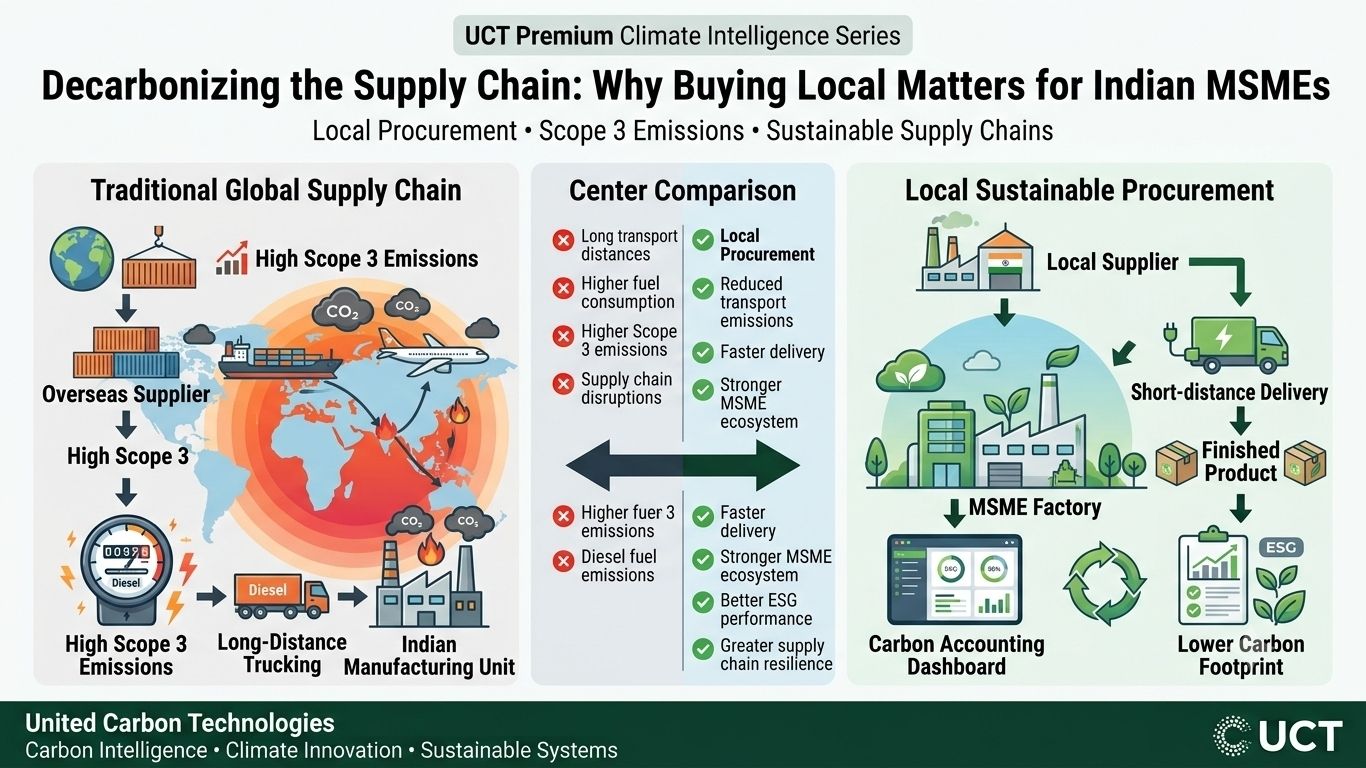
One of the most practical ways to lower these emissions is by buying locally. Procuring goods and services from nearby suppliers shortens transportation distances, reduces fuel consumption, improves supply chain resilience, and supports regional economic development. For Indian Micro, Small and Medium Enterprises (MSMEs), local sourcing can deliver both environmental and business advantages.
This guide explains how local procurement contributes to supply chain decarbonization, why it matters for Scope 3 emissions, and how Indian MSMEs can build sustainable procurement strategies that strengthen both competitiveness and climate performance.
How does buying local help decarbonize the supply chain?
Buying local reduces transportation distances, lowers fuel consumption, decreases Scope 3 emissions, strengthens supply chain resilience, and supports sustainable procurement. For Indian MSMEs, local sourcing can improve ESG performance while reducing operational risks and logistics costs.
Introduction
Global supply chains have enabled businesses to source products from almost anywhere in the world. While this has improved access to materials and reduced production costs in many industries, it has also increased transportation emissions, fuel consumption, and supply chain complexity. Every shipment moved by truck, ship, rail, or aircraft contributes to greenhouse gas emissions that add to an organization's overall carbon footprint.
For Indian MSMEs, buying locally is no longer just about supporting nearby businesses—it is becoming a practical strategy for reducing emissions, improving supply chain reliability, and preparing for growing ESG expectations from customers, investors, and regulators.
As businesses begin measuring Scope 3 emissions through carbon accounting, procurement decisions become increasingly important. Choosing suppliers closer to manufacturing facilities or customers can significantly reduce logistics-related emissions while creating stronger regional business networks.
🌍 Build a Low-Carbon Supply Chain with Climate Intelligence
Supply chain emissions often represent the largest share of an organization's carbon footprint. UCT Climate Intelligence helps businesses measure supplier emissions, improve procurement decisions, strengthen ESG reporting, and identify practical opportunities for supply chain decarbonization.
Measure • Analyze • Optimize • Decarbonize
💡 Did You Know?
For many organizations, Scope 3 emissions generated across the value chain can account for more than 70% of their total carbon footprint. Procurement decisions therefore play a major role in achieving long-term decarbonization goals.
Why Supply Chain Emissions Matter
Every product has a journey before reaching the customer. Raw materials are extracted, components are manufactured, products are assembled, packaged, transported, distributed, and eventually delivered. Each stage consumes energy and produces greenhouse gas emissions. As supply chains become more global, these emissions continue to increase.
Businesses seeking Net Zero targets or stronger ESG performance cannot focus only on emissions from their own facilities. They must also understand emissions generated throughout their value chain, making supply chain management a critical component of carbon accounting.
Major Sources of Supply Chain Emissions
- Long-distance transportation and freight.
- International shipping and air cargo.
- Supplier manufacturing processes.
- Packaging materials.
- Warehouse operations.
- Fuel consumption during logistics.
- Purchased goods and services.
Understanding Scope 3 Emissions in Procurement
Scope 3 emissions include indirect greenhouse gas emissions that occur across an organization's value chain. Unlike Scope 1 emissions from owned operations or Scope 2 emissions from purchased electricity, Scope 3 emissions often originate from suppliers, transportation providers, distributors, and customers.
For Indian MSMEs supplying larger corporations, measuring and reducing Scope 3 emissions is becoming increasingly important because customers are asking suppliers to provide sustainability data as part of ESG reporting requirements.
| Supply Chain Activity | Emission Source | Reduction Opportunity |
|---|---|---|
| Purchased Materials | Supplier Manufacturing | Choose sustainable suppliers |
| Transportation | Fuel Consumption | Buy from local suppliers |
| Warehousing | Electricity Usage | Energy-efficient facilities |
| Packaging | Material Production | Use recyclable materials |
🎓 Learn Carbon Accounting for Supply Chains
Discover how procurement, Scope 3 emissions, ESG reporting, and carbon accounting work together to build resilient and sustainable supply chains through UCT Academy.
Measure and Reduce Your Supply Chain Emissions
United Carbon Technologies helps organizations assess Scope 3 emissions, develop sustainable procurement strategies, prepare ESG reports, and implement Climate Intelligence solutions to build low-carbon supply chains.
Why Buying Local Reduces Carbon Emissions
One of the simplest ways to decarbonize a supply chain is to shorten the distance products travel before reaching manufacturers or customers. Every kilometer saved reduces fuel consumption, transportation costs, and greenhouse gas emissions. Local procurement minimizes reliance on long-distance shipping, air freight, and complex logistics networks that contribute significantly to Scope 3 emissions.
Buying locally also improves visibility across the supply chain. Businesses can collaborate more closely with suppliers, monitor sustainability practices, improve quality, and respond faster to disruptions. Instead of focusing solely on cost, procurement decisions increasingly consider environmental performance and long-term resilience.
Benefits of Local Procurement
- Lower transportation-related emissions.
- Reduced fuel consumption.
- Faster deliveries.
- Lower logistics costs.
- Improved supplier collaboration.
- Greater supply chain transparency.
- Better resilience during disruptions.
- Support for regional economic development.
How Local Procurement Benefits Indian MSMEs
Indian MSMEs form the backbone of the country's manufacturing and service economy. Many serve as suppliers to larger enterprises that are increasingly expected to disclose ESG performance and Scope 3 emissions. By sourcing locally and improving sustainability practices, MSMEs can strengthen customer relationships while becoming more competitive in domestic and international markets.
Local sourcing also reduces dependency on international supply chains that may be affected by geopolitical events, fuel price volatility, or transportation delays. This improves business continuity while lowering environmental impact.
| Business Benefit | Climate Benefit |
|---|---|
| Lower transportation costs | Reduced logistics emissions |
| Reliable supplier network | Lower Scope 3 emissions |
| Faster production cycles | Less fuel consumption |
| Improved ESG performance | Better sustainability reporting |
Building a Sustainable Procurement Policy
Sustainable procurement goes beyond selecting the lowest-cost supplier. It incorporates environmental, social, and governance considerations into purchasing decisions. Businesses that establish procurement policies aligned with sustainability objectives are better prepared for future regulations and customer expectations.
Key Elements of a Green Procurement Policy
- Prioritize local and regional suppliers where practical.
- Include sustainability criteria during supplier evaluation.
- Request environmental data from suppliers.
- Encourage recyclable and low-carbon packaging.
- Monitor supplier ESG performance.
- Reduce unnecessary transportation.
- Promote ethical sourcing practices.
- Review procurement policies regularly.
Using Carbon Accounting to Measure Supply Chain Emissions
Organizations cannot reduce emissions they do not measure. Carbon accounting enables businesses to quantify emissions associated with suppliers, purchased goods, logistics, transportation, warehousing, and product distribution. These insights help procurement teams identify emission hotspots and evaluate opportunities for improvement.
Modern carbon accounting platforms integrate operational data with emission factors to calculate Scope 3 emissions more accurately. This information supports ESG reporting, supplier engagement, and long-term decarbonization planning.
Technology Is Transforming Sustainable Supply Chains
Digital technologies are making supply chains smarter and more sustainable. Carbon accounting software, AI-powered analytics, IoT sensors, and digital procurement platforms allow organizations to track emissions, monitor supplier performance, optimize transportation routes, and improve operational efficiency.
As Indian enterprises continue their digital transformation, integrating climate intelligence into procurement decisions will become an important competitive advantage.
India Context: Local Procurement Supports Atmanirbhar Bharat and Sustainability
India's manufacturing sector is expanding rapidly through initiatives such as Make in India, Atmanirbhar Bharat, and increasing investments in domestic manufacturing. Local procurement aligns with these initiatives by strengthening regional supply chains while reducing transportation-related emissions.
For Indian MSMEs, sustainable procurement is becoming more than an environmental initiative. It helps businesses improve resilience, meet ESG expectations from larger customers, reduce operational risks, and prepare for future sustainability regulations.
What's Next?
Supply chain sustainability is rapidly evolving from a voluntary initiative into a business necessity. As organizations begin measuring Scope 3 emissions and implementing carbon accounting systems, procurement teams will play a critical role in achieving Net Zero targets and building climate-resilient businesses.
Related Reads
- What Is Carbon Accounting? Complete Guide for Beginners
- Understanding Scope 1, Scope 2 & Scope 3 Emissions
- How to Build a Carbon Inventory
- The Hidden Carbon Cost of E-Commerce Logistics in India
- Cloud Computing & Data Center Footprints: What Indian IT Hubs Need to Know
- The Carbon Footprint of AI: Managing Tech Emissions in Indian Enterprises
- Climate Resilient Cities: How Urban Green Spaces Benefit Indian Real Estate
- ESG Reporting Checklist for Businesses
Quick Summary
- Supply chains are a major source of Scope 3 emissions.
- Buying locally reduces transportation emissions.
- Local procurement strengthens MSME resilience.
- Sustainable procurement supports ESG reporting.
- Carbon accounting identifies supply chain emission hotspots.
- Technology improves supply chain transparency.
- Climate Intelligence enables data-driven procurement decisions.
- Indian businesses can lower costs while reducing carbon emissions.
Frequently Asked Questions
1. What is supply chain decarbonization?
Supply chain decarbonization is the process of reducing greenhouse gas emissions generated across sourcing, manufacturing, transportation, warehousing, and distribution activities.
2. Why does buying local reduce emissions?
Local procurement shortens transportation distances, lowering fuel consumption and reducing logistics-related greenhouse gas emissions.
3. What are Scope 3 emissions?
Scope 3 emissions are indirect emissions generated throughout an organization's value chain, including suppliers, transportation, purchased goods, and product distribution.
4. Why are Scope 3 emissions important?
For many organizations, Scope 3 emissions represent the largest share of their total carbon footprint and significantly influence ESG performance.
5. How can MSMEs benefit from sustainable procurement?
MSMEs can reduce costs, improve operational resilience, strengthen ESG performance, and meet sustainability expectations from larger customers.
6. What is a sustainable procurement policy?
A sustainable procurement policy integrates environmental, social, and governance considerations into purchasing decisions while supporting responsible sourcing.
7. How does carbon accounting support procurement?
Carbon accounting measures emissions from suppliers and logistics, helping organizations identify opportunities to reduce their supply chain footprint.
8. Can technology improve supply chain sustainability?
Yes. Digital platforms, carbon accounting software, AI, and analytics improve visibility, optimize logistics, and reduce emissions.
9. Why is local sourcing important for India's economy?
Local sourcing supports MSMEs, strengthens regional manufacturing, improves supply chain resilience, and aligns with India's sustainable development goals.
10. How can United Carbon Technologies help?
United Carbon Technologies helps organizations measure Scope 3 emissions, develop sustainable procurement strategies, implement carbon accounting, and strengthen ESG reporting through Climate Intelligence solutions.
Key Takeaways
- Supply chain emissions are a major contributor to business carbon footprints.
- Buying local is an effective strategy for reducing Scope 3 emissions.
- MSMEs can improve resilience and competitiveness through sustainable procurement.
- Carbon accounting provides visibility into supplier and logistics emissions.
- Climate Intelligence enables smarter, lower-carbon supply chain decisions.
Build a Low-Carbon Supply Chain with UCT
Measure Scope 3 emissions, improve procurement decisions, strengthen ESG reporting, and decarbonize your supply chain with Climate Intelligence solutions from United Carbon Technologies.