

Fast Fashion vs. Circular Textiles: The Evolving ESG Landscape for Indian Garment Exporters
Search Description: Explore how circular textiles, ESG reporting, and sustainable supply chains are transforming India's garment export industry and global competitiveness.
By United Carbon Technologies | Published: August 2026 | Updated: August 2026
Join business leaders, sustainability professionals, exporters, manufacturers, and climate practitioners exploring ESG reporting, carbon accounting, circular economy, and Climate Intelligence with United Carbon Technologies.
The Fashion Industry Is Entering a New ESG Era
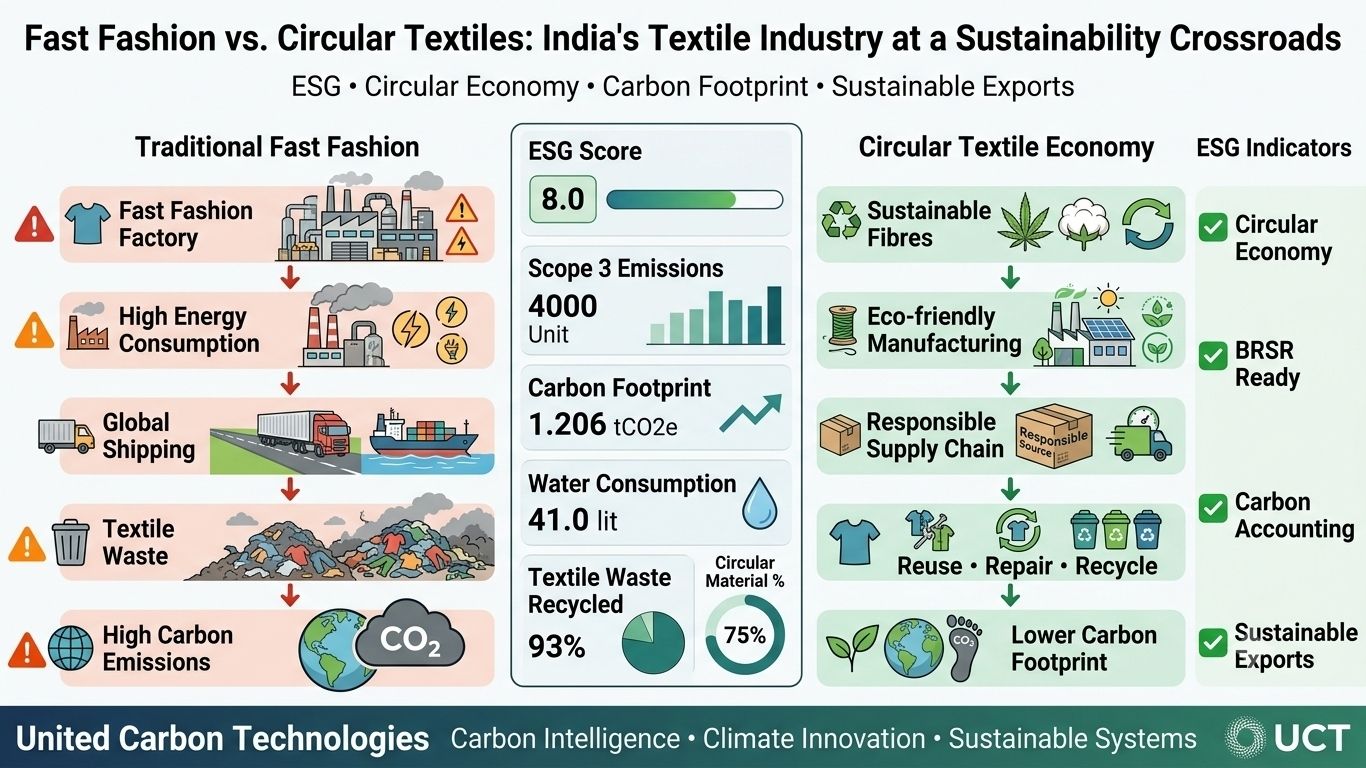
For decades, fast fashion has driven rapid production, lower prices, and shorter product lifecycles. While this model has made clothing more affordable, it has also contributed to rising carbon emissions, excessive water consumption, textile waste, and increasing pressure on global supply chains. Today, investors, regulators, and international buyers are demanding a more sustainable approach.
Circular textiles are emerging as the future of the fashion industry. Instead of the traditional "take-make-dispose" model, circular systems emphasize durability, repair, reuse, recycling, and responsible manufacturing. These practices reduce environmental impacts while improving resource efficiency across the textile value chain.
For Indian garment exporters, sustainability is no longer just a brand value—it is becoming a business requirement. ESG reporting, carbon accounting, BRSR compliance, and transparent supply chains are increasingly influencing procurement decisions in global markets.
Why are circular textiles important for Indian garment exporters?
Circular textiles reduce waste, lower carbon emissions, improve resource efficiency, strengthen ESG performance, and help Indian garment exporters meet evolving global sustainability expectations and regulatory requirements.
Introduction
India is one of the world's largest textile and garment manufacturing hubs, supplying apparel to global brands across Europe, North America, and Asia. As international sustainability regulations become more stringent, exporters are being asked to demonstrate environmental responsibility alongside product quality and competitive pricing.
The textile industry has significant environmental impacts throughout its lifecycle—from raw material production and dyeing to transportation, retail, and end-of-life disposal. Measuring and reducing these impacts has become central to ESG reporting, climate commitments, and sustainable supply chain management.
Businesses that invest in circular textiles, renewable energy, efficient manufacturing, and transparent carbon accounting will be better positioned to compete in international markets while contributing to India's low-carbon economic transition.
💡 Did You Know?
A garment's environmental footprint extends far beyond manufacturing. Raw material production, textile processing, transportation, consumer use, and disposal all contribute to its overall carbon footprint, making lifecycle thinking essential for sustainable fashion.
Fast Fashion's Hidden Environmental Cost
Fast fashion focuses on producing large volumes of inexpensive clothing at high speed to respond to changing consumer trends. While commercially successful, this model places enormous pressure on natural resources and contributes to greenhouse gas emissions throughout the supply chain.
Cotton cultivation requires significant water resources, synthetic fibres rely on fossil fuels, dyeing processes consume energy and chemicals, and international transportation increases carbon emissions. At the end of a garment's life, large quantities of textile waste often end up in landfills or are incinerated, creating additional environmental impacts.
Environmental Challenges of Fast Fashion
- High greenhouse gas emissions across supply chains.
- Excessive water consumption during textile production.
- Growing textile waste entering landfills.
- Heavy dependence on virgin raw materials.
- Chemical-intensive dyeing and finishing processes.
- Long-distance global transportation emissions.
- Increasing Scope 3 emissions for fashion brands.
- Limited product durability and low recycling rates.
Why Circular Textiles Are Transforming Global Fashion
Circular textiles replace the traditional linear production model with systems designed to keep materials in use for as long as possible. Products are created for durability, repairability, recycling, and responsible disposal, reducing both resource consumption and greenhouse gas emissions throughout their lifecycle.
Many international brands are now requiring suppliers to demonstrate recycled material content, responsible sourcing, carbon reporting, and waste reduction initiatives. For Indian exporters, adopting circular textile practices is becoming an important competitive advantage rather than simply an environmental initiative.
| Fast Fashion | Circular Textile Model |
|---|---|
| Short product lifespan | Long-lasting product design |
| High waste generation | Reuse, repair and recycling |
| Virgin material dependence | Recycled and renewable fibres |
| Limited transparency | Traceable ESG-focused supply chains |
| Higher lifecycle emissions | Lower lifecycle carbon footprint |
As global buyers increasingly prioritize sustainable sourcing, circular textile strategies can help Indian manufacturers improve operational efficiency, reduce environmental risks, and strengthen long-term export competitiveness.
Measuring the Carbon Footprint of Textile Supply Chains
The textile industry generates emissions throughout the product lifecycle—from fibre cultivation and yarn production to dyeing, manufacturing, logistics, retail, customer use, and disposal. Understanding these emissions through carbon accounting enables organizations to identify hotspots and prioritize emission reduction initiatives.
Many garment exporters discover that their largest emissions come from Scope 3 activities, including raw material sourcing, transportation, supplier operations, packaging, and product end-of-life management. Improving visibility across these stages supports better ESG reporting and strengthens relationships with international customers.
Major Sources of Textile Industry Emissions
- Raw material cultivation and fibre production.
- Energy-intensive spinning and weaving operations.
- Textile dyeing and chemical processing.
- Steam generation and industrial heating.
- Domestic and international transportation.
- Packaging materials.
- Product use by consumers.
- Textile disposal and landfill waste.
Organizations that measure emissions across Scope 1, Scope 2, and Scope 3 gain better visibility into operational risks, supplier performance, and future sustainability opportunities.
Circular Business Models for Garment Exporters
The global fashion industry is shifting toward circular business models that keep textiles in use for as long as possible. Rather than producing garments that quickly become waste, companies are designing products for durability, reuse, repair, refurbishment, resale, and recycling.
Indian exporters adopting circular textile strategies can reduce material costs, improve resource efficiency, strengthen ESG performance, and attract international buyers looking for sustainable sourcing partners.
Examples of Circular Textile Practices
- Using recycled polyester and regenerated fibres.
- Increasing recycled fabric content.
- Textile recycling partnerships.
- Water-efficient dyeing technologies.
- Renewable energy powered manufacturing.
- Repair and resale initiatives.
- Eco-friendly packaging.
- Waste fabric recovery programs.
Technology Driving Sustainable Fashion
Digital transformation is helping textile manufacturers improve sustainability performance while increasing operational efficiency. Artificial intelligence, IoT sensors, blockchain traceability, satellite monitoring, digital twins, and Climate Intelligence platforms provide valuable insights into emissions, energy consumption, water use, and supply chain performance.
Modern carbon accounting platforms allow manufacturers to automate emissions calculations, generate ESG reports, evaluate supplier performance, and identify cost-effective decarbonization opportunities.
Emerging Technologies
- Artificial Intelligence for production optimization.
- IoT sensors for energy monitoring.
- Digital carbon accounting software.
- Blockchain-based supply chain traceability.
- Water monitoring systems.
- Smart manufacturing analytics.
- Renewable energy management platforms.
- Climate Intelligence dashboards.
The Future of India's Sustainable Textile Industry
India's textile industry has a significant opportunity to become a global leader in sustainable manufacturing. Investments in renewable energy, cleaner production technologies, circular textiles, recycled materials, and transparent ESG reporting will strengthen export competitiveness while reducing environmental impacts.
International regulations, climate commitments, and buyer expectations will continue driving sustainability across the fashion industry. Organizations that embrace Climate Intelligence today will be better prepared for tomorrow's global marketplace.
India Context: Sustainability as a Competitive Advantage
India is one of the world's largest producers and exporters of textiles and garments. As global buyers increasingly prioritize sustainable sourcing, Indian manufacturers have an opportunity to differentiate themselves through ESG reporting, circular production models, responsible supply chains, renewable energy adoption, and comprehensive carbon accounting. These efforts not only support compliance but also enhance long-term competitiveness in international markets.
What's Next?
The future of fashion will be shaped by circular economy principles, low-carbon manufacturing, transparent supply chains, AI-powered sustainability analytics, and climate-focused regulations. Businesses that begin measuring and reducing their environmental footprint today will be better positioned to access premium markets and meet evolving ESG expectations.
Related Reads
- What Is Carbon Accounting? Complete Guide for Beginners
- Beyond Consumer Recycling: Why Indian Industries Must Shift to a Circular Economy
- Decarbonizing the Supply Chain: Why Buying Local Matters for Indian MSMEs
- The Lifecycle Carbon Analysis of Daily Consumer Goods in India
- The Hidden Carbon Cost of E-Commerce Logistics in India
- The Carbon Footprint of AI: Managing Tech Emissions in Indian Enterprises
- Climate Resilient Cities: How Urban Green Spaces Benefit Indian Real Estate
- Addressing Food Waste & Carbon Sequestration: Methane Mitigation in India's Agri-Business Sector
Quick Summary
- Fast fashion has significant environmental and carbon impacts.
- Circular textiles reduce waste and improve resource efficiency.
- ESG reporting is becoming essential for garment exporters.
- BRSR encourages transparent sustainability disclosures.
- Carbon accounting identifies emission hotspots.
- Scope 3 emissions are critical in textile supply chains.
- Technology supports sustainable manufacturing.
- Indian exporters can gain a competitive advantage through ESG leadership.
Frequently Asked Questions
1. What are circular textiles?
Circular textiles are designed to be reused, repaired, recycled, and kept in use for as long as possible, reducing waste and resource consumption.
2. Why is ESG important for garment exporters?
Global buyers increasingly require suppliers to demonstrate environmental, social, and governance performance alongside product quality.
3. What is BRSR?
Business Responsibility and Sustainability Reporting (BRSR) is SEBI's sustainability reporting framework for listed companies in India.
4. What is Scope 3 in the textile industry?
Scope 3 includes emissions from suppliers, transportation, raw materials, packaging, product use, and end-of-life disposal.
5. How does carbon accounting help textile businesses?
Carbon accounting measures greenhouse gas emissions, identifies reduction opportunities, and supports ESG reporting.
6. What are the biggest environmental impacts of fast fashion?
High carbon emissions, excessive water consumption, chemical pollution, textile waste, and inefficient resource use.
7. Can circular textiles improve export competitiveness?
Yes. Sustainable production practices increasingly influence procurement decisions made by international apparel brands.
8. Which technologies support sustainable fashion?
Artificial intelligence, IoT, blockchain, carbon accounting software, and Climate Intelligence platforms improve sustainability performance.
9. How can Indian manufacturers begin their ESG journey?
Start by measuring emissions, improving operational efficiency, implementing carbon accounting, and preparing sustainability disclosures.
10. How can United Carbon Technologies help?
UCT supports businesses with Climate Intelligence, ESG reporting, carbon accounting, sustainability analytics, Scope 3 assessments, and decarbonization strategies.
Key Takeaways
- Circular textiles represent the future of sustainable fashion.
- ESG reporting is becoming a market expectation for exporters.
- Carbon accounting improves decision-making and transparency.
- Technology accelerates sustainable manufacturing.
- Indian garment exporters can strengthen global competitiveness through Climate Intelligence and responsible supply chains.