

```html
Addressing Food Waste & Carbon Sequestration: Methane Mitigation in India's Agri-Business Sector
Search Description: Discover how reducing food waste, methane emissions, and carbon sequestration strategies can help India's agri-business sector build a sustainable future.
By United Carbon Technologies | Published: August 2026 | Updated: August 2026
Join sustainability professionals, agri-business leaders, students, researchers, and climate practitioners exploring carbon accounting, methane reduction, circular agriculture, carbon sequestration, and ESG with United Carbon Technologies.
Food Waste Is More Than a Waste Problem—It's a Climate Problem
Every year, millions of tonnes of food are lost before reaching consumers or wasted after purchase. Beyond the economic losses, food waste produces significant greenhouse gas emissions, particularly methane—a gas far more potent than carbon dioxide over the short term. Reducing food waste is therefore one of the fastest ways to reduce emissions across agriculture and food systems.
At the same time, carbon sequestration through healthier soils, agroforestry, regenerative farming, and improved land management offers opportunities to remove carbon dioxide from the atmosphere while improving agricultural productivity. Together, methane mitigation and carbon sequestration can play a vital role in building climate-resilient agri-businesses.
For India, where agriculture supports millions of livelihoods and food demand continues to grow, integrating food waste reduction, circular resource management, and climate-smart farming will be essential for achieving long-term sustainability.
How does reducing food waste help fight climate change?
Reducing food waste lowers methane emissions from landfills, conserves natural resources, improves supply chain efficiency, and supports carbon sequestration through composting, regenerative agriculture, and circular economy practices.
Introduction
The global food system is responsible for a significant share of greenhouse gas emissions. While much attention is given to crop production and transportation, food waste often remains an overlooked contributor to climate change. When organic waste decomposes in landfills without oxygen, it releases methane—a greenhouse gas with a much higher warming potential than carbon dioxide over the short term.
Addressing food waste requires collaboration across farmers, processors, logistics providers, retailers, restaurants, consumers, and policymakers. By improving storage, transportation, inventory management, and waste recovery, businesses can simultaneously reduce emissions and improve operational efficiency.
Carbon sequestration further strengthens climate action by capturing atmospheric carbon in soils, forests, and agricultural landscapes. Together, these strategies help transform waste into valuable resources while supporting India's transition toward a circular and climate-smart economy.
💡 Did You Know?
Food waste generates methane when it decomposes in landfills. Recovering edible food, composting organic waste, and converting agricultural residues into bioenergy can significantly reduce emissions while creating economic value.
Why Food Waste Has Become a Major Climate Challenge
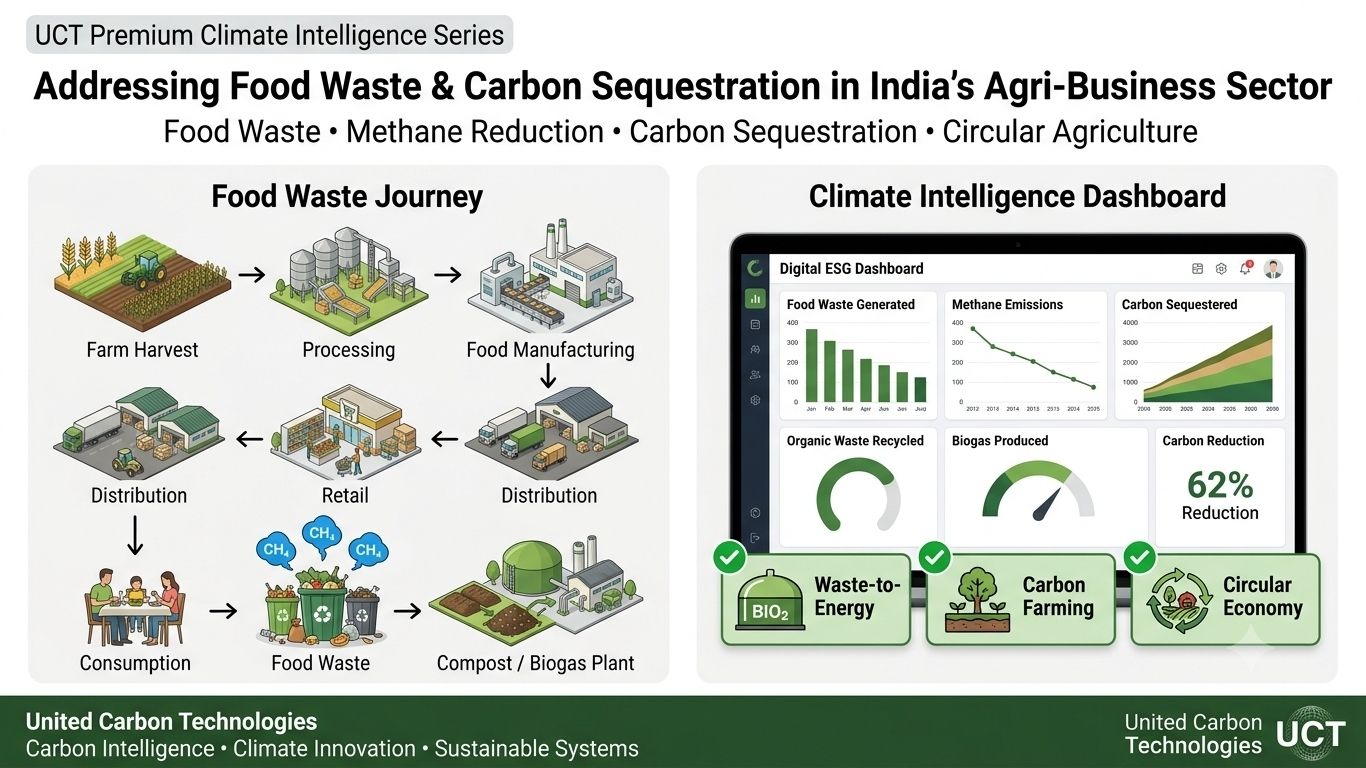
Food waste occurs throughout the agricultural value chain—from harvesting and storage to transportation, processing, retail, and household consumption. Every kilogram of wasted food represents wasted land, water, fertilizers, energy, labour, and transportation resources. When discarded food ends up in landfills, the environmental impact continues through methane emissions.
Climate change itself also increases food losses by affecting crop yields, storage conditions, transportation networks, and supply chain reliability. Reducing food waste therefore improves both climate resilience and food security.
Environmental Impacts of Food Waste
- Higher methane emissions from landfill decomposition.
- Wasted freshwater and agricultural resources.
- Unnecessary energy consumption during production and transport.
- Greater pressure on forests and agricultural land.
- Higher carbon emissions across food supply chains.
- Economic losses for farmers and businesses.
- Increased pressure on waste management systems.
- Reduced overall resource efficiency.
Understanding Methane Emissions and Carbon Sequestration
Methane (CH₄) is one of the most powerful greenhouse gases contributing to global warming. Agriculture, livestock, rice cultivation, organic waste, and landfill decomposition are among the largest human-related methane sources. Reducing methane emissions delivers relatively rapid climate benefits because methane remains in the atmosphere for a shorter period than carbon dioxide.
Carbon sequestration works differently. Instead of preventing emissions, it removes carbon dioxide from the atmosphere and stores it naturally in soils, forests, wetlands, and vegetation. Practices such as regenerative agriculture, agroforestry, cover cropping, conservation tillage, and restoring degraded land all enhance carbon storage while improving soil health.
| Climate Strategy | Primary Objective | Examples |
|---|---|---|
| Methane Mitigation | Reduce greenhouse gas emissions | Food waste reduction, landfill gas capture, biogas systems |
| Carbon Sequestration | Remove carbon dioxide from the atmosphere | Agroforestry, regenerative farming, healthy soils, afforestation |
When businesses combine methane mitigation with carbon sequestration, they can reduce emissions today while actively removing carbon over the long term—creating a more resilient and sustainable agricultural system.
Food Waste Across India's Agri-Business Supply Chain
Food waste is not limited to households. It occurs at nearly every stage of India's agricultural value chain, beginning on farms and continuing through storage, processing, transportation, retail, hospitality, and consumer use. Identifying where losses occur allows businesses and policymakers to implement targeted solutions that improve efficiency while reducing greenhouse gas emissions.
| Supply Chain Stage | Common Causes of Food Waste | Potential Solutions |
|---|---|---|
| Farm Production | Weather damage, harvesting losses | Climate-smart farming and better harvesting practices |
| Storage | Poor storage facilities and spoilage | Modern warehouses and cold-chain infrastructure |
| Processing | Production inefficiencies | Resource-efficient manufacturing and by-product utilization |
| Transportation | Delayed logistics and temperature fluctuations | Optimized logistics and refrigerated transport |
| Retail | Expired inventory and cosmetic standards | Inventory optimization and food donation programs |
| Consumers | Over-purchasing and improper storage | Awareness and responsible consumption |
Waste-to-Energy and Circular Agriculture Solutions
Organic waste should not be viewed as garbage but as a valuable resource. Circular agriculture focuses on recovering nutrients, generating renewable energy, and minimizing landfill disposal. Technologies such as anaerobic digestion, composting, biomass utilization, and bioenergy production convert agricultural waste into useful products while reducing methane emissions.
Examples of Circular Agriculture
- Converting food waste into biogas.
- Producing organic compost for farms.
- Using crop residues for bioenergy.
- Recovering nutrients from agricultural waste.
- Generating renewable electricity from biomass.
- Producing biofertilizers.
- Reducing landfill disposal.
- Supporting regenerative agriculture.
Waste-to-energy projects not only reduce methane emissions but also improve energy security, create additional revenue streams, and strengthen circular economy practices across India's agri-business sector.
Carbon Sequestration Opportunities in Agriculture
Agricultural landscapes can become powerful carbon sinks when managed sustainably. Healthy soils naturally store carbon, while trees, perennial vegetation, and restored ecosystems continuously remove carbon dioxide from the atmosphere. Improving soil organic carbon also increases water retention, fertility, biodiversity, and resilience against climate extremes.
Carbon Sequestration Practices
- Agroforestry systems.
- Conservation agriculture.
- Cover cropping.
- Crop rotation.
- Reduced tillage.
- Organic soil amendments.
- Wetland restoration.
- Tree planting around farms.
These practices contribute to climate mitigation while improving long-term agricultural productivity and reducing dependence on synthetic inputs.
What Indian Businesses Can Do Today
Food manufacturers, agri-businesses, exporters, retailers, hospitality companies, and logistics providers all have opportunities to reduce emissions through better waste management and improved operational efficiency. Climate action is becoming an important business strategy rather than simply an environmental initiative.
Priority Actions for Businesses
- Measure food waste across operations.
- Track methane emissions.
- Implement carbon accounting systems.
- Strengthen ESG reporting.
- Improve cold-chain efficiency.
- Invest in waste-to-energy projects.
- Support regenerative farming practices.
- Collaborate across supply chains.
Future Trends in Climate-Smart Agri-Business
Emerging technologies such as artificial intelligence, satellite monitoring, IoT sensors, digital carbon accounting platforms, and Climate Intelligence are transforming agricultural sustainability. Businesses are increasingly using data-driven insights to predict food losses, optimize logistics, improve soil health, and measure carbon sequestration with greater accuracy.
As sustainability reporting becomes more comprehensive, organizations that invest in climate-smart agriculture today will be better positioned to meet future ESG expectations and remain competitive in global markets.
India Context: Building a Climate-Resilient Food System
India is one of the world's largest agricultural producers, making food security and sustainable farming critical national priorities. Government initiatives supporting natural farming, bioenergy, waste management, climate-smart agriculture, and improved supply chain infrastructure create opportunities to reduce emissions while strengthening rural livelihoods. Integrating methane mitigation with carbon sequestration can help India achieve both environmental and economic objectives.
What's Next?
Future agricultural systems will increasingly combine Climate Intelligence, carbon accounting, regenerative agriculture, satellite monitoring, AI-powered analytics, and circular economy principles. Organizations that adopt these approaches today can improve resilience, reduce emissions, and unlock new sustainability opportunities.
Related Reads
- What Is Carbon Accounting? Complete Guide for Beginners
- Beyond Consumer Recycling: Why Indian Industries Must Shift to a Circular Economy
- The Lifecycle Carbon Analysis of Daily Consumer Goods in India
- Decarbonizing the Supply Chain: Why Buying Local Matters for Indian MSMEs
- The Hidden Carbon Cost of E-Commerce Logistics in India
- Climate Resilient Cities: How Urban Green Spaces Benefit Indian Real Estate
- Cooling the Subcontinent: Sustainable Air Conditioning Alternatives for Indian Buildings
- The Carbon Footprint of AI: Managing Tech Emissions in Indian Enterprises
Quick Summary
- Food waste contributes significantly to methane emissions.
- Methane mitigation delivers rapid climate benefits.
- Carbon sequestration removes atmospheric carbon dioxide.
- Circular agriculture converts waste into valuable resources.
- Waste-to-energy supports renewable energy production.
- Climate-smart farming improves resilience and productivity.
- Carbon accounting strengthens ESG reporting.
- Agri-businesses play a vital role in India's climate transition.
Frequently Asked Questions
1. Why is food waste considered a climate issue?
Food waste releases methane in landfills and wastes the resources used to produce, transport, and process food.
2. What is methane mitigation?
Methane mitigation refers to actions that reduce methane emissions from agriculture, waste, energy, and other sectors.
3. What is carbon sequestration?
Carbon sequestration is the process of capturing and storing carbon dioxide in soils, forests, vegetation, and other natural systems.
4. How does composting reduce emissions?
Composting diverts organic waste from landfills, reducing methane generation while producing nutrient-rich soil amendments.
5. What is circular agriculture?
Circular agriculture minimizes waste by reusing resources, recovering nutrients, generating renewable energy, and improving soil health.
6. How can businesses reduce food waste?
Businesses can improve inventory management, optimize logistics, strengthen cold chains, donate surplus food, and adopt waste recovery systems.
7. Why is carbon accounting important for agri-business?
Carbon accounting helps measure emissions, identify reduction opportunities, support ESG reporting, and improve sustainability performance.
8. What role does waste-to-energy play?
Waste-to-energy converts organic waste into renewable energy while reducing landfill emissions.
9. How does regenerative agriculture support carbon sequestration?
Regenerative practices improve soil health, increase carbon storage, enhance biodiversity, and strengthen climate resilience.
10. How can United Carbon Technologies help?
UCT provides Climate Intelligence, carbon accounting, ESG reporting, sustainability analytics, and decarbonization solutions for agri-businesses and enterprises.
Key Takeaways
- Reducing food waste lowers methane emissions.
- Carbon sequestration strengthens long-term climate action.
- Circular agriculture transforms waste into valuable resources.
- Climate Intelligence improves sustainability decision-making.
- India's agri-business sector can lead the transition to a low-carbon future.