

The Lifecycle Carbon Analysis of Daily Consumer Goods in India
Search Description: Learn how lifecycle analysis measures the carbon footprint of everyday products in India and supports sustainable consumption and smarter buying decisions.
By United Carbon Technologies | Published: August 2026 | Updated: August 2026
Join professionals, students, sustainability leaders, manufacturers, and ESG practitioners exploring carbon accounting, life cycle assessment, circular economy, and climate innovation with United Carbon Technologies.
Every Product Has a Carbon Story
From the morning cup of tea to the smartphone in your pocket, every product we use has an environmental footprint. Raw materials are extracted, factories manufacture components, trucks transport products, retailers sell them, consumers use them, and eventually those products are recycled or discarded. Every stage generates greenhouse gas emissions that contribute to climate change.
Lifecycle Analysis (LCA) helps us understand the complete environmental impact of products instead of focusing only on manufacturing. It provides businesses, policymakers, and consumers with valuable insights into where emissions occur and how they can be reduced across the entire product lifecycle.
As India moves toward sustainable manufacturing, circular economy practices, and ESG reporting, lifecycle carbon analysis is becoming an essential decision-making tool for companies of every size.
What is lifecycle carbon analysis?
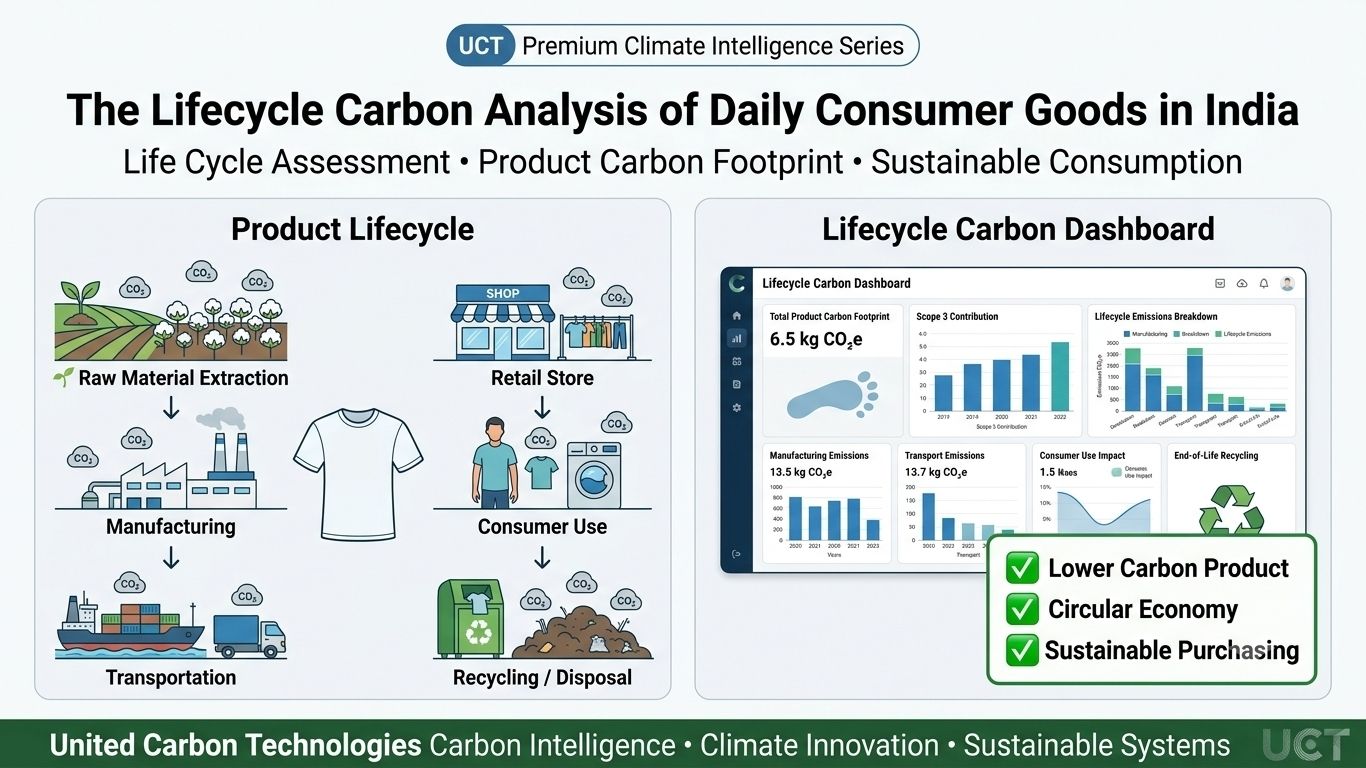
Lifecycle carbon analysis, also called Life Cycle Assessment (LCA), measures greenhouse gas emissions generated throughout a product's entire lifecycle—from raw material extraction and manufacturing to transportation, consumer use, and end-of-life recycling or disposal.
Introduction
Most people associate carbon emissions with factories, power plants, or vehicles. However, emissions occur long before a product reaches the store shelf and continue even after consumers stop using it. Understanding this complete journey is essential for making informed sustainability decisions.
Lifecycle carbon analysis enables organizations to identify hidden emissions, improve resource efficiency, reduce waste, and design products with lower environmental impacts. Consumers also benefit by choosing products that are manufactured, transported, and disposed of more sustainably.
Whether it is a cotton T-shirt, a plastic bottle, a laptop, or packaged food, every product leaves behind a measurable carbon footprint. Measuring that footprint is the first step toward reducing it.
💡 Did You Know?
For many consumer products, transportation and raw material extraction can generate as much carbon as manufacturing itself. Looking only at factory emissions often misses a significant part of a product's total environmental impact.
What Is Lifecycle Analysis (Life Cycle Assessment)?
Life Cycle Assessment (LCA) is a scientific method used to evaluate the environmental impacts of a product, process, or service throughout its entire lifecycle. Instead of measuring emissions at only one stage, LCA examines every phase—from extracting raw materials to recycling or disposal.
Businesses use lifecycle analysis to improve product design, reduce emissions, enhance resource efficiency, comply with ESG requirements, and support sustainability reporting. Governments and researchers also rely on LCA to compare products, develop environmental policies, and encourage cleaner production methods.
Why Lifecycle Analysis Matters
- Measures total product carbon footprint.
- Identifies emission hotspots.
- Supports sustainable product design.
- Improves manufacturing efficiency.
- Strengthens ESG reporting.
- Supports circular economy strategies.
- Enables informed consumer choices.
- Helps businesses meet sustainability goals.
The Six Stages of a Product's Carbon Journey
Every consumer product follows a lifecycle consisting of multiple interconnected stages. Carbon emissions can occur during each phase, making it important to evaluate the complete journey instead of focusing on manufacturing alone.
| Lifecycle Stage | Typical Carbon Sources |
|---|---|
| Raw Material Extraction | Mining, agriculture, resource processing |
| Manufacturing | Factory energy, machinery, industrial processes |
| Transportation | Road, rail, sea and air logistics |
| Retail & Distribution | Warehousing, refrigeration, packaging |
| Consumer Use | Electricity, maintenance, washing, charging |
| End of Life | Landfill, incineration, recycling or reuse |
Understanding emissions at every stage helps manufacturers prioritize improvements where they will have the greatest environmental impact while also reducing costs and resource consumption.
Lifecycle Analysis of 10 Everyday Consumer Goods
Every product we purchase has a unique carbon footprint depending on the materials used, manufacturing methods, transportation distance, product lifespan, and disposal practices. Understanding these differences helps consumers make more sustainable purchasing decisions while encouraging manufacturers to improve product design.
| Product | Major Lifecycle Emissions | How to Reduce Impact |
|---|---|---|
| Cotton T-Shirt | Cotton farming, dyeing, transportation | Buy durable clothing and wash less frequently. |
| Plastic Water Bottle | Plastic production and disposal | Use reusable bottles. |
| Smartphone | Mining, electronics manufacturing | Extend device lifespan. |
| Laptop | Semiconductor manufacturing | Repair instead of replacing. |
| Packaged Food | Agriculture, packaging, logistics | Buy local and reduce food waste. |
| LED Bulb | Manufacturing materials | Use throughout its full lifespan. |
| Wooden Furniture | Timber harvesting and transport | Choose certified sustainable wood. |
| Coffee | Cultivation and transportation | Support responsibly sourced products. |
| Running Shoes | Synthetic materials and manufacturing | Purchase durable products. |
| Refrigerator | Manufacturing and electricity use | Choose energy-efficient models. |
Why Lifecycle Analysis Matters for Businesses
Businesses increasingly use Life Cycle Assessment to identify emission hotspots across products and supply chains. Rather than focusing solely on factory emissions, organizations can improve procurement, manufacturing, logistics, packaging, product durability, and recycling strategies to reduce their overall carbon footprint.
Lifecycle analysis also supports ESG reporting, carbon disclosure, product innovation, and compliance with emerging international sustainability requirements. Companies that understand product emissions are better prepared for growing customer expectations and future environmental regulations.
Business Benefits of LCA
- Improves product sustainability.
- Supports ESG reporting.
- Reduces operational costs.
- Strengthens investor confidence.
- Improves supply chain transparency.
- Supports export market requirements.
- Enhances brand reputation.
- Encourages circular product design.
Life Cycle Assessment in Indian Manufacturing
India's manufacturing sector is rapidly adopting sustainable production practices. Export-oriented industries, automotive manufacturers, textile companies, electronics producers, food processors, and consumer goods companies are increasingly measuring product carbon footprints to remain globally competitive.
Life Cycle Assessment enables manufacturers to reduce waste, optimize energy consumption, improve material efficiency, and identify opportunities for low-carbon innovation. As international buyers demand greater transparency, LCA is becoming an important business capability for Indian enterprises.
Combining Life Cycle Assessment with carbon accounting allows organizations to understand both operational emissions and product-level emissions, creating a stronger foundation for ESG reporting and sustainability strategy.
How Consumers Can Reduce Product Carbon Footprints
Consumers influence product emissions through purchasing choices, product usage, maintenance, and disposal. Choosing durable, repairable, recyclable, and locally manufactured products helps reduce lifecycle emissions while supporting more sustainable production systems.
Simple Actions That Make a Difference
- Buy only what you need.
- Choose durable products.
- Support local manufacturers.
- Repair instead of replacing items.
- Reduce single-use plastics.
- Recycle responsibly.
- Choose products with sustainable packaging.
- Look for environmental certifications.
The Future of Product Carbon Transparency
Around the world, governments, investors, and consumers are demanding greater transparency about the environmental impacts of products. Digital product passports, carbon footprint labels, ESG reporting, and lifecycle disclosures are expected to become increasingly common over the coming years.
Businesses that invest in lifecycle analysis today will be better prepared for future regulations, strengthen customer trust, and gain a competitive advantage in sustainability-focused markets.
India Context: Building Sustainable Consumption
India's growing manufacturing sector and expanding middle class create both opportunities and challenges for sustainable consumption. Initiatives such as Make in India, Extended Producer Responsibility (EPR), resource efficiency programs, and circular economy policies encourage manufacturers to reduce product lifecycle impacts. Consumers also play an important role by supporting durable, repairable, and environmentally responsible products.
What's Next?
Lifecycle Analysis is evolving beyond environmental reporting into a strategic business tool. As Climate Intelligence, digital product passports, AI-powered sustainability platforms, and carbon accounting systems mature, organizations will gain deeper insights into product emissions and resource efficiency throughout the value chain.
Related Reads
- What Is Carbon Accounting? Complete Guide for Beginners
- How to Build a Carbon Inventory
- Beyond Consumer Recycling: Why Indian Industries Must Shift to a Circular Economy
- Decarbonizing the Supply Chain: Why Buying Local Matters for Indian MSMEs
- The Hidden Carbon Cost of E-Commerce Logistics in India
- Cooling the Subcontinent: Sustainable Air Conditioning Alternatives for Indian Buildings
- The Carbon Footprint of AI: Managing Tech Emissions in Indian Enterprises
- Climate Resilient Cities: How Urban Green Spaces Benefit Indian Real Estate
Quick Summary
- Lifecycle Analysis measures emissions from cradle to grave.
- Every product has hidden carbon emissions.
- LCA helps businesses improve sustainability performance.
- Consumers can reduce emissions through smarter purchasing decisions.
- Product transparency is becoming increasingly important.
- Lifecycle thinking supports ESG and circular economy goals.
- Carbon accounting and LCA work together to improve climate performance.
- Sustainable consumption benefits businesses, consumers, and the environment.
Frequently Asked Questions
1. What is Life Cycle Assessment (LCA)?
LCA is a method for measuring the environmental impact of a product throughout its entire lifecycle.
2. Why is lifecycle analysis important?
It identifies where emissions occur so businesses and consumers can reduce environmental impacts.
3. What stages are included in LCA?
Raw material extraction, manufacturing, transportation, retail, product use, and end-of-life disposal or recycling.
4. Which products have high lifecycle emissions?
Electronics, textiles, packaged foods, automobiles, plastics, and appliances often have significant lifecycle emissions.
5. How does LCA support ESG?
It provides product-level environmental data for sustainability reporting and decision-making.
6. Can consumers reduce product carbon footprints?
Yes. Buying durable products, repairing items, recycling, and supporting local manufacturing all help.
7. Is LCA useful for MSMEs?
Absolutely. It helps improve efficiency, reduce waste, and strengthen competitiveness.
8. What is product carbon footprint?
It is the total greenhouse gas emissions generated throughout a product's lifecycle.
9. How does LCA support the circular economy?
It identifies opportunities for reuse, recycling, better product design, and resource efficiency.
10. How can United Carbon Technologies help?
UCT provides Climate Intelligence, carbon accounting, ESG reporting, sustainability analytics, and lifecycle assessment support for organizations.
Key Takeaways
- Every product has a measurable carbon footprint.
- Lifecycle Analysis provides a complete picture of emissions.
- Businesses use LCA to improve products and ESG performance.
- Consumers influence emissions through purchasing choices.
- Climate Intelligence makes lifecycle data actionable.