

Cooling the Subcontinent: Sustainable Air Conditioning Alternatives for Indian Buildings
Search Description: Discover sustainable cooling solutions for Indian buildings, reduce operational carbon, improve HVAC efficiency, and support green building design.
By United Carbon Technologies | Published: August 2026 | Updated: August 2026
Join professionals, architects, engineers, sustainability leaders, and students exploring operational carbon, climate technology, ESG reporting, Net Zero buildings, and sustainable infrastructure with United Carbon Technologies.
Keeping Buildings Cool Without Heating the Planet
India is becoming one of the world's fastest-growing markets for air conditioning. Rising temperatures, rapid urbanization, expanding commercial infrastructure, and improving living standards are increasing demand for cooling across homes, offices, hospitals, shopping malls, educational institutions, and industrial facilities. While air conditioning improves comfort and productivity, it also contributes significantly to electricity consumption and greenhouse gas emissions.
For many commercial buildings, cooling systems represent one of the largest operational energy loads. As India's electricity demand continues to grow, improving cooling efficiency has become a critical climate priority. Sustainable cooling technologies can reduce operational carbon, lower energy costs, improve occupant comfort, and help organizations meet ESG and Net Zero commitments.
This guide explains why operational carbon matters, how conventional air conditioning impacts the environment, and which sustainable cooling strategies are best suited for Indian buildings.
How can Indian buildings reduce operational carbon from cooling?
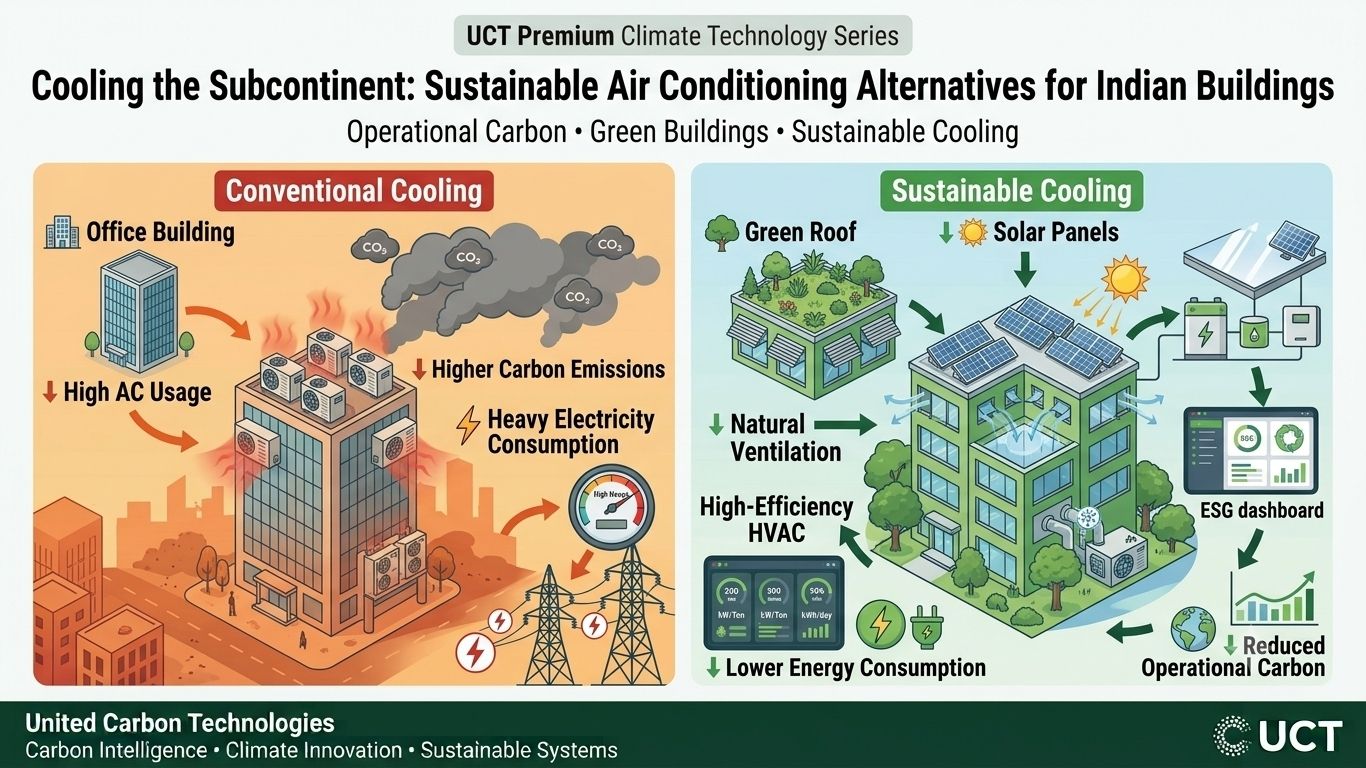
Indian buildings can reduce operational carbon by adopting passive cooling techniques, energy-efficient HVAC systems, smart building automation, better insulation, renewable energy, and climate-responsive building design.
Introduction
Cooling is no longer a luxury—it has become an essential part of modern life. Offices depend on climate-controlled environments for employee productivity, hospitals require precise temperature management, data centers generate significant heat, and residential buildings increasingly rely on air conditioners during prolonged heatwaves.
However, conventional cooling systems consume large amounts of electricity, much of which still comes from fossil fuel-based power generation. This creates a cycle where increasing temperatures drive greater cooling demand, which in turn contributes to additional greenhouse gas emissions that further intensify climate change.
Breaking this cycle requires smarter building design, efficient cooling technologies, renewable energy integration, and data-driven energy management. Sustainable cooling is no longer simply an environmental initiative—it is becoming a strategic business investment.
💡 Did You Know?
Cooling systems can account for 40–60% of electricity consumption in many commercial buildings, making HVAC efficiency one of the biggest opportunities for reducing operational carbon emissions.
Why Cooling Is Becoming a Climate Challenge
India experiences diverse climatic conditions ranging from hot and humid coastal regions to extremely dry inland areas. Rising average temperatures, more frequent heatwaves, and rapid urbanization are increasing the demand for mechanical cooling across nearly every sector of the economy.
Urban heat islands further worsen this challenge. Concrete buildings, asphalt roads, limited vegetation, and dense development trap heat, making cities significantly warmer than surrounding rural areas. As outdoor temperatures increase, air conditioners work harder, consuming more electricity and generating greater carbon emissions.
Key Drivers of Rising Cooling Demand
- Increasing urban temperatures.
- Rapid commercial construction.
- Growing middle-class households.
- Expansion of data centers.
- Higher demand for thermal comfort.
- Climate change and frequent heatwaves.
- Growth of hospitals, malls, and IT parks.
- Economic development and infrastructure expansion.
Understanding Operational Carbon in Buildings
Operational carbon refers to greenhouse gas emissions generated while a building is in use. Unlike embodied carbon, which is associated with construction materials and building processes, operational carbon comes from daily activities such as lighting, heating, cooling, ventilation, elevators, appliances, and other energy-consuming systems.
For most office buildings, shopping centers, hotels, hospitals, and educational campuses, HVAC systems represent one of the largest contributors to operational carbon emissions. Improving cooling efficiency therefore has an immediate impact on both energy consumption and carbon reduction.
| Operational Carbon Source | Reduction Strategy |
|---|---|
| Air Conditioning & HVAC | High-efficiency HVAC systems |
| Lighting | LED and smart controls |
| Ventilation | Demand-controlled ventilation |
| Building Equipment | Energy-efficient equipment |
| Electricity Consumption | Renewable energy integration |
By continuously measuring energy use and emissions, organizations can identify inefficiencies, reduce operational costs, and improve sustainability performance through better carbon management.
Passive Cooling Strategies for Indian Buildings
The cleanest form of cooling is the cooling that never needs electricity. Passive cooling techniques reduce indoor temperatures by using building orientation, natural ventilation, insulation, shading, and climate-responsive architecture instead of relying solely on mechanical air conditioning.
Many traditional Indian buildings already demonstrate excellent passive cooling principles. Thick walls, shaded courtyards, verandas, jaali screens, high ceilings, and natural airflow kept buildings comfortable long before modern air conditioners became common. Today's architects are combining these traditional concepts with modern engineering to create energy-efficient buildings.
Effective Passive Cooling Techniques
- Building orientation to reduce direct solar heat gain.
- External shading devices and sunshades.
- Green roofs and rooftop gardens.
- Reflective or cool roof coatings.
- Natural cross ventilation.
- Double-glazed energy-efficient windows.
- High-performance wall insulation.
- Landscaping with native trees for natural shading.
These strategies reduce cooling demand while improving indoor comfort and lowering electricity bills throughout the building's lifecycle.
Energy-Efficient HVAC Technologies
Mechanical cooling will remain necessary for many commercial buildings, hospitals, hotels, data centers, and manufacturing facilities. The objective is therefore to use smarter HVAC technologies that consume less energy while maintaining occupant comfort.
Modern HVAC systems incorporate intelligent controls, variable-speed equipment, efficient compressors, and advanced monitoring technologies that significantly reduce electricity consumption compared to conventional systems.
| Technology | Sustainability Benefit |
|---|---|
| Variable Refrigerant Flow (VRF) | Higher energy efficiency |
| Inverter Air Conditioners | Reduced electricity consumption |
| High-Efficiency Chillers | Lower operational emissions |
| Demand-Controlled Ventilation | Optimizes fresh air supply |
| Building Management Systems (BMS) | Real-time HVAC optimization |
When integrated with renewable electricity and smart energy management, these technologies significantly reduce operational carbon emissions across commercial buildings.
Smart Buildings and AI-Based Cooling Optimization
Modern buildings are increasingly becoming intelligent systems that continuously monitor occupancy, weather conditions, indoor temperature, humidity, and energy consumption. Artificial Intelligence and Internet of Things (IoT) technologies enable HVAC systems to respond dynamically instead of operating at fixed settings throughout the day.
Smart building platforms can automatically adjust cooling levels based on occupancy patterns, reducing unnecessary energy use during evenings, weekends, or low-occupancy periods.
Benefits of Smart Cooling Systems
- Continuous energy monitoring.
- Predictive equipment maintenance.
- Lower electricity consumption.
- Reduced operational carbon emissions.
- Improved indoor comfort.
- Longer HVAC equipment life.
- Real-time ESG performance tracking.
- Lower operating costs.
Green Building Certifications Encourage Efficient Cooling
Green building certification frameworks encourage organizations to reduce energy consumption while improving occupant well-being. Efficient cooling systems contribute significantly toward achieving higher sustainability ratings and demonstrating environmental leadership.
Many certification systems evaluate building energy performance, water efficiency, indoor environmental quality, renewable energy integration, and carbon emissions throughout a building's operational life.
Buildings that continuously measure operational energy use are better positioned to identify efficiency improvements, reduce emissions, and strengthen ESG reporting using reliable environmental data.
India's Growing Cooling Demand and the Path Forward
India's demand for cooling is expected to grow substantially over the coming decades as urban populations expand and temperatures continue to rise. Without improvements in energy efficiency, this demand could significantly increase electricity consumption and associated carbon emissions.
Fortunately, India's transition toward renewable energy, smart cities, energy-efficient appliances, green building standards, and digital energy management creates an opportunity to decouple economic growth from operational emissions. Sustainable cooling technologies will become a critical component of climate-resilient infrastructure.
India Context: Cooling for a Hotter Future
Cities including Ahmedabad, Delhi, Mumbai, Bengaluru, Hyderabad, Chennai, Pune, and Jaipur are already experiencing longer periods of extreme heat. Commercial buildings, IT parks, hospitals, educational institutions, airports, and industrial facilities must prepare for increasing cooling demand while minimizing environmental impacts. Investing in energy-efficient HVAC systems, passive cooling, and operational carbon measurement will become essential for India's sustainable urban development.
What's Next?
The future of sustainable buildings extends beyond efficient air conditioners. Integrated design, renewable energy, intelligent building management, operational carbon accounting, and climate-responsive architecture will define the next generation of green infrastructure across India.
Related Reads
- Climate Resilient Cities: How Urban Green Spaces Benefit Indian Real Estate
- Beyond Consumer Recycling: Why Indian Industries Must Shift to a Circular Economy
- Cloud Computing & Data Center Footprints: What Indian IT Hubs Need to Know
- The Carbon Footprint of AI: Managing Tech Emissions in Indian Enterprises
- Decarbonizing the Supply Chain: Why Buying Local Matters for Indian MSMEs
- What Is Carbon Accounting? Complete Guide for Beginners
- How to Build a Carbon Inventory
- ESG Reporting Checklist for Businesses
Quick Summary
- Cooling is becoming one of India's largest sources of building energy demand.
- Operational carbon can be reduced through efficient HVAC systems.
- Passive cooling reduces dependence on mechanical air conditioning.
- Smart buildings optimize energy consumption using AI and IoT.
- Green building certifications encourage sustainable cooling practices.
- Renewable energy further reduces operational emissions.
- Climate Intelligence enables continuous monitoring of building performance.
- Sustainable cooling supports ESG and Net Zero objectives.
Frequently Asked Questions
1. What is operational carbon in buildings?
Operational carbon refers to greenhouse gas emissions generated from the day-to-day operation of a building, including electricity used for cooling, heating, lighting, and equipment.
2. Why is air conditioning a climate concern?
Air conditioning consumes significant electricity, and when that electricity comes from fossil fuels, it contributes to greenhouse gas emissions.
3. What is passive cooling?
Passive cooling uses building design, ventilation, shading, insulation, and landscaping to reduce indoor temperatures without relying heavily on mechanical cooling.
4. What are energy-efficient HVAC systems?
These are modern heating, ventilation, and air conditioning systems designed to provide thermal comfort while consuming less electricity.
5. How do smart buildings reduce cooling energy?
Smart buildings use sensors, AI, IoT, and automation to adjust cooling based on occupancy, weather conditions, and real-time energy demand.
6. Can renewable energy reduce cooling emissions?
Yes. Solar power and other renewable energy sources can significantly reduce the carbon emissions associated with building cooling.
7. Why is sustainable cooling important for India?
India's rising temperatures and urbanization are increasing cooling demand, making energy-efficient solutions essential for reducing electricity consumption and emissions.
8. What role does carbon accounting play in buildings?
Carbon accounting measures operational emissions, helping organizations identify opportunities to improve efficiency and reduce environmental impacts.
9. Which sectors benefit most from sustainable cooling?
Commercial offices, hospitals, hotels, airports, shopping malls, educational institutions, manufacturing facilities, and data centers all benefit significantly.
10. How can United Carbon Technologies help organizations reduce operational carbon?
UCT provides Climate Intelligence, carbon accounting, ESG reporting support, sustainability consulting, and emissions measurement solutions that help organizations optimize building performance.
Key Takeaways
- Cooling demand is increasing rapidly across India.
- Operational carbon is a major component of building emissions.
- Passive cooling reduces energy demand naturally.
- Efficient HVAC systems lower both electricity costs and emissions.
- Climate Intelligence enables continuous improvement in building sustainability.