

Climate Scenario Analysis: How Businesses Can Test Their Resilience Against Future Climate Risks
Climate change is no longer a distant environmental issue—it is becoming an important business risk. Rising temperatures, extreme weather events, changing regulations, evolving consumer preferences, and shifts in global markets can affect business operations, supply chains, assets, investments, and long-term financial performance.
This is where Climate Scenario Analysis (CSA) becomes important.
Climate scenario analysis helps businesses explore different possible future climate conditions and evaluate how these changes could affect operations, supply chains, investments, assets, and financial performance. It allows organizations to move from reactive risk management toward more proactive resilience planning.
International climate-related disclosure frameworks have encouraged organizations to consider climate scenarios when evaluating climate-related risks and opportunities. For Indian businesses, scenario analysis can also become increasingly relevant as climate-related risks, sustainability expectations, and ESG disclosures develop.
What is Climate Scenario Analysis?
Climate scenario analysis is a strategic process that helps businesses evaluate how different climate-related futures—such as higher temperatures, extreme weather events, carbon pricing, or changing regulations—may affect operations, finances, supply chains, assets, and long-term resilience.
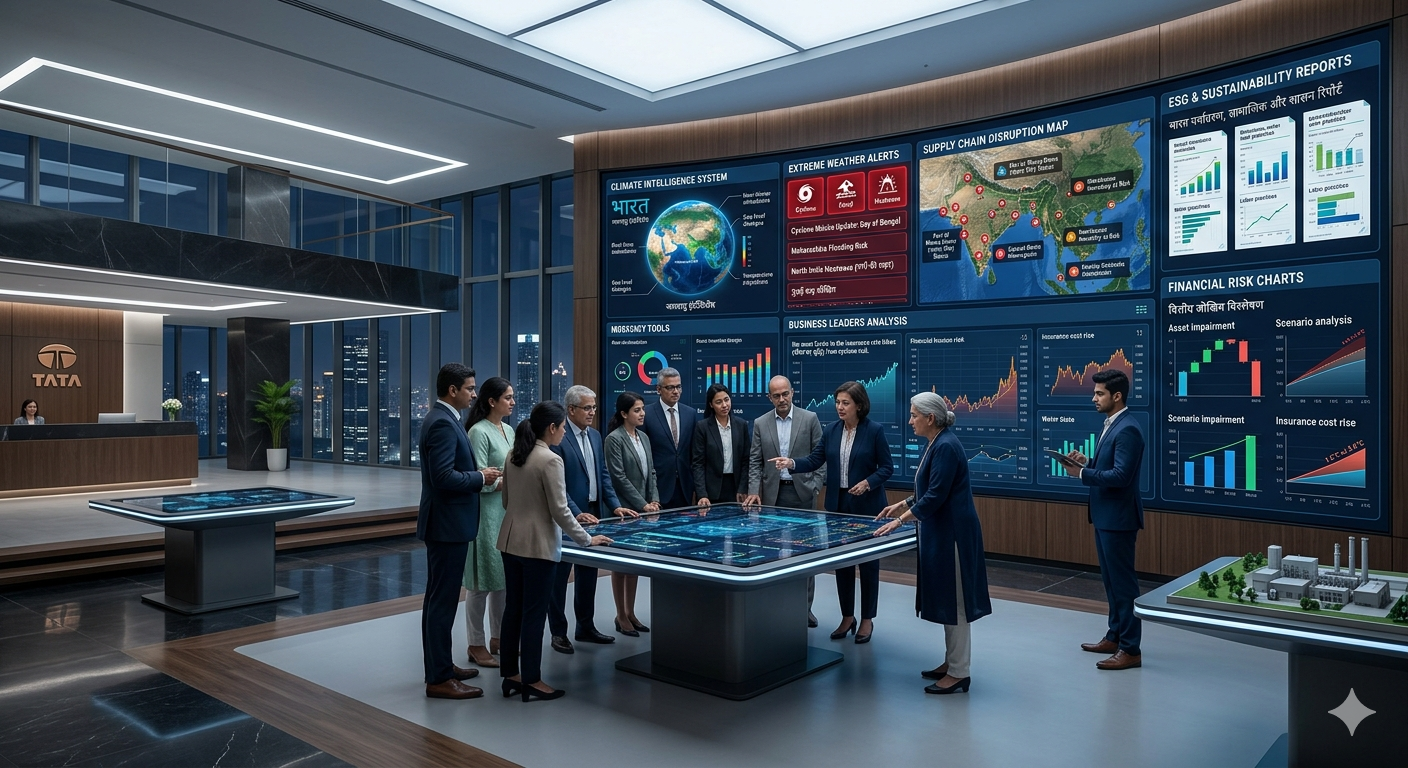
Climate Scenario Analysis • Climate Risk • Business Resilience • ESG • India
Introduction
Businesses routinely prepare for market risks, financial risks, operational disruptions, and changes in customer demand. Climate change introduces another layer of uncertainty—particularly because some climate-related risks can develop over much longer time horizons than conventional business planning cycles.
Business leaders may therefore need to consider questions such as:
- What could happen if average temperatures continue to rise?
- How could extreme weather affect facilities and supply chains?
- What if water availability becomes a constraint on production?
- How might stricter carbon-related regulations affect operating costs?
- Could changing customer preferences alter demand for certain products?
- Which assets could become vulnerable under different climate conditions?
Climate scenario analysis provides a structured method for exploring these questions. Rather than attempting to predict one exact future, organizations examine multiple plausible futures and evaluate how their business model might perform under each one.
For Indian businesses, this approach can be particularly useful because climate exposure can vary considerably by geography, industry, infrastructure, energy dependence, water availability, and supply-chain structure.
📊 Explore Climate Intelligence
Understanding climate risk starts with reliable information about emissions, operations, exposure, and sustainability performance.
UCT is developing climate intelligence and carbon measurement solutions designed to help Indian businesses better understand their environmental data and sustainability risks.
Explore UCT Climate Intelligence💡 Did You Know?
Climate scenarios are not predictions of one guaranteed future. They are structured representations of possible future conditions that can help organizations examine how different climate, policy, technology, and economic developments could affect their business.
1. What Is Climate Scenario Analysis?
Climate scenario analysis is a strategic planning method used to understand how different future climate conditions could affect an organization.
Instead of asking:
businesses can ask:
A scenario can incorporate a combination of climate, economic, technological, regulatory, and market variables.
Depending on the organization, these variables may include:
- Changes in average and extreme temperatures
- Flooding and other extreme weather events
- Water availability and water stress
- Changes in energy prices
- Carbon pricing or other climate-related policies
- Expansion of renewable energy
- Technological changes
- Changing customer preferences
- Investor expectations
- Changes in environmental regulations
- Supply-chain disruption
The objective is not to produce a perfectly accurate forecast. Instead, scenario analysis helps management identify vulnerabilities, examine potential consequences, and consider possible responses.
2. The Two Main Types of Climate Risks in Scenario Analysis
Climate scenario analysis commonly considers two broad categories of climate-related risk: physical risks and transition risks.
2.1 Physical Climate Risks
Physical risks arise from the direct effects of climate change on people, infrastructure, assets, operations, and natural resources.
Examples include:
- Extreme heat
- Flooding
- Cyclones and severe storms
- Changing rainfall patterns
- Water scarcity
- Wildfire risk in exposed regions
- Damage to physical infrastructure
- Disruption to agricultural inputs
- Reduced availability of certain natural resources
For example, a manufacturing facility located in a water-stressed region could face operational challenges if prolonged periods of low water availability affect production processes.
Similarly, extreme heat can affect worker conditions, electricity demand, equipment performance, logistics, and certain industrial processes.
2.2 Climate Transition Risks
Transition risks arise as economies, industries, governments, investors, and consumers respond to climate change and move toward lower-emission systems.
Examples include:
- Changes in climate-related regulations
- Carbon pricing mechanisms
- Changes in energy systems
- Technology substitution
- Changing customer preferences
- Investor expectations
- Changes in financing conditions
- New product standards
- Higher costs for carbon-intensive activities
For example, a business that relies heavily on carbon-intensive processes may need to evaluate how future regulatory or market changes could affect its operating costs, capital requirements, technology choices, and competitiveness.
| Risk Type | What It Involves | Examples |
|---|---|---|
| Physical Risk | Direct effects of changing climate conditions | Heatwaves, floods, water stress, storms |
| Transition Risk | Risks arising from the transition toward a lower-carbon economy | Regulation, technology shifts, carbon pricing, market changes |
🎓 Start the Climate Knowledge Challenge
Build your understanding of climate change, carbon footprints, ESG, and sustainability through UCT Academy.
Get Free Course Access🏢 Talk to Our ESG Team
Climate scenario analysis can help businesses connect climate risks with operational planning, ESG strategy, carbon management, and long-term resilience.
Businesses can begin by identifying their major climate exposures, understanding their emissions and operational dependencies, and evaluating how different future conditions could affect critical activities.
Talk to Our ESG Team3. What Climate Scenarios Can Businesses Examine?
Climate scenario analysis does not require a business to assume that one particular future will definitely occur. Instead, organizations can examine a range of plausible conditions and consider how their business model would respond.
The scenarios selected should be relevant to the organization's industry, geography, assets, supply chain, investment horizon, and strategic objectives.
Common scenario dimensions include:
- Lower-emission transition: Faster adoption of cleaner technologies, stronger climate policies, and accelerated decarbonization.
- Delayed transition: Climate policies and technology changes occur more gradually before accelerating later.
- Higher physical-risk conditions: Businesses experience greater exposure to physical climate impacts because global emissions remain elevated.
- Sector-specific transition: Particular industries experience rapid technology, regulatory, or market changes.
A business does not necessarily need dozens of scenarios. A smaller set of carefully selected scenarios can provide useful insight when they are connected to specific business risks and decision-making.
4. How Businesses Can Conduct Climate Scenario Analysis
A practical climate scenario analysis can be developed through a structured sequence of steps. The depth of analysis will depend on the organization's size, data availability, industry exposure, and reporting requirements.
Step 1: Define the Business Scope
The first step is to determine what the analysis will cover.
The scope may include:
- Corporate offices
- Manufacturing facilities
- Warehouses
- Retail locations
- Critical infrastructure
- Key suppliers
- Transportation networks
- Major investment projects
Businesses should also establish the time horizon—for example, near-term, medium-term, and longer-term planning periods.
Step 2: Identify Material Climate Risks
The next step is to identify climate-related risks that could materially affect the organization.
This assessment can consider both physical and transition risks.
A food-processing company may identify water availability, agricultural supply disruption, extreme heat, electricity reliability, energy prices, and changing environmental requirements as potentially important climate-related factors.
Step 3: Select Relevant Climate Scenarios
Businesses can then select scenarios appropriate to the identified risks.
The scenarios should be sufficiently different to reveal how the organization might perform under contrasting future conditions.
For example, a company could examine:
- A rapid low-carbon transition scenario
- A delayed-transition scenario
- A scenario involving greater physical climate impacts
The purpose is not to decide which scenario will happen. The purpose is to understand how different conditions could influence business performance.
Step 4: Map Climate Risks to Business Activities
Once scenarios are selected, businesses can connect climate variables to actual business activities.
For example:
| Climate Factor | Potential Business Exposure |
|---|---|
| Extreme heat | Worker productivity, cooling demand, equipment performance |
| Water stress | Production constraints and higher water-management costs |
| Flooding | Facility damage, logistics disruption and supply-chain interruptions |
| Carbon-related regulation | Compliance requirements, operating costs and capital planning |
| Energy transition | Changes in energy costs, technology investments and procurement |
Step 5: Assess Potential Financial and Operational Effects
The analysis becomes more useful when climate risks are connected to business consequences.
Depending on available data, organizations can examine potential effects on:
- Revenue
- Operating expenditure
- Capital expenditure
- Asset values
- Insurance costs
- Energy costs
- Production capacity
- Supply-chain reliability
- Financing requirements
For example, higher temperatures could increase cooling requirements for certain facilities. Water scarcity could affect production capacity. New climate-related requirements could create additional compliance or technology costs.
The level of financial quantification should reflect the quality of the underlying data. Where precise financial estimates are not possible, businesses can use qualitative or semi-quantitative assessments rather than presenting uncertain numbers as exact forecasts.
Step 6: Identify Resilience Measures
After identifying vulnerabilities, management can examine potential responses.
These may include:
- Energy-efficiency improvements
- Renewable energy procurement
- Water-efficiency measures
- Backup infrastructure
- Supplier diversification
- Climate-resilient facility design
- Business continuity planning
- Low-carbon technology adoption
- Improved climate data collection
Step 7: Integrate Findings Into Business Strategy
The final objective is to connect scenario analysis with actual decision-making.
Climate risk information can inform:
- Capital expenditure decisions
- Facility planning
- Procurement strategies
- Supply-chain management
- Insurance planning
- Energy strategy
- Product development
- ESG strategy
- Risk management
Scenario analysis becomes more valuable when it influences decisions rather than remaining a standalone sustainability exercise.
📊 Climate Intelligence Insight
A climate scenario analysis is only as useful as the information connected to it. Facility locations, energy consumption, water dependence, emissions data, supplier information, asset exposure, and operational dependencies can help businesses translate broad climate scenarios into organization-specific risks.
5. Climate Scenario Analysis in the Indian Business Context
India's diverse geography and economic structure mean that climate-related business exposure can vary significantly between states, cities, industries, and individual facilities.
A business operating in an industrial area may face different climate considerations from an agricultural processor, technology company, logistics provider, or financial institution.
Indian businesses may need to examine factors such as:
- Extreme heat and rising cooling requirements
- Water availability and water stress
- Monsoon variability
- Flooding and urban drainage risks
- Cyclones in exposed coastal regions
- Supply-chain disruption
- Energy-system changes
- Transition toward renewable energy
- Climate-related regulatory developments
- Changing expectations from investors and customers
For example, a company with multiple facilities across India should not necessarily treat climate exposure as identical across all locations. A location-specific assessment can reveal different physical risks, infrastructure dependencies, and adaptation requirements.
Why Location Matters
Two facilities belonging to the same company can have very different climate-risk profiles.
One facility may have greater exposure to extreme heat, while another may face flood risk or water availability concerns. A supply-chain network can create another layer of exposure because disruption at one critical supplier can affect operations elsewhere.
This makes geographic and operational data important inputs into a meaningful climate scenario analysis.
6. How Climate Scenario Analysis Supports ESG and Climate Reporting
Climate scenario analysis can also support broader ESG and climate-risk management processes.
It can help organizations connect climate-related risks with:
- Governance
- Risk management
- Strategy
- Metrics and targets
- Carbon accounting
- Climate transition planning
- Business resilience
For organizations preparing climate-related disclosures, scenario analysis can provide a structured way to explain how climate risks and opportunities have been considered in strategic planning.
However, scenario analysis should not be treated as simply another ESG reporting checkbox. Its underlying purpose is to improve understanding of how climate-related conditions could affect the organization and what management can do in response.
🌱 Understand Climate Risk Before It Becomes a Business Disruption
Climate intelligence connects environmental information with business decision-making. Build your understanding of climate risk, carbon emissions, ESG, and sustainability with UCT.
Start the Climate Knowledge Challenge🏢 Build a Climate-Resilient Business Strategy
Climate scenario analysis can help organizations identify exposure, understand potential business consequences, and evaluate resilience measures before making long-term decisions.
UCT is developing climate intelligence, carbon measurement, and ESG solutions for Indian businesses seeking to strengthen their sustainability data and decision-making capabilities.
Talk to Our ESG Team7. What Businesses Should Measure Before Running a Climate Scenario Analysis
A scenario analysis becomes more useful when businesses have reliable information about their current operations. Before testing future scenarios, organizations should establish a reasonable baseline of their assets, activities, emissions, resource consumption, and operational dependencies.
Important baseline information may include:
- Location of major facilities and assets
- Energy consumption and energy sources
- Fuel consumption
- Water consumption and water dependency
- Greenhouse gas emissions
- Production volumes
- Critical suppliers and sourcing locations
- Transportation and logistics dependencies
- Insurance and asset information
- Existing climate adaptation measures
This information provides the foundation for connecting broad climate scenarios with actual business exposure.
The Baseline Matters
A business cannot meaningfully evaluate how its resilience may change in the future without first understanding where it stands today. Strong baseline data can therefore improve both climate-risk analysis and broader ESG management.
8. Climate Scenario Analysis Across Different Business Sectors
Climate risks do not affect every industry in the same way. The relevant scenarios and indicators should therefore be adapted to the organization's business model.
Manufacturing
Manufacturers may examine exposure to extreme heat, water availability, electricity demand, facility flooding, raw-material disruption, and changes in energy systems.
Agriculture and Food Businesses
Agricultural and food-related businesses may consider changing rainfall patterns, temperature increases, water availability, crop yields, agricultural supply-chain disruption, and changing input costs.
Logistics and Transportation
Logistics businesses may examine the impact of extreme heat, flooding, storms, infrastructure disruption, fuel-transition requirements, and changing transportation technologies.
Information Technology and Services
Technology and service companies may have relatively different direct exposures but can still face risks through office locations, data centers, electricity demand, water requirements, employee disruption, and critical suppliers.
Financial Institutions
Banks, insurers, and investors may need to consider climate exposure within financed assets, borrowers, investment portfolios, insured properties, and other financial relationships.
These examples demonstrate why a generic climate-risk assessment may not provide sufficient insight. The material risks depend on the organization's activities, assets, geography, supply chain, and financial relationships.
9. How Climate Scenario Analysis Can Improve Business Resilience
The primary value of scenario analysis is not the scenario itself. Its value comes from what an organization does with the information.
A business may discover, for example, that a particular facility becomes increasingly exposed to heat stress under a future scenario. Management could then evaluate cooling efficiency, worker safety measures, equipment upgrades, operational scheduling, renewable energy, or other adaptation options.
Similarly, if a critical supplier is located in an area exposed to flooding, the organization could examine supplier diversification, inventory planning, alternative sourcing, or business continuity measures.
Scenario analysis can therefore support a broader resilience cycle:
Identify → Analyse → Quantify → Respond → Monitor
Climate Exposure → Business Impact → Financial/Operational Effect → Resilience Measures → Continuous Review
This approach can help move climate risk from a sustainability department's discussion into broader enterprise risk management and strategic planning.
10. Common Mistakes Businesses Should Avoid
Climate scenario analysis can become less useful when it is treated as a theoretical exercise disconnected from business decisions.
1. Treating Scenarios as Predictions
A scenario represents a possible future condition, not a guaranteed forecast. Businesses should avoid presenting scenario outputs as certainty.
2. Using Generic Risks Without Business Context
Simply listing heatwaves, floods, carbon regulation, and other risks does not show how those risks could affect a particular organization.
3. Ignoring Location
Climate exposure can vary significantly between facilities and operating regions. Location-specific information can therefore be important.
4. Focusing Only on Physical Risks
Businesses should consider both physical risks and transition risks. A company could be relatively resilient to one category while remaining exposed to another.
5. Using Weak or Outdated Data
Poor baseline information can reduce the usefulness of the analysis. Businesses should establish clear data sources, assumptions, boundaries, and limitations.
6. Separating Climate Risk From Business Strategy
If the results never influence investment, procurement, operations, risk management, or strategic planning, the exercise may have limited practical value.
11. A Practical Climate Scenario Analysis Framework for Indian Businesses
Businesses beginning their climate-risk journey can use a simple framework before moving toward more sophisticated modelling.
| Stage | Key Question | Business Output |
|---|---|---|
| 1. Scope | What assets, operations and time horizons should be assessed? | Defined assessment boundary |
| 2. Exposure | Which climate hazards and transition factors are relevant? | Climate-risk inventory |
| 3. Scenarios | Which plausible future conditions should be tested? | Scenario set |
| 4. Impact | How could the risks affect operations and finances? | Impact assessment |
| 5. Response | What measures could reduce exposure? | Resilience action plan |
| 6. Monitoring | What indicators should be tracked over time? | Climate-risk monitoring system |
12. From Climate Risk Data to Climate Intelligence
The next stage of climate-risk management is connecting environmental information with business intelligence.
Instead of keeping climate data, emissions data, operational data, and ESG information in separate systems, organizations can increasingly work toward integrated climate intelligence.
Such systems can help businesses connect:
- Carbon emissions
- Energy consumption
- Climate exposure
- Operational performance
- ESG indicators
- Climate targets
- Risk assessments
- Resilience actions
For Indian businesses, this can create a stronger foundation for understanding how climate risks interact with operational performance and sustainability objectives.
UCT Climate Intelligence Perspective
Climate intelligence is not simply about collecting more environmental data. It is about turning relevant climate and carbon information into insights that can support better business decisions.
UCT is developing climate measurement and intelligence solutions for Indian businesses, with a focus on carbon measurement, ESG data, sustainability analytics, and decision-oriented climate information.
Related Reads
Quick Summary
- Climate scenario analysis helps businesses examine how different future climate conditions could affect their operations and strategy.
- It considers both physical risks and transition risks.
- Businesses should connect scenarios with their actual assets, operations, supply chains, and financial exposures.
- Indian businesses may need to consider location-specific risks such as extreme heat, water stress, flooding, changing rainfall patterns, and other climate-related disruptions.
- Scenario analysis is not a prediction of one certain future.
- Reliable baseline data improves the usefulness of climate-risk assessments.
- The results can support resilience planning, ESG strategy, risk management, and long-term investment decisions.
- Climate scenario analysis becomes more valuable when it is integrated into mainstream business planning rather than treated as a standalone sustainability exercise.
Frequently Asked Questions
1. What is climate scenario analysis?
Climate scenario analysis is a method businesses use to examine how different plausible future climate and transition conditions could affect their operations, assets, finances, supply chains, and strategy.
2. Is climate scenario analysis the same as climate forecasting?
No. Scenario analysis examines multiple plausible future conditions and their potential implications. It should not be interpreted as a prediction that one particular scenario will definitely occur.
3. What are physical climate risks?
Physical climate risks are risks arising from the direct effects of climate change, such as extreme heat, flooding, storms, changing rainfall patterns, and water stress.
4. What are climate transition risks?
Transition risks arise from changes associated with the move toward a lower-carbon economy. They can include regulatory changes, technology shifts, changing markets, energy-system changes, and evolving customer or investor expectations.
5. Why is climate scenario analysis relevant to Indian businesses?
Indian businesses operate across diverse climatic and geographic conditions and may face risks involving extreme heat, water availability, flooding, rainfall variability, supply-chain disruption, energy transitions, and changing sustainability expectations.
6. What data does a business need for climate scenario analysis?
Useful information can include facility locations, energy and fuel consumption, emissions, water dependence, production data, suppliers, transportation dependencies, assets, and existing resilience measures.
7. Can small and medium-sized businesses conduct climate scenario analysis?
Yes. The depth and sophistication can be scaled according to the size of the business, available data, industry exposure, and decision-making needs. A smaller business can begin with material risks affecting its key facilities, suppliers, resources, and operations.
8. How does climate scenario analysis support ESG?
It can help connect climate-related risks and opportunities with governance, strategy, risk management, metrics, targets, resilience planning, and broader sustainability management.
9. How often should businesses review climate scenarios?
There is no single frequency suitable for every organization. Businesses can review their scenarios when material changes occur in their operations, risk exposure, strategy, regulation, technology, or available climate information.
10. What is the first step for a business starting climate scenario analysis?
A practical starting point is to establish the organization's scope and baseline, identify material physical and transition risks, determine which locations and activities are exposed, and then select scenarios relevant to those risks.
Build Climate Resilience With Better Climate Intelligence
Climate risks can affect operations, resources, supply chains, assets, and long-term business strategy. Understanding these risks today can help organizations prepare for a range of possible futures.
Explore UCT's climate intelligence, carbon measurement, ESG, and sustainability initiatives for Indian businesses.
Explore United Carbon TechnologiesAbout this article: This article is part of the UCT Climate Knowledge Hub India, developed by United Carbon Technologies to provide practical educational content on climate intelligence, carbon accounting, ESG, sustainability, and climate-related business issues.
Built as part of ongoing climate-tech research and sustainability initiatives.