

Battery Energy Storage Systems in India: How Businesses Can Manage Renewable Power More Reliably
By United Carbon Technologies | Climate Knowledge Hub India
Published: November 2026 | Updated: November 2026
Stay informed about India's changing climate and energy landscape.
Follow the Climate Knowledge Hub for practical insights on renewable energy, carbon management, ESG reporting and climate technology.
India's growing use of solar and wind power is creating new opportunities for businesses to reduce dependence on conventional electricity and improve their energy performance. However, renewable electricity generation does not always match the timing of business demand. Solar power is generated mainly during daylight hours, while factories, commercial buildings and infrastructure facilities may require electricity during evenings, nights or periods of changing demand.
Battery Energy Storage Systems (BESS) offer a practical way to address this timing gap. They store electricity when it is available and release it when it is needed. For Indian businesses, battery storage can support renewable energy integration, help manage peak electricity demand, improve power reliability and provide greater flexibility in energy procurement.
As India's electricity system prepares for a larger share of variable renewable energy, battery storage is becoming an important part of the country's energy infrastructure. Businesses are therefore beginning to evaluate not only how much renewable electricity they can procure, but also how effectively they can use it throughout their operating hours.
What Are Battery Energy Storage Systems?
A Battery Energy Storage System (BESS) stores electricity in rechargeable batteries and releases it when required. It can charge using solar, wind or grid electricity and discharge during periods of high demand, low renewable generation or other operational requirements. For businesses, BESS can help improve renewable energy utilisation, manage peak loads and strengthen electricity supply flexibility.
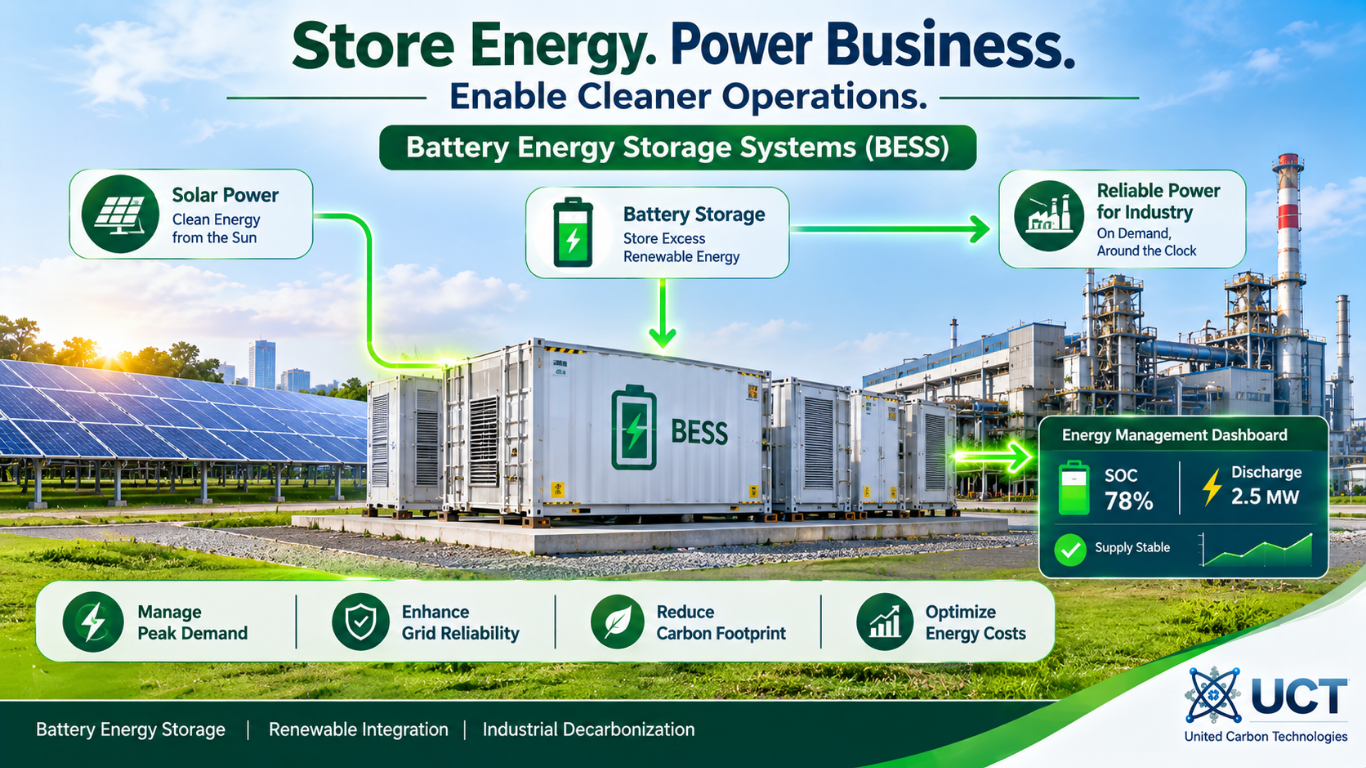
Battery storage can help Indian businesses use renewable electricity more flexibly across different operating hours.
Introduction: Why Battery Storage Matters for Indian Businesses
Renewable energy procurement is increasingly becoming part of corporate energy planning. Businesses are installing rooftop solar systems, entering into renewable power purchase arrangements and exploring other ways to reduce the emissions associated with electricity consumption.
Yet generating or procuring renewable electricity is only one part of the challenge. Businesses must also consider when that electricity is available and when their facilities need it.
For example, a manufacturing plant may generate substantial solar electricity during the afternoon but continue operating after sunset. A commercial building may experience its highest electricity demand during specific working hours. A cold-storage facility may need dependable electricity throughout the day and night. In each case, the timing of electricity generation and consumption can influence the practical value of renewable power.
Battery storage can help bridge this gap. Instead of using all available electricity immediately, a business can store a portion of it and use that energy later, subject to the battery's capacity, charging conditions and operating strategy.
This does not mean that a battery automatically makes a facility independent of the electricity grid. Its performance depends on system design, storage duration, energy demand, charging arrangements, efficiency losses, safety requirements and economics. However, when properly planned, BESS can become a useful component of a wider energy management strategy.
For Indian businesses, the opportunity is particularly relevant as electricity demand grows and the power system integrates more solar and wind generation. Battery storage can connect renewable energy procurement with the operational realities of factories, offices, warehouses, data centres and commercial infrastructure.
Explore Climate Intelligence for Business Decisions
Understanding renewable energy and battery storage is part of a broader sustainability strategy. Businesses also need reliable information about electricity consumption, greenhouse gas emissions and operational performance.
United Carbon Technologies is developing India-focused carbon measurement and ESG reporting solutions to help businesses strengthen their climate and sustainability decision-making.
Did You Know?
According to the Central Electricity Authority's National Electricity Plan projections, India is expected to require approximately 47.24 GW of Battery Energy Storage System capacity, equivalent to 236 GWh of storage, by 2031–32. This reflects the growing importance of storage in supporting a power system with a larger share of renewable electricity.
Source: Central Electricity Authority and Ministry of Power, Government of India.
1. Understanding How a Battery Energy Storage System Works
A Battery Energy Storage System is more than a collection of batteries. It is an integrated system of electrical, electronic, control and safety equipment designed to store electricity and deliver it according to operational requirements.
Most modern stationary BESS installations use rechargeable battery technologies, with lithium-ion systems widely used in commercial and grid-scale applications. Other technologies are also being developed and deployed for different storage requirements.
The Main Components of a BESS
1. Battery modules and racks
These contain the individual battery cells that store electrical energy through electrochemical processes. Multiple cells are assembled into modules and racks to achieve the required energy capacity.
2. Battery Management System (BMS)
The BMS monitors important battery parameters such as voltage, temperature, current and state of charge. It helps manage safe operation and can identify conditions that require protective action.
3. Power Conversion System (PCS)
The PCS converts electricity between the form required by the battery and the alternating-current electricity commonly used by buildings, industrial equipment and the grid. It controls charging and discharging according to the system design.
4. Energy Management System (EMS)
The EMS coordinates when the battery should charge or discharge. Depending on the installation, it can use electricity demand, renewable generation, electricity tariffs, operating schedules and other inputs to guide battery operation.
5. Thermal management and safety systems
Battery systems require appropriate temperature control, monitoring, electrical protection, fire detection and emergency response arrangements. These provisions are important for safe and reliable operation, particularly in large installations.
How the Charging and Discharging Cycle Works
A typical business installation may operate through the following sequence:
- Charging: Electricity from rooftop solar, another renewable source or the grid is used to charge the battery.
- Monitoring: The BMS and EMS monitor battery condition, electricity demand and system operating requirements.
- Energy storage: The battery retains energy until it is required, within its designed operating limits.
- Discharging: The PCS converts stored energy into usable electricity and supplies it to the connected load or another permitted point in the system.
- Recharging: The battery is charged again when suitable electricity is available and the operating strategy requires it.
For example, a factory with rooftop solar may generate more electricity than it can use during certain afternoon hours. Instead of relying entirely on immediate consumption or export arrangements, the facility may store some surplus electricity in a battery and use it during an evening production shift.
The actual amount of electricity delivered later will be lower than the amount used to charge the battery because energy is lost during charging, storage and discharging. This is why system efficiency must be considered when evaluating a BESS project.
2. Why Indian Businesses Are Exploring Battery Energy Storage
Businesses are evaluating battery storage for several reasons. The value of a BESS installation is not limited to storing renewable electricity. Depending on the facility's electricity profile, tariff structure, grid conditions and system configuration, it may support multiple operational objectives.
2.1 Better Use of Solar and Wind Electricity
Solar and wind generation vary with weather and time. A business may have access to renewable electricity when its immediate demand is relatively low, while its demand may continue when renewable generation declines.
Battery storage can shift a portion of the available electricity from one period to another. This can help businesses use more of their renewable generation at times when it is operationally useful.
2.2 Managing Peak Electricity Demand
Some industrial and commercial electricity tariffs include demand-related charges or time-based pricing structures. A facility may experience short periods of high electricity demand that affect its electricity bill.
A suitably designed BESS may discharge during selected peak-demand periods and reduce the amount of electricity drawn from the grid at those times. This is commonly referred to as peak shaving.
However, the financial benefit depends on the applicable tariff, demand measurement interval, battery power rating, available stored energy and the facility's load profile. Businesses should evaluate actual electricity bills and interval-level consumption data before assuming that battery storage will reduce costs.
2.3 Supporting Power Reliability
For facilities where interruptions can affect production, equipment or stored products, battery systems may provide backup power or support critical loads when configured for that purpose.
For example, a manufacturing facility may identify essential control systems, safety equipment, communication infrastructure or selected production processes that require continuity during an interruption.
Not every grid-connected BESS automatically provides backup power. The system must be designed with appropriate isolation, switching, protection and islanding capabilities. Businesses should also establish which loads need support and for how long.
2.4 Greater Flexibility in Energy Procurement
Businesses using rooftop solar, open-access renewable electricity or other procurement arrangements may need to manage differences between the timing of electricity availability and consumption.
A battery can provide an additional operational option by storing electricity when available and supplying it later. This may help businesses coordinate renewable procurement with their demand patterns, subject to applicable electricity regulations and contractual arrangements.
2.5 Supporting Emissions Reduction Planning
Battery storage can support a company's broader decarbonisation strategy when it enables greater use of renewable electricity or reduces reliance on more carbon-intensive electricity during particular periods.
However, installing a battery does not automatically reduce greenhouse gas emissions. The emissions outcome depends on the source of charging electricity, the timing of charging and discharging, battery efficiency and the electricity displaced when the battery operates.
Businesses should therefore assess BESS performance alongside their electricity consumption and emissions data rather than treating installed storage capacity as proof of emissions reduction.
Building a More Reliable Renewable Energy Strategy?
Battery storage, renewable electricity and energy efficiency can work together as part of a practical business decarbonisation plan. Start by understanding your electricity consumption, demand patterns and emissions baseline.
For Indian Businesses: Start with Your Energy Data
Before investing in battery storage, businesses should understand their electricity consumption patterns, peak demand, renewable energy availability and operational requirements.
A structured energy and emissions assessment can help identify where storage may be useful, which loads should be prioritised and how a proposed system could contribute to wider sustainability objectives.
Connect with the UCT team: Talk to United Carbon Technologies about carbon measurement, ESG reporting and climate intelligence for business.
3. Major Business Applications of Battery Energy Storage Systems
The usefulness of a Battery Energy Storage System depends on the electricity requirements of the facility where it is installed. A manufacturing plant, commercial office, warehouse and data centre may have very different energy consumption patterns. Therefore, businesses should identify the operational problem they want to solve before selecting a storage system.
Several applications are particularly relevant to India's industrial and commercial sectors.
3.1 Industrial Manufacturing Facilities
Manufacturing facilities often operate with large electrical loads, machinery, motors, compressors, pumps and process equipment. Some plants operate across multiple shifts, while others experience significant changes in electricity demand during production cycles.
Battery storage can support these facilities in several ways:
- Storing surplus electricity generated by rooftop or captive solar installations.
- Supplying stored electricity during selected high-demand periods.
- Supporting critical electrical loads during grid interruptions when the system is designed for backup operation.
- Improving coordination between renewable generation and industrial electricity consumption.
- Supporting energy management strategies based on production schedules and electricity tariffs.
For example, a manufacturing facility in Gujarat may generate solar electricity during the afternoon but continue operating during evening shifts. A properly sized battery system could store part of the available solar electricity and discharge it during selected evening operating hours.
The business case would depend on the facility's actual solar generation, consumption profile, battery efficiency, electricity tariff and investment cost.
3.2 Commercial Buildings and Office Campuses
Large office buildings, business parks, shopping centres, hotels and commercial campuses may experience predictable electricity demand patterns. Air conditioning, lighting, lifts, IT infrastructure and other building systems contribute to their electricity requirements.
A BESS can be integrated with rooftop solar and building energy management systems to support:
- Reducing selected periods of peak grid electricity consumption.
- Using stored renewable electricity when solar generation declines.
- Supporting critical building services during interruptions, where configured appropriately.
- Coordinating electricity use with time-based tariff structures.
For commercial property operators, battery storage may also become part of a broader building efficiency and sustainability strategy. However, it should be evaluated alongside energy-efficient cooling, lighting improvements and other demand-reduction measures.
3.3 Data Centres and Digital Infrastructure
Data centres require highly reliable electricity to operate servers, cooling systems, networking equipment and supporting infrastructure. Even short interruptions can affect digital services and business continuity.
Battery systems already play an important role in many data-centre backup architectures, often alongside uninterruptible power supply systems and standby generators.
In addition to backup applications, appropriately designed energy storage may support peak-demand management and coordination with renewable electricity procurement.
However, energy storage used for backup reliability and storage used for renewable energy shifting are not necessarily designed in the same way. Data-centre operators must consider power quality, response time, redundancy, critical load requirements and required backup duration.
3.4 Cold Storage and Warehousing
Cold-storage facilities, food processing units and temperature-controlled warehouses depend on continuous refrigeration. Electricity interruptions or unstable supply conditions can create operational risks, particularly where temperature-sensitive products are stored.
Battery storage may support selected refrigeration loads, monitoring equipment and control systems when integrated with suitable backup arrangements.
It can also help facilities use solar electricity more flexibly. For example, solar generation during daytime hours may be stored and used during periods when refrigeration demand continues after sunset.
Businesses should carefully calculate the energy required to maintain essential temperatures and determine whether the battery can support the required loads for the necessary duration.
3.5 Hospitals and Healthcare Infrastructure
Hospitals, diagnostic centres and healthcare facilities require reliable electricity for medical equipment, lighting, refrigeration, ventilation and essential support systems.
Battery storage can form part of a facility's electricity resilience strategy by supporting designated critical loads when properly configured.
It may also be integrated with rooftop solar systems to improve the use of renewable electricity. However, battery storage should not replace the need for appropriate emergency power planning, redundant supply arrangements and safety procedures in healthcare environments.
3.6 Renewable Energy Developers and Captive Power Projects
Renewable energy developers and businesses operating captive solar or wind projects may use battery storage to manage differences between electricity generation and demand.
Depending on project design and applicable regulations, storage can help:
- Shift renewable electricity from one time period to another.
- Support more predictable electricity delivery arrangements.
- Improve the operational flexibility of renewable energy projects.
- Coordinate generation, storage and consumption through an integrated energy management system.
The commercial structure and electricity market arrangements must be examined carefully before a storage project is developed.
4. Understanding Different Battery Energy Storage Operating Models
Businesses do not necessarily need to own and operate a battery system themselves. The appropriate model depends on their capital availability, technical capabilities, electricity requirements, project size and commercial objectives.
Some businesses may prefer direct ownership, while others may consider service-based or third-party arrangements.
4.1 Behind-the-Meter Battery Storage
Behind-the-meter storage is installed on the consumer's side of the electricity meter. It is generally connected to the facility's electrical infrastructure and can be operated to support the business's own electricity requirements.
Common applications include:
- Peak-demand management.
- Solar electricity storage and later consumption.
- Backup support for selected loads.
- Improved coordination between renewable generation and electricity demand.
This model is relevant to factories, offices, warehouses, commercial buildings and other electricity consumers seeking greater control over their energy usage.
4.2 Front-of-the-Meter Storage
Front-of-the-meter storage is generally connected to the electricity network rather than being installed primarily to serve a single consumer's internal electrical loads.
Such systems may be developed by independent power producers, energy companies or other project developers, subject to the applicable regulatory and market framework.
Potential functions include supporting grid operations, managing variations in electricity supply and demand, and providing eligible electricity system services.
For businesses, this model may be relevant when evaluating participation in larger energy projects or entering into commercial arrangements involving stored electricity.
4.3 Captive Solar Plus Battery Storage
In this model, a business combines its own solar generation system with battery storage. Electricity generated during periods of high solar availability can be used immediately or stored for later consumption.
This approach may be useful for industrial facilities with substantial daytime solar generation and electricity requirements extending into the evening.
However, the system must be designed around actual generation and consumption data. Oversizing either the solar installation or battery can increase capital costs without delivering proportionate operational benefits.
4.4 Third-Party Ownership and Energy Storage as a Service
Under a third-party ownership arrangement, an external developer, energy service company or project operator may finance, install and maintain the storage system. The business pays according to an agreed commercial arrangement.
Depending on the contract, this may involve fixed service payments, capacity-based charges, performance-linked payments or another agreed pricing structure.
Energy Storage as a Service can reduce the need for a business to manage every technical and operational aspect of a battery installation. However, the contract should clearly define:
- Battery availability and performance commitments.
- Ownership of the equipment and associated infrastructure.
- Maintenance and replacement responsibilities.
- Charging and discharging operating rights.
- Electricity cost allocation and billing arrangements.
- Performance monitoring and reporting requirements.
- End-of-contract responsibilities and battery disposal arrangements.
Businesses should compare the total contractual cost with the financial and operational implications of direct ownership.
4.5 Hybrid Energy Systems
A hybrid energy system combines battery storage with two or more electricity sources or technologies. A common business configuration may include solar generation, battery storage and grid electricity.
In some facilities, a hybrid arrangement may also include standby generators or other energy assets.
The objective is to coordinate different sources according to availability, operating requirements, cost and reliability priorities. An energy management system can help determine how these components interact.
Hybrid systems can offer operational flexibility, but their performance depends on system integration, control logic, protection arrangements and maintenance quality.
5. Battery Technologies Used in Energy Storage Systems
Battery chemistry is one of the important decisions in BESS project planning. Different technologies have different characteristics relating to energy density, operating life, safety, efficiency, temperature performance, material requirements and cost.
The right technology depends on the intended application rather than simply selecting the battery with the highest advertised capacity.
5.1 Lithium-Ion Batteries
Lithium-ion batteries are widely used in modern stationary energy storage installations. They offer relatively high energy density, good round-trip efficiency and flexible system configurations.
Two commonly discussed lithium-ion chemistries are:
Lithium Iron Phosphate (LFP): LFP batteries are widely considered for stationary storage because of their thermal stability characteristics, long cycle-life potential and suitability for applications where safety and operating life are important considerations.
Nickel Manganese Cobalt (NMC): NMC batteries offer higher energy density in many configurations and are used in various applications. Their suitability for stationary storage depends on system design, safety provisions and operating requirements.
Both chemistries require appropriate battery management, thermal monitoring and protective systems. Neither should be considered risk-free.
5.2 Sodium-Ion Batteries
Sodium-ion batteries use sodium-based electrochemical systems rather than lithium-based chemistry. Sodium is more widely available as a raw material, and this technology is attracting attention as an alternative for selected energy storage applications.
Potential advantages include the possibility of reducing dependence on certain critical battery materials and developing alternative supply chains.
However, commercial maturity, energy density, cost, product availability and operating performance vary by manufacturer and application. Businesses should evaluate actual project specifications rather than assume that sodium-ion batteries are already interchangeable with established lithium-ion systems.
5.3 Flow Batteries
Flow batteries store energy in liquid electrolytes contained in external tanks. Their power capacity and energy storage capacity can be designed with a degree of separation, making them potentially suitable for certain longer-duration stationary storage applications.
They may be considered where long operating duration, frequent cycling or particular lifecycle requirements are important.
However, flow battery systems can require larger physical installations and have different cost and operational characteristics compared with lithium-ion systems. Their suitability must be evaluated on a project-specific basis.
5.4 Emerging Battery Technologies
Research and commercial development are continuing across several other battery technologies, including solid-state batteries, advanced sodium-based systems and other long-duration storage approaches.
These technologies may offer future opportunities for stationary storage. However, businesses should distinguish between laboratory developments, pilot projects and commercially available systems with proven operating records.
How Should Businesses Compare Battery Technologies?
A meaningful comparison should consider more than the initial purchase price. Important evaluation parameters include:
- Usable energy capacity in kilowatt-hours (kWh) or megawatt-hours (MWh).
- Power output in kilowatts (kW) or megawatts (MW).
- Discharge duration at the required power level.
- Round-trip efficiency.
- Expected cycle life and calendar life.
- Operating temperature range and thermal management needs.
- Warranty conditions and degradation guarantees.
- Safety certifications and fire protection arrangements.
- Maintenance, replacement and end-of-life costs.
Businesses should obtain comparable technical specifications and lifecycle cost estimates from multiple qualified suppliers before selecting a technology.
6. Planning a Battery Storage Project: What Businesses Should Evaluate
Installing a BESS is an infrastructure decision that requires technical, financial, operational and regulatory assessment. A battery system that works well for one business may not deliver the same results for another.
Before beginning procurement, companies should evaluate the following factors.
6.1 Analyse Electricity Consumption Patterns
The first step is understanding how much electricity the facility consumes and when it consumes it.
Businesses should collect electricity bills, interval-level consumption data where available, maximum demand records, operating schedules and information about critical electrical loads.
This assessment helps determine whether the main objective is peak shaving, renewable energy shifting, backup support or another application.
6.2 Determine Required Power and Energy Capacity
Battery systems are generally described using two important measurements:
- Power capacity: The rate at which the battery can deliver or absorb electricity, usually measured in kW or MW.
- Energy capacity: The amount of electricity the battery can store, usually measured in kWh or MWh.
For example, a battery system rated at 1 MW / 2 MWh has a nominal energy capacity of 2 MWh and a rated power capacity of 1 MW. Under idealised conditions, this corresponds to two hours of discharge at full rated power.
Actual usable duration may differ because of operating limits, reserve requirements, conversion losses, battery degradation and system design.
6.3 Evaluate Solar Generation and Charging Sources
Businesses planning to combine solar generation with battery storage should examine hourly generation data and compare it with their electricity demand.
The assessment should identify periods of surplus generation, potential charging windows and the hours when stored energy may be required.
Grid charging may also be considered where permitted and commercially appropriate. However, the source of charging electricity should be tracked when evaluating the system's emissions performance.
6.4 Assess the Total Cost of Ownership
The investment assessment should include more than the battery purchase price. A complete project estimate may include:
- Battery modules, racks and enclosures.
- Power conversion equipment.
- Energy management and control systems.
- Electrical integration and grid connection infrastructure.
- Civil works and site preparation.
- Thermal management and fire safety equipment.
- Installation, commissioning and testing.
- Maintenance, insurance and operational expenses.
- Potential augmentation or replacement costs.
- End-of-life collection, recycling and disposal arrangements.
Businesses should also estimate the financial value of expected benefits using realistic assumptions about electricity tariffs, demand charges, system efficiency and operating cycles.
6.5 Check Site Conditions and Electrical Infrastructure
Battery installations require suitable space, structural arrangements, electrical connections, ventilation or thermal management, emergency access and safety provisions.
Companies should examine site layout, environmental conditions, existing electrical infrastructure and the requirements of the relevant electricity distribution company or other authorities.
Large systems may require additional technical studies, protection coordination and grid-interconnection assessments.
6.6 Review Regulations and Approvals
Battery storage projects in India must be planned in accordance with applicable electricity regulations, safety standards, technical requirements and local approval processes.
Depending on the project configuration, businesses may need to review applicable requirements relating to electrical installations, grid connectivity, metering, fire safety, building permissions, renewable energy arrangements and battery waste management.
Regulatory requirements can differ according to project size, location, ownership structure and whether the system is behind the meter or connected to the electricity network.
Businesses should consult qualified electrical professionals, the relevant distribution company and appropriate regulatory authorities before commissioning a project.
6.7 Plan Battery Safety and End-of-Life Management
Battery safety must be addressed throughout the project lifecycle, from design and installation to operation, maintenance and eventual decommissioning.
Businesses should require appropriate monitoring systems, electrical protection, fire detection and emergency response procedures. They should also establish clear responsibilities for inspection, maintenance and incident reporting.
End-of-life planning is equally important. Batteries should be directed through appropriate collection, recycling or authorised waste-management channels in accordance with applicable Indian battery waste management requirements.
For companies adopting battery storage as part of a sustainability strategy, responsible battery sourcing, material recovery and end-of-life management should be considered alongside operational emissions benefits.
Related Reads from Climate Knowledge Hub India
Explore these connected topics to understand the wider renewable energy and business decarbonisation landscape.
- Green Hydrogen in India: Where It Can Help Businesses Reduce Industrial Emissions
- Industrial Electrification: How Indian Industries Can Replace Fossil-Fuel Energy
- Industrial Waste Heat Recovery: How Indian Factories Can Capture Energy That Is Currently Lost
- Corporate Climate Transition Plan: How Businesses Can Turn Climate Targets into Action
7. Understanding the Economics of Battery Energy Storage
One of the most important questions for a business considering battery storage is whether the system can deliver sufficient financial and operational value over its useful life.
The financial case for a Battery Energy Storage System (BESS) should be based on the facility's actual electricity consumption, tariff structure, renewable energy availability and operating requirements. A battery that performs well in one location may not be financially attractive in another.
7.1 Initial Capital Investment
The initial investment generally includes battery modules, power conversion equipment, control systems, electrical integration, safety infrastructure, installation and commissioning.
The total project cost also depends on the required power rating, energy capacity, discharge duration, site conditions and the level of integration with existing electrical infrastructure.
Businesses should request a complete project cost breakdown rather than comparing suppliers only on the quoted battery price per kWh.
7.2 Electricity Bill Savings
A BESS may create financial value by reducing electricity drawn from the grid during selected high-cost or high-demand periods.
For example, a business may charge its battery when solar electricity is available and use the stored electricity during a period when grid electricity is more expensive or when demand charges are significant.
However, the savings must account for charging costs, round-trip efficiency losses, applicable tariff rules, battery degradation and operating expenses.
7.3 Peak Shaving and Demand Charge Management
Some commercial and industrial electricity tariffs include charges based on maximum recorded demand. A battery may discharge during selected peak periods to reduce the maximum grid demand recorded by the facility.
For this strategy to work, the system must have sufficient power capacity and stored energy at the right time. The facility's demand measurement interval and tariff conditions are also important.
Businesses should model several operating scenarios using historical electricity data before estimating savings.
7.4 Battery Degradation and Replacement Costs
Battery performance changes over time. Repeated charging and discharging, temperature conditions, operating depth and other factors can gradually reduce the amount of energy a battery can store and deliver.
Financial planning should therefore account for expected degradation, warranty conditions, maintenance, possible system augmentation and eventual replacement.
A project that appears attractive based only on its first-year performance may deliver a different result when assessed over its full operating life.
7.5 Lifecycle Cost and Levelised Cost of Storage
Businesses can compare storage options by considering the total cost of owning and operating a system over its useful life in relation to the electricity it delivers.
The Levelised Cost of Storage (LCOS) is one approach used to assess the cost of stored electricity delivered over the system's lifetime. It considers factors such as capital expenditure, operating costs, charging electricity, efficiency, degradation, replacement and total energy discharged.
LCOS is useful for comparing technical and commercial options, but it should not be treated as the only decision-making measure. The value of backup capability, demand management, renewable energy utilisation and operational resilience may also matter to a business.
7.6 Financial Evaluation Before Investment
Before approving a BESS project, businesses should prepare a financial assessment covering:
- Initial project investment and financing costs.
- Expected annual electricity bill savings.
- Charging electricity costs and energy losses.
- Expected battery degradation and usable capacity over time.
- Maintenance, insurance and operational expenses.
- Potential augmentation or replacement expenditure.
- Applicable taxes, duties, incentives or project support, where eligible.
- Expected payback period, net present value and internal rate of return.
Financial projections should use realistic assumptions and include sensitivity analysis for changes in electricity tariffs, battery costs, utilisation, efficiency and operating conditions.
8. India's Battery Storage Landscape: Policy Direction and Market Opportunities
India's battery storage market is developing alongside the expansion of renewable energy, electricity demand and grid modernisation. Energy storage is increasingly recognised as an important requirement for managing variations in renewable electricity generation and supporting power system flexibility.
8.1 India's Projected Battery Storage Requirement
The Central Electricity Authority's National Electricity Plan projects a substantial increase in battery energy storage requirements as India's electricity system expands.
For 2031–32, the plan estimates a Battery Energy Storage System requirement of approximately 47.24 GW of power capacity and 236.22 GWh of energy storage capacity.
These figures represent planning projections, not the amount of BESS capacity already installed or operational. They indicate the scale of storage infrastructure that may be required to support India's future electricity system.
8.2 Viability Gap Funding for Battery Storage
The Government of India has introduced Viability Gap Funding (VGF) initiatives to support the development of battery storage projects.
The original scheme approved in 2023 envisaged support for 4,000 MWh of BESS projects, with financial assistance of up to 40% of capital cost through budgetary support. Subsequent government updates have reported an increase in the supported capacity under the scheme as battery costs declined.
A further scheme announced in 2025 supports the development of additional BESS capacity through financial assistance from the Power System Development Fund.
These initiatives are intended to improve project viability and encourage storage deployment. However, businesses should check the current scheme guidelines, eligibility conditions, procurement structure and applicable deadlines before assuming that a particular project qualifies for support.
8.3 Opportunities for Indian Industries
The expansion of battery storage can create opportunities across several parts of India's industrial and energy ecosystem:
- Manufacturing: Battery cells, modules, packs, enclosures and associated electrical equipment.
- Power electronics: Inverters, power conversion systems, control equipment and energy management solutions.
- Project development: Engineering, procurement, construction, commissioning and system integration.
- Software and analytics: Battery monitoring, performance optimisation, forecasting and energy management platforms.
- Operations and maintenance: Inspection, diagnostics, safety monitoring and lifecycle management.
- Recycling and refurbishment: Collection, material recovery and responsible management of end-of-life batteries.
For Indian businesses, these developments may create opportunities not only to adopt storage systems but also to participate in the wider battery supply chain.
8.4 State-Level and Electricity Market Considerations
Battery storage opportunities can vary across Indian states because electricity tariffs, renewable energy resources, distribution arrangements, grid infrastructure and regulatory conditions are not identical.
A business considering storage in Gujarat, Maharashtra, Karnataka, Tamil Nadu or another state should evaluate the relevant state electricity regulatory commission's orders, distribution company requirements and applicable central regulations.
Businesses exploring open-access renewable power or grid-connected storage should also review the relevant metering, scheduling, connectivity and settlement arrangements.
National policy support creates an enabling environment, but the commercial case for an individual project still depends on its location and operating model.
9. Can Battery Storage Reduce a Company's Carbon Footprint?
Battery storage can contribute to corporate decarbonisation, but its climate benefit depends on how the system is charged and operated.
It is important to distinguish between storing renewable electricity and storing electricity drawn from the conventional grid. The source and timing of charging can significantly influence the emissions outcome.
9.1 Storing Renewable Electricity
When a battery stores electricity generated by a renewable source, such as solar power, it can help make that electricity available at a later time.
For example, a factory may store surplus rooftop solar electricity during the afternoon and use it during an evening production shift. This can increase the proportion of its electricity demand served by renewable generation, depending on the system design and operating conditions.
9.2 Understanding Grid-Charged Batteries
A battery charged using grid electricity does not automatically deliver an emissions reduction. If the electricity used for charging has a high emissions intensity, and the battery later displaces electricity with a lower emissions intensity, the overall climate benefit may be limited or even negative after accounting for efficiency losses.
Businesses should therefore assess the emissions intensity of electricity at the relevant charging and discharging periods wherever suitable data is available.
9.3 Considering Battery Efficiency and Lifecycle Impacts
Battery systems consume some electricity during charging, storage and conversion. This means that more electricity may be required to charge a battery than the amount ultimately delivered to the business.
There are also lifecycle impacts associated with raw material extraction, battery manufacturing, transportation, maintenance and end-of-life treatment.
A credible environmental assessment should consider both operational electricity emissions and relevant lifecycle impacts instead of focusing only on the amount of renewable electricity stored.
9.4 Integrating BESS into Corporate Emissions Accounting
Companies should maintain records of electricity purchased, renewable electricity generated or procured, battery charging, battery discharging and relevant energy losses.
These records can help sustainability teams understand the contribution of storage to electricity management and emissions performance.
Battery storage should not automatically be counted as a renewable energy certificate, carbon credit or independent emissions reduction claim. Any renewable electricity or greenhouse gas accounting claim must follow the relevant accounting methodology and contractual evidence requirements.
For companies preparing ESG or BRSR disclosures, the most useful approach is to connect storage performance with documented energy consumption, renewable electricity sourcing and emissions data.
10. A Practical Roadmap for Indian Businesses Considering Battery Storage
Businesses do not need to begin with a large battery installation. A structured assessment can help identify the most suitable application and reduce the risk of investing in a system that does not match actual operating needs.
Step 1: Establish the Energy Baseline
Collect electricity bills, interval consumption records, maximum demand information, operating schedules and renewable energy generation data. Identify how much electricity the facility consumes and when demand is highest.
Step 2: Identify the Business Objective
Decide whether the main purpose is renewable energy shifting, peak shaving, backup support, improved energy reliability or another operational requirement. A clearly defined objective helps determine the appropriate system configuration.
Step 3: Conduct a Technical Feasibility Assessment
Evaluate the required power rating, energy capacity, discharge duration, battery technology, electrical integration, site conditions, safety provisions and grid connectivity requirements.
Step 4: Compare Commercial Models
Compare direct ownership, third-party ownership, energy storage as a service and other available procurement arrangements. Assess capital requirements, contractual obligations, operating responsibilities and expected financial returns.
Step 5: Verify Regulations and Project Approvals
Review applicable electricity regulations, state-level requirements, electrical safety provisions, fire protection requirements, metering arrangements and battery waste management obligations. Obtain professional advice and necessary approvals before installation.
Step 6: Select a Qualified Technology and Project Partner
Evaluate suppliers and integrators based on technical experience, safety systems, performance guarantees, warranty conditions, maintenance capability, software controls and end-of-life arrangements.
Step 7: Begin with a Pilot or Phased Installation
Where practical, businesses can begin with a pilot installation or a phased deployment. This allows the company to understand actual performance before expanding the system.
Step 8: Monitor Performance and Environmental Outcomes
Track charging and discharging energy, system efficiency, availability, battery health, peak-demand reduction, electricity cost impact and renewable energy utilisation.
Where the system is part of a decarbonisation strategy, maintain supporting records to evaluate its contribution to the company's greenhouse gas emissions performance.
11. Common Mistakes Businesses Should Avoid
Battery storage projects can deliver useful operational benefits, but poor planning may reduce their financial value and create unnecessary technical risks.
Businesses should avoid these common mistakes:
- Choosing capacity without analysing demand: A battery should be sized according to the actual power and energy requirements of the facility.
- Focusing only on purchase price: Maintenance, degradation, replacement, efficiency and end-of-life costs must also be evaluated.
- Assuming every battery provides backup power: Backup capability requires suitable electrical architecture and controls.
- Ignoring charging electricity costs: The source and cost of charging electricity affect the financial and environmental performance of the system.
- Overestimating emissions reductions: Grid-charged storage does not automatically create a lower-carbon electricity supply.
- Ignoring battery safety: Thermal management, fire detection, electrical protection and emergency procedures must be incorporated into project planning.
- Overlooking end-of-life responsibilities: Battery collection, recycling and authorised waste management should be addressed from the beginning.
- Using unrealistic financial assumptions: Savings should be calculated using actual tariff conditions, operating data and realistic degradation estimates.
A well-planned project should balance technical performance, financial viability, operational reliability and environmental responsibility.
Quick Summary: Battery Energy Storage Systems in India
- Battery Energy Storage Systems store electricity and release it when required.
- Businesses can use BESS for renewable energy shifting, peak shaving and appropriately configured backup support.
- Industrial facilities, offices, data centres, warehouses and healthcare infrastructure may have different storage requirements.
- Behind-the-meter, front-of-the-meter, captive renewable and third-party service models offer different operating arrangements.
- Lithium-ion, sodium-ion and flow batteries have different technical and commercial characteristics.
- Project economics should include capital expenditure, charging costs, efficiency, degradation, maintenance and replacement.
- India's National Electricity Plan projects 47.24 GW / 236.22 GWh of BESS capacity requirement by 2031–32.
- Battery storage can support decarbonisation, but emissions benefits depend on charging electricity and operating conditions.
- Battery safety, regulatory compliance and responsible end-of-life management are essential.
- Businesses should begin with energy data and a feasibility assessment before investing.
Frequently Asked Questions (FAQs)
1. What is a Battery Energy Storage System (BESS)?
A Battery Energy Storage System is an integrated system that stores electricity in rechargeable batteries and releases it when required. It includes batteries, power conversion equipment, monitoring systems, controls and safety components.
2. How can battery storage help Indian businesses?
Battery storage can help businesses use renewable electricity more flexibly, manage selected peak-demand periods, support critical loads when configured for backup and improve control over electricity consumption.
3. Can a business store solar electricity for use at night?
Yes. A business can use a battery system to store surplus solar electricity generated during the day and discharge it later, subject to battery capacity, system efficiency and operating requirements.
4. Which battery technology is commonly used in commercial BESS projects?
Lithium-ion batteries are widely used in commercial and grid-scale storage. LFP and NMC are two established lithium-ion chemistries. Sodium-ion and flow batteries are also being developed or deployed for selected applications.
5. What is the difference between battery power capacity and energy capacity?
Power capacity, measured in kW or MW, indicates how quickly a battery can deliver or absorb electricity. Energy capacity, measured in kWh or MWh, indicates how much electricity it can store. Both are necessary when selecting a system.
6. Does battery storage reduce electricity bills?
It may reduce electricity costs by supporting peak-demand management, renewable energy utilisation or time-based electricity consumption strategies. Actual savings depend on tariffs, charging costs, system efficiency, degradation and operating patterns.
7. Does installing a battery automatically reduce a company's carbon footprint?
No. The emissions outcome depends on the source of electricity used to charge the battery, the electricity displaced during discharge, energy losses and lifecycle impacts. Grid-charged batteries do not automatically provide emissions reductions.
8. What is the projected BESS requirement in India by 2031–32?
The Central Electricity Authority's National Electricity Plan projects approximately 47.24 GW of battery power capacity and 236.22 GWh of battery energy storage capacity requirement by 2031–32.
9. Are there government support schemes for battery storage projects in India?
Yes. The Government of India has introduced Viability Gap Funding initiatives to support the development of BESS projects. Eligibility, funding limits, procurement arrangements and timelines depend on the applicable scheme guidelines.
10. What should a business assess before installing a BESS?
A business should assess its electricity demand profile, peak loads, renewable generation, required power and energy capacity, project economics, site conditions, battery safety, regulatory requirements, maintenance and end-of-life management.
Make Renewable Energy Work More Effectively for Your Business
Battery storage is becoming an important part of India's evolving energy landscape. But selecting the right system requires more than choosing a battery. Businesses need reliable energy data, practical feasibility assessments and a clear understanding of their emissions and sustainability objectives.
United Carbon Technologies is developing India-focused carbon measurement, ESG reporting and climate intelligence solutions to support better sustainability decisions.
Continue Your Climate Learning Journey
Explore more practical guides on renewable energy, carbon accounting, climate technology and ESG developments in India.
+ Follow Climate Knowledge Hub IndiaAbout this article: This article is prepared by United Carbon Technologies for Climate Knowledge Hub India. It is intended to provide general educational information on battery energy storage, renewable electricity management and business applications. Project-specific technical, financial and regulatory decisions should be based on professional assessments and applicable regulations.