

India's Carbon Intelligence Platform Explained (Complete Beginner Guide)
By United Carbon Technologies | Climate Knowledge Hub India
Join thousands of readers exploring carbon accounting, ESG, sustainability, climate technology, and climate intelligence.
Carbon Intelligence Platforms help organizations collect environmental data, measure greenhouse gas emissions, automate ESG reporting, and make smarter sustainability decisions. As India accelerates its transition toward a low-carbon economy, carbon intelligence is becoming an essential capability for businesses, institutions, and governments.
What is a Carbon Intelligence Platform?
A Carbon Intelligence Platform is a digital system that collects sustainability data, measures carbon emissions, automates ESG reporting, analyzes climate risks, and helps organizations reduce their environmental impact using data-driven insights.
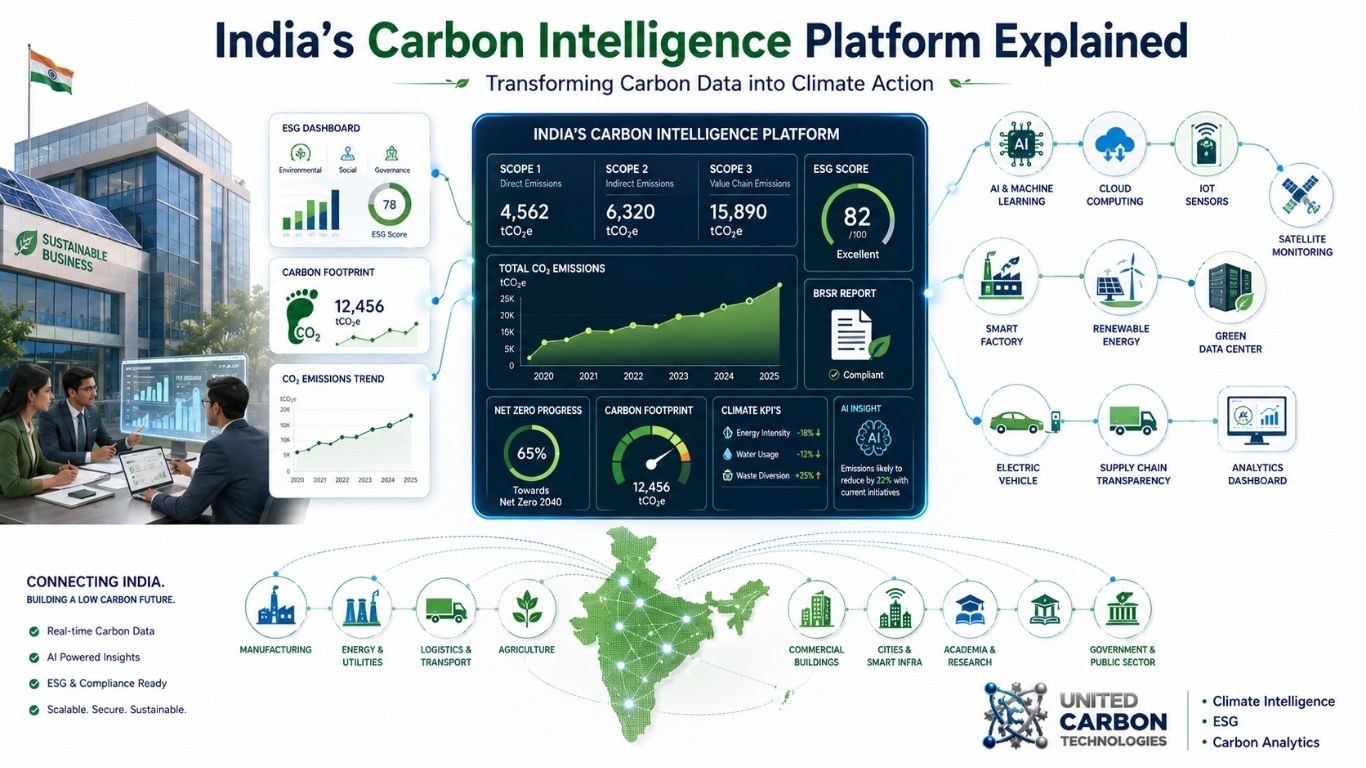
Managing climate impact has become far more complex than simply measuring electricity consumption or fuel usage. Modern organizations generate environmental data across factories, offices, supply chains, transportation networks, and business operations. Turning this information into meaningful climate action requires intelligent digital systems.
This is where Carbon Intelligence Platforms play a crucial role. They transform raw sustainability data into actionable insights that support carbon accounting, ESG reporting, climate risk management, regulatory compliance, and long-term Net Zero planning.
As India's sustainability ecosystem continues to evolve, carbon intelligence is becoming one of the most valuable capabilities for businesses seeking operational efficiency, regulatory readiness, and environmental leadership.
Did you know?
Many organizations generate sustainability data from dozens of departments, but without an integrated carbon intelligence platform, transforming that data into meaningful climate decisions can be difficult.
What Is a Carbon Intelligence Platform?
A Carbon Intelligence Platform is software that brings together environmental, operational, and sustainability data into one centralized system. Instead of relying on spreadsheets and manual calculations, organizations can continuously monitor emissions, analyze performance, identify risks, and generate reports automatically.
These platforms combine carbon accounting, ESG analytics, compliance management, climate intelligence, and decision-support tools to help organizations understand where emissions originate and where improvements can deliver the greatest impact.
- Carbon footprint measurement
- Greenhouse gas accounting
- ESG performance monitoring
- Climate risk analysis
- Net Zero progress tracking
- Sustainability reporting
Why Carbon Intelligence Matters Today
Businesses are facing increasing expectations from investors, regulators, customers, and supply chain partners to demonstrate measurable environmental performance. Sustainability reporting is no longer just about compliance—it has become a strategic business capability.
Carbon intelligence allows organizations to move beyond collecting environmental data. It helps transform data into insights that improve operational efficiency, reduce emissions, identify climate-related risks, and support better business decisions.
- Supports ESG reporting
- Improves carbon accounting accuracy
- Identifies emission hotspots
- Enables data-driven sustainability decisions
- Strengthens climate resilience
- Supports long-term business strategy
The Growing Need for Carbon Intelligence in India
India's sustainability landscape is changing rapidly. Businesses are preparing for increasing ESG disclosures, climate reporting expectations, renewable energy adoption, and future carbon market opportunities. At the same time, investors and global supply chains increasingly expect transparent environmental data.
Digital carbon intelligence platforms help organizations manage these growing requirements by simplifying emissions measurement, automating reporting, and improving sustainability decision-making across the enterprise.
- Growing ESG adoption
- BRSR reporting requirements
- Net Zero commitments
- Supply chain transparency
- Climate risk management
- Digital sustainability transformation
Understanding your environmental data is the first step toward reducing emissions, improving sustainability performance, and building a resilient future.
Learn how digital carbon intelligence can simplify carbon accounting, ESG reporting, climate risk analysis, and Net Zero planning.
How Carbon Intelligence Platforms Work
A Carbon Intelligence Platform brings together environmental data from across an organization into a single digital ecosystem. Instead of relying on disconnected spreadsheets, businesses can continuously monitor emissions, analyze sustainability performance, and automate reporting through one centralized platform.
The process typically begins with collecting operational data, converting it into greenhouse gas emissions, analyzing trends, and generating dashboards and reports that support better decision-making.
1. Data Collection
The first step is gathering environmental and operational data from multiple business activities. This information forms the foundation of carbon accounting and sustainability reporting.
- Electricity consumption
- Fuel usage
- Industrial processes
- Business travel
- Water consumption
- Waste generation
- Supply chain activities
- Procurement data
2. Carbon Accounting
Once operational data is collected, internationally accepted emission factors are applied to calculate greenhouse gas emissions. The results are usually expressed as carbon dioxide equivalent (CO₂e), allowing organizations to compare emissions across different activities.
Carbon accounting creates a standardized method for understanding environmental impact and preparing sustainability disclosures.
3. Scope 1, Scope 2, and Scope 3 Measurement
Modern Carbon Intelligence Platforms classify emissions using the Greenhouse Gas Protocol, making reporting consistent and globally recognized.
- Scope 1: Direct emissions from company-owned operations.
- Scope 2: Indirect emissions from purchased electricity and energy.
- Scope 3: Value chain emissions including suppliers, logistics, employee travel, purchased goods, product use, and waste.
Together, these categories provide a comprehensive picture of an organization's environmental impact.
4. Interactive Dashboards
Instead of reviewing static spreadsheets, decision-makers can monitor sustainability performance through real-time dashboards that visualize emissions, energy consumption, trends, and key performance indicators.
- Carbon footprint dashboards
- Department-wise emissions
- Facility comparisons
- Historical trends
- Emission hotspots
- Progress toward sustainability targets
5. Automated ESG Reporting
Carbon Intelligence Platforms significantly reduce manual reporting by automatically generating sustainability reports using the latest organizational data.
This improves reporting accuracy while reducing the time required to prepare ESG disclosures, BRSR reports, carbon inventories, and sustainability documentation.
Key Features of a Carbon Intelligence Platform
Modern platforms do far more than calculate emissions. They combine advanced analytics, automation, climate intelligence, and compliance tools into a unified sustainability management system.
AI-Powered Sustainability Analytics
Artificial Intelligence helps identify emission patterns, detect inefficiencies, forecast future emissions, and recommend practical reduction opportunities using large environmental datasets.
Carbon Footprint Measurement
Automatically calculate organizational emissions across operations, facilities, products, projects, and supply chains using standardized carbon accounting methodologies.
ESG Reporting
Generate structured ESG reports that help organizations communicate environmental performance to investors, regulators, customers, and stakeholders.
BRSR Reporting Support
Indian businesses preparing Business Responsibility and Sustainability Reporting (BRSR) disclosures can organize sustainability data more efficiently through centralized reporting workflows.
Net Zero Planning
Track emission reduction targets, monitor progress toward Net Zero commitments, and evaluate long-term decarbonization strategies through measurable performance indicators.
Climate Risk Assessment
Identify operational and environmental risks associated with climate change, resource availability, regulatory changes, and carbon-intensive business activities.
Compliance Management
Centralize sustainability documentation and prepare environmental information required for evolving reporting standards and climate-related regulations.
Forecasting and Scenario Analysis
Organizations can evaluate future emission scenarios before making investment or operational decisions, enabling better long-term sustainability planning.
Instead of simply reporting historical emissions, Carbon Intelligence Platforms help organizations understand future risks, identify reduction opportunities, and make informed sustainability decisions using real-time data.
Who Uses Carbon Intelligence Platforms?
Carbon Intelligence is no longer limited to large multinational corporations. As sustainability expectations continue to grow, organizations of every size are beginning to adopt digital carbon management solutions.
Large Enterprises
Major corporations use carbon intelligence platforms to manage complex operations across multiple facilities, suppliers, and international business units while supporting ESG reporting and Net Zero commitments.
Manufacturing Industries
Factories monitor production emissions, fuel consumption, industrial processes, waste generation, and resource efficiency to improve sustainability performance and reduce operating costs.
MSMEs
Small and medium-sized enterprises are increasingly measuring carbon emissions to meet customer expectations, participate in sustainable supply chains, and prepare for future ESG requirements.
Real Estate and Infrastructure
Property developers and infrastructure companies monitor building energy performance, water usage, operational efficiency, and lifecycle emissions throughout project development.
Banks and Financial Institutions
Financial institutions evaluate climate-related risks, sustainable finance opportunities, ESG performance, and environmental disclosures as part of responsible investment strategies.
Government and Public Sector
Government agencies use sustainability data to support climate policies, monitor environmental performance, improve resource management, and achieve national climate objectives.
Educational Institutions
Universities, research organizations, and training institutions use Carbon Intelligence Platforms to measure campus emissions, promote sustainability education, and build climate awareness among future professionals.
As India's sustainability ecosystem continues to mature, Carbon Intelligence Platforms are becoming valuable tools for businesses, institutions, startups, government organizations, and educational campuses seeking to improve carbon management, ESG performance, regulatory readiness, and long-term climate resilience.
Core Components of a Carbon Intelligence Platform
An effective carbon intelligence platform brings together environmental data, business operations, and sustainability reporting into a single digital ecosystem. Instead of managing emissions information through spreadsheets, organizations can monitor, analyze, and improve their environmental performance using real-time insights.
Modern platforms help transform raw sustainability data into meaningful intelligence that supports better business decisions, regulatory compliance, and long-term climate strategies.
- Carbon Footprint Measurement — Calculate emissions across Scope 1, Scope 2, and Scope 3 using standardized methodologies.
- Automated Data Collection — Gather information from electricity bills, fuel consumption, logistics, procurement, and operational systems.
- Emission Factor Database — Convert business activity data into CO₂ equivalent (CO₂e) emissions using recognized emission factors.
- Real-Time Dashboards — Monitor emissions trends, department-wise performance, and sustainability KPIs from a centralized dashboard.
- ESG & BRSR Reporting — Organize sustainability data required for ESG disclosures, BRSR reporting, and investor communication.
- Target Tracking — Measure progress toward carbon reduction goals, net-zero commitments, and sustainability roadmaps.
- Analytics & Forecasting — Identify emission hotspots, compare historical performance, and forecast future emissions.
- Compliance Management — Help organizations prepare for evolving climate regulations and reporting requirements.
Carbon management becomes significantly easier when emissions data, ESG reporting, analytics, and sustainability performance are managed through one intelligent platform instead of multiple disconnected files.
How Carbon Intelligence Supports Better Business Decisions
Carbon intelligence is no longer limited to environmental reporting. Organizations increasingly use emissions data to improve operational efficiency, reduce costs, strengthen ESG performance, and identify sustainability opportunities across the business.
When environmental data becomes part of everyday decision-making, companies can balance growth with climate responsibility while preparing for future regulations and stakeholder expectations.
- Identify high-emission operations that require optimization.
- Reduce energy costs through efficiency improvements.
- Improve supply chain sustainability and procurement decisions.
- Support ESG ratings and investor confidence.
- Prepare for carbon disclosure and climate reporting requirements.
- Strengthen long-term business resilience against climate-related risks.
- Track measurable sustainability performance over time.
As climate reporting becomes more data-driven, organizations that invest in carbon intelligence today will be better positioned to manage risk, demonstrate transparency, and compete in a low-carbon economy.
United Carbon Technologies is building ACIS (Advanced Carbon Intelligence System)—an India-focused climate intelligence platform designed to simplify carbon accounting, ESG reporting, sustainability analytics, and climate data management for organizations of every size.
India's Growing Need for Carbon Intelligence
India's sustainability landscape is evolving rapidly. Businesses are facing increasing expectations from regulators, investors, customers, financial institutions, and global supply chains to measure and disclose their environmental performance accurately.
As organizations begin tracking greenhouse gas emissions, energy consumption, water usage, waste generation, and ESG metrics, traditional reporting methods are becoming difficult to manage. Carbon intelligence platforms help centralize sustainability information and transform it into actionable insights.
- Growing ESG adoption across Indian industries.
- Increasing focus on BRSR and sustainability disclosures.
- Expansion of renewable energy and decarbonization initiatives.
- Global customers requesting emissions transparency across supply chains.
- Rising demand for accurate carbon accounting and climate analytics.
- Better decision-making through real-time sustainability dashboards.
How ACIS Is Building India's Carbon Intelligence Ecosystem
United Carbon Technologies is developing ACIS (Advanced Carbon Intelligence System) to make carbon management simpler, smarter, and more accessible for Indian organizations.
Rather than functioning as only a carbon calculator, ACIS is being designed as an integrated climate intelligence ecosystem that combines emissions measurement, ESG analytics, sustainability reporting, climate education, and business intelligence into one unified platform.
- India-focused carbon footprint calculations.
- Scope 1, Scope 2, and Scope 3 emissions management.
- ESG and sustainability reporting support.
- BRSR-ready environmental data management.
- Interactive dashboards and climate analytics.
- Carbon reduction planning and performance tracking.
- Climate knowledge resources through UCT Academy.
- Future-ready AI-powered sustainability intelligence.
The long-term vision is to build a digital climate ecosystem that empowers businesses, institutions, policymakers, and individuals with reliable environmental intelligence to support India's transition toward a low-carbon economy.
The Future of Carbon Intelligence in India
The future of sustainability management will be driven by intelligent digital platforms that combine artificial intelligence, automation, climate analytics, satellite data, IoT devices, and real-time business information. Carbon intelligence is expected to become a standard business capability rather than a specialized sustainability function.
Organizations will increasingly rely on predictive analytics to forecast emissions, identify climate risks, optimize energy consumption, and monitor ESG performance continuously instead of preparing reports only once a year.
As India's climate ecosystem continues to evolve, carbon intelligence platforms will play a central role in helping businesses improve transparency, strengthen resilience, support net-zero strategies, and accelerate sustainable growth through data-driven decision-making.
Related Climate Intelligence Guides
- What Are Scope 1, Scope 2 and Scope 3 Emissions?
- What Is Carbon Footprint in India?
- What Are Carbon Credits in India?
- ESG Knowledge Hub
- Climate Technology Articles
- Carbon intelligence converts emissions data into business insights.
- Organizations use carbon intelligence to measure Scope 1, Scope 2, and Scope 3 emissions.
- Digital platforms simplify ESG reporting and sustainability management.
- Carbon intelligence supports better business decisions and climate action.
- AI, automation, and analytics are shaping the future of sustainability management.
- India is rapidly moving toward digital climate intelligence solutions.
- ACIS is being developed as an India-focused carbon intelligence ecosystem.
Frequently Asked Questions
What is a carbon intelligence platform?
A carbon intelligence platform is software that helps organizations measure, analyze, manage, and report greenhouse gas emissions using centralized environmental data and analytics.
Why is carbon intelligence important?
Carbon intelligence enables organizations to understand their environmental impact, improve sustainability performance, support ESG reporting, and make informed climate-related decisions.
How does a carbon intelligence platform work?
It collects operational data, converts it into carbon emissions using emission factors, and presents insights through dashboards, reports, and sustainability analytics.
Who uses carbon intelligence platforms?
Businesses, manufacturers, government organizations, educational institutions, consultants, investors, and sustainability professionals use carbon intelligence platforms.
What is the difference between carbon accounting and carbon intelligence?
Carbon accounting measures emissions, while carbon intelligence analyzes emissions data to support reporting, forecasting, decision-making, and emission reduction strategies.
Can carbon intelligence help with ESG reporting?
Yes. Carbon intelligence platforms organize sustainability data required for ESG disclosures, BRSR reporting, climate risk assessments, and corporate sustainability reports.
What technologies are used in carbon intelligence?
Modern platforms use cloud computing, artificial intelligence (AI), Internet of Things (IoT), automation, analytics, APIs, and business intelligence dashboards.
Why is carbon intelligence becoming important in India?
As India expands ESG reporting, renewable energy, sustainability initiatives, and climate regulations, organizations need digital tools to manage environmental data efficiently.
What industries benefit from carbon intelligence?
Manufacturing, energy, logistics, real estate, finance, healthcare, education, retail, and technology sectors all benefit from better emissions measurement and sustainability insights.
What is ACIS by United Carbon Technologies?
ACIS (Advanced Carbon Intelligence System) is an India-focused climate intelligence platform being developed by United Carbon Technologies to simplify carbon accounting, ESG reporting, sustainability analytics, and climate data management.
Explore the Future of Climate Intelligence
Learn ESG, sustainability, carbon intelligence, and climate-tech concepts shaping the future of business and environmental strategy..
Join readers building climate intelligence knowledge for a sustainable future.