

Net Zero vs Carbon Neutral: What's the Difference for Indian Businesses?
Search Description: Learn the difference between Net Zero and Carbon Neutral, why it matters for Indian businesses, ESG reporting, BRSR compliance, and climate strategy.
By United Carbon Technologies | Published: April 2026 | Updated: July 2026
Stay updated with practical guides on Carbon Accounting, ESG Reporting, Climate Technology, Sustainability Careers, and India's transition toward Net Zero.
Net Zero vs Carbon Neutral Explained
Many businesses use Net Zero and Carbon Neutral as if they mean the same thing. They don't.
Although both aim to reduce climate impact, their strategies, reporting requirements, and long-term commitments are very different. Understanding these differences has become increasingly important as investors, regulators, customers, and supply chain partners expect credible climate action rather than marketing claims.
Whether you are an MSME, startup, manufacturer, exporter, or listed company in India, knowing when to pursue Carbon Neutrality and when to develop a Net Zero roadmap can influence future competitiveness, ESG ratings, access to finance, and customer trust.
What is the difference between Net Zero and Carbon Neutral?
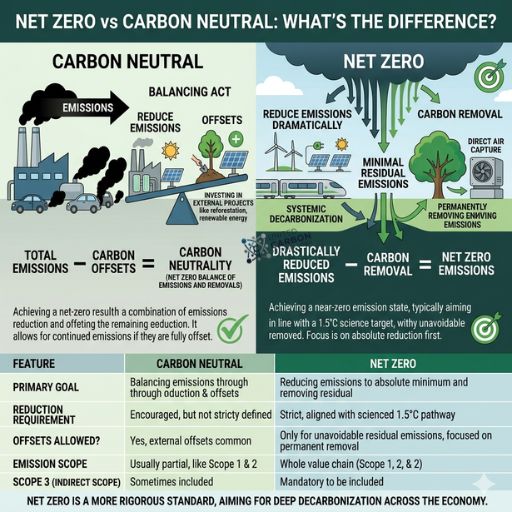
Carbon Neutral means balancing greenhouse gas emissions by purchasing carbon offsets after measuring emissions. Net Zero requires organizations to first reduce emissions across Scope 1, Scope 2, and Scope 3 by around 90–95%, using carbon removals only for unavoidable residual emissions. Net Zero therefore represents a much deeper and science-based climate commitment.
Introduction
Climate commitments are no longer limited to multinational corporations. Across India, businesses of every size are being asked by investors, customers, regulators, and global buyers to disclose their greenhouse gas emissions and demonstrate credible decarbonization plans.
This shift is driven by several factors:
- Growing ESG reporting expectations
- India's Net Zero target for 2070
- BRSR reporting requirements
- International supply chain expectations
- Increasing investor scrutiny
- Carbon disclosure requirements
Unfortunately, many organizations still confuse Carbon Neutrality with Net Zero. Some believe buying carbon credits automatically makes them climate leaders, while others assume Net Zero simply means planting more trees.
In reality, these two concepts represent very different levels of ambition.
Carbon Neutrality focuses on balancing emissions through offsets. Net Zero focuses on eliminating emissions at their source before considering any offsets.
Understanding this distinction helps businesses avoid greenwashing, improve ESG performance, prepare for future regulations, and build long-term resilience.
📊 Measure Your Carbon Footprint Before Setting Climate Goals
Every successful Net Zero journey starts with accurate emissions data. UCT Carbon Intelligence helps organizations calculate greenhouse gas emissions, build carbon inventories, prepare ESG reports, and develop practical decarbonization strategies.
Measure • Report • Reduce • Improve
💡 Did You Know?
More than 90% of emissions for many large companies originate from their value chain (Scope 3), making supplier engagement one of the biggest challenges in achieving Net Zero.
What is Carbon Neutral?
Carbon Neutrality means balancing greenhouse gas emissions by removing or offsetting an equivalent amount elsewhere.
The process generally involves four steps:
- Measure emissions
- Reduce emissions where possible
- Purchase verified carbon credits
- Claim Carbon Neutral status
For example, an Indian IT company may emit 1,000 tonnes of CO₂ annually. Instead of reducing all operational emissions immediately, it purchases certified carbon credits supporting renewable energy or afforestation projects that remove or avoid the same amount of emissions.
Its net emissions become zero on paper, even though many operational emissions still exist.
Advantages of Carbon Neutrality
- Quick to implement
- Lower upfront investment
- Improves sustainability branding
- Supports voluntary climate commitments
- Suitable as an early milestone
Limitations
- Can rely heavily on offsets
- Does not always encourage operational improvements
- Greater risk of greenwashing claims
- Less aligned with long-term science-based pathways
What is Net Zero?
Net Zero is a long-term strategy that prioritizes eliminating greenhouse gas emissions across an organization's entire value chain.
Instead of depending mainly on offsets, companies redesign operations, improve energy efficiency, adopt renewable energy, electrify transport, engage suppliers, redesign products, and reduce emissions throughout their lifecycle.
Only a very small amount of unavoidable residual emissions may be balanced using high-quality carbon removals.
This approach aligns much more closely with global scientific recommendations and emerging international reporting frameworks.
🎓 Learn Carbon Accounting with UCT Academy
Understand Scope 1, Scope 2, Scope 3 emissions, ESG reporting, carbon footprints, and sustainability through beginner-friendly climate education programs designed for students, professionals, and businesses.
Need Help Building Your Net Zero Roadmap?
United Carbon Technologies supports organizations with Carbon Footprint Assessment, ESG Reporting, Carbon Accounting, Climate Strategy, Supplier Engagement, Sustainability Consulting, and Net Zero planning.
Net Zero vs Carbon Neutral: A Side-by-Side Comparison
While both approaches contribute to climate action, they differ significantly in ambition, implementation, and long-term business value. The table below summarizes the key differences.
| Feature | Carbon Neutral | Net Zero |
|---|---|---|
| Main Objective | Balance emissions through offsets | Reduce emissions at source first |
| Emission Reduction | Recommended but not always required | Core requirement (around 90–95%) |
| Offsets | Major role | Only for unavoidable emissions |
| Scope Covered | Usually Scope 1 & 2 | Scope 1, 2 & 3 |
| Time Horizon | Short to medium term | Long-term transformation |
| Business Impact | Improves sustainability claims | Improves resilience, competitiveness and investor confidence |
Why More Companies Are Choosing Net Zero
Around the world, climate expectations are changing rapidly. Investors increasingly ask for measurable emissions reductions rather than offset purchases alone. Customers want transparency, regulators expect better disclosure, and multinational companies require suppliers to report greenhouse gas emissions.
As a result, businesses pursuing Net Zero often experience benefits beyond environmental performance.
- Lower long-term energy costs
- Improved operational efficiency
- Better ESG ratings
- Greater access to sustainable finance
- Enhanced reputation with customers
- Stronger supply chain relationships
- Reduced regulatory risk
Carbon Neutrality can still play an important role, particularly as an early milestone. However, organizations seeking long-term climate leadership increasingly use Carbon Neutral initiatives as a stepping stone toward comprehensive Net Zero strategies.
Common Misconceptions About Net Zero
Several myths continue to create confusion among businesses beginning their sustainability journey.
Myth 1: Buying Carbon Credits Is Enough
Carbon credits can compensate for some emissions, but they cannot replace the need for reducing emissions within your own operations.
Myth 2: Net Zero Is Only for Large Corporations
MSMEs, startups, educational institutions, hospitals, hotels, logistics companies, and manufacturers can all begin their Net Zero journey through energy efficiency, renewable energy, waste reduction, and better carbon measurement.
Myth 3: Net Zero Is Too Expensive
Many emission reduction initiatives—including LED lighting, efficient equipment, digital monitoring, and solar installations—reduce operational costs over time.
Myth 4: Carbon Neutral and Net Zero Mean the Same Thing
They share the same destination—a lower climate impact—but follow very different pathways.
How Indian Businesses Can Begin Their Net Zero Journey
Building a Net Zero strategy does not happen overnight. Most organizations progress through several practical stages.
- Measure current greenhouse gas emissions.
- Create a carbon inventory.
- Identify major emission sources.
- Improve energy efficiency.
- Adopt renewable energy wherever feasible.
- Reduce waste generation.
- Engage suppliers in emission reduction.
- Monitor progress annually.
- Disclose ESG performance transparently.
- Offset only unavoidable residual emissions.
This structured approach enables organizations to reduce costs while strengthening their long-term sustainability performance.
India Context
India has committed to achieving Net Zero emissions by 2070 while continuing economic development. This national commitment is encouraging industries to improve energy efficiency, increase renewable energy adoption, strengthen ESG disclosures, and build more sustainable supply chains.
Large listed companies are already reporting sustainability information through Business Responsibility and Sustainability Reporting (BRSR). At the same time, global buyers increasingly request emissions data from Indian suppliers, making carbon accounting relevant even for MSMEs.
Organizations that begin measuring and reducing emissions today will likely be better positioned for future regulations, international trade requirements, green financing opportunities, and customer expectations.
What's Next?
For many organizations, Carbon Neutrality serves as an important first milestone. However, the future of corporate sustainability lies in comprehensive Net Zero strategies supported by accurate emissions data, transparent ESG reporting, science-based targets, and continuous operational improvements.
Businesses that invest early in climate intelligence will be better prepared for emerging regulations and increasingly climate-conscious markets.
Related Reads
Quick Summary
- Carbon Neutral focuses on balancing emissions using offsets.
- Net Zero prioritizes reducing emissions before using removals.
- Net Zero generally covers Scope 1, Scope 2, and Scope 3 emissions.
- Carbon Neutrality can be an important transitional milestone.
- Accurate carbon accounting is essential for both approaches.
- Indian businesses increasingly require emissions reporting due to ESG expectations.
- Climate transparency improves investor and customer confidence.
- Net Zero supports long-term business resilience.
Frequently Asked Questions
1. What is the biggest difference between Net Zero and Carbon Neutral?
Net Zero prioritizes reducing emissions, while Carbon Neutral primarily balances emissions using offsets.
2. Which approach is more credible?
Net Zero is generally considered more credible because it requires measurable emission reductions.
3. Can small businesses achieve Net Zero?
Yes. Even MSMEs can reduce emissions through energy efficiency, renewable energy, and improved resource management.
4. Are carbon credits still important?
Yes, but mainly for unavoidable emissions after substantial reductions have been achieved.
5. Does Net Zero include Scope 3 emissions?
Yes. Comprehensive Net Zero strategies typically address Scope 1, Scope 2, and Scope 3 emissions.
6. Is Carbon Neutral easier to achieve?
Generally yes, because organizations can rely more heavily on verified carbon offsets.
7. Why does ESG reporting matter?
It improves transparency, supports investor confidence, and prepares businesses for evolving regulations.
8. What industries benefit from Net Zero?
Manufacturing, logistics, construction, agriculture, IT, healthcare, retail, and virtually every other sector.
9. Does India have a Net Zero target?
Yes. India has announced a national Net Zero target for 2070.
10. How can UCT help?
United Carbon Technologies supports organizations through carbon footprint assessments, ESG reporting, carbon accounting, climate intelligence, and Net Zero roadmap development.
Key Takeaways
- Net Zero and Carbon Neutral are not the same.
- Emission reduction should always come before offsetting.
- Reliable carbon data is the foundation of every climate strategy.
- Indian businesses should begin preparing for future disclosure requirements today.
- Early climate action strengthens competitiveness and long-term resilience.
Build a Smarter Climate Strategy with UCT
Whether you're starting with carbon accounting or planning a complete Net Zero roadmap, United Carbon Technologies can help your organization measure emissions, strengthen ESG reporting, and build a practical sustainability strategy for the future.