

How to Build a Carbon Inventory for Your Business (Step-by-Step)
By United Carbon Technologies | Climate Knowledge Hub India
Join 1,500+ readers exploring climate intelligence and ESG.
Building a carbon inventory is the first step toward understanding your business's environmental impact. Whether you are an MSME, startup, or large enterprise in India, a well-prepared carbon inventory helps support carbon accounting, ESG reporting, sustainability planning, and future regulatory compliance.
A reliable carbon inventory also enables businesses to benchmark performance, respond to customer requirements, and prepare for emerging sustainability regulations.How do you build a carbon inventory?
A carbon inventory is built by identifying emission sources, defining organizational boundaries, collecting activity data, classifying emissions into Scope 1, Scope 2, and Scope 3, calculating greenhouse gas emissions, and reviewing the results to create an emission reduction plan.
How to Build a Carbon Inventory for Your Business
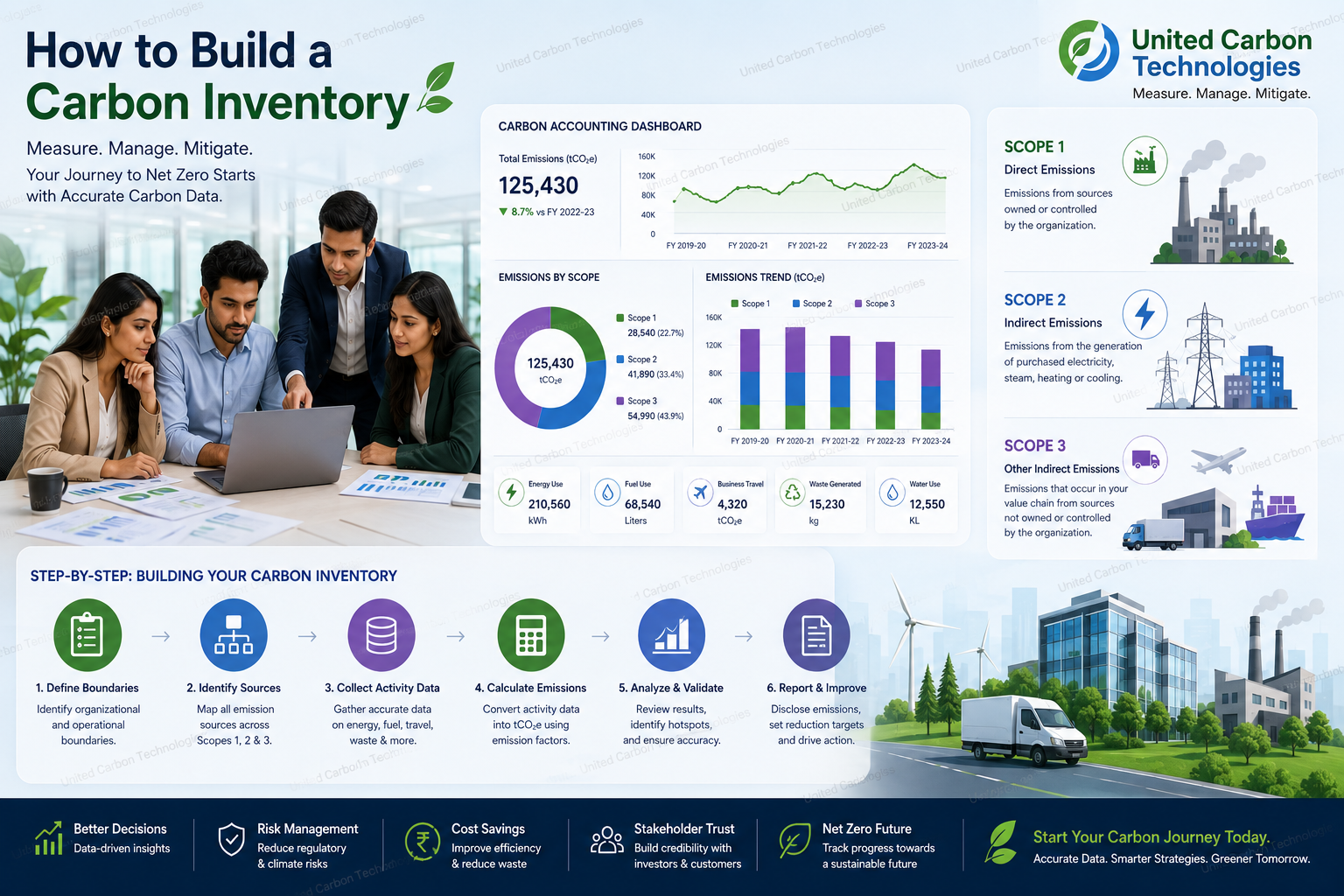
Before a business can reduce emissions, it must first understand where those emissions come from. A carbon inventory provides a structured record of greenhouse gas emissions generated across business operations and forms the foundation of carbon accounting and ESG reporting.
For Indian businesses, developing an accurate carbon inventory is becoming increasingly important as customers, investors, supply chains, and sustainability regulations demand greater transparency.
Did you know? Many organizations find that indirect (Scope 3) emissions make up the largest share of their carbon footprint, highlighting the importance of collecting data beyond direct operations..
Step 1: Define Your Organizational Boundary
Begin by deciding which facilities, offices, factories, warehouses, and business operations will be included in your carbon inventory.
- Corporate offices
- Manufacturing facilities
- Retail outlets
- Warehouses
- Owned vehicles
Building a carbon inventory is the first step toward ESG reporting and sustainability planning.
Need help building your first carbon inventory, calculating emissions, or preparing for ESG reporting? Our team can help businesses measure emissions, identify reduction opportunities, and build a practical sustainability roadmap.
Step 2: Identify All Emission Sources
Create a complete list of activities that generate greenhouse gas emissions throughout your business.
- Electricity consumption
- Diesel generators
- Company vehicles
- Business travel
- Purchased materials
- Waste disposal
- Employee commuting
Step 3: Categorize Emissions into Scope 1, Scope 2 and Scope 3
Classifying emissions into internationally accepted categories makes reporting consistent and comparable.
- Scope 1: Direct emissions from owned operations.
- Scope 2: Indirect emissions from purchased electricity.
- Scope 3: Other indirect emissions across the value chain.
Step 4: Collect Activity Data
Once emission sources have been identified, gather reliable activity data for each source. The accuracy of your carbon inventory depends on the quality of the information collected.
Useful business records include electricity bills, fuel purchase invoices, travel records, logistics data, production reports, procurement records, and waste disposal information.
- Monthly electricity consumption (kWh)
- Diesel and petrol usage (Litres)
- LPG or natural gas consumption
- Business travel distance
- Freight transportation records
- Raw material purchases
- Waste generation data
Step 5: Calculate Greenhouse Gas Emissions
Convert activity data into greenhouse gas emissions using recognized emission factors. The results are typically expressed in kilograms or tonnes of carbon dioxide equivalent (CO₂e).
Many organizations use specialized carbon accounting software or nationally accepted emission factors to perform these calculations accurately.
- Convert electricity into CO₂e
- Convert fuel consumption into CO₂e
- Estimate travel emissions
- Calculate waste-related emissions
Step 6: Review Data Quality
Before publishing your carbon inventory, verify that the information is complete, consistent, and supported by documentation.
- Check missing data
- Validate calculation methods
- Review assumptions
- Maintain supporting evidence
Step 7: Identify Emission Hotspots
After calculating emissions, identify which activities contribute the largest share of your carbon footprint. These emission hotspots usually offer the greatest opportunities for reduction.
For many Indian businesses, electricity consumption, transportation, purchased materials, and logistics account for the highest emissions.
- High electricity use
- Fuel-intensive operations
- Supply chain emissions
- Business travel
Step 8: Develop an Emission Reduction Plan
A carbon inventory should lead to action. Use the findings to develop practical emission reduction strategies aligned with your business goals.
- Improve energy efficiency
- Adopt renewable electricity
- Optimize transportation
- Reduce operational waste
- Engage suppliers
Which Businesses Should Prepare a Carbon Inventory?
Every business can benefit from understanding its emissions, regardless of size.
- Manufacturing companies
- Export-oriented businesses
- MSMEs
- Technology companies
- Construction firms
- Retail businesses
- Educational institutions
- Service organizations
Common Mistakes Businesses Make
Many first-time carbon inventories contain avoidable errors that reduce reporting accuracy.
- Ignoring Scope 3 emissions
- Missing operational boundaries
- Using incomplete utility records
- Failing to update inventories annually
- Not documenting calculation assumptions
Benefits of Maintaining a Carbon Inventory
A well-maintained carbon inventory provides much more than compliance support. It becomes a valuable management tool for improving operational efficiency and strengthening sustainability performance.
- Supports ESG reporting
- Improves investor confidence
- Identifies cost-saving opportunities
- Strengthens climate risk management
- Prepares for future carbon regulations
Carbon Inventory for Indian Businesses
As India strengthens its climate commitments and sustainability reporting ecosystem, organizations are increasingly expected to understand and disclose greenhouse gas emissions. Building a carbon inventory today helps businesses improve operational efficiency, satisfy customer and investor expectations, prepare for ESG and BRSR reporting, and remain competitive in a low-carbon economy.
Built as part of ongoing climate-tech research and innovation initiatives supported by early-stage incubation and grant programs.
Related Climate Insights
Continue learning with our guides on How to Measure Carbon Footprint for Small Businesses, Scope 1, Scope 2 and Scope 3 Emissions, and Carbon Accounting Explained.
- Define organizational boundaries.
- Identify all emission sources.
- Collect reliable operational data.
- Classify emissions into Scope 1, 2 and 3.
- Calculate emissions using accepted methodologies.
- Review results and identify reduction opportunities.
- Update the inventory every year.
- Identify emission hotspots before planning reductions.
Frequently Asked Questions
What is a carbon inventory?
A carbon inventory is a structured record of greenhouse gas emissions generated by an organization during a defined reporting period.
Why is a carbon inventory important?
It helps businesses measure emissions, improve sustainability performance, support ESG reporting, and identify opportunities to reduce costs and environmental impact.
How often should a carbon inventory be updated?
Most organizations prepare and review their carbon inventory annually to monitor progress and maintain accurate reporting.
Who should prepare a carbon inventory?
Any organization that wants to understand, manage, or reduce greenhouse gas emissions can benefit from preparing a carbon inventory, regardless of size or industry.
Does a carbon inventory help with ESG reporting?
Yes. A carbon inventory provides the emissions data required for ESG reporting, sustainability disclosures, and many voluntary or regulatory reporting frameworks.
Start Your Climate Learning Journey
Learn carbon accounting, ESG reporting, and climate intelligence through practical resources designed for businesses and professionals.
Join early learners building climate intelligence across India.