

Carbon Accounting vs Carbon Footprint: What's the Difference?
By United Carbon Technologies | Climate Knowledge Hub India
Join 1,500+ readers exploring climate intelligence, carbon accounting, and ESG.
Many people use the terms carbon accounting and carbon footprint interchangeably, but they have different meanings. Understanding the difference helps businesses measure emissions accurately, improve sustainability performance, and prepare for ESG reporting and future climate regulations in India.
What is the difference between carbon accounting and carbon footprint?
A carbon footprint measures the total greenhouse gas emissions generated by an individual, product, organization, or activity. Carbon accounting is the systematic process of measuring, calculating, managing, and reporting those emissions using recognized standards and methodologies.
Carbon Accounting vs Carbon Footprint Explained
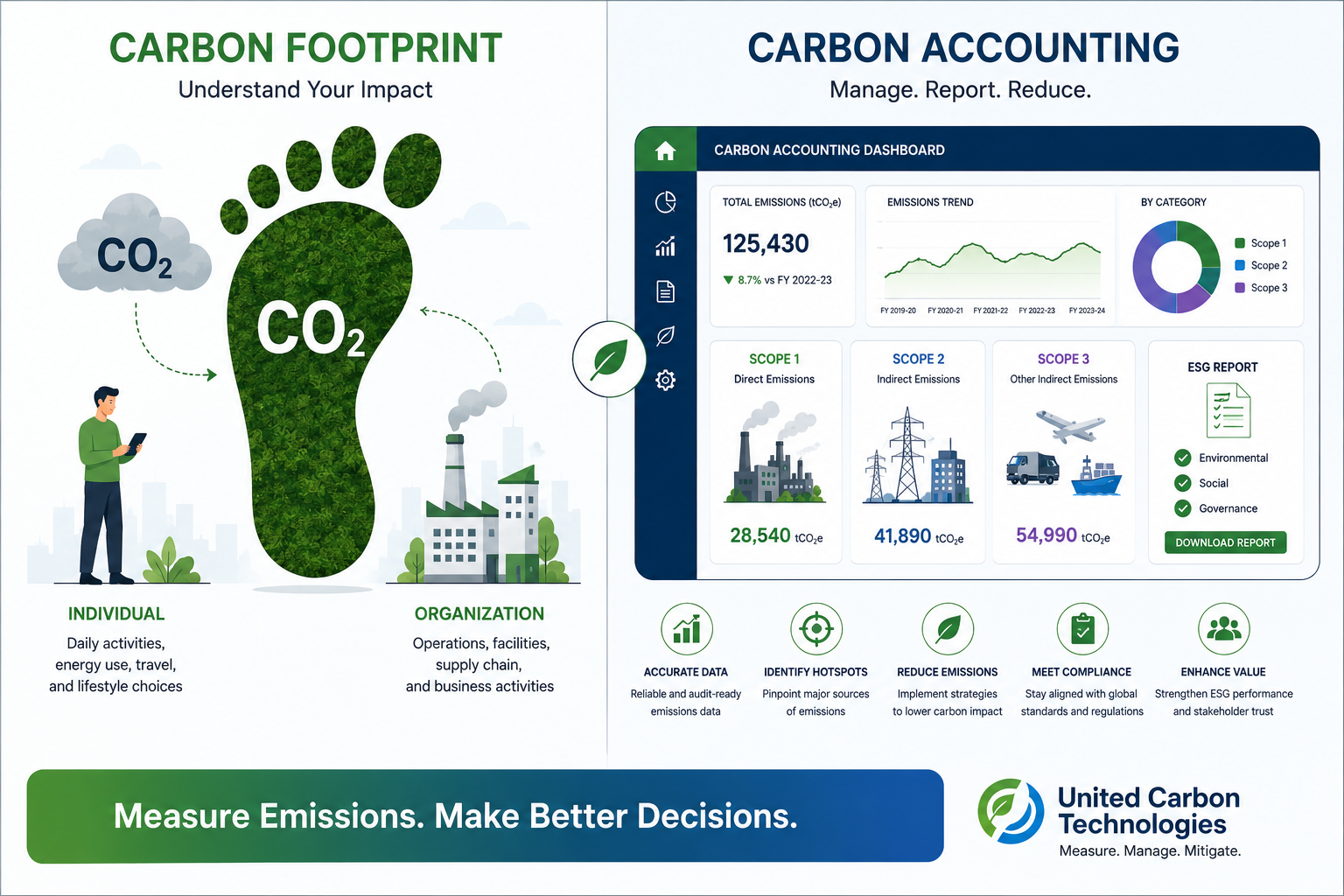
As climate reporting becomes increasingly important, organizations are expected to understand not only how much they emit but also how those emissions are measured and managed. While a carbon footprint provides the final measurement of emissions, carbon accounting is the complete system used to calculate, organize, verify, and report that information.
For businesses in India, understanding this distinction is essential for preparing ESG reports, meeting customer expectations, improving operational efficiency, and supporting long-term sustainability goals.
What Is a Carbon Footprint?
A carbon footprint represents the total greenhouse gas emissions produced by an activity, product, individual, event, or organization over a specific period. It is usually expressed in tonnes of carbon dioxide equivalent (CO₂e).
Carbon footprints help answer one simple question:
"How much greenhouse gas have we emitted?"
- Measures total emissions
- Usually reported annually
- Expressed as CO₂e
- Can apply to individuals, businesses, products, or events
What Is Carbon Accounting?
Carbon accounting is the structured process of identifying emission sources, collecting activity data, calculating greenhouse gas emissions, classifying them into Scope 1, Scope 2, and Scope 3, and preparing reports using internationally recognized standards.
Carbon accounting answers a much broader question:
"Where do emissions come from, how are they measured, and how can they be reduced?"
- Collects operational data
- Calculates emissions
- Maintains documentation
- Supports ESG reporting
- Tracks emission reductions over time
The Simplest Way to Understand the Difference
Think of carbon accounting as the process and a carbon footprint as the final result.
- Collects data
- Measures emissions
- Calculates CO₂e
- Organizes Scope 1, 2 and 3
- Creates reports
Carbon Footprint
- The final emissions value
- Shows total environmental impact
- Used for benchmarking and reduction goals
Understanding how emissions are measured helps businesses identify reduction opportunities, improve ESG reporting, and prepare for future sustainability requirements.
Whether you're an MSME, startup, exporter, or large enterprise, our climate experts can help you build a carbon inventory, calculate emissions, and prepare for ESG reporting.
Why Businesses Need Carbon Accounting
As sustainability expectations continue to grow, businesses need more than just an estimate of emissions. Carbon accounting provides a structured framework for measuring environmental performance and making informed business decisions.
- Supports ESG and sustainability reporting
- Improves investor confidence
- Meets customer and supply chain requirements
- Identifies opportunities to reduce emissions and costs
- Prepares organizations for future climate regulations
When Should You Calculate a Carbon Footprint?
Calculating a carbon footprint is useful whenever an organization wants to understand its environmental impact or track progress toward emission reduction goals.
Businesses commonly calculate their carbon footprint:
- Annually for sustainability reporting
- Before setting Net Zero targets
- When preparing ESG disclosures
- For customer and investor requests
- To benchmark year-on-year performance
International Standards Used for Carbon Accounting
Most organizations follow internationally recognized standards to ensure emissions are measured consistently and transparently.
- Greenhouse Gas (GHG) Protocol
- ISO 14064
- Corporate Sustainability Reporting frameworks
- Science-based climate reporting methodologies
Using accepted standards improves data quality and makes sustainability reporting more credible.
Carbon Accounting in India
Indian businesses are increasingly expected to understand and report greenhouse gas emissions as sustainability becomes a strategic business priority. Companies working with global customers, investors, exporters, and regulated industries are facing growing demand for transparent environmental data.
Preparing a structured carbon accounting system today helps organizations strengthen ESG reporting, improve operational efficiency, and stay prepared for evolving climate disclosure requirements.
Common Misconceptions
- Myth: Carbon accounting and carbon footprint mean the same thing.
Reality: Carbon accounting is the measurement process, while the carbon footprint is the final result. - Myth: Only large corporations need carbon accounting.
Reality: MSMEs and growing businesses also benefit by understanding emissions, improving efficiency, and meeting customer expectations. - Myth: Carbon accounting is only about compliance.
Reality: It also helps identify operational improvements, cost savings, and sustainability opportunities.
Related Climate Insights
Continue learning with these guides:
- How to Build a Carbon Inventory for Your Business
- What Are Scope 1, Scope 2 and Scope 3 Emissions?
- How to Measure Carbon Footprint for Small Businesses
- What Is Net Zero in India?
Why This Matters for Indian Businesses
India is moving toward a more transparent sustainability ecosystem through ESG reporting, responsible supply chains, renewable energy adoption, and climate-focused business practices. Understanding the difference between carbon accounting and carbon footprints helps organizations make better decisions, improve reporting quality, and remain competitive in both domestic and international markets.
- Carbon accounting is the process of measuring and managing emissions.
- A carbon footprint is the total greenhouse gas emissions produced.
- Carbon accounting creates the data used to calculate a carbon footprint.
- Both are essential for ESG reporting and sustainability planning.
- Understanding the difference helps businesses make informed climate decisions.
Frequently Asked Questions
What is the difference between carbon accounting and a carbon footprint?
Carbon accounting is the process used to measure and manage greenhouse gas emissions, while a carbon footprint is the total amount of emissions calculated through that process.
Can a company have a carbon footprint without carbon accounting?
Every organization has a carbon footprint, but without carbon accounting it is difficult to measure emissions accurately or identify where they originate.
Why is carbon accounting important for ESG reporting?
Carbon accounting provides reliable emissions data that organizations use for ESG reporting, sustainability disclosures, climate targets, and investor communication.
Do small businesses need carbon accounting?
Yes. Carbon accounting helps MSMEs improve efficiency, meet customer expectations, prepare for future regulations, and strengthen sustainability performance.
What standards are commonly used for carbon accounting?
Many organizations use internationally recognized frameworks such as the GHG Protocol and ISO 14064 to measure and report greenhouse gas emissions consistently.
Start Your Climate Learning Journey
Build practical knowledge in carbon accounting, ESG reporting, climate intelligence, and sustainability through resources designed for businesses, professionals, and students.
Join thousands of learners building climate knowledge across India.