

Industrial Waste Heat Recovery: How Indian Factories Can Capture Energy That Is Currently Lost
Search Description: Discover how Indian factories can recover industrial waste heat, improve energy efficiency, reduce fuel consumption and lower carbon emissions.
By United Carbon Technologies | Climate Knowledge Hub India
Published: November 2026 | Updated: November 2026
Join early readers exploring ESG, sustainability, and climate technology in India.
Indian industries consume substantial amounts of energy to manufacture products, operate machinery, heat materials and maintain industrial processes. However, a significant portion of this energy does not remain within the production system. Instead, it escapes through hot exhaust gases, steam systems, furnaces, boilers, kilns, industrial ovens, cooling systems and heated process streams.
This unused thermal energy is known as industrial waste heat.
For many factories, waste heat represents an overlooked opportunity to improve energy efficiency without necessarily installing additional fuel-based energy systems or replacing existing industrial equipment.
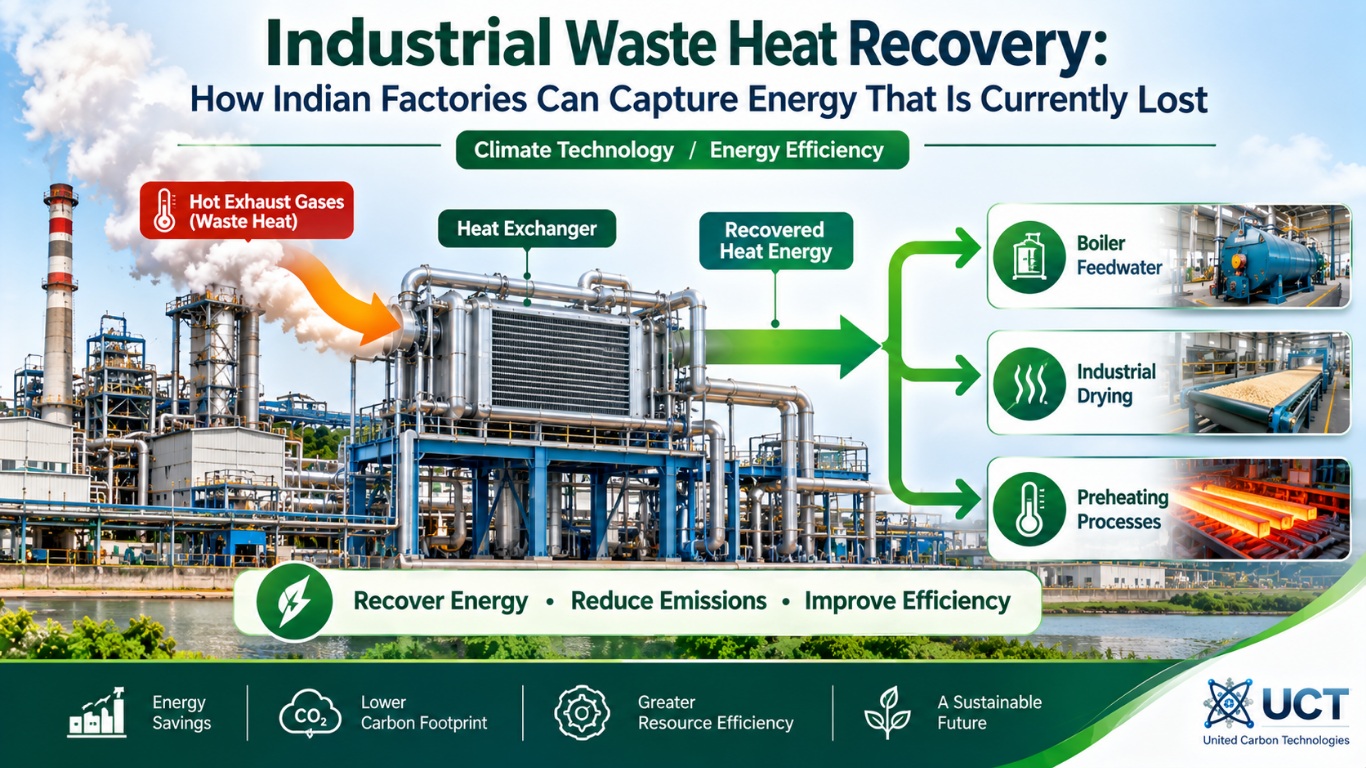
Through industrial waste heat recovery, factories can capture a portion of this rejected heat and reuse it for activities such as preheating combustion air, heating boiler feedwater, drying materials, generating steam or supporting other industrial processes.
For Indian manufacturers facing rising energy costs, increasing sustainability expectations and pressure to reduce greenhouse gas emissions, waste heat recovery can become an important component of industrial decarbonization.
The opportunity is particularly relevant for energy-intensive sectors such as steel, cement, chemicals, textiles, food processing, pharmaceuticals and refineries.
Understanding where heat is lost, how it can be recovered and whether it can be economically reused is the first step towards building more energy-efficient industrial operations.
Featured Snippet: What Is Industrial Waste Heat Recovery?
Industrial waste heat recovery is the process of capturing thermal energy released or discarded during industrial operations and reusing it for productive purposes. Factories can recover heat from exhaust gases, furnaces, boilers, kilns, steam systems and hot industrial processes to reduce additional energy requirements, improve operational efficiency and lower associated carbon emissions.
Unlike industrial electrification, which involves replacing fossil-fuel-based energy with electricity, waste heat recovery focuses on making better use of energy that has already been generated and would otherwise be lost.
UCT Climate Intelligence: Measure Industrial Energy Losses
Understanding industrial emissions begins with understanding how energy is consumed across different production activities.
At United Carbon Technologies, our climate intelligence and carbon measurement initiatives focus on helping Indian businesses understand their energy consumption, carbon footprint and sustainability performance.
Industrial waste heat recovery is one area where better energy data can help businesses identify opportunities for operational improvement.
By measuring fuel consumption, process energy requirements, thermal losses and associated emissions, manufacturers can develop a clearer picture of where efficiency improvements may deliver environmental and economic value.
Measure. Understand. Improve.
Did You Know?
Industrial facilities can release substantial amounts of thermal energy through exhaust gases, hot surfaces, steam losses and cooling processes.
In some energy-intensive operations, exhaust streams leave furnaces, kilns and boilers at temperatures high enough to support additional heating applications.
Rather than allowing all this energy to escape, suitable recovery systems can capture and redirect a portion of the available heat.
The actual recovery potential depends on exhaust temperature, heat availability, process requirements, operating hours, equipment condition and the economics of installation.
1. Understanding Industrial Waste Heat: Where Does the Energy Go?
Every industrial production process involves energy conversion.
Factories use electricity, coal, natural gas, furnace oil, biomass, LPG and other energy sources to operate machinery and achieve the temperatures required for manufacturing.
However, not all the energy supplied to an industrial process becomes useful output.
A portion is transferred into products, another portion supports the intended process, and some leaves the system as unwanted thermal energy.
This rejected heat can escape through several pathways.
A. Hot Exhaust Gases
Industrial furnaces, boilers, kilns and combustion equipment generate hot exhaust gases.
These gases often carry thermal energy that could potentially be recovered before they are discharged through chimneys or exhaust systems.
B. Industrial Cooling Systems
Certain manufacturing processes require cooling to maintain safe operating temperatures and product quality.
Heat removed through cooling water, cooling circuits and other thermal management systems may represent another recovery opportunity, depending on its temperature and availability.
C. Steam Distribution Losses
Steam is widely used in Indian industries for heating, processing, drying and sterilization.
Poorly insulated pipes, leaking steam traps, condensate losses and inefficient distribution systems can contribute to unnecessary energy waste.
Recovering condensate and improving steam-system efficiency can help reduce the additional energy required for steam generation.
D. Hot Industrial Products and Materials
In industries such as steel, cement, ceramics and glass manufacturing, materials may leave production stages at high temperatures.
Some of this thermal energy can potentially be transferred to incoming materials, combustion air or other industrial processes.
E. Industrial Ovens and Drying Systems
Textile processing, food manufacturing, chemical production and other industries frequently use heated air and drying equipment.
Exhaust air from these systems may contain recoverable thermal energy that can be reused for incoming air or other suitable heating requirements.
The first step towards waste heat recovery is therefore not purchasing new equipment. It is identifying where useful thermal energy is leaving the production system.
2. Why Waste Heat Recovery Matters for Indian Manufacturing
India has a large and diverse industrial sector, with manufacturing activities requiring different levels of process heat.
From textile dyeing units in Gujarat to cement plants in Rajasthan, steel manufacturing facilities in eastern India and food-processing industries across multiple states, thermal energy plays an important role in industrial production.
When factories lose useful heat, they may need to consume additional fuel or electricity to achieve the same production requirements.
Recovering suitable waste heat can help address this inefficiency.
A. Reducing Additional Fuel Consumption
Recovered heat can be used to preheat combustion air, boiler feedwater, raw materials or process fluids.
This reduces the amount of additional energy needed to achieve the required operating temperature.
B. Improving Industrial Energy Efficiency
Waste heat recovery allows factories to extract more useful output from the energy they already consume.
This can improve overall thermal efficiency and support better energy management.
C. Reducing Operational Energy Costs
When recovered heat replaces energy that would otherwise have to be purchased, it can reduce operating expenses.
The financial benefit depends on installation costs, available heat, operating hours, maintenance requirements and the cost of displaced energy.
D. Supporting Industrial Decarbonization
If recovered heat reduces the consumption of fossil fuels, it can also reduce associated direct greenhouse gas emissions.
For example, a factory that uses recovered furnace exhaust heat to preheat combustion air may require less fuel to maintain the same process conditions.
E. Strengthening ESG and Energy Reporting
Documented waste heat recovery projects can support corporate energy-efficiency initiatives and sustainability reporting.
Businesses can monitor energy savings, fuel displacement and associated emission reductions to evaluate the environmental performance of their projects.
However, waste heat recovery should not be treated as an automatic emissions reduction. Companies need to establish a reliable baseline, measure actual energy savings and calculate the resulting emissions impact using appropriate emission factors.
Understand Your Industrial Carbon Footprint
Industrial energy losses are not just operational concerns. They can also influence a company's overall carbon footprint.
United Carbon Technologies is developing India-focused carbon measurement and climate intelligence solutions to help businesses understand their emissions and sustainability performance.
Explore how your organisation can strengthen its carbon measurement and ESG reporting approach.
Explore UCT Carbon Intelligence3. Major Industrial Waste Heat Recovery Technologies
Waste heat recovery is not based on a single technology.
Different systems are designed to capture heat from different temperature ranges, industrial processes and exhaust streams.
The appropriate technology depends on the available heat source, the required temperature of the receiving process and the technical and economic feasibility of recovering that energy.
A. Economizers
Economizers are heat exchangers commonly used in boiler systems.
They capture heat from boiler exhaust gases and transfer it to incoming boiler feedwater.
As a result, the boiler requires less additional fuel to raise the water to the required operating temperature.
Economizers are particularly relevant for industrial facilities operating boilers for continuous steam production.
B. Recuperators
Recuperators transfer heat from hot exhaust gases to incoming combustion air or another process stream.
They are frequently used in industrial furnaces and heating systems.
By preheating incoming air, recuperators reduce the additional fuel needed to achieve the desired furnace temperature.
C. Regenerators
Regenerators temporarily store heat from hot exhaust gases in a heat-storage medium and subsequently transfer that stored heat to incoming air or another process stream.
They are used in certain high-temperature industrial applications, including specialised furnace operations.
D. Waste Heat Boilers
Waste heat boilers recover thermal energy from hot exhaust gases to generate steam or hot water.
The generated steam can be used for industrial heating, process requirements or other suitable applications.
They can be particularly useful in industries where high-temperature exhaust streams are continuously available.
E. Heat Exchangers
Industrial heat exchangers transfer thermal energy between two fluids without necessarily mixing them.
They can be used to recover heat from hot liquids, gases and process streams.
Depending on the design, recovered heat may be reused for water heating, process preheating, drying or other industrial requirements.
F. Heat Pumps
Industrial heat pumps can upgrade lower-temperature waste heat to a more useful temperature level.
They use external energy, commonly electricity, to transfer heat from a lower-temperature source to a higher-temperature application.
This makes them particularly interesting when waste heat is available but its temperature is insufficient for direct reuse.
The selection of a recovery technology should always begin with a detailed assessment of the temperature, quantity, continuity and quality of the available waste heat.
Industrial waste heat recovery is not simply about capturing heat. It is about matching recovered thermal energy with a suitable industrial demand.
Is Your Factory Losing Recoverable Energy?
Understanding energy consumption and identifying opportunities for industrial efficiency are important steps towards better sustainability performance.
Connect with United Carbon Technologies to explore carbon measurement, ESG reporting and climate intelligence initiatives for your business.
Talk to Our ESG Team4. Industrial Waste Heat Recovery Applications Across Indian Industries
Industrial waste heat recovery opportunities differ depending on the manufacturing process, operating temperature, fuel type and production requirements. A recovery system suitable for a steel plant may not be appropriate for a textile processing unit or food manufacturing facility.
India's diverse manufacturing ecosystem offers several opportunities to capture and reuse thermal energy that would otherwise be rejected.
A. Steel and Iron Manufacturing
Steel manufacturing involves several high-temperature processes, including furnaces, reheating operations, sintering and other thermal treatments.
These processes can generate substantial quantities of hot exhaust gases and high-temperature materials.
Potential waste heat recovery applications include:
- Recovering heat from furnace exhaust gases.
- Preheating combustion air before it enters industrial furnaces.
- Recovering heat from hot sinter and other process materials.
- Generating steam through suitable waste heat boilers.
- Reusing recovered heat in other compatible production operations.
For steel manufacturers, recovering thermal energy can improve furnace efficiency, reduce additional fuel requirements and support industrial emissions reduction strategies.
B. Cement Manufacturing
Cement production requires substantial thermal energy, particularly during clinker manufacturing in rotary kilns.
Hot gases released from cement kilns and clinker cooling operations can contain significant recoverable thermal energy.
Waste heat recovery systems in cement plants can capture energy from these streams and use it for electricity generation through waste heat recovery power generation systems.
Other potential applications include:
- Recovering heat from preheater exhaust gases.
- Capturing heat from clinker cooler exhaust air.
- Generating steam for power generation.
- Using recovered heat in suitable material drying applications.
Waste heat recovery power generation can help cement plants reduce their dependence on externally purchased electricity, although actual savings depend on plant configuration, heat availability and system performance.
C. Textile and Dyeing Industries
Textile manufacturing and processing facilities frequently require hot water, steam and heated air for dyeing, washing, drying and finishing operations.
These activities can create opportunities to recover heat from wastewater, exhaust air and steam condensate.
Potential applications include:
- Recovering heat from hot dyeing wastewater.
- Preheating incoming process water.
- Recovering heat from textile drying machine exhaust.
- Improving steam condensate recovery.
- Using heat exchangers to transfer energy between compatible process streams.
Textile clusters in Gujarat and other manufacturing regions may benefit from evaluating these opportunities, particularly where continuous production creates a consistent demand for process heating.
D. Food Processing and Dairy Industries
Food processing facilities use thermal energy for pasteurization, sterilization, cooking, evaporation, cleaning and drying.
These processes frequently involve heating and cooling operations, creating opportunities for heat recovery.
Examples include:
- Recovering heat from pasteurization cooling systems.
- Preheating incoming milk or other process liquids.
- Recovering thermal energy from boiler exhaust gases.
- Improving hot water generation efficiency.
- Using heat recovery systems in suitable drying operations.
In dairy facilities, regenerative heat exchange during pasteurization can transfer energy from heated product streams to incoming cold product streams. This reduces the additional heating and cooling requirements of the process.
Food safety, hygiene and separation between product streams must remain central to system design.
E. Chemical and Pharmaceutical Industries
Chemical and pharmaceutical manufacturing involves reactors, distillation columns, dryers, boilers, thermal oil systems and other equipment that can produce recoverable heat.
Potential applications include:
- Recovering heat from reactor cooling systems.
- Using heat from distillation processes to preheat incoming streams.
- Recovering energy from hot process liquids.
- Improving boiler and steam-system efficiency.
- Using industrial heat pumps for suitable low-temperature heat streams.
In these industries, heat recovery systems must be designed carefully to address chemical compatibility, contamination risks, process safety and the required temperature conditions.
F. Refineries and Petrochemical Industries
Refineries and petrochemical facilities operate several energy-intensive processes involving furnaces, heat exchangers, distillation units and steam networks.
These facilities often have multiple hot and cold process streams that can be evaluated for heat integration.
Potential recovery opportunities include:
- Preheating crude oil using recovered process heat.
- Recovering heat from furnace flue gases.
- Improving heat integration between process streams.
- Recovering condensate and improving steam systems.
- Using suitable waste heat for hot water and utility applications.
Because refineries involve complex interconnected operations, systematic process integration studies can help identify opportunities that may not be visible when individual equipment systems are assessed separately.
5. Understanding Waste Heat Temperature and Recovery Potential
Not all industrial waste heat has the same recovery potential. Temperature is one of the most important factors determining how recovered energy can be reused.
High-temperature waste heat can often support demanding industrial heating requirements, while lower-temperature heat may be better suited for water preheating, space heating or heat pump applications.
For practical assessment, waste heat opportunities are commonly classified into broad temperature categories.
| Temperature Category | Illustrative Temperature Range | Potential Applications |
|---|---|---|
| High-temperature heat | Above 400°C | Combustion air preheating, steam generation and industrial process heating |
| Medium-temperature heat | 100°C–400°C | Boiler feedwater heating, process preheating and steam generation where suitable |
| Low-temperature heat | Below 100°C | Hot water production, washing, low-temperature drying and heat pump applications |
Note: These are illustrative engineering categories, not universal regulatory classifications. Actual recovery suitability depends on the source temperature, available heat quantity, temperature difference, process demand and technology selected.
Why Temperature Matching Matters
A factory may have a large quantity of low-temperature waste heat, but that does not automatically mean it can be used for every industrial application.
For example, heat at 60°C may be useful for preheating water or supporting a heat pump system, but it cannot directly replace the heat required for a high-temperature furnace operating at several hundred degrees Celsius.
Engineers therefore need to compare the temperature of the waste heat source with the temperature requirements of the receiving process.
They must also consider the minimum temperature difference needed for effective heat transfer, equipment fouling, corrosion, pressure conditions and operational reliability.
6. How Indian Factories Can Identify Waste Heat Recovery Opportunities
Before investing in recovery equipment, manufacturers should understand their existing thermal energy flows.
A structured energy assessment helps identify where heat is being rejected, how much energy may be available and whether another industrial process can use it.
The following steps can help factories develop a practical waste heat recovery assessment.
Step 1: Conduct an Industrial Energy Audit
Begin by reviewing energy consumption across major equipment and production operations.
Collect information about:
- Fuel consumption by process and equipment.
- Electricity consumption and operating patterns.
- Boiler and furnace performance.
- Steam generation and distribution.
- Exhaust gas temperatures.
- Cooling water temperatures and flow rates.
- Production schedules and operating hours.
An energy audit can help establish where significant thermal energy losses may be occurring.
Step 2: Identify and Measure Waste Heat Sources
Once major energy-consuming processes have been identified, the next step is to measure potential waste heat streams.
Important parameters include:
- Temperature of exhaust gases and process fluids.
- Flow rate of the available heat stream.
- Operating hours and continuity of heat availability.
- Pressure and chemical composition where relevant.
- Variations in temperature during different production cycles.
For example, measuring the temperature of boiler exhaust gases can help determine whether an economizer or another suitable heat recovery arrangement may be technically feasible.
Step 3: Identify Processes That Require Additional Heating
Waste heat recovery becomes more valuable when a suitable heat demand exists near the heat source.
Factories should identify operations that regularly require additional thermal energy.
These may include:
- Boiler feedwater heating.
- Combustion air preheating.
- Raw material preheating.
- Industrial drying.
- Hot water production.
- Process liquid heating.
Matching heat supply with heat demand is essential for reducing energy losses and avoiding unnecessary equipment complexity.
Step 4: Evaluate Technical Feasibility
Not every waste heat source can be recovered economically or safely.
Technical evaluation should consider:
- Available temperature difference.
- Heat exchanger compatibility.
- Corrosion and fouling risks.
- Available installation space.
- Impact on existing production operations.
- Maintenance and cleaning requirements.
- Safety and process control requirements.
Engineers should also assess whether the recovery equipment could increase pressure drop, affect exhaust systems or interfere with existing plant operations.
Step 5: Calculate Energy Savings and Financial Feasibility
After identifying a technically suitable opportunity, factories should estimate the amount of useful heat that can realistically be recovered.
Financial assessment should include:
- Estimated annual energy recovery.
- Fuel or electricity that can actually be displaced.
- Equipment and installation costs.
- Operating and maintenance expenses.
- Production downtime during installation.
- Expected equipment life.
- Estimated payback period.
A project should be evaluated using realistic operating conditions rather than assuming that all available waste heat can be recovered continuously.
Step 6: Monitor Performance After Installation
Installing a recovery system is only the beginning. Factories should continuously monitor whether the equipment is delivering the expected energy savings.
Useful performance indicators include:
- Heat recovered per hour or per year.
- Fuel consumption before and after installation.
- Temperature of incoming and outgoing process streams.
- System availability and operating hours.
- Maintenance requirements.
- Actual energy cost savings.
- Verified greenhouse gas emission reductions.
Consistent monitoring helps businesses identify performance deterioration, equipment problems and additional opportunities for improvement.
7. Economic Benefits and Investment Considerations
For Indian manufacturers, the financial case for waste heat recovery is closely linked to energy prices, production volumes, equipment utilisation and the cost of installation.
A recovery project may offer significant long-term value when a factory has a continuous source of usable waste heat and a nearby process requiring additional thermal energy.
A. Reduced Fuel and Energy Purchases
When recovered heat replaces energy that would otherwise have been purchased, the factory can reduce its energy expenditure.
For example, preheating boiler feedwater through an economizer can reduce the additional fuel required for steam generation.
B. Improved Production Efficiency
Better thermal integration can reduce unnecessary heating requirements and improve the overall efficiency of industrial operations.
This may also reduce the energy intensity of production, measured as energy consumed per unit of output.
C. Long-Term Operational Value
Once installed and properly maintained, suitable recovery systems can provide energy savings over several years.
However, the actual financial return depends on maintenance costs, equipment reliability, energy prices and the stability of production demand.
D. Important Investment Risks
Factories should avoid selecting recovery systems based only on theoretical energy availability.
Potential risks include:
- Insufficient operating hours to justify the investment.
- Fluctuating waste heat temperatures.
- Corrosion or fouling of heat transfer surfaces.
- High installation and integration costs.
- Limited demand for recovered heat.
- Unexpected maintenance requirements.
- Interruption of production during installation.
A detailed technical and financial feasibility study helps businesses assess these risks before committing capital.
Build a More Energy-Efficient Industrial Operation
Industrial energy efficiency requires more than reducing electricity consumption. Understanding fuel use, thermal losses and process-level emissions can help businesses identify meaningful improvement opportunities.
United Carbon Technologies is developing carbon measurement and climate intelligence solutions for Indian businesses.
Talk to Our ESG TeamRelated Reads
Explore more climate technology, industrial decarbonization and energy efficiency topics from the UCT Climate Knowledge Hub.
- Industrial Electrification: How Indian Industries Can Replace Fossil-Fuel Energy
- Green Hydrogen in India: Where It Can Help Businesses Reduce Industrial Emissions
- Marginal Abatement Cost Curves Explained: How Companies Can Prioritize Carbon Reduction Projects
- Carbon Footprint in India: A Complete Guide
8. Challenges in Implementing Industrial Waste Heat Recovery in India
Although industrial waste heat recovery offers significant energy-efficiency opportunities, implementation requires careful technical planning, investment and operational coordination.
Indian manufacturers, particularly small and medium-sized enterprises, may face several challenges when evaluating and installing recovery systems.
A. Limited Awareness of Available Technologies
Many factories focus primarily on fuel procurement, electricity consumption and production output. Thermal losses may not receive the same level of attention.
Limited awareness of heat recovery technologies can prevent businesses from identifying opportunities that could improve energy efficiency.
B. High Initial Investment Requirements
Waste heat recovery equipment, including heat exchangers, economizers, waste heat boilers and industrial heat pumps, may require substantial initial investment.
For smaller manufacturers, installation costs and uncertainty about the expected financial return can delay project implementation.
C. Technical Integration with Existing Equipment
Many Indian factories operate machinery installed over several decades.
Integrating new heat recovery equipment into existing boilers, furnaces, exhaust systems and production lines may require engineering modifications.
These modifications must not compromise production quality, equipment safety or operational reliability.
D. Variations in Waste Heat Availability
Industrial processes do not always generate heat at a constant rate.
Batch production, changing production volumes, equipment shutdowns and variations in operating conditions can affect the quantity and temperature of available waste heat.
Recovery systems must therefore be designed around realistic operating conditions rather than theoretical maximum heat availability.
E. Maintenance and Operational Requirements
Heat exchangers and other recovery equipment may experience fouling, corrosion, scaling and reduced heat transfer performance.
Industries dealing with dusty exhaust gases, corrosive chemicals or contaminated process streams may require specialised equipment and regular cleaning.
Maintenance planning is essential to ensure that the system continues to deliver the expected energy savings.
F. Limited Availability of Process-Level Energy Data
Some manufacturing facilities do not maintain detailed records of thermal energy consumption and losses across individual production processes.
Without accurate temperature measurements, flow data, operating hours and fuel consumption information, estimating the recovery potential becomes difficult.
Improving industrial energy measurement and monitoring is therefore an important starting point for identifying viable projects.
9. Industrial Waste Heat Recovery and Carbon Emissions Reduction
Industrial waste heat recovery can contribute to emissions reduction when recovered thermal energy replaces additional energy that would otherwise have been consumed.
For example, when a factory captures furnace exhaust heat to preheat combustion air, the furnace may require less fuel to maintain the same production conditions.
This can reduce direct greenhouse gas emissions associated with fuel combustion.
A. Reducing Scope 1 Emissions
Scope 1 emissions include direct greenhouse gas emissions from sources owned or controlled by an organisation, such as fuel combustion in industrial boilers, furnaces and other equipment.
If waste heat recovery reduces fossil fuel consumption in these systems, the resulting fuel savings can contribute to lower Scope 1 emissions.
B. Reducing Scope 2 Emissions
Some waste heat recovery systems generate electricity using recovered thermal energy, such as waste heat recovery power generation in cement plants.
If this electricity reduces the amount of grid electricity purchased by the facility, it may contribute to lower market- or location-based Scope 2 emissions, subject to the applicable accounting methodology and electricity arrangements.
C. Improving Energy and Carbon Intensity
Manufacturers can monitor energy consumption and greenhouse gas emissions relative to production output.
For example, a company may track:
- Fuel consumption per tonne of product.
- Electricity consumption per unit of production.
- Recovered thermal energy per operating hour.
- Greenhouse gas emissions per tonne of manufactured output.
- Annual energy savings from heat recovery projects.
These indicators can help companies understand whether operational improvements are producing measurable results.
D. Measuring Actual Emissions Reductions
Companies should establish an appropriate baseline and compare energy consumption under equivalent production conditions before and after implementation.
Emission reductions should be calculated using relevant fuel-specific and electricity-related emission factors, consistent with the company's chosen greenhouse gas accounting methodology.
Businesses should also consider additional electricity consumption from fans, pumps, heat pumps and other recovery equipment.
Recovering waste heat does not automatically eliminate emissions. Its climate benefit depends on the net energy savings and the emissions associated with the energy source being displaced.
10. The Role of Waste Heat Recovery in India's Industrial Decarbonization Strategy
India's industrial transition requires a combination of energy efficiency, cleaner energy sources, technological innovation and improved resource management.
Waste heat recovery can play an important role because it addresses energy losses within existing industrial infrastructure.
Rather than depending entirely on new energy supplies, factories can first examine how efficiently they are using the energy already entering their production systems.
A. Improving Existing Industrial Infrastructure
Many factories can begin with relatively established technologies such as boiler economizers, combustion air recuperators, condensate recovery systems and improved insulation.
These interventions can help improve thermal efficiency without requiring a complete replacement of production equipment.
B. Supporting Industrial Energy Management
Waste heat recovery can be incorporated into broader industrial energy management programmes.
Factories can combine energy audits, equipment monitoring, process optimisation and thermal integration to improve overall energy performance.
C. Supporting Corporate Sustainability Goals
Industrial energy efficiency projects can contribute to corporate sustainability initiatives when their results are measured and documented.
Manufacturers can include relevant energy-saving projects in their environmental performance monitoring, ESG disclosures and applicable sustainability reporting frameworks.
D. Creating Opportunities for Indian Climate Technology Solutions
Growing demand for industrial energy efficiency creates opportunities for Indian engineering companies, technology developers, energy consultants and climate-tech businesses.
These opportunities include advanced heat exchangers, industrial heat pumps, thermal storage, digital energy monitoring and data-driven process optimisation.
For India's manufacturing ecosystem, the development and adoption of such solutions can support both industrial competitiveness and long-term decarbonization.
11. What Should Indian Businesses Do Next?
Factories do not need to begin with large-scale waste heat recovery installations. A systematic approach can help businesses identify suitable opportunities and prioritise projects based on measurable benefits.
Industrial management teams can begin with the following actions:
- Review energy consumption: Identify major fuel-consuming and electricity-consuming industrial processes.
- Map thermal losses: Identify hot exhaust gases, steam losses, cooling streams and heated materials.
- Measure available heat: Record temperature, flow rate, operating hours and other relevant parameters.
- Identify heat demand: Find nearby processes that require additional heating or hot water.
- Evaluate technologies: Assess economizers, recuperators, heat exchangers, waste heat boilers and heat pumps as appropriate.
- Assess financial feasibility: Compare installation costs with realistic energy savings and operating expenses.
- Monitor results: Track actual heat recovery, fuel displacement, electricity use and emissions performance.
For smaller manufacturing businesses, starting with a detailed energy audit and improvements to existing steam and boiler systems may be a practical first step.
For larger energy-intensive facilities, more comprehensive process integration studies may reveal opportunities across multiple production stages.
12. The Future of Industrial Waste Heat Recovery in India
As Indian industries focus increasingly on energy productivity, operational efficiency and emissions reduction, waste heat recovery is likely to remain an important area of industrial technology development.
Emerging approaches are expanding the possibilities for recovering and reusing thermal energy.
A. Advanced Industrial Heat Pumps
Industrial heat pumps can upgrade lower-temperature waste heat for applications that require higher temperatures.
Improvements in industrial heat pump technology may make additional low-temperature heat sources economically useful, depending on the required temperature lift and electricity costs.
B. Thermal Energy Storage
Thermal energy storage systems can capture heat when it is available and release it when a process requires energy.
This can help address differences between the timing of waste heat availability and industrial heat demand.
C. Digital Monitoring and Predictive Maintenance
Industrial sensors, energy management systems and digital monitoring tools can help track heat recovery performance.
Data analytics can identify declining heat exchanger performance, unusual energy consumption and maintenance requirements.
D. Integrated Industrial Energy Systems
Future industrial facilities may increasingly integrate waste heat recovery with renewable electricity, electrified heating, thermal storage and efficient process design.
These technologies can complement each other as part of a broader industrial decarbonization strategy.
Ultimately, the goal is to reduce unnecessary energy demand, improve resource productivity and make industrial production more efficient.
Quick Summary: Industrial Waste Heat Recovery
- Industrial waste heat is thermal energy released or discarded during manufacturing and other industrial operations.
- Common sources include furnaces, boilers, kilns, exhaust gases, cooling systems and steam networks.
- Technologies such as economizers, recuperators, regenerators, heat exchangers and waste heat boilers can capture and reuse thermal energy.
- Indian industries including steel, cement, textiles, chemicals, food processing and refineries have potential recovery opportunities.
- Recovered heat can reduce additional fuel requirements and improve industrial energy efficiency.
- Successful implementation requires energy audits, temperature measurements, heat-demand matching and financial feasibility studies.
- Measured energy savings can contribute to industrial carbon emissions reduction.
- Continuous monitoring helps businesses verify actual performance and maintain long-term benefits.
Key takeaway: Before investing in additional energy supplies, Indian factories should examine how much useful thermal energy they are already generating and potentially losing.
Frequently Asked Questions (FAQs)
1. What is industrial waste heat recovery?
Industrial waste heat recovery is the process of capturing thermal energy released during industrial operations and reusing it for productive applications. It can reduce additional energy consumption and improve manufacturing efficiency.
2. Why is waste heat recovery important for Indian factories?
It can help Indian factories reduce fuel consumption, improve thermal efficiency, lower operating costs and reduce associated greenhouse gas emissions. It also helps manufacturers make better use of energy already consumed during production.
3. Which industries can benefit from waste heat recovery?
Steel, cement, chemicals, textiles, food processing, dairy, pharmaceuticals, refineries, ceramics and glass manufacturing can all have potential waste heat recovery opportunities, depending on their processes and operating conditions.
4. What are the common sources of industrial waste heat?
Common sources include furnace exhaust gases, boiler flue gases, kiln exhaust, hot process liquids, steam condensate, cooling systems, industrial ovens and hot materials leaving production processes.
5. What technologies are used for industrial waste heat recovery?
Common technologies include economizers, recuperators, regenerators, heat exchangers, waste heat boilers and industrial heat pumps. The appropriate solution depends on the available heat source and the receiving process requirements.
6. Can waste heat recovery reduce carbon emissions?
Yes. When recovered heat displaces fossil fuel consumption or grid electricity, it can reduce associated greenhouse gas emissions. Companies must measure net energy savings and account for the energy consumed by recovery equipment.
7. Is waste heat recovery suitable for small and medium-sized industries?
Yes. MSMEs can evaluate opportunities such as boiler economizers, condensate recovery, insulation improvements and process heat exchange. The most suitable solution depends on the facility's energy use, available waste heat and investment capacity.
8. What is the difference between waste heat recovery and industrial electrification?
Waste heat recovery captures and reuses thermal energy that would otherwise be lost during industrial operations. Industrial electrification replaces equipment or processes that use fossil fuels with electricity-based alternatives. Both can complement each other in industrial decarbonization.
9. How can a factory calculate the potential of waste heat recovery?
A factory can begin with an energy audit, measure exhaust temperatures and flow rates, identify available heat streams and compare them with existing heating requirements. Engineers can then estimate recoverable energy, equipment costs, fuel displacement and potential savings.
10. Does industrial waste heat recovery require replacing existing machinery?
Not necessarily. Many recovery systems can be integrated with existing boilers, furnaces, exhaust systems and production equipment. However, engineering modifications and safety assessments may be necessary depending on the installation.
Turn Industrial Energy Insights into Climate Action
Industrial decarbonization begins with understanding how energy is consumed, where thermal losses occur and how operational improvements can reduce environmental impact.
United Carbon Technologies is developing India-focused carbon measurement, climate intelligence and ESG reporting solutions to support businesses in understanding and improving their sustainability performance.
Measure Carbon. Understand Energy. Build Sustainable Systems.
Explore United Carbon TechnologiesFor business enquiries and ESG-related discussions, connect with our team.
About United Carbon Technologies: United Carbon Technologies is an India-focused climate-tech initiative working on carbon measurement, climate intelligence, ESG reporting and sustainability solutions for businesses. Its work includes developing India-specific carbon measurement approaches and digital sustainability tools.
This article is intended for general educational and informational purposes. Actual waste heat recovery potential, engineering design, energy savings and emissions reductions should be assessed using site-specific measurements and qualified technical evaluation.