

Carbon Pricing Explained: Taxes vs Emissions Trading
By United Carbon Technologies | Climate Knowledge Hub India
Join readers exploring carbon markets, ESG reporting, climate policy, and sustainability strategies.
Carbon pricing has become one of the world's most widely discussed climate policy tools. Governments use carbon taxes and emissions trading systems to encourage businesses and industries to reduce greenhouse gas emissions while supporting the transition to a lower-carbon economy.
What is carbon pricing?
Carbon pricing is a policy approach that assigns a financial cost to greenhouse gas emissions. The two most common mechanisms are carbon taxes, which set a fixed price on emissions, and emissions trading systems (ETS), where companies buy and sell emissions allowances within an established market.
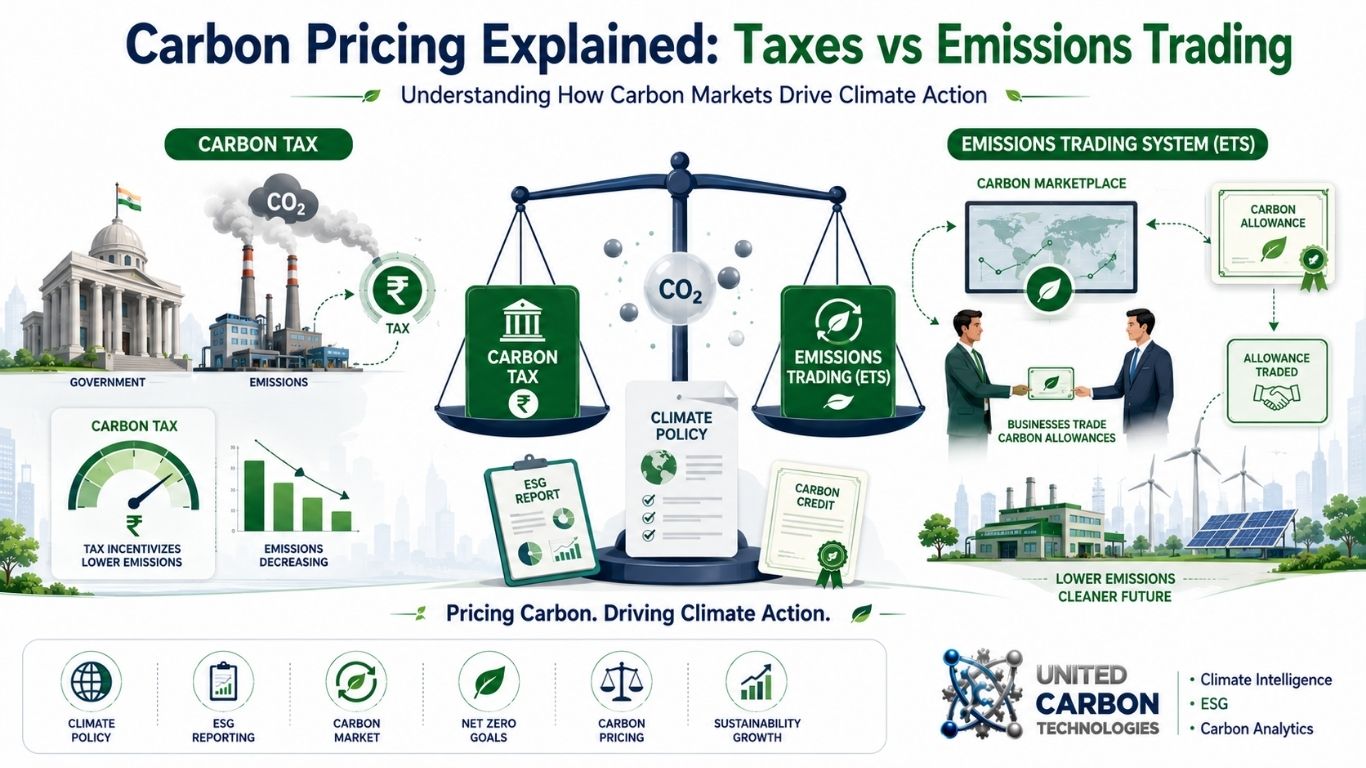
Climate change creates environmental costs that are often not reflected in the price of goods and services. Carbon pricing aims to incorporate these costs into economic decision-making by encouraging cleaner technologies, energy efficiency, and lower emissions.
Today, countries around the world use different forms of carbon pricing to meet climate commitments, support innovation, and encourage sustainable economic growth. Understanding how these systems work helps businesses prepare for the evolving landscape of climate policy.
Did you know?
More than 70 carbon pricing instruments—including carbon taxes and emissions trading systems—have been implemented or scheduled worldwide, covering a significant share of global greenhouse gas emissions.
Why Governments Use Carbon Pricing
Carbon pricing is designed to encourage emission reductions by creating financial incentives for businesses and consumers to adopt cleaner technologies and improve energy efficiency.
- Reduce greenhouse gas emissions
- Support national climate goals
- Encourage clean technology innovation
- Improve energy efficiency
- Generate public revenue for climate initiatives
- Promote sustainable economic growth
- Encourage low-carbon investments
What Is a Carbon Tax?
A carbon tax places a fixed price on greenhouse gas emissions or the carbon content of fossil fuels. Businesses pay a predetermined amount based on the quantity of emissions they generate.
Because the cost per tonne of emissions is known in advance, carbon taxes provide predictable price signals that encourage organizations to reduce emissions and invest in cleaner alternatives.
Advantages of Carbon Taxes
- Simple and transparent pricing structure
- Predictable compliance costs
- Encourages long-term investment planning
- Can generate revenue for climate programs
- Relatively straightforward to administer
Understanding carbon pricing helps organizations prepare for future sustainability regulations, carbon markets, and ESG reporting requirements.
What Is an Emissions Trading System (ETS)?
An Emissions Trading System, often called a cap-and-trade system, sets an overall limit on emissions and distributes or auctions emission allowances to participating organizations. Companies that emit less than their allowance may sell unused credits, while those exceeding their limits must purchase additional allowances.
Unlike a carbon tax, where the price is fixed, the price of allowances in an ETS is determined by market supply and demand.
Advantages of Emissions Trading
- Provides flexibility for businesses
- Rewards organizations that reduce emissions early
- Encourages market-driven innovation
- Supports cost-effective emissions reductions
- Creates a transparent carbon market
United Carbon Technologies helps organizations strengthen ESG reporting, carbon accounting, climate intelligence, and sustainability strategies for emerging climate regulations.
Carbon Tax vs Emissions Trading: Key Differences
Although both mechanisms aim to reduce greenhouse gas emissions, they operate differently. A carbon tax focuses on setting a fixed price for emissions, while an emissions trading system controls the total amount of emissions and allows the market to determine the price of emission allowances.
| Carbon Tax | Emissions Trading System (ETS) |
|---|---|
| Fixed carbon price | Market determines allowance price |
| Government sets tax rate | Government sets emissions cap |
| Predictable compliance costs | Allowance prices may fluctuate |
| Simple administration | Requires an active carbon market |
| Provides price certainty | Provides emissions certainty |
How Carbon Pricing Influences Businesses
Carbon pricing encourages organizations to evaluate their emissions, improve operational efficiency, and invest in lower-carbon technologies. Businesses that understand their carbon footprint are often better positioned to respond to future regulations and market expectations.
- Improves energy efficiency
- Supports emissions reduction strategies
- Encourages renewable energy adoption
- Strengthens ESG reporting
- Promotes sustainable innovation
- Helps identify carbon-related financial risks
- Improves long-term competitiveness
Carbon Pricing and ESG Reporting
As carbon pricing mechanisms expand globally, organizations increasingly integrate carbon pricing assumptions into ESG reporting, climate risk assessments, and long-term sustainability planning.
Businesses with reliable emissions data are better equipped to evaluate future compliance costs, identify emissions reduction opportunities, and demonstrate climate-related governance to investors and stakeholders.
Carbon Pricing in India
India is strengthening its climate policy framework while expanding initiatives related to carbon markets, energy efficiency, renewable energy, and emissions reporting. Businesses are increasingly monitoring developments that may influence future carbon pricing and climate disclosure requirements.
Although India's carbon market is still evolving, organizations that establish strong carbon accounting and emissions measurement systems today will be better prepared for future climate regulations and sustainability expectations.
The Future of Carbon Pricing
Carbon pricing is expected to play an increasingly important role in global climate policy as countries work toward net-zero emissions. Future systems may become more integrated with international carbon markets, climate disclosures, ESG reporting, and corporate sustainability strategies.
Businesses that proactively improve emissions visibility and climate intelligence today will be better positioned to adapt to tomorrow's regulatory and market environment.
Building Climate Intelligence for Tomorrow's Economy
United Carbon Technologies is developing climate intelligence solutions that help businesses measure carbon emissions, improve ESG reporting, strengthen sustainability strategies, and prepare for an evolving low-carbon economy.
Related Reads
- Understanding Carbon Disclosure: What Companies Need to Report
- Carbon Reporting Software: What Businesses Should Look For
- ESG Reporting Checklist for Businesses
- What Is a Carbon Disclosure Report?
- How Businesses Collect Scope 3 Data
- How Climate Data Helps Businesses Make Decisions
- How to Set Science-Based Climate Targets for Businesses
- Complete Guide to Carbon Footprint in India
Carbon Pricing and India's Low-Carbon Transition
India is steadily advancing policies that support emissions reduction, renewable energy adoption, energy efficiency, and sustainable industrial development. Alongside these efforts, the country is developing market-based mechanisms that encourage businesses to improve carbon management and climate performance.
Organizations that understand carbon pricing today will be better prepared for future climate regulations, carbon market participation, ESG reporting requirements, and investor expectations in an increasingly sustainability-focused economy.
- Carbon pricing assigns a financial cost to greenhouse gas emissions.
- Carbon taxes apply a fixed price per unit of emissions.
- Emissions trading systems use market-based allowance trading.
- Both approaches encourage cleaner technologies and emissions reductions.
- Understanding carbon pricing helps businesses prepare for future climate policies.
Frequently Asked Questions
What is carbon pricing?
Carbon pricing is a climate policy that places a financial value on greenhouse gas emissions to encourage businesses and consumers to reduce their carbon footprint.
What is the difference between a carbon tax and emissions trading?
A carbon tax sets a fixed price on emissions, while an emissions trading system establishes an emissions cap and allows companies to buy and sell emission allowances in a market.
Why do governments use carbon pricing?
Governments use carbon pricing to reduce emissions, encourage clean technology investment, improve energy efficiency, and support national climate objectives.
How does carbon pricing affect businesses?
Carbon pricing encourages organizations to improve energy efficiency, measure emissions accurately, reduce carbon-intensive activities, and strengthen ESG and sustainability strategies.
Is carbon pricing relevant in India?
Yes. As India expands climate initiatives and develops carbon market mechanisms, businesses should understand carbon pricing to prepare for future sustainability regulations and reporting requirements.
Understand the Economics of Climate Action
Explore practical guides on carbon markets, ESG reporting, climate intelligence, carbon accounting, and sustainability strategies shaping the future of business.
Join professionals building climate knowledge for a low-carbon future.