

Role of ESG Dashboards in BRSR Compliance: A Complete Guide for Indian Businesses
By United Carbon Technologies | Climate Knowledge Hub India
Published: May 2026 | Updated: July 2026
🌿 Stay Ahead in ESG & Climate Intelligence
Follow United Carbon Technologies for practical guides on ESG reporting, BRSR compliance, carbon accounting, climate technology, sustainability careers, and India's transition toward a low-carbon economy.
Businesses across India are collecting more sustainability data than ever before. However, spreadsheets, emails, and disconnected systems often make ESG reporting slow, inconsistent, and difficult to verify. ESG dashboards solve this challenge by centralizing environmental, social, and governance data into one platform, making BRSR reporting more accurate, transparent, and efficient.
What is the role of an ESG dashboard in BRSR compliance?
An ESG dashboard is a centralized digital platform that helps organizations collect, monitor, analyze, and report sustainability data required for Business Responsibility and Sustainability Reporting (BRSR). By automating KPI tracking, carbon accounting, and compliance workflows, ESG dashboards improve reporting accuracy, reduce manual effort, and support better decision-making.
Introduction
Environmental, Social, and Governance (ESG) reporting has become an essential business function rather than a voluntary sustainability initiative. As investors, regulators, customers, financial institutions, and supply chain partners demand greater transparency, Indian organizations must manage increasingly complex sustainability information.
The introduction of the Business Responsibility and Sustainability Report (BRSR) by the Securities and Exchange Board of India (SEBI) has accelerated the need for structured ESG data management. Companies are now expected to disclose information across environmental performance, employee welfare, governance practices, human rights, business ethics, resource consumption, climate risks, and value-chain impacts.
Managing hundreds of sustainability indicators manually using spreadsheets often results in inconsistent data, reporting delays, duplication of work, and compliance risks. This is where ESG dashboards are transforming the reporting process.
Instead of collecting sustainability information only during annual reporting, ESG dashboards enable businesses to monitor ESG performance continuously through real-time metrics, automated workflows, centralized databases, and executive reporting.
This guide explains how ESG dashboards support BRSR compliance, improve decision-making, strengthen corporate governance, and prepare Indian businesses for the future of sustainability reporting.
Build Smarter ESG Reporting with Technology
At United Carbon Technologies (UCT), we believe sustainability reporting should be accurate, efficient, and data-driven. Our climate intelligence initiatives focus on simplifying carbon accounting, ESG measurement, sustainability analytics, and compliance through modern digital solutions designed for Indian businesses.
👉 Explore practical ESG insights, carbon intelligence resources, and sustainability innovation from UCT.
💡 Did You Know?
Organizations typically collect ESG information from finance, HR, operations, procurement, manufacturing, energy management, and supply chain teams. Without a centralized dashboard, gathering this information manually can take weeks, increasing the risk of inconsistent reporting and compliance errors.
What Is an ESG Dashboard?
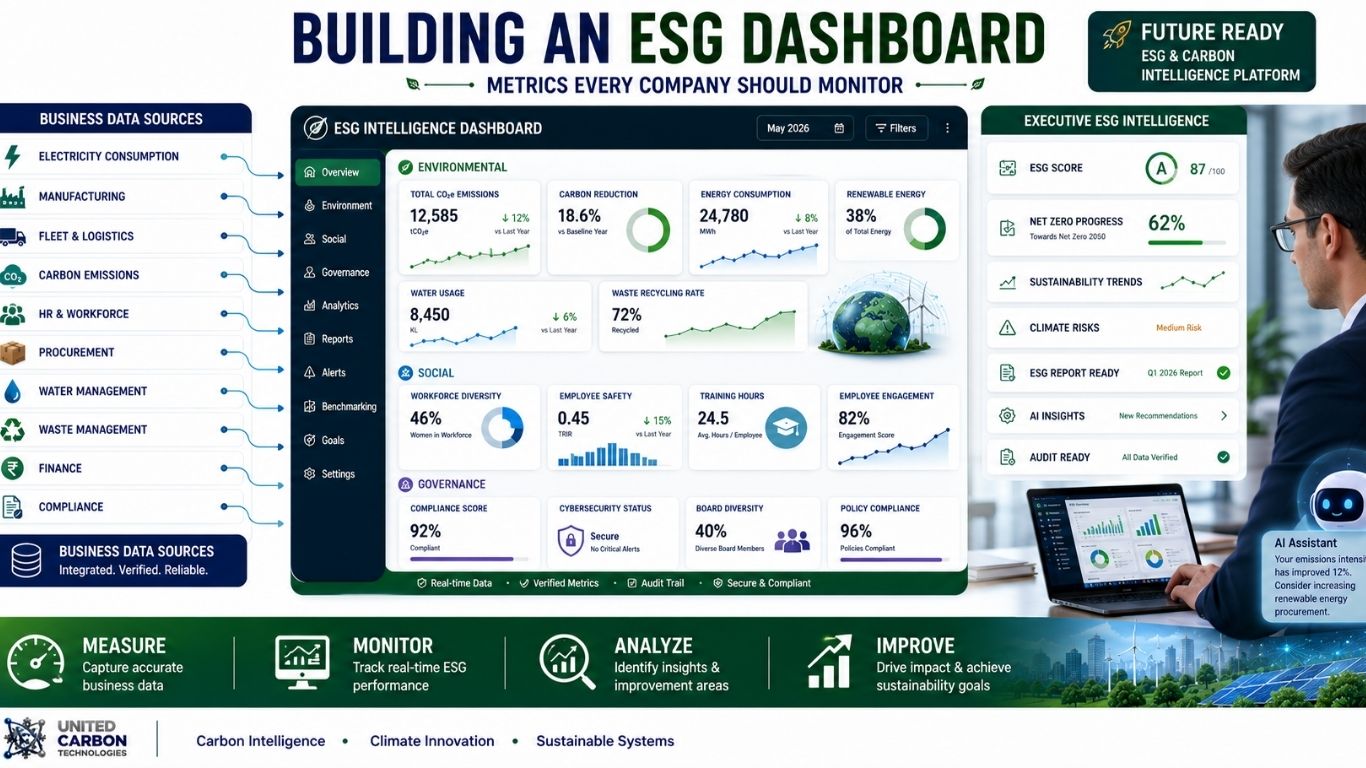
An ESG dashboard is a centralized digital platform that collects, organizes, analyzes, and visualizes sustainability data across an organization. It provides business leaders with real-time visibility into environmental, social, and governance performance through interactive charts, KPIs, compliance indicators, and automated reporting tools.
Instead of maintaining multiple spreadsheets across departments, ESG dashboards consolidate information into a single source of truth, improving transparency, accountability, and decision-making.
Typical ESG dashboards monitor carbon emissions, energy consumption, renewable energy use, water management, waste generation, workplace safety, employee diversity, governance metrics, supplier sustainability, regulatory compliance, and sustainability targets.
Why ESG Dashboards Are Becoming Essential for BRSR Reporting
BRSR reporting requires businesses to disclose a wide range of quantitative and qualitative sustainability information. Gathering this information manually from different departments is time-consuming and prone to errors. ESG dashboards streamline this process by continuously collecting and organizing ESG data throughout the year rather than only during reporting season.
With automated KPI tracking, centralized documentation, workflow management, and real-time analytics, organizations can prepare BRSR reports more efficiently while improving the accuracy and reliability of disclosed information.
As sustainability regulations continue to evolve, businesses that adopt digital ESG management systems today will be better positioned to meet future compliance requirements, strengthen stakeholder confidence, and make informed sustainability decisions.
Related Guide
New to BRSR reporting? Start with our complete guide explaining the BRSR Reporting Process in India before exploring ESG technology solutions.
Looking for Smarter ESG Management?
Digital ESG platforms help businesses automate sustainability reporting, monitor carbon emissions, centralize ESG data, and simplify compliance with evolving reporting frameworks.
United Carbon Technologies is developing climate intelligence solutions that make ESG reporting more practical, transparent, and scalable for Indian organizations.
Key Features of an Effective ESG Dashboard
Not all ESG dashboards offer the same capabilities. While basic reporting tools display sustainability metrics, modern ESG dashboards function as centralized intelligence platforms that continuously collect, analyze, and visualize ESG data across the organization.
An effective ESG dashboard should provide real-time insights rather than static reports. This enables leadership teams to identify trends, monitor performance against sustainability goals, and make informed business decisions throughout the year instead of only during reporting season.
- Centralized ESG Data Repository – Consolidates sustainability information from multiple departments into a single platform.
- Carbon Emissions Tracking – Measures Scope 1, Scope 2, and where applicable, Scope 3 greenhouse gas emissions.
- Energy Monitoring – Tracks electricity, fuel, and renewable energy consumption across facilities.
- Water & Waste Management – Records water usage, wastewater treatment, recycling, and waste diversion metrics.
- Workforce & Social Indicators – Monitors diversity, health & safety, employee training, and community initiatives.
- Governance Monitoring – Tracks ethics policies, board composition, compliance activities, and business conduct indicators.
- Automated KPI Dashboards – Visualizes sustainability performance using interactive charts and scorecards.
- Audit Trails – Maintains records supporting assurance and regulatory verification.
How ESG Dashboards Simplify BRSR Compliance
Preparing a Business Responsibility and Sustainability Report involves collecting information from finance, operations, procurement, human resources, manufacturing, legal, and environmental teams. Without digital systems, consolidating this information often becomes one of the most time-consuming parts of compliance.
ESG dashboards simplify the reporting process by replacing disconnected spreadsheets with standardized digital workflows.
- Automatically collect sustainability information throughout the year.
- Reduce duplicate data entry across departments.
- Maintain historical ESG records for year-over-year comparison.
- Generate standardized reports aligned with BRSR disclosure requirements.
- Improve collaboration between sustainability, finance, HR, and operations teams.
- Support management reviews before final submission.
Rather than treating ESG reporting as an annual compliance exercise, dashboards encourage continuous sustainability management.
Connecting ESG Dashboards with Carbon Accounting
Carbon accounting forms one of the most important components of modern ESG reporting. Organizations increasingly need accurate emissions data to understand climate impacts, identify reduction opportunities, and respond to investor expectations.
An ESG dashboard integrates carbon accounting with broader sustainability metrics, allowing organizations to monitor emissions alongside operational performance.
Typical carbon indicators displayed include:
- Scope 1 Direct Emissions
- Scope 2 Purchased Electricity Emissions
- Scope 3 Value Chain Emissions
- Carbon Intensity
- Energy Consumption
- Renewable Energy Share
- Emission Reduction Targets
- Monthly Carbon Trends
When carbon accounting is integrated into a centralized dashboard, sustainability teams spend less time preparing reports and more time implementing emission reduction strategies.
Benefits of ESG Dashboards for Different Types of Businesses
Organizations at different stages of sustainability maturity benefit from ESG dashboards in different ways.
| Business Type | Primary Benefit |
|---|---|
| Listed Companies | Supports BRSR disclosures and investor reporting. |
| Large Enterprises | Centralizes ESG information across multiple business units. |
| Manufacturing Companies | Tracks emissions, energy, waste, and resource efficiency. |
| Export-Oriented Businesses | Supports international customer sustainability requirements. |
| MSMEs | Builds ESG readiness for future supply chain expectations. |
| Financial Institutions | Improves sustainability risk assessment and portfolio monitoring. |
Common Challenges When Implementing ESG Dashboards
Technology alone cannot guarantee successful ESG reporting. Organizations often face operational and organizational challenges during implementation.
- Fragmented sustainability data across departments.
- Limited data ownership and accountability.
- Manual reporting processes.
- Lack of standardized ESG metrics.
- Integration with existing ERP and business systems.
- Employee awareness and training gaps.
- Data quality and verification concerns.
- Budget limitations for digital transformation.
Addressing these challenges requires executive support, cross-functional collaboration, and clear governance structures.
The Future of ESG Dashboards in India
India's sustainability reporting ecosystem continues to evolve as businesses face increasing expectations from regulators, investors, customers, lenders, and global supply chains.
Future ESG dashboards are expected to become more intelligent through artificial intelligence, machine learning, predictive analytics, automated carbon accounting, supplier sustainability integration, and real-time compliance monitoring.
Rather than simply generating reports, next-generation ESG platforms will function as strategic decision-support systems that help organizations improve sustainability performance while managing climate-related risks.
🇮🇳 India Context
India is rapidly strengthening its sustainability reporting ecosystem through initiatives such as BRSR, climate action commitments, renewable energy expansion, and increasing corporate ESG disclosures. As reporting expectations grow, businesses are moving from manual spreadsheet-based processes toward digital ESG management platforms that improve transparency, efficiency, and decision-making.
Companies that invest in ESG data management today will be better prepared for future regulatory developments, stakeholder expectations, and international sustainability standards.
Related Reads
- BRSR Reporting Process in India
- BRSR Core vs BRSR Comprehensive Explained
- ESG vs BRSR: Key Differences Explained
- Common Challenges in BRSR Reporting
- How MSMEs Can Prepare for ESG Reporting
- What Is Carbon Accounting?
Quick Summary
- ESG dashboards centralize sustainability information.
- They simplify BRSR data collection and reporting.
- Carbon accounting becomes easier through automated tracking.
- Real-time KPIs improve management decision-making.
- Digital workflows reduce manual reporting errors.
- Dashboards strengthen audit readiness and transparency.
- Organizations can monitor ESG performance continuously.
- Technology enables scalable sustainability management.
Frequently Asked Questions
1. What is an ESG dashboard?
An ESG dashboard is a digital platform that collects, monitors, and visualizes environmental, social, and governance performance indicators.
2. How does an ESG dashboard support BRSR reporting?
It centralizes ESG data, automates KPI tracking, improves reporting accuracy, and simplifies compliance workflows.
3. Can MSMEs use ESG dashboards?
Yes. MSMEs can use simplified ESG dashboards to monitor sustainability performance and prepare for future reporting requirements.
4. Does an ESG dashboard measure carbon emissions?
Most modern ESG platforms include carbon accounting modules for tracking greenhouse gas emissions.
5. Is an ESG dashboard mandatory for BRSR?
No. However, dashboards significantly improve reporting efficiency and data quality.
6. What departments contribute ESG data?
Finance, HR, operations, procurement, manufacturing, legal, environment, and governance teams typically contribute ESG information.
7. Can ESG dashboards integrate with ERP software?
Many ESG platforms support integration with ERP, energy monitoring systems, and business intelligence tools.
8. What KPIs are commonly tracked?
Carbon emissions, energy, water, waste, diversity, safety, governance, ethics, supplier sustainability, and climate targets.
9. Are ESG dashboards useful beyond compliance?
Yes. They improve operational efficiency, sustainability planning, and strategic decision-making.
10. How is United Carbon Technologies contributing?
United Carbon Technologies is developing climate intelligence and ESG solutions to help Indian businesses simplify carbon accounting, sustainability measurement, and ESG reporting through technology-driven platforms.
Build the Future of ESG Reporting
The future of sustainability reporting lies in accurate data, intelligent analytics, and continuous performance monitoring. ESG dashboards enable organizations to move beyond compliance and build resilient, transparent, and future-ready businesses.
United Carbon Technologies (UCT) is committed to advancing climate intelligence, carbon accounting, and ESG innovation for Indian businesses through practical knowledge, digital solutions, and sustainability technologies.
🌿 Explore more ESG, BRSR, and Climate Intelligence resources at the UCT Climate Knowledge Hub.