

What Is BRSR in India? The Complete Beginner Guide to Business Responsibility & Sustainability Reporting
Learn everything about BRSR (Business Responsibility and Sustainability Reporting) in India, including SEBI requirements, ESG reporting, BRSR Core, disclosure principles, carbon emissions reporting, and how businesses can prepare for compliance.
By United Carbon Technologies | Climate Knowledge Hub India
Join thousands of readers learning ESG, carbon accounting, climate technology, sustainability reporting, and India's evolving climate regulations.
Part of the Climate Knowledge Hub by United Carbon Technologies — building India's climate intelligence ecosystem through ESG education, carbon accounting, sustainability software, and climate technology research.
Business Responsibility and Sustainability Reporting (BRSR) is India's primary ESG reporting framework for listed companies. Introduced by SEBI, BRSR helps organizations disclose environmental, social, and governance (ESG) performance using a standardized reporting structure that improves transparency, investor confidence, and long-term sustainability.
As climate regulations, carbon accounting, and sustainability reporting become increasingly important, understanding BRSR is no longer limited to large corporations. Companies across supply chains, MSMEs, consultants, investors, and sustainability professionals are preparing for a future driven by ESG data and climate intelligence.
What is BRSR?
BRSR (Business Responsibility and Sustainability Reporting) is an ESG disclosure framework introduced by the Securities and Exchange Board of India (SEBI). It enables companies to report environmental, social, and governance performance through standardized disclosures covering emissions, energy, water, waste, workforce, governance, ethics, and sustainable business practices.
BRSR reporting in India, SEBI BRSR framework, Business Responsibility and Sustainability Reporting, ESG reporting India, BRSR Core, sustainability disclosure, carbon accounting, Scope 1 Scope 2 Scope 3 emissions, climate reporting, ESG compliance, and sustainability reporting software are becoming essential topics for Indian businesses.
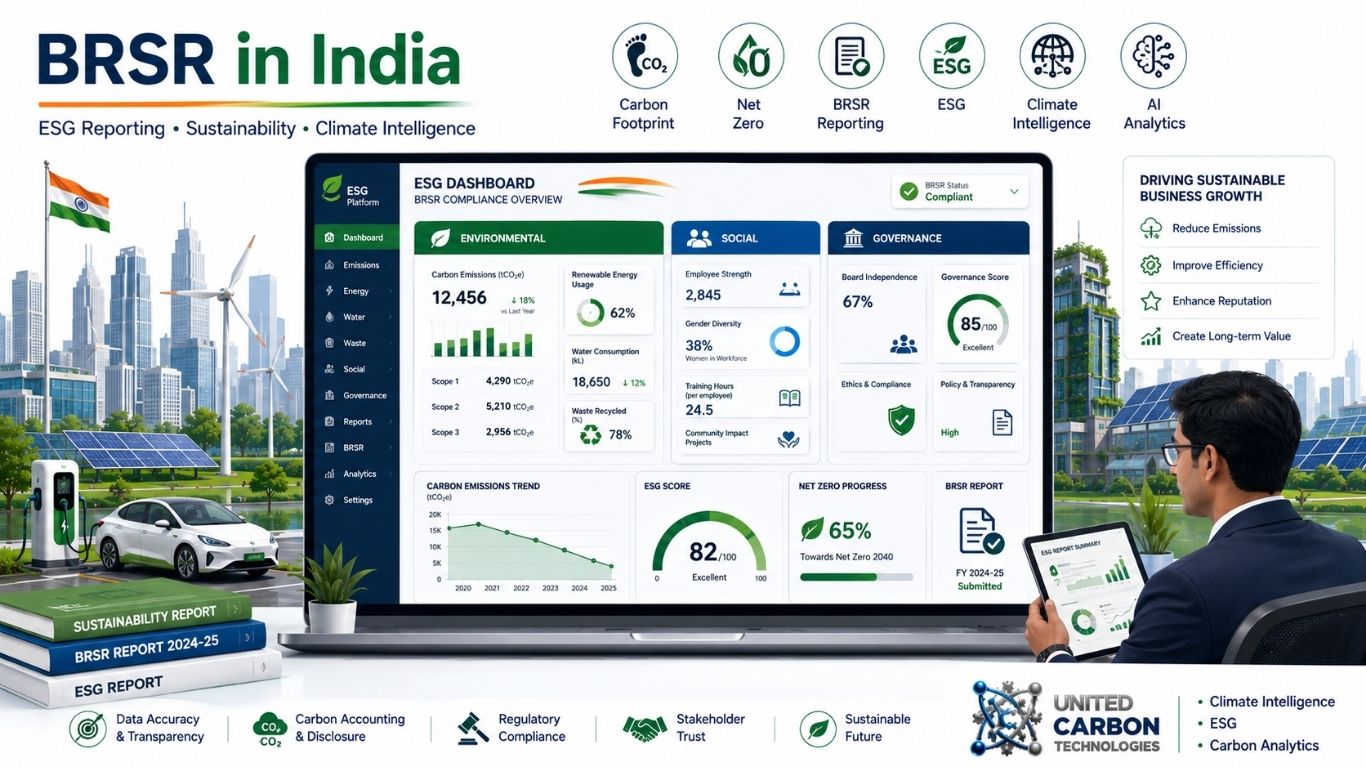
Sustainability reporting has evolved from a voluntary corporate initiative into an important business requirement. Investors, regulators, financial institutions, customers, and supply chain partners increasingly expect companies to demonstrate how they manage environmental, social, and governance risks alongside financial performance.
To create a consistent reporting framework for Indian companies, SEBI introduced Business Responsibility and Sustainability Reporting (BRSR). The framework helps organizations communicate their sustainability performance through structured disclosures that improve transparency and comparability across industries.
Beyond regulatory compliance, BRSR helps businesses understand carbon emissions, resource efficiency, governance practices, workforce wellbeing, responsible supply chains, and climate-related risks. It also lays the foundation for better ESG strategies, carbon accounting systems, and long-term value creation.
India's BRSR framework covers one of the world's largest groups of listed companies reporting standardized ESG information. As sustainability regulations continue to evolve, reliable environmental data and digital reporting systems are becoming essential business capabilities rather than optional initiatives.
Why Was BRSR Introduced?
As businesses grow, their impact extends beyond financial performance to include environmental sustainability, employee welfare, ethical governance, and community development. Investors, regulators, customers, and financial institutions increasingly expect companies to disclose how they manage these non-financial risks alongside traditional financial reporting.
To improve transparency and create a consistent sustainability reporting framework, the Securities and Exchange Board of India (SEBI) introduced the Business Responsibility and Sustainability Reporting (BRSR) framework. BRSR enables companies to report standardized Environmental, Social, and Governance (ESG) information that stakeholders can easily compare across industries.
The framework also aligns India's corporate reporting ecosystem with global sustainability trends, helping Indian businesses become more competitive in international markets while supporting responsible and sustainable economic growth.
- Improve ESG transparency across listed companies
- Provide consistent sustainability disclosures
- Strengthen investor confidence
- Encourage responsible business practices
- Support India's long-term sustainability and climate goals
- Promote better risk management and corporate governance
Evolution of Sustainability Reporting: From BRR to BRSR
India's sustainability reporting journey has evolved significantly over the past decade. Before BRSR, companies followed the Business Responsibility Report (BRR), which primarily focused on responsible business practices based on the National Voluntary Guidelines.
As global ESG expectations expanded, companies required a more comprehensive reporting framework that included measurable sustainability data, climate-related disclosures, carbon emissions, social performance, governance practices, and value-chain information. This led SEBI to replace BRR with the more robust Business Responsibility and Sustainability Reporting (BRSR) framework.
- BRR: Focused mainly on responsible business principles.
- BRSR: Expands reporting to include measurable ESG performance indicators.
- BRR: Limited sustainability metrics.
- BRSR: Covers environmental, social, governance, climate, and value-chain disclosures.
- BRSR: Better aligns Indian reporting with international ESG expectations.
Who Needs to File BRSR?
BRSR is mandatory for India's top listed companies identified by SEBI based on market capitalization. However, many organizations outside the mandatory category are also voluntarily adopting BRSR principles because investors, customers, lenders, multinational buyers, and supply-chain partners increasingly request ESG information.
Even businesses that are not legally required to publish BRSR reports today may benefit from preparing sustainability data early, as ESG expectations continue to expand across industries.
- Top listed companies covered by SEBI requirements
- Companies preparing for future ESG regulations
- Businesses supplying large listed organizations
- Export-oriented companies serving global customers
- Organizations seeking ESG-focused investment
- Companies working toward Net Zero and sustainability goals
Collecting sustainability data early makes reporting significantly easier. Businesses that continuously monitor energy, emissions, water, waste, and ESG indicators are better positioned for future compliance, investor due diligence, and sustainability reporting.
Objectives of BRSR
The primary objective of BRSR is to help businesses measure, manage, and communicate sustainability performance in a structured and transparent manner. Rather than viewing ESG as a compliance exercise, BRSR encourages organizations to integrate sustainability into business strategy, operational decision-making, and long-term value creation.
The framework enables stakeholders to evaluate how companies create value while managing environmental and social impacts.
- Increase transparency and corporate accountability
- Improve ESG disclosures for investors
- Encourage sustainable business practices
- Strengthen governance and ethical business conduct
- Support climate risk identification and management
- Improve data quality for sustainability reporting
- Encourage responsible supply-chain management
- Support India's transition toward a sustainable economy
The Nine Principles of Responsible Business (NGRBC)
BRSR is built upon the National Guidelines on Responsible Business Conduct (NGRBC), which define nine core principles that encourage businesses to operate responsibly while creating long-term economic, environmental, and social value.
Principle 1 — Ethics, Transparency and Accountability
Businesses should conduct operations with integrity, transparency, accountability, and strong ethical governance.
Principle 2 — Sustainable Products and Services
Organizations should develop products and services that are safe, resource-efficient, environmentally responsible, and sustainable throughout their lifecycle.
Principle 3 — Employee Well-being
Businesses should respect employee rights, promote diversity, ensure workplace safety, and create healthy working environments.
Principle 4 — Stakeholder Responsiveness
Companies should understand and respond to the needs of stakeholders, including employees, customers, investors, suppliers, and local communities.
Principle 5 — Human Rights
Organizations should respect and promote human rights across their operations and supply chains.
Principle 6 — Environmental Protection
Businesses should minimize environmental impacts through efficient resource management, pollution prevention, biodiversity conservation, and climate action.
Principle 7 — Responsible Public Policy
Companies should engage responsibly in public policy development while maintaining transparency and ethical conduct.
Principle 8 — Inclusive Growth
Businesses should contribute to inclusive economic development and support local communities through responsible business practices.
Principle 9 — Customer Value
Organizations should deliver products and services that create long-term value while ensuring customer safety, privacy, satisfaction, and responsible consumption.
Together, these nine principles form the foundation of BRSR reporting and encourage organizations to integrate sustainability into every aspect of business operations, from governance and employee wellbeing to environmental stewardship and customer responsibility.
Learning BRSR Is the First Step Toward ESG Success
Understanding India's sustainability reporting framework helps businesses prepare for evolving ESG regulations, carbon accounting, climate disclosures, and responsible business practices.
Explore our free Climate Knowledge Hub to build practical knowledge in ESG, Net Zero, carbon footprint management, climate intelligence, and sustainability reporting.
Understanding the BRSR Reporting Framework
BRSR is much more than a sustainability questionnaire. It is a structured ESG disclosure framework that enables companies to report standardized environmental, social, and governance information in a consistent and transparent manner.
Rather than focusing only on financial performance, BRSR helps organizations demonstrate how they manage climate risks, natural resources, employees, ethics, governance, and long-term value creation. The framework also allows investors, regulators, lenders, customers, and other stakeholders to compare sustainability performance across companies and industries.
A complete BRSR report combines qualitative disclosures, quantitative metrics, management practices, and measurable sustainability indicators to provide a comprehensive picture of responsible business performance.
The Three Main Sections of a BRSR Report
The BRSR framework is divided into three major reporting sections, each serving a specific purpose within the overall ESG disclosure process.
Section A — General Disclosures
This section provides fundamental information about the company, its operations, products, workforce, subsidiaries, business activities, markets served, and overall organizational profile.
- Company profile
- Business activities
- Products and services
- Locations and operations
- Employees and workforce
- Supply chain overview
- Corporate structure
Section B — Management and Process Disclosures
This section explains how sustainability is integrated into business strategy, governance, policies, decision-making processes, and risk management.
- ESG governance structure
- Board oversight
- Sustainability policies
- Risk management framework
- Stakeholder engagement
- Internal monitoring systems
Section C — Principle-wise Performance Disclosures
The largest section of BRSR measures how companies perform against each of the nine NGRBC principles using standardized ESG indicators and performance metrics.
- Environmental performance
- Employee wellbeing
- Human rights
- Responsible supply chains
- Customer responsibility
- Governance practices
- Community development
Essential Indicators vs Leadership Indicators
To improve consistency and encourage progressive sustainability reporting, BRSR classifies disclosures into two categories: Essential Indicators and Leadership Indicators.
Essential Indicators (EI)
Essential Indicators represent the minimum disclosures expected from companies. These indicators focus on measurable ESG performance and form the core of BRSR reporting.
- Energy consumption
- Greenhouse gas emissions
- Water usage
- Waste generation
- Employee diversity
- Occupational health & safety
- Training and development
- Governance disclosures
Leadership Indicators (LI)
Leadership Indicators are voluntary disclosures that demonstrate advanced sustainability practices and organizational maturity beyond minimum compliance requirements.
- Climate adaptation initiatives
- Circular economy practices
- Biodiversity conservation
- Sustainable procurement
- Innovation in sustainability
- Advanced ESG governance
- Long-term climate strategy
Organizations that report strong Leadership Indicators often demonstrate greater ESG maturity and long-term sustainability leadership, making these disclosures increasingly valuable to investors and international stakeholders.
Learning BRSR Is the First Step Toward ESG Success
Understanding India's sustainability reporting framework helps businesses prepare for evolving ESG regulations, carbon accounting, climate disclosures, and responsible business practices.
What Is BRSR Core?
BRSR Core is a focused subset of the BRSR framework introduced to improve the quality, consistency, and assurance of critical ESG disclosures. It emphasizes measurable sustainability data that investors and regulators consider highly material for evaluating corporate performance.
Unlike general sustainability narratives, BRSR Core prioritizes objective, verifiable, and assurance-ready ESG metrics that can be independently reviewed.
The framework also encourages organizations to improve the quality of sustainability data collected across their value chains, making digital ESG systems increasingly important.
- Standardized ESG indicators
- Reliable sustainability data
- Greater reporting consistency
- Improved investor confidence
- Better comparability across industries
- Higher quality climate disclosures
Key ESG Metrics Reported Under BRSR
BRSR requires companies to disclose a wide range of sustainability information covering environmental performance, social responsibility, governance practices, operational risks, and business ethics.
Although reporting requirements vary depending on the indicator, organizations typically monitor hundreds of sustainability data points throughout the reporting cycle.
Environmental Metrics
- Scope 1 greenhouse gas emissions
- Scope 2 emissions
- Scope 3 emissions (where applicable)
- Energy consumption
- Renewable energy usage
- Water withdrawal and recycling
- Waste generation
- Hazardous waste management
- Air emissions
- Resource efficiency
- Biodiversity initiatives
Social Metrics
- Employee health and safety
- Gender diversity
- Equal opportunity
- Employee turnover
- Training hours
- Skill development
- Human rights practices
- Community engagement
- Customer wellbeing
- Supply chain responsibility
Governance Metrics
- Board composition
- Independent directors
- Business ethics
- Anti-corruption measures
- Risk management
- Data privacy
- Whistleblower mechanisms
- Policy compliance
- Corporate governance practices
Environmental, Social and Governance (ESG) Disclosures Explained
BRSR organizes sustainability reporting around the three pillars of ESG. Together, these disclosures provide stakeholders with a comprehensive understanding of how an organization manages long-term environmental impact, social responsibility, and corporate governance.
Environmental (E)
Environmental disclosures focus on how a company manages natural resources, greenhouse gas emissions, climate risks, pollution, waste, energy efficiency, renewable energy adoption, water conservation, and biodiversity.
Social (S)
Social disclosures evaluate relationships with employees, customers, suppliers, communities, and other stakeholders. Topics include workplace safety, diversity, inclusion, employee wellbeing, human rights, labour practices, and community development.
Governance (G)
Governance disclosures examine how organizations are directed and controlled through ethical leadership, board oversight, compliance systems, risk management, transparency, anti-corruption policies, and responsible decision-making.
Together, these three pillars enable investors, regulators, lenders, and customers to evaluate whether a business is prepared for future sustainability challenges while creating long-term value for all stakeholders.
How Companies Prepare for BRSR Reporting
Preparing a Business Responsibility and Sustainability Report (BRSR) is an organization-wide exercise that goes beyond simply filling out a reporting template. Companies need structured processes, reliable data, cross-functional collaboration, and leadership commitment to produce accurate and meaningful disclosures.
Leading organizations typically establish ESG governance committees, define reporting responsibilities, identify material sustainability topics, and implement systems to collect environmental, social, and governance (ESG) data throughout the year rather than only during reporting season.
A typical BRSR preparation roadmap includes:
- Understanding SEBI's BRSR disclosure requirements
- Identifying applicable ESG indicators
- Assigning responsibilities across departments
- Collecting environmental and operational data
- Establishing internal review and approval processes
- Improving data quality and documentation
- Preparing disclosures for annual reporting
- Planning continuous ESG improvement initiatives
Organizations that embed ESG into daily operations generally find BRSR reporting more efficient, while also improving decision-making and long-term sustainability performance.
Data Collection for BRSR
One of the biggest challenges in BRSR reporting is collecting reliable, consistent, and auditable sustainability data. Unlike financial reporting, ESG information often comes from multiple departments and facilities, making centralized data management essential.
Typical BRSR data sources include:
- Electricity and energy consumption records
- Fuel purchase and usage data
- Water withdrawal and discharge information
- Waste generation and recycling records
- Human resources and employee wellbeing metrics
- Occupational health and safety reports
- Supply chain sustainability information
- Corporate governance and compliance records
Many companies still manage ESG information using spreadsheets, emails, and manual reporting processes. As reporting requirements expand, organizations are increasingly adopting centralized ESG platforms to improve data accuracy, transparency, and reporting efficiency.
Carbon Accounting and Scope 1, Scope 2 & Scope 3 Emissions
Carbon accounting has become one of the most important components of modern ESG reporting. Although BRSR covers a wide range of sustainability topics, greenhouse gas emissions are increasingly scrutinized by investors, regulators, lenders, and customers.
Organizations typically classify emissions into three internationally recognized categories:
- Scope 1: Direct emissions from company-owned operations, vehicles, generators, and manufacturing processes.
- Scope 2: Indirect emissions from purchased electricity, steam, heating, or cooling consumed by the organization.
- Scope 3: Indirect emissions occurring across the value chain, including suppliers, logistics, employee travel, product use, and waste management.
Among these, Scope 3 emissions are usually the most difficult to calculate because they involve suppliers, customers, contractors, and other external stakeholders. However, they often represent the largest share of an organization's total carbon footprint.
Accurate carbon accounting enables companies to:
- Measure greenhouse gas emissions consistently
- Identify high-emission operations and processes
- Develop science-based emission reduction strategies
- Support Net Zero roadmaps
- Strengthen ESG disclosures and sustainability reporting
- Prepare for future climate-related regulations
Carbon measurement is becoming a foundational step for ESG reporting, BRSR compliance, sustainability strategy, and climate risk management.
ESG Dashboards and Digital BRSR Reporting
Manual sustainability reporting is rapidly being replaced by digital ESG platforms capable of collecting, validating, analyzing, and visualizing sustainability data in real time. Digital reporting improves efficiency while reducing reporting errors and duplicated work.
Modern ESG dashboards help organizations:
- Monitor ESG KPIs continuously
- Track energy, water, waste, and emissions
- Visualize Scope 1, Scope 2, and Scope 3 emissions
- Generate automated sustainability reports
- Support BRSR, ESG, and climate disclosures
- Monitor progress toward Net Zero targets
- Improve executive decision-making using real-time insights
Instead of collecting information only at the end of the financial year, digital platforms allow sustainability teams to monitor performance throughout the year, identify risks earlier, and improve reporting accuracy.
Common Challenges in BRSR Reporting
Although awareness of ESG reporting is growing rapidly, many organizations continue to face operational and technical challenges while implementing BRSR.
Some of the most common challenges include:
- Fragmented ESG data across multiple departments
- Limited availability of Scope 3 emissions data
- Manual spreadsheet-based reporting processes
- Lack of standardized sustainability KPIs
- Difficulty obtaining supplier sustainability information
- Insufficient internal ESG expertise
- Changing reporting requirements and evolving regulations
- Limited use of automation and digital tools
Organizations that invest in ESG governance, employee training, standardized processes, and digital reporting systems are generally better positioned to meet both current and future sustainability reporting expectations.
Why Climate Intelligence Platforms Will Transform BRSR Compliance
The future of ESG reporting is shifting from static annual reports to continuous, data-driven climate intelligence. Businesses increasingly require integrated platforms that combine carbon accounting, ESG analytics, compliance management, and sustainability reporting into a single ecosystem.
Climate intelligence platforms automate much of the work traditionally performed through spreadsheets by connecting operational data with sustainability metrics and reporting frameworks.
Capabilities of next-generation climate intelligence platforms include:
- Automated carbon footprint calculations
- Scope 1, Scope 2, and Scope 3 emission tracking
- Real-time ESG dashboards
- BRSR and ESG reporting workflows
- Climate risk monitoring and analytics
- Sustainability KPI management
- Supplier ESG data integration
- Executive reporting and decision-support dashboards
At United Carbon Technologies, we are developing ACIS (Advanced Carbon Intelligence System) as an India-focused climate intelligence platform designed to simplify carbon accounting, ESG reporting, BRSR compliance, sustainability analytics, and climate decision-making. By combining automation, data intelligence, and digital reporting, ACIS aims to help organizations transition from reactive compliance to proactive sustainability management.
Related ESG & Sustainability Guides
Continue building your understanding of ESG reporting, carbon accounting, climate regulations, and sustainability with these in-depth guides from United Carbon Technologies.
- What Are Scope 1, Scope 2 & Scope 3 Emissions?
- What Is Carbon Footprint in India?
- What Is Net Zero? Complete Guide
- What Are Carbon Credits in India?
- India's Carbon Intelligence Platform Explained
- Explore More ESG Articles
The Future of BRSR Reporting in India
India's sustainability reporting landscape is evolving rapidly. As investors, regulators, financial institutions, customers, and global supply chains increasingly demand transparent ESG information, BRSR is expected to become a cornerstone of corporate sustainability reporting.
Organizations that begin building strong ESG governance, reliable sustainability data systems, and robust carbon accounting processes today will be better positioned to manage regulatory changes, strengthen stakeholder confidence, and remain competitive in a low-carbon economy.
The future of BRSR will increasingly rely on digital reporting, climate intelligence, artificial intelligence, automation, and real-time sustainability analytics rather than manual spreadsheet-based reporting.
Key Takeaways
- BRSR is India's standardized ESG reporting framework introduced by SEBI.
- It improves corporate transparency, sustainability reporting, and investor confidence.
- The framework covers environmental, social, and governance disclosures across nine business principles.
- Accurate carbon accounting, ESG data management, and climate reporting are becoming essential for modern businesses.
- Digital ESG platforms and climate intelligence systems are transforming how companies prepare BRSR reports.
- Businesses that invest in sustainability today will be better prepared for future regulations, Net Zero goals, and responsible growth.
Our Perspective on the Future of ESG Reporting
At United Carbon Technologies, we believe the future of sustainability reporting is moving beyond compliance. Organizations will increasingly require continuous carbon measurement, real-time ESG analytics, climate risk intelligence, and automated reporting systems that integrate directly with business operations.
This vision is driving the development of ACIS (Advanced Carbon Intelligence System), an India-focused climate intelligence platform designed to simplify carbon accounting, ESG reporting, BRSR compliance, sustainability analytics, and decision-making through intelligent automation.
This guide is part of the United Carbon Technologies Climate Knowledge Hub, created to simplify ESG reporting, carbon accounting, climate intelligence, sustainability regulations, and emerging climate technologies for businesses operating in India.
BRSR at a Glance
- Framework: Business Responsibility and Sustainability Reporting (BRSR)
- Regulator: Securities and Exchange Board of India (SEBI)
- Purpose: Standardized ESG reporting and corporate sustainability disclosures
- Applies to: Top 1,000 listed companies (mandatory)
- Key Areas: Environment, Social, Governance (ESG)
- Includes: Carbon emissions, energy, water, waste, workforce, governance, ethics, and supply chain information
- Supports: ESG reporting, Net Zero planning, climate risk management, and investor transparency
Continue Learning: ESG, Carbon & Sustainability
Continue exploring India's growing climate intelligence ecosystem with these beginner-friendly guides on ESG reporting, carbon accounting, Net Zero, sustainability, and climate technology.
- What Is ESG? A Complete Beginner Guide
- What Is Carbon Footprint in India?
- What Are Scope 1, Scope 2 & Scope 3 Emissions?
- What Is Carbon Accounting?
- What Are Carbon Credits in India?
- Carbon Markets in India Explained
- What Is Net Zero? Complete Guide
- India's Carbon Intelligence Platform Explained
- How Businesses Measure Operational Carbon
- How Businesses Collect Scope 3 Data
- Sustainability KPIs Every Company Should Track
- Carbon Reporting Software: What Businesses Should Look For
- Climate Technologies That Can Help Save the Planet
- How Renewable Energy Reduces Carbon Emissions
- Explore All ESG & Sustainability Articles
Frequently Asked Questions (FAQs)
1. What is BRSR in India?
Business Responsibility and Sustainability Reporting (BRSR) is SEBI's ESG reporting framework that enables listed companies to disclose their environmental, social, and governance performance in a standardized and transparent manner.
2. Is BRSR mandatory in India?
Yes. BRSR is mandatory for the top 1,000 listed companies in India by market capitalization, as specified by the Securities and Exchange Board of India (SEBI). Other companies may voluntarily adopt the framework to strengthen sustainability reporting.
3. Who needs to prepare a BRSR report?
Primarily, India's top listed companies are required to prepare BRSR reports. However, many unlisted companies, MSMEs, exporters, and supply chain partners are also beginning to align with BRSR principles due to growing investor and customer expectations.
4. What information is included in a BRSR report?
A BRSR report includes disclosures related to governance, environmental performance, carbon emissions, energy consumption, water use, waste management, employee wellbeing, diversity, ethics, supply chain practices, and other ESG indicators.
5. What are the nine principles of BRSR?
BRSR is built around the National Guidelines on Responsible Business Conduct (NGRBC), which cover ethical governance, sustainable products and services, employee wellbeing, stakeholder engagement, human rights, environmental stewardship, responsible public policy, inclusive growth, and customer value.
6. What is BRSR Core?
BRSR Core is a focused subset of essential ESG indicators introduced to improve consistency, comparability, and assurance of sustainability disclosures. It emphasizes measurable environmental, social, and governance metrics that are increasingly important for investors and regulators.
7. How is carbon accounting related to BRSR?
Carbon accounting helps organizations measure Scope 1, Scope 2, and Scope 3 greenhouse gas emissions. These emissions are important environmental indicators that support BRSR disclosures, ESG reporting, climate risk management, and Net Zero planning.
8. What challenges do companies face while implementing BRSR?
Common challenges include collecting accurate ESG data, measuring carbon emissions, managing supplier information, integrating data from multiple departments, ensuring data quality, and transitioning from manual reporting to digital sustainability management systems.
9. How do ESG software and climate intelligence platforms help with BRSR?
Digital ESG platforms simplify BRSR compliance by automating data collection, carbon accounting, KPI tracking, dashboard creation, sustainability analytics, and report generation. They improve reporting accuracy while reducing manual effort.
10. Why is BRSR important for the future of Indian businesses?
BRSR helps organizations improve transparency, strengthen investor confidence, manage sustainability risks, prepare for evolving regulations, support Net Zero strategies, and remain competitive in an economy increasingly focused on responsible business practices.
Build ESG Confidence with Better Data
Whether you're beginning your ESG journey or preparing for BRSR reporting, understanding sustainability data is the first step toward better environmental performance and long-term business resilience.
Explore our climate education resources, learn carbon accounting fundamentals, and discover how intelligent climate platforms can simplify ESG reporting.
Building India's Climate Intelligence Ecosystem — Education • Carbon Intelligence • ESG • Sustainability