

Just Transition Explained: How Indian Businesses Can Decarbonize Without Leaving Workers Behind
By United Carbon Technologies | Climate Knowledge Hub India
Published: 28 September 2026 | Updated: 28 September 2026
Want more practical ESG and climate insights? + Follow for ESG Insights
Decarbonization is changing how businesses produce goods, consume energy, manage supply chains and invest in technology. But the transition to a lower-carbon economy is not only an environmental or technological challenge. It is also a workforce and business transformation challenge.
When a company replaces fossil-fuel-intensive equipment, changes production processes, adopts automation, shifts to renewable energy, redesigns its supply chain or moves toward lower-carbon products, the effects can extend to employees, contractors, suppliers and communities.
This is where the concept of a just transition becomes important. It asks an additional question alongside “How quickly can we reduce emissions?”:
“How can we decarbonize while ensuring that workers and affected communities are not left behind?”
For Indian businesses, this question can become increasingly relevant as companies respond to climate targets, energy-transition pressures, changing technologies, customer expectations and evolving ESG requirements.
Featured Snippet: What Is a Just Transition?
A just transition is an approach to moving toward environmentally sustainable and lower-carbon economic activity while managing the effects of that transition on workers, businesses and communities. For companies, it can involve workforce planning, reskilling, social dialogue, worker protection, new green-job opportunities and responsible investment alongside emissions reduction.
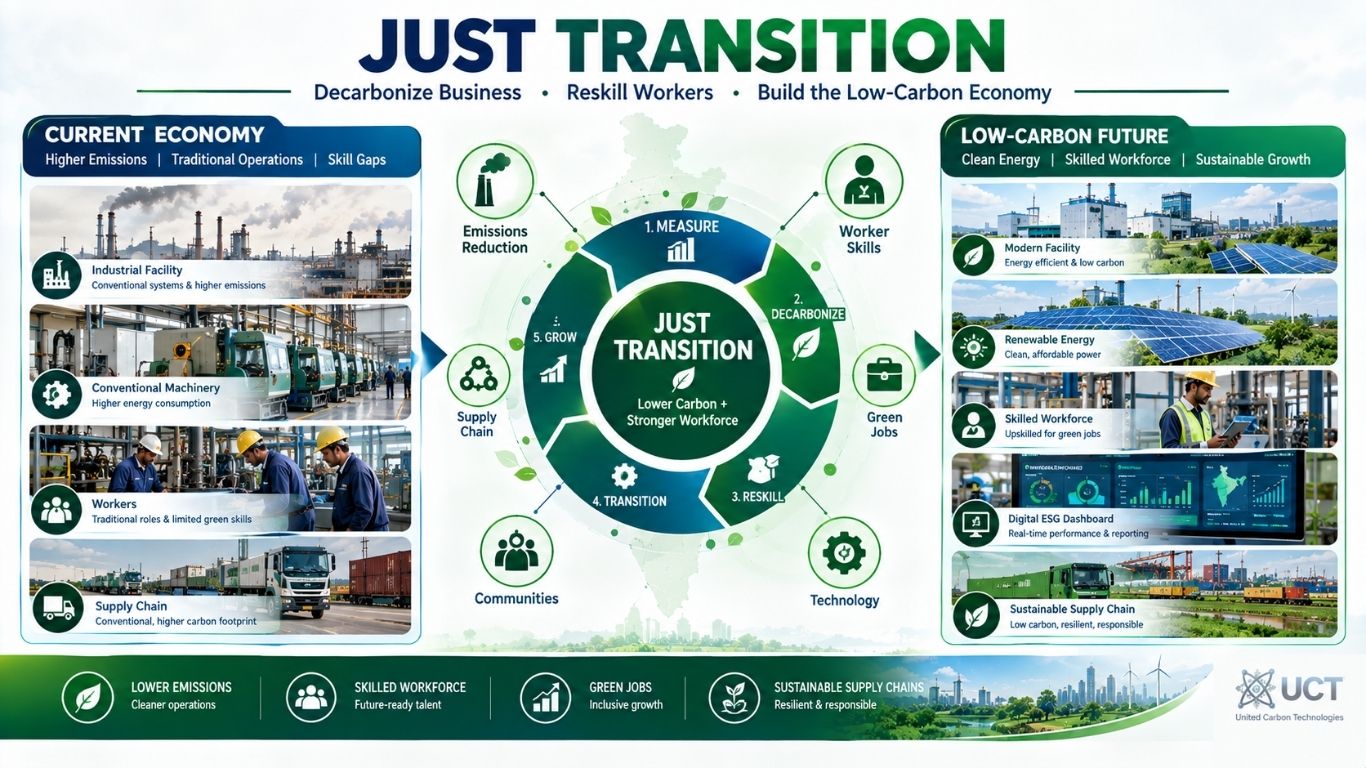
Just transition: connecting business decarbonization with workforce skills, jobs and social resilience.
Introduction: Why Decarbonization Is Also a People Challenge
A company's climate strategy often begins with numbers: greenhouse-gas emissions, energy consumption, renewable-energy procurement, efficiency targets and net-zero ambitions.
But behind those numbers are people.
Employees operate production systems. Technicians maintain machinery. Drivers move goods. Contractors support facilities. Suppliers provide materials and services. Entire communities can depend economically on particular industries or industrial clusters.
When a business changes its technology or operating model to reduce emissions, the workforce may also need to change.
Some roles may require new skills. Some existing jobs may evolve. New roles may emerge in renewable energy, energy efficiency, electrification, environmental management, carbon accounting, sustainability reporting and climate technology.
The International Labour Organization describes just transition as an approach that seeks to maximize the social and economic opportunities of environmental action while minimizing and managing its challenges, with social dialogue and workers' rights forming important elements of the process.
For businesses, therefore, just transition is not simply about protecting existing jobs indefinitely. It is about managing change responsibly while preparing people for the economy that is emerging.
Build Climate Intelligence Beyond Emissions
A strong climate strategy connects emissions data with operational decisions, workforce transformation, technology adoption and long-term business resilience.
Explore UCT Climate IntelligenceDid You Know?
The just-transition discussion is not limited to governments or workers in traditional fossil-fuel industries. The ILO's business guidance recognizes that enterprises themselves need to anticipate changes in production, skills, employment and business opportunities as economies become more environmentally sustainable.
For Indian businesses, this means that a decarbonization strategy can be strengthened when emissions reduction and workforce planning are considered together.
1. What Does “Just Transition” Mean for a Business?
In a corporate context, just transition means planning the movement toward lower-carbon and more environmentally sustainable operations in a way that considers the people affected by that transformation.
It brings together two dimensions that are sometimes treated separately:
| Decarbonization | People & Workforce |
|---|---|
| Reduce greenhouse-gas emissions | Understand workforce implications |
| Improve energy efficiency | Identify changing skills requirements |
| Electrify processes | Reskill and upskill employees |
| Adopt renewable energy | Create pathways into emerging green roles |
| Redesign products and supply chains | Consider suppliers, contractors and affected communities |
The objective is not to slow down climate action. Instead, the objective is to make the transition more planned, inclusive and resilient.
This distinction matters because poorly planned transformation can create workforce disruption even when the underlying environmental objective is important.
A company replacing a conventional production line with a lower-emission automated system, for example, may reduce energy consumption while simultaneously changing the skills required to operate and maintain the facility.
A just-transition approach would consider both sides of that change: the environmental outcome and the human consequences.
2. Why Is Just Transition Becoming Important for Indian Businesses?
India's energy and industrial transformation is taking place alongside rising demand for electricity, continued industrial expansion and increasing investment in cleaner technologies. The IEA reports that India's electricity demand has been rising strongly and that clean-energy investment accounted for 83% of power-sector investment in 2024.
These changes can create opportunities for businesses, but they can also alter the skills, technologies and employment structures associated with different activities.
The implications are particularly relevant for businesses connected to energy-intensive and resource-intensive sectors.
| Business Change | Potential Workforce Implication |
|---|---|
| Renewable-energy adoption | New installation, operation and maintenance skills |
| Industrial electrification | Electrical, automation and equipment-maintenance skills |
| Energy-efficient machinery | New technical competencies and training requirements |
| Digital climate monitoring | Data, analytics and sustainability skills |
| Lower-carbon products | Product-development and process redesign capabilities |
| Supply-chain decarbonization | Supplier engagement, carbon-data and procurement skills |
The issue can become especially significant in regions where particular industries provide a large share of local employment or economic activity. India's coal transition discussions, for example, have highlighted the potential economic and social implications of changes in coal-related activity and the importance of regional planning, economic diversification and stakeholder participation.
For individual businesses, the practical question is therefore not simply whether decarbonization is necessary. It is also:
“What skills, jobs, suppliers and communities will be affected as our business changes—and how can we prepare them?”
Is Your Business Ready for the Workforce Side of Decarbonization?
Start by mapping which employees, contractors, suppliers and operational teams could be affected by planned climate and technology changes.
Explore Climate Intelligence SolutionsPlanning a Business Decarbonization Strategy?
A credible transition strategy should consider more than emissions targets. It can also examine operational changes, technology investments, workforce skills, supply-chain impacts, climate risks and the broader ESG implications of the transition.
Talk to our ESG team about building a structured climate and sustainability roadmap for your business.
Talk to Our ESG Team3. Just Transition vs Decarbonization: What Is the Difference?
Decarbonization and just transition are closely connected, but they describe different aspects of the business transformation.
Decarbonization focuses primarily on reducing greenhouse-gas emissions and moving business operations, products and value chains toward lower-carbon models.
Just transition adds a social and workforce dimension to that transformation by considering how changes affect employees, contractors, suppliers and communities.
| Decarbonization | Just Transition |
|---|---|
| Focuses on emissions reduction | Considers people affected by the transition |
| Targets energy and process transformation | Considers workforce and skills transformation |
| Measures carbon and energy performance | Considers employment, skills and social outcomes alongside environmental goals |
| Can involve new technologies | Considers whether workers can adapt to those technologies |
| Focuses on operational transformation | Broadens transformation to workers, suppliers and communities |
A company can therefore have an ambitious emissions-reduction strategy without having a comprehensive just-transition strategy.
The two approaches become stronger when they are designed together.
4. Which Workers Can Be Affected by Business Decarbonization?
The workforce effects of decarbonization can vary considerably by sector, technology and location. They are also not limited to permanent employees.
A company's transition planning may need to consider several groups:
| Group | Possible Transition Issue |
|---|---|
| Employees | Changing job roles, new technologies or new competency requirements |
| Contract Workers | Changes in operational requirements or contractor capabilities |
| Suppliers | New environmental requirements and carbon-data expectations |
| Technicians | Need for skills related to electrification, automation or renewable technologies |
| Local Communities | Economic effects where businesses or industries are major local employers |
| Future Workforce | Demand for new green, digital and sustainability-related capabilities |
This broader view is important because a business transition can affect people outside the organization's formal payroll.
5. What Are Green Jobs and Why Do They Matter?
One of the most important opportunities associated with a just transition is the creation and expansion of jobs connected to environmentally sustainable economic activity.
Green jobs can emerge across many parts of the economy rather than only in renewable-energy companies.
- Renewable-energy installation and maintenance
- Energy-efficiency management
- Electric mobility and charging infrastructure
- Industrial electrification
- Environmental monitoring
- Carbon accounting and emissions management
- ESG data and reporting
- Waste management and circular economy
- Sustainable product development
- Climate-risk and sustainability analysis
- Environmental engineering and technology
- Nature and ecosystem management
For Indian businesses, this creates an important workforce-planning opportunity: some existing employees may be able to transition into new roles through targeted training rather than being replaced entirely.
6. Reskilling and Upskilling: The Core of a Business Just Transition
As technologies and production systems change, the skills required by employees can change with them.
For example, a manufacturing company introducing electric equipment may require employees to understand new electrical systems, controls, diagnostics and maintenance procedures.
A company implementing a sophisticated carbon-management system may require employees to develop capabilities in emissions data, carbon accounting, ESG reporting and environmental analytics.
This makes reskilling and upskilling important components of corporate transition planning.
| Existing Capability | Potential Future Skill |
|---|---|
| Conventional equipment maintenance | Electrified and digitally monitored equipment maintenance |
| Traditional energy management | Energy efficiency and renewable-energy management |
| Conventional procurement | Sustainable procurement and supplier carbon management |
| Financial reporting | Integration of ESG and sustainability information |
| Production operations | Low-carbon process optimization |
Businesses can begin by conducting a skills-gap assessment: identify the capabilities required by the future operating model, compare them with current workforce capabilities, and determine which gaps can be addressed through training, recruitment or partnerships.
7. How Can Indian Businesses Build a Just Transition Strategy?
A practical corporate just-transition strategy does not need to begin with a complex standalone program. It can be integrated into the company's existing climate, ESG, HR, operations and risk-management processes.
A useful starting framework is:
| Step | Business Action |
|---|---|
| 1. Map | Identify business activities, technologies, facilities and workers likely to be affected. |
| 2. Assess | Evaluate potential employment, skills, operational and community implications. |
| 3. Plan | Integrate workforce considerations into the company's decarbonization roadmap. |
| 4. Reskill | Develop training programs for changing technologies and processes. |
| 5. Engage | Maintain structured communication with employees, workers, suppliers and relevant stakeholders. |
| 6. Measure | Track both environmental progress and relevant workforce outcomes. |
| 7. Improve | Use lessons from implementation to strengthen the transition plan. |
8. What Should a Corporate Just Transition Plan Include?
A company's approach can be scaled according to its size, sector and transition exposure. A practical corporate plan may include the following components:
Workforce Impact Assessment
Identify which roles, functions and worker groups may be affected by planned technology, process or business-model changes.
Skills-Gap Analysis
Compare current workforce capabilities with the skills required for the company's future low-carbon operating model.
Reskilling and Upskilling Plan
Develop training pathways that help employees adapt to new equipment, processes, technologies and sustainability responsibilities.
Worker Engagement
Create appropriate mechanisms for communicating major changes, understanding workforce concerns and incorporating relevant feedback into implementation.
Supplier and Contractor Considerations
Assess how new climate requirements may affect smaller suppliers, contractors and service providers connected to the business.
Community Considerations
Where a business has a significant local economic footprint, transition planning can consider potential effects on surrounding communities and local economic activity.
Green Job Creation
Identify new roles and career pathways that can emerge from renewable energy, energy efficiency, circular economy, environmental management and climate-related business activities.
9. How Can Just Transition Connect With ESG Reporting?
Just transition can also become relevant to a company's broader ESG information system because workforce and social considerations increasingly intersect with environmental transformation.
For example, a company may already track:
- Greenhouse-gas emissions
- Energy consumption
- Renewable-energy use
- Employee training
- Occupational health and safety
- Employee turnover
- Diversity and inclusion indicators
- Supplier performance
A just-transition lens can help connect these datasets to the company's decarbonization strategy.
Instead of asking only whether emissions declined, management can also ask whether employees received the training required for the transition, whether new capabilities were developed, and whether important stakeholders were engaged during major changes.
From Carbon Data to Transition Intelligence
A mature climate strategy can connect emissions data + technology changes + workforce skills + operational risks + ESG performance into a broader picture of business transformation.
10. Just Transition in Energy-Intensive Industries
The workforce dimension of decarbonization can become particularly important in energy-intensive industries where technology, fuel mix and production processes are undergoing significant change.
Examples can include:
- Steel and metals
- Cement
- Chemicals
- Power generation
- Mining
- Heavy manufacturing
- Transport and logistics
- Oil and gas-related activities
The exact transition pathway will differ between industries. Some businesses may focus heavily on electrification and renewable electricity. Others may require process innovation, alternative fuels, material efficiency, circularity or new production technologies.
The workforce implications will therefore also differ.
A practical transition plan should identify these differences instead of assuming that every industry or every worker will experience decarbonization in the same way.
11. The Role of Leadership in a Just Transition
A just transition cannot be treated solely as an HR initiative. It can require coordination between leadership, sustainability, operations, finance, procurement and human resources.
Senior leadership can establish the direction by connecting climate objectives with workforce and business strategy.
| Function | Potential Role |
|---|---|
| Board / Leadership | Set transition direction and oversee major strategic impacts. |
| Sustainability / ESG | Connect climate targets with social and environmental considerations. |
| HR | Lead workforce mapping, skills-gap assessment and training. |
| Operations | Identify technology and process changes affecting workers. |
| Finance | Consider transition investment, workforce-development costs and long-term business implications. |
| Procurement | Engage suppliers and contractors in the transition. |
This cross-functional structure helps ensure that the social consequences of decarbonization are considered while major business decisions are being designed, rather than only after implementation begins.
Decarbonization Should Be a Business Transformation Strategy
For Indian businesses, the transition to a lower-carbon economy can involve technology, capital, operations, supply chains and people. A structured approach can help organizations prepare for these changes rather than responding to them separately.
Talk to Our ESG Team12. How Can Businesses Measure a Just Transition?
One of the challenges of just transition planning is that businesses are more accustomed to measuring environmental indicators such as greenhouse-gas emissions and energy consumption than workforce impacts associated with decarbonization.
A practical approach is to combine environmental, workforce and business-transition indicators.
| Area | Illustrative Indicator |
|---|---|
| Emissions | GHG emissions reduced through the transition |
| Skills | Employees receiving transition-related training |
| Reskilling | Employees completing relevant reskilling programmes |
| Employment | Workforce changes associated with major transition projects |
| Green Roles | New or transformed roles supporting environmental objectives |
| Engagement | Worker and stakeholder engagement activities |
| Suppliers | Suppliers supported or trained for transition requirements |
These indicators should not be treated as a universal checklist. Each company should select metrics that reflect its sector, workforce structure, transition strategy and material impacts.
The objective is to make the social dimension of decarbonization visible, trackable and connected to management decisions.
13. How Can MSMEs Approach Just Transition?
Just transition is not only a concern for large corporations. Indian MSMEs can also face workforce and skills implications as they adopt cleaner technologies, improve energy efficiency and respond to changing customer or supply-chain expectations.
However, an MSME does not necessarily need a large standalone just-transition department.
A practical starting approach could include:
- Identify major decarbonization changes planned for the next three to five years.
- Identify employees and contractors whose roles could be affected.
- Map the skills required by the new technology or process.
- Identify which existing employees can be reskilled.
- Build practical training into the implementation budget.
- Communicate significant changes early and clearly.
- Track workforce and environmental outcomes together.
For a small manufacturing business, for example, replacing conventional machinery with more efficient or electrified equipment may create a relatively manageable skills transition if training is planned alongside the investment.
This illustrates an important principle: just transition can be proportionate to the scale of the business.
14. How Should Companies Include Workers in Decarbonization Planning?
Workers often have direct knowledge of production processes, equipment, safety issues and operational constraints. Their involvement can therefore provide useful information when companies are planning major operational changes.
Worker engagement can include:
- Structured consultations before major technology changes
- Training-needs assessments
- Employee feedback mechanisms
- Safety discussions around new technologies
- Skills-development programmes
- Communication about changes in job responsibilities
- Engagement with relevant worker representatives where applicable
The ILO's just-transition framework emphasizes social dialogue as an important element of managing the transition toward environmentally sustainable economies. ([ilo.org](https://www.ilo.org/topics-and-sectors/just-transition-towards-environmentally-sustainable-economies-and-societies?utm_source=chatgpt.com))
For businesses, meaningful engagement is therefore not simply a communication exercise. It can become part of operational risk management and workforce planning.
15. Just Transition and Supply Chains: Why Suppliers Matter
A company's decarbonization strategy can affect more than its own employees.
Large companies increasingly work with suppliers and contractors that may themselves need to change equipment, energy sources, production methods or reporting practices to meet new requirements.
This creates a supply-chain dimension to just transition.
| Supply-Chain Change | Potential Challenge | Possible Business Response |
|---|---|---|
| New carbon-data requirements | Smaller suppliers may lack measurement capabilities | Training and capacity building |
| Cleaner production requirements | Investment constraints | Phased implementation and supplier engagement |
| New technology requirements | Skills and technical gaps | Technical support and knowledge sharing |
| Changing procurement standards | Business-model adjustment | Clear transition timelines and expectations |
This is particularly relevant for Indian MSME suppliers that may be part of larger corporate value chains. Building supplier capability can sometimes be an important part of achieving corporate decarbonization goals without creating avoidable disruption across the value chain.
16. A Practical Just Transition Roadmap for Indian Businesses
A company can gradually build just-transition capability alongside its wider climate strategy.
| Stage | Focus | Key Activities |
|---|---|---|
| 1. Understand | Identify transition drivers | Understand climate targets, customer expectations, technology changes and regulatory context. |
| 2. Map | Identify affected people | Map employees, contractors, suppliers and communities potentially affected. |
| 3. Assess | Identify workforce impacts | Conduct skills-gap, employment and operational assessments. |
| 4. Prepare | Build solutions | Develop reskilling, training, engagement and supplier-support programmes. |
| 5. Transition | Implement change | Deploy technology and process changes alongside workforce programmes. |
| 6. Measure | Track outcomes | Monitor emissions, skills, employment and other relevant indicators. |
| 7. Improve | Strengthen the approach | Use results and stakeholder feedback to improve future transition decisions. |
17. Common Mistakes Businesses Should Avoid
1. Treating Decarbonization as Only a Technology Project
Technology can reduce emissions, but new technology can also change operating procedures and workforce requirements. The people dimension should therefore be considered during project planning.
2. Waiting Until Jobs Are Already Affected
Workforce planning is generally more useful when it begins before major technology or business-model changes are implemented.
3. Focusing Only on Permanent Employees
Contractors, suppliers and other workers connected to business operations can also experience transition-related changes.
4. Treating Training as an Afterthought
If new equipment or processes require new capabilities, training should be considered part of the transition investment rather than an unrelated activity.
5. Measuring Only Carbon Reduction
Emissions are essential to a decarbonization strategy, but they do not show the full workforce and social dimensions of a transition.
6. Ignoring Smaller Suppliers
Large companies can unintentionally transfer transition costs to smaller suppliers if new environmental requirements are introduced without adequate communication or capability support.
18. What Could a Mature Just Transition Strategy Look Like?
A mature approach does not necessarily mean creating a separate and complicated reporting system. Instead, just-transition considerations can become embedded within normal business planning.
At a mature stage, a company may be able to connect:
- Climate targets
- Capital investment plans
- Technology roadmaps
- Workforce planning
- Skills development
- Supplier engagement
- Community considerations
- ESG reporting
- Risk management
- Performance measurement
This creates a more integrated view of the transition: what the company needs to change, why it needs to change, who is affected, what capabilities are required, and how progress will be measured.
For Indian businesses preparing for a lower-carbon economy, this integrated approach can help position workforce development as part of transition planning rather than as a separate social initiative.
19. Just Transition and the Future of Indian Business
India's transition toward cleaner energy, more efficient production and lower-carbon business models will involve different sectors, regions, technologies and workforce groups.
For companies, the transition can create both challenges and opportunities: new technologies can change existing roles, while new markets and sustainability-related activities can create demand for different capabilities.
The businesses that prepare early can build transition planning into investment decisions, workforce development and supply-chain strategy rather than treating each change as an isolated project.
Ultimately, a just transition asks businesses to look at decarbonization through a wider lens:
Reduce emissions.
Build new capabilities.
Prepare people for change.
Create pathways into the low-carbon economy.
Related Reads
Continue exploring related climate, carbon and ESG topics from the UCT Climate Knowledge Hub India:
- What Is a Corporate Climate Transition Plan? A Practical Guide for Indian Businesses
- Climate Scenario Analysis: How Businesses Can Test Their Resilience Against Future Climate Risks
- Supplier Decarbonization: A Step-by-Step Guide for Businesses
- Carbon Accounting Explained: How Businesses Measure Their Emissions
- What Is Scope 3 Emissions? A Practical Guide for Indian Businesses
Quick Summary: Just Transition for Indian Businesses
- Just transition connects environmental transformation with workforce and social considerations.
- Decarbonization focuses on reducing emissions, while just transition considers how the transformation affects workers, suppliers and communities.
- Technology changes can create new skills requirements and new employment opportunities.
- Reskilling and upskilling can help employees adapt to changing technologies and processes.
- MSMEs can adopt a proportionate approach based on their size, sector and transition exposure.
- Suppliers and contractors can also be affected by changing climate and procurement requirements.
- Worker engagement can provide useful operational information and support responsible implementation.
- Companies can track workforce indicators alongside environmental performance.
- A mature just-transition strategy can connect climate targets, investment, HR, operations, procurement and ESG reporting.
- The objective is to support a lower-carbon economy while preparing people and businesses for the changes involved.
Frequently Asked Questions About Just Transition
1. What is a just transition?
A just transition is an approach to moving toward environmentally sustainable and lower-carbon economic activity while considering the effects of that transition on workers, businesses and communities.
2. Why is just transition important for businesses?
Business decarbonization can change technologies, production processes, skills requirements, supply chains and employment structures. Just-transition planning helps businesses consider these effects alongside emissions reduction.
3. Is just transition only about protecting jobs?
No. It can include workforce protection, reskilling, new green-job opportunities, worker engagement, supplier support, social dialogue and preparation for changing business models.
4. What is the difference between decarbonization and just transition?
Decarbonization primarily focuses on reducing greenhouse-gas emissions. Just transition adds consideration of the workers, suppliers and communities affected by the transformation toward a lower-carbon economy.
5. How can companies reskill workers for the green economy?
Companies can identify future skills requirements, compare them with current workforce capabilities, develop training programmes and create pathways for employees to move into changing or emerging roles.
6. Can MSMEs implement a just-transition strategy?
Yes. MSMEs can use a proportionate approach by identifying major planned business changes, affected workers, future skills requirements and practical training needs.
7. What industries may face significant just-transition challenges?
Energy-intensive and resource-intensive industries such as steel, cement, chemicals, mining, power generation, heavy manufacturing and transport may face significant workforce and technology changes. Actual impacts vary by company and transition pathway.
8. How does just transition relate to ESG?
Just transition can connect the environmental and social dimensions of ESG by linking emissions reduction and environmental transformation with workforce development, skills, employment and stakeholder engagement.
9. Should companies include suppliers in just-transition planning?
Where suppliers or contractors are materially affected by a company's transition requirements, considering their capabilities and transition challenges can support a more resilient value chain.
10. How should an Indian business start a just-transition strategy?
A practical starting point is to identify planned decarbonization changes, map potentially affected workers and suppliers, conduct a skills-gap assessment, develop reskilling plans and track workforce outcomes alongside environmental performance.
Build a Climate Transition That Includes People
Decarbonization is changing how businesses operate, invest, produce and compete. The transition can be stronger when companies prepare their people, skills and value chains alongside their emissions-reduction strategy.
UCT is developing climate intelligence and sustainability solutions designed to help Indian businesses understand carbon, ESG and environmental data and build more structured sustainability strategies.
Explore UCT Climate IntelligenceAbout United Carbon Technologies
United Carbon Technologies is a climate-tech and sustainability initiative developing carbon intelligence, ESG reporting, climate education and sustainability solutions for Indian businesses.
Our work focuses on making climate and sustainability information more practical, measurable and accessible for organizations navigating India's evolving ESG and environmental landscape.
Built as part of ongoing climate-tech research and sustainability initiatives.