

How Companies Calculate Their Corporate Carbon Footprint
By United Carbon Technologies | Climate Knowledge Hub India
Join thousands of readers learning about carbon accounting, ESG reporting, climate technology, Net Zero, sustainability, and climate intelligence.
Measuring a company's carbon footprint is the foundation of effective climate action. Organizations worldwide are calculating greenhouse gas emissions to meet ESG requirements, comply with regulations, improve operational efficiency, and achieve Net Zero goals. This guide explains how businesses calculate their corporate carbon footprint step by step.
How do companies calculate their corporate carbon footprint?
Companies calculate their corporate carbon footprint by collecting activity data such as fuel consumption, electricity usage, business travel, logistics, waste, and purchased goods, then applying internationally recognized emission factors to estimate greenhouse gas emissions across Scope 1, Scope 2, and Scope 3.
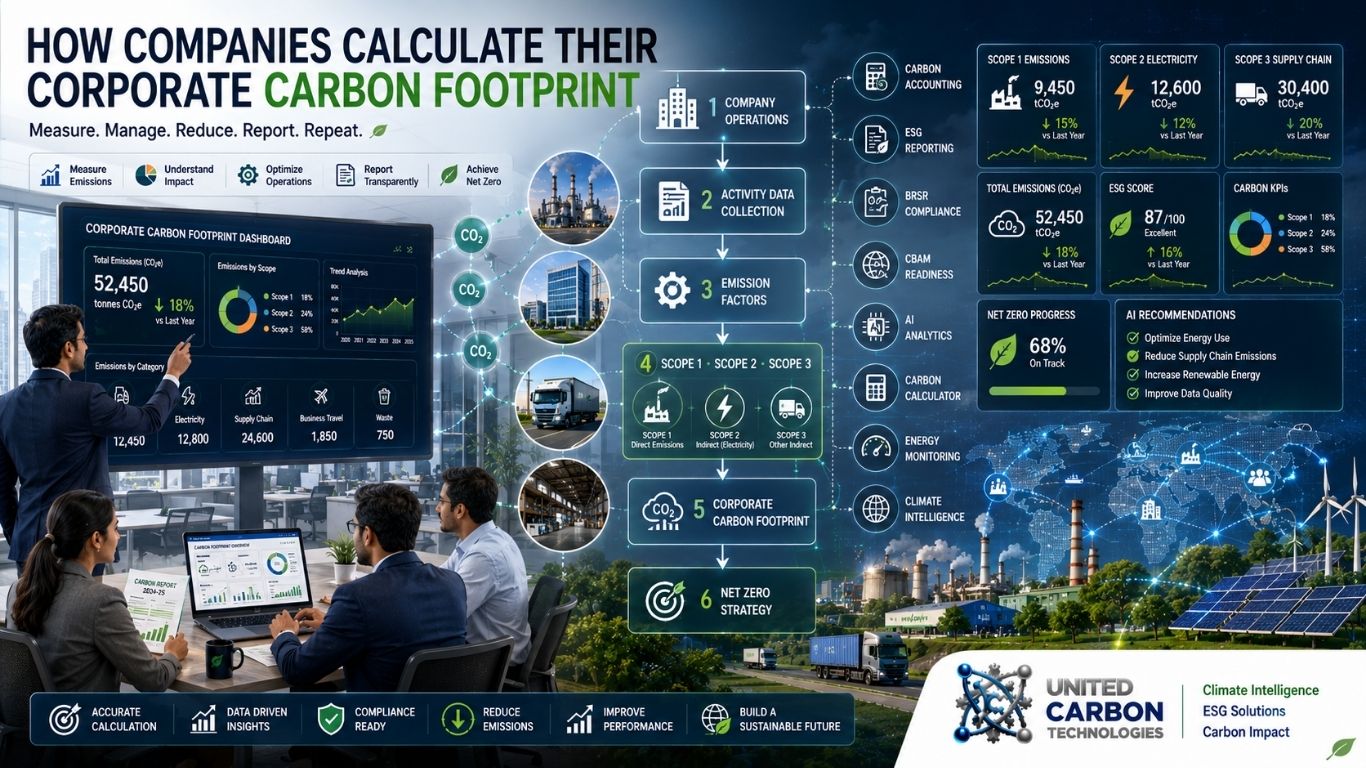
Businesses around the world are under increasing pressure to understand and reduce their environmental impact. Investors expect greater transparency, regulators are introducing stricter disclosure requirements, customers are demanding sustainable products, and global supply chains increasingly require emissions reporting from suppliers.
The first step toward meaningful climate action is understanding where greenhouse gas emissions originate. This is achieved by calculating a company's corporate carbon footprint—a comprehensive measure of emissions generated directly and indirectly through business activities.
Whether a business is preparing an ESG report, complying with India's Business Responsibility and Sustainability Reporting (BRSR) framework, responding to international regulations like the Carbon Border Adjustment Mechanism (CBAM), or pursuing Net Zero, accurate carbon accounting has become an essential business capability rather than a voluntary initiative.
For many organizations, more than 70% of total greenhouse gas emissions often originate from their value chain (Scope 3 emissions), making comprehensive carbon accounting essential for identifying the biggest opportunities for emission reductions.
What Is a Corporate Carbon Footprint?
A corporate carbon footprint represents the total greenhouse gas emissions generated by an organization's operations and value chain over a defined reporting period. These emissions are measured in carbon dioxide equivalent (CO₂e), allowing different greenhouse gases to be compared using a common metric.
A complete corporate carbon footprint includes emissions from fuel combustion, purchased electricity, company vehicles, manufacturing processes, business travel, logistics, waste generation, purchased goods and services, employee commuting, and many other business activities.
Rather than being a single number, a corporate carbon footprint provides businesses with valuable insights into where emissions occur, enabling informed decisions that improve efficiency, reduce costs, strengthen ESG performance, and support long-term sustainability strategies.
Why Measuring Carbon Emissions Is Important
Carbon accounting is no longer simply an environmental exercise—it has become a core component of business strategy and risk management. Organizations that accurately measure their emissions are better positioned to respond to regulatory changes, investor expectations, customer requirements, and emerging market opportunities.
Calculating a corporate carbon footprint helps organizations:
- Meet ESG reporting requirements.
- Support BRSR and sustainability disclosures.
- Prepare for international regulations such as CBAM.
- Identify opportunities to reduce operational costs.
- Improve energy efficiency.
- Track progress toward Net Zero commitments.
- Strengthen investor and stakeholder confidence.
- Build resilient and sustainable supply chains.
In today's business environment, organizations cannot effectively reduce emissions without first understanding where those emissions originate.
The International Standard for Carbon Accounting
Most organizations calculate their greenhouse gas emissions using the internationally recognized Greenhouse Gas (GHG) Protocol. This framework provides standardized methodologies for identifying, measuring, categorizing, and reporting emissions across different business activities.
The GHG Protocol divides emissions into three categories—Scope 1, Scope 2, and Scope 3—ensuring consistency across industries and making sustainability reporting comparable worldwide. It also forms the foundation for many ESG frameworks, BRSR reporting requirements, and corporate climate strategies.
Understanding Scope 1, Scope 2, and Scope 3 Emissions
The foundation of every corporate carbon footprint is the classification of greenhouse gas emissions into three internationally recognized categories: Scope 1, Scope 2, and Scope 3. These categories, defined by the Greenhouse Gas (GHG) Protocol, help organizations identify where emissions originate and determine which activities they can directly or indirectly influence.
Scope 1 – Direct Emissions
Scope 1 emissions are greenhouse gases released directly from sources owned or controlled by the company.
Typical Scope 1 emission sources include:
- Fuel burned in company-owned vehicles.
- Diesel generators.
- Boilers and furnaces.
- Manufacturing processes.
- Industrial equipment.
- Refrigerant leakage from HVAC systems.
- Company-owned machinery.
These emissions are usually the easiest to measure because the organization has direct control over the equipment generating them.
Scope 2 – Indirect Energy Emissions
Scope 2 emissions come from the electricity, steam, heating, or cooling purchased by an organization. Although these emissions occur at the power plant rather than the business premises, they are attributed to the organization because it consumes the energy.
Common Scope 2 sources include:
- Purchased electricity.
- District heating systems.
- Purchased steam.
- Purchased cooling services.
For many offices, IT companies, hospitals, educational institutions, and commercial buildings, electricity represents one of the largest sources of emissions.
Scope 3 – Value Chain Emissions
Scope 3 includes all other indirect emissions occurring throughout the organization's value chain. These are often the largest—and most challenging—emissions to measure because they involve suppliers, customers, logistics partners, and product life cycles.
Examples include:
- Purchased goods and services.
- Transportation and logistics.
- Employee commuting.
- Business travel.
- Waste disposal.
- Capital goods.
- Cloud computing and data centres.
- Use of sold products.
- End-of-life product disposal.
For manufacturing companies, Scope 3 emissions frequently account for more than half of the total corporate carbon footprint, making supplier engagement increasingly important.
What Data Do Companies Collect?
Carbon accounting begins with collecting reliable activity data rather than measuring carbon dioxide directly. Activity data represents the operational information that can be converted into greenhouse gas emissions using standardized emission factors.
Typical data collected includes:
- Electricity consumption (kWh).
- Diesel, petrol, LPG, and natural gas usage.
- Company vehicle fuel consumption.
- Manufacturing production volumes.
- Business travel (air, rail, taxi).
- Employee commuting patterns.
- Water consumption.
- Waste generation and disposal methods.
- Purchased raw materials.
- Supplier procurement data.
- Freight and logistics records.
- Packaging materials.
The quality of a company's carbon footprint depends heavily on the accuracy, completeness, and consistency of this operational data.
What Are Emission Factors?
An emission factor is a scientifically established value that converts an activity into greenhouse gas emissions. Instead of measuring emissions directly from every business activity, organizations multiply operational data by standardized emission factors published by recognized authorities.
For example:
- 1 litre of diesel has a known emission factor.
- 1 kWh of electricity has an emission factor based on the national electricity grid.
- Each kilometre travelled by aircraft has an associated emission factor.
- Each tonne of waste sent to landfill generates measurable emissions.
Emission factors are commonly published by organizations such as the IPCC, national governments, environmental agencies, and electricity grid operators. Using standardized factors ensures consistent and internationally comparable reporting.
Not Sure Where Your Company's Emissions Come From?
Calculating a corporate carbon footprint starts with identifying the right data sources and emission boundaries. Whether you're beginning your ESG journey or preparing for BRSR, CBAM, or Net Zero, our experts can help you establish a reliable carbon accounting framework.
How Carbon Emissions Are Calculated
Although carbon accounting involves large datasets, the basic calculation follows a straightforward methodology used worldwide.
The standard equation is:
For example:
- Electricity consumed = 50,000 kWh
- Grid emission factor = 0.71 kg CO₂e/kWh
- Total emissions = 35,500 kg CO₂e (35.5 tonnes CO₂e)
The same methodology is applied across fuel use, transportation, purchased materials, waste, logistics, and business travel to calculate an organization's complete carbon footprint.
Setting Organizational and Operational Boundaries
Before calculating emissions, companies must clearly define what parts of the business are included in the inventory. These are known as organizational and operational boundaries.
Organizational boundaries determine which entities, subsidiaries, offices, factories, or business units are included in reporting.
Operational boundaries determine which emission sources fall under Scope 1, Scope 2, and Scope 3.
Clearly defining these boundaries ensures transparency, consistency, and comparability across reporting years while preventing double counting or omissions.
Step-by-Step Corporate Carbon Footprint Calculation Process
- Define organizational and operational boundaries.
- Identify all emission sources.
- Collect reliable activity data.
- Apply appropriate emission factors.
- Calculate Scope 1, Scope 2, and Scope 3 emissions.
- Convert emissions into tonnes of CO₂ equivalent (tCO₂e).
- Review and verify calculations.
- Prepare carbon inventory reports.
- Identify emission hotspots.
- Develop reduction strategies and track progress annually.
Modern organizations increasingly automate these steps using digital carbon accounting platforms, improving reporting accuracy while significantly reducing manual effort.
How Companies Verify Their Carbon Footprint
A corporate carbon footprint is only valuable if stakeholders can trust the data behind it. Investors, regulators, customers, lenders, and business partners increasingly expect organizations to demonstrate that their emissions have been calculated accurately using internationally accepted methodologies.
Many organizations therefore conduct internal reviews or seek independent third-party verification to improve the credibility of their carbon inventories. Verification helps identify data gaps, calculation errors, inconsistent reporting methods, and opportunities to strengthen future reporting cycles.
Verified emissions data also supports ESG reporting, sustainability disclosures, BRSR compliance, CDP submissions, and Net Zero commitments.
Corporate Carbon Footprint Reporting Frameworks
Once emissions have been calculated, businesses report the information through various sustainability and climate disclosure frameworks. While each framework has its own reporting requirements, they all depend on accurate carbon accounting.
Common reporting frameworks include:
- Greenhouse Gas (GHG) Protocol
- Business Responsibility and Sustainability Reporting (BRSR)
- Global Reporting Initiative (GRI)
- International Sustainability Standards Board (ISSB)
- Carbon Disclosure Project (CDP)
- Task Force on Climate-related Financial Disclosures (TCFD)
- Science Based Targets initiative (SBTi)
- European Sustainability Reporting Standards (ESRS)
Organizations that build reliable carbon accounting systems can often use the same emissions data across multiple reporting frameworks, significantly reducing reporting effort.
Common Challenges in Corporate Carbon Accounting
Although the methodology for calculating emissions is well established, implementing it across a business can be challenging. Companies often collect data from multiple departments, suppliers, facilities, and external partners, making consistency difficult without structured processes.
Some of the most common challenges include:
- Incomplete activity data.
- Poor data quality.
- Manual spreadsheet calculations.
- Limited supplier emissions data.
- Changing emission factors.
- Difficulty calculating Scope 3 emissions.
- Multiple reporting standards.
- Lack of internal expertise.
- Disconnected business systems.
- Keeping reports audit-ready.
As sustainability regulations become more demanding, manual reporting methods become increasingly difficult to manage, encouraging organizations to adopt digital carbon management platforms.
Turn Sustainability Data into Business Intelligence
United Carbon Technologies helps organizations simplify carbon accounting, ESG reporting, BRSR compliance, Net Zero planning, climate risk management, and sustainability reporting through expert consulting and next-generation digital solutions.
We're also developing ACIS (Advanced Carbon Intelligence System), an AI-powered climate intelligence platform designed to automate emissions measurement, Scope 1, Scope 2 & Scope 3 accounting, ESG reporting, energy analytics, and sustainability dashboards.
How Digital Carbon Accounting Is Transforming Businesses
Modern organizations are moving away from spreadsheets and adopting cloud-based carbon accounting platforms that automate data collection, emissions calculations, reporting, and performance monitoring. Digital platforms improve data accuracy, reduce reporting time, and provide management with real-time sustainability insights.
Key capabilities of modern carbon accounting software include:
- Automated activity data collection.
- Real-time Scope 1, Scope 2, and Scope 3 calculations.
- Integration with ERP, finance, procurement, and utility systems.
- Emission factor libraries with automatic updates.
- Interactive ESG dashboards.
- Audit-ready reporting.
- Reduction target tracking.
- Scenario modelling for Net Zero planning.
Digital carbon accounting not only improves compliance but also enables organizations to make faster, data-driven sustainability decisions.
The Future of Corporate Carbon Accounting: AI-Powered Climate Intelligence
The future of carbon accounting extends beyond annual reporting. Businesses are increasingly adopting artificial intelligence, machine learning, IoT sensors, and predictive analytics to monitor emissions continuously rather than once a year.
These technologies enable organizations to identify emission hotspots, forecast future emissions, recommend reduction opportunities, and support strategic business decisions using real-time climate intelligence.
At United Carbon Technologies, we are developing the Advanced Carbon Intelligence System (ACIS) to help organizations move beyond traditional reporting toward intelligent carbon management.
Future ACIS modules are designed to support:
- Corporate Carbon Footprint Calculator
- Scope 1, Scope 2 & Scope 3 Management
- AI-powered Carbon Analytics
- Real-time ESG Dashboards
- BRSR Reporting Support
- CBAM Readiness
- Net Zero Roadmaps
- Executive Sustainability Reporting
- Climate Risk Insights
- Decision-support through Climate Intelligence
As climate regulations continue to evolve, businesses that embrace intelligent carbon accounting will be better positioned to improve operational efficiency, strengthen stakeholder confidence, and remain competitive in the transition to a low-carbon economy.
Related Reads
- What Is Carbon Accounting? A Complete Guide
- Understanding Scope 1, Scope 2 & Scope 3 Emissions
- ESG Reporting Explained: What Indian Companies Must Know
- Why BRSR Matters for Indian Businesses
- Carbon Border Adjustment Mechanism (CBAM) Explained for Indian Exporters
- Carbon Reporting Software: What Businesses Should Look For
- Sustainability KPIs Every Company Should Track
- What Is Net Zero?
- A corporate carbon footprint measures all greenhouse gas emissions generated by a business.
- Most organizations follow the internationally recognized GHG Protocol.
- Emissions are categorized into Scope 1, Scope 2, and Scope 3.
- Calculations are based on activity data and standardized emission factors.
- High-quality data collection is the foundation of accurate carbon accounting.
- Carbon footprint reporting supports ESG, BRSR, CBAM, and Net Zero initiatives.
- Digital carbon accounting platforms improve reporting efficiency and accuracy.
- AI-powered climate intelligence platforms like ACIS represent the future of corporate carbon management.
Frequently Asked Questions (FAQs)
1. What is a corporate carbon footprint?
A corporate carbon footprint is the total greenhouse gas (GHG) emissions generated directly and indirectly by an organization's operations and value chain. It includes Scope 1, Scope 2, and Scope 3 emissions and is typically measured in tonnes of carbon dioxide equivalent (tCO₂e).
2. How do companies calculate their carbon footprint?
Companies calculate their carbon footprint by collecting activity data such as electricity consumption, fuel use, business travel, waste generation, logistics, and purchased goods, then multiplying these values by internationally recognized emission factors to estimate greenhouse gas emissions.
3. What are Scope 1, Scope 2, and Scope 3 emissions?
Scope 1 covers direct emissions from company-owned sources, Scope 2 includes indirect emissions from purchased electricity and energy, while Scope 3 includes all other indirect emissions across the organization's value chain, such as suppliers, transportation, business travel, and waste.
4. Which standard is used for corporate carbon accounting?
Most organizations follow the internationally recognized Greenhouse Gas (GHG) Protocol, which provides standardized methodologies for calculating, categorizing, and reporting greenhouse gas emissions across Scope 1, Scope 2, and Scope 3.
5. Why is calculating a corporate carbon footprint important?
Carbon footprint measurement helps organizations comply with ESG reporting requirements, BRSR, CBAM, sustainability disclosures, Net Zero commitments, and investor expectations while identifying opportunities to reduce emissions and improve operational efficiency.
6. What data is required for corporate carbon accounting?
Typical data includes electricity consumption, fuel usage, company vehicles, manufacturing processes, purchased materials, logistics, employee commuting, business travel, waste generation, water consumption, and supplier information.
7. What are emission factors?
Emission factors are standardized scientific values that convert business activities such as fuel consumption or electricity use into greenhouse gas emissions, allowing organizations to calculate their carbon footprint accurately.
8. Can software automate corporate carbon accounting?
Yes. Modern carbon accounting software automates data collection, emissions calculations, Scope 1, Scope 2, and Scope 3 reporting, ESG dashboards, audit-ready reports, and sustainability performance tracking, significantly improving efficiency and accuracy.
9. How does carbon accounting support ESG and Net Zero goals?
Accurate carbon accounting provides the emissions data needed for ESG reporting, climate disclosures, reduction target setting, progress tracking, and long-term Net Zero strategies, enabling businesses to make informed sustainability decisions.
10. How will AI improve corporate carbon accounting?
Artificial Intelligence can automate emissions calculations, identify data gaps, predict future emissions, recommend reduction opportunities, monitor sustainability performance in real time, and support intelligent climate decision-making across the organization.
Start Your Climate Knowledge Journey Today
Climate change is reshaping the way businesses operate, report, and compete. Whether you're a business owner, sustainability professional, student, investor, or simply eager to understand the low-carbon economy, building climate knowledge today will help you make better decisions tomorrow.
Join thousands of learners exploring practical topics such as carbon accounting, Scope 1, Scope 2 & Scope 3 emissions, ESG reporting, BRSR, CBAM, Net Zero, climate technology, carbon footprint management, and AI-powered climate intelligence through India's growing Climate Knowledge Hub.
As sustainability regulations and stakeholder expectations continue to evolve, organizations that understand and measure their environmental impact will be better positioned to reduce costs, improve resilience, attract investment, and lead the transition toward a low-carbon future.
Measure Today. Reduce Tomorrow. Lead the Low-Carbon Economy.
✔ Free Climate Learning Resources | ✔ Weekly Sustainability Insights | ✔ Early Access to ACIS Climate Intelligence Platform | ✔ Join India's Next Generation of Climate Leaders