

Marginal Abatement Cost Curves Explained: How Companies Can Prioritize Carbon Reduction Projects
By United Carbon Technologies | Climate Knowledge Hub India
Published: 30 September 2026 | Updated: 30 September 2026
🌱 Follow United Carbon Technologies for ESG & Climate Intelligence Insights
* Follow for ESG InsightsCompanies increasingly have more carbon-reduction opportunities than they can implement at the same time. Energy efficiency, renewable electricity, electrification, fuel switching, process improvements, equipment upgrades, logistics changes and supplier decarbonization can all contribute to emissions reduction—but each project can have a different investment requirement, operating impact and carbon-abatement potential.
This creates a practical management question: Which carbon reduction projects should a company implement first?
A Marginal Abatement Cost Curve (MACC) provides a structured way to answer that question. It compares potential emissions-reduction measures according to two central dimensions: the amount of greenhouse-gas emissions they can avoid and the net cost of reducing each unit of emissions.
For companies developing a decarbonization strategy, a MACC can turn a long list of climate initiatives into a more structured investment and implementation roadmap.
Featured Snippet: What Is a Marginal Abatement Cost Curve?
A Marginal Abatement Cost Curve (MACC) is a decision-support tool that compares carbon-reduction measures by their estimated emissions-abatement potential and net cost per tonne of greenhouse-gas emissions avoided. Companies can use a MACC to identify relatively low-cost or cost-saving opportunities, understand higher-cost reduction options, and sequence decarbonization projects toward emissions targets.
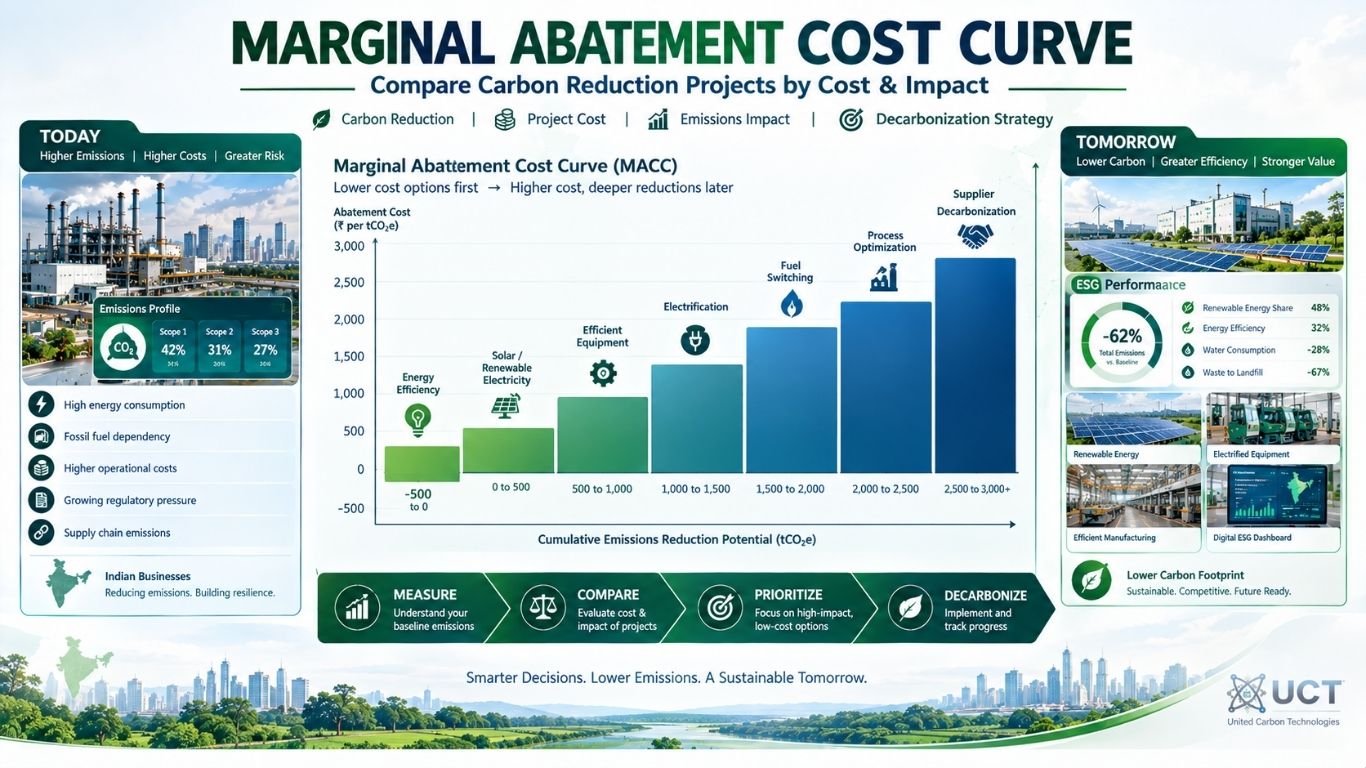
Marginal Abatement Cost Curves help businesses compare carbon-reduction projects by cost and emissions-abatement potential.
Introduction: Why Companies Need a Better Way to Prioritize Decarbonization
A corporate decarbonization strategy can quickly become complicated.
One business may identify dozens of possible actions: installing rooftop solar, purchasing renewable electricity, improving boiler efficiency, replacing inefficient motors, electrifying heating, optimizing compressed-air systems, changing refrigerants, improving logistics, reducing process waste, switching fuels or working with suppliers to reduce Scope 3 emissions.
The challenge is not simply identifying these opportunities. The challenge is deciding which actions should receive capital, management attention and implementation capacity first.
Two projects can produce similar emissions reductions but have very different financial characteristics. One may require little investment and reduce operating costs. Another may require significant capital expenditure and have a long payback period. A third may have a higher cost but be essential for achieving a company's long-term emissions target because cheaper options alone cannot deliver sufficient reductions.
A MACC helps make these differences visible.
The World Bank describes abatement cost as the cost of an intervention that reduces greenhouse-gas emissions by a tonne, taking into account both additional costs and savings associated with the intervention. It also notes that negative abatement costs can represent opportunities where emissions reductions are accompanied by a net economic gain.
In a corporate setting, this makes the MACC particularly useful as a bridge between carbon accounting and capital allocation.
Build Better Decarbonization Decisions With Climate Intelligence
Carbon reduction begins with knowing where emissions come from—but effective climate strategy also requires understanding which interventions can reduce those emissions, at what cost, and over what timeframe.
Explore UCT Climate IntelligenceDid You Know?
A MACC does not simply identify projects that reduce emissions. It can also show the relative economics of those reductions. Some measures can have a negative net abatement cost because energy savings or other operating benefits can outweigh the additional investment and operating costs. Other measures may have positive costs and therefore require deliberate capital allocation, strategic justification or additional incentives.
1. What Is a Marginal Abatement Cost Curve?
A Marginal Abatement Cost Curve is a visual representation of different greenhouse-gas reduction opportunities arranged according to their estimated cost of abatement.
In a typical corporate MACC:
- The horizontal axis represents the cumulative emissions-reduction potential, often measured in tonnes of CO2e.
- The vertical axis represents the estimated marginal or net abatement cost, commonly expressed as cost per tonne of CO2e avoided.
- Each bar represents an individual decarbonization measure or group of related measures.
- The width of a bar indicates the potential emissions reduction associated with that measure.
- The height of a bar indicates its estimated abatement cost.
Measures are generally arranged from lower to higher abatement cost. This allows management teams to see which opportunities may provide relatively inexpensive emissions reductions and which options require greater financial commitment.
The World Bank has described MACCs as a tool for comparing technologies or measures according to both their expected emissions-abatement potential and marginal net cost.
2. What Does “Marginal Abatement Cost” Actually Mean?
The phrase can sound more complicated than it is.
Abatement means reducing or avoiding greenhouse-gas emissions compared with a defined baseline.
Cost represents the additional economic cost associated with achieving that reduction, after considering relevant savings and other financial effects.
Marginal refers to the cost associated with an additional unit of emissions reduction.
At a simplified level, a company's abatement cost can be represented as:
The exact calculation used in a corporate MACC can be considerably more sophisticated. Companies may incorporate capital expenditure, operating expenditure, energy savings, maintenance costs, project lifetime, financing assumptions, fuel and electricity prices, incentives, residual asset values and other factors.
The important principle is that the calculation should compare the economics of the proposed intervention with a clearly defined baseline or business-as-usual scenario.
Without a credible baseline, the estimated emissions reduction and abatement cost can become misleading.
3. Why Are MACCs Useful for Corporate Decarbonization?
Companies often face a resource-allocation problem when implementing climate strategies.
Capital is limited. Engineering resources are limited. Management attention is limited. Some projects can be implemented within months, while others require technology selection, feasibility studies, permitting, procurement, financing and several years of asset planning.
A MACC helps place these options into a common analytical framework.
For example, an industrial company might identify the following potential initiatives:
| Potential Project | Potential Impact | Typical Business Question |
|---|---|---|
| Energy-efficiency upgrade | Lower energy use | Can savings offset investment? |
| Rooftop solar | Lower electricity-related emissions | What is the cost and generation potential? |
| Electrification | Reduced fossil-fuel use | Is electricity availability and economics suitable? |
| Fuel switching | Potential Scope 1 reduction | What is the incremental cost and technical feasibility? |
| Process redesign | Potentially significant emissions reduction | What capital and operational changes are required? |
A MACC allows these different opportunities to be viewed together rather than evaluated as completely separate sustainability projects.
The World Bank notes that MACCs can help decision-makers compare abatement options and identify lower-cost opportunities. Recent corporate decarbonization work likewise uses MACCs to compare the cost and potential of individual emissions-reduction levers.
Want to Know Where Your Carbon Reduction Opportunities Are?
A credible carbon baseline is the starting point for identifying meaningful abatement opportunities. UCT is developing India-focused carbon measurement and climate intelligence solutions designed to help businesses move from emissions data toward practical climate action.
Explore UCT Carbon Intelligence4. How Do Companies Read a MACC?
Reading a MACC becomes easier once the two axes and the bars are understood.
Imagine a company has identified ten carbon-reduction projects. The projects are arranged from lower to higher net abatement cost.
A project appearing toward the left side may have a relatively low or negative abatement cost. A project further toward the right side may require progressively greater expenditure per tonne of emissions avoided.
However, the width of each bar matters just as much as its height.
A low-cost project with very small abatement potential may contribute less to a company's overall emissions target than a moderately expensive project capable of eliminating a much larger volume of emissions.
This is why companies should not interpret a MACC as simply a list of “cheap projects first.”
The curve should instead help management understand the relationship between:
- Cost of abatement
- Potential emissions reduction
- Capital requirements
- Implementation timing
- Technical feasibility
- Operational impact
- Strategic importance
The MACC therefore works best as a decision-support framework, rather than an automatic investment-ranking mechanism.
Planning Your Company's Carbon Reduction Strategy?
UCT helps businesses understand carbon, ESG and climate-intelligence concepts through practical, India-focused resources and emerging carbon measurement solutions.
Talk to Our ESG Team5. What Data Does a Company Need to Build a MACC?
A useful Marginal Abatement Cost Curve starts with reliable business and emissions data. The quality of the curve depends heavily on the quality of the assumptions behind each potential reduction project.
Before calculating project-level abatement costs, a company should establish a sufficiently detailed emissions and operational baseline.
Depending on the business, this may include:
- Electricity consumption by facility or operation
- Coal, natural gas, LPG, diesel and other fuel consumption
- Stationary combustion emissions
- Company-owned and controlled vehicle fuel use
- Production volumes and operating hours
- Process emissions
- Purchased electricity and applicable emission factors
- Relevant Scope 3 emissions categories
- Existing energy-efficiency measures
- Equipment age and performance
- Current energy prices and fuel costs
- Planned capital expenditure and asset replacement cycles
For Indian businesses, the quality of electricity and fuel data can be particularly important because operating conditions, electricity sources, tariffs, production patterns and equipment profiles can vary significantly between facilities and states.
A company should therefore avoid building a MACC entirely from generic assumptions when facility-specific information is available.
6. Step One: Establish the Baseline Emissions
The first analytical step is to determine what emissions the company is trying to reduce.
This normally requires defining a baseline year and establishing the company's greenhouse-gas emissions inventory for that period.
For many corporate decarbonization programs, the inventory is organized around Scope 1, Scope 2 and relevant Scope 3 emissions.
| Emissions Category | Examples | Potential MACC Opportunities |
|---|---|---|
| Scope 1 | On-site fuel combustion, company vehicles, process emissions | Fuel switching, electrification, efficiency, process changes |
| Scope 2 | Purchased electricity | Energy efficiency, renewable electricity, onsite generation |
| Scope 3 | Purchased goods, logistics, business travel, product use and other value-chain emissions | Supplier programs, logistics optimization, material substitution, product redesign |
The baseline should also establish the expected emissions trajectory if the company does nothing beyond existing commitments and already-planned activities.
This is important because abatement represents a reduction relative to a defined reference scenario. A project should not automatically receive credit for reductions that would have happened anyway.
7. Step Two: Identify Carbon Reduction Projects
Once the baseline is established, the company can create a long list of potential abatement measures.
The list should be broad during the initial assessment. It can subsequently be filtered based on technical feasibility, financial viability and strategic relevance.
Potential measures may include:
- High-efficiency motors and equipment
- Variable frequency drives
- Compressed-air optimization
- Waste-heat recovery
- Boiler efficiency improvements
- Building energy-efficiency measures
- Rooftop solar
- Renewable electricity procurement
- Battery storage where appropriate
- Electrification of selected processes
- Low-carbon fuels
- Process redesign
- Material efficiency
- Waste reduction
- Fleet electrification
- Route optimization
- Supplier decarbonization
- Product redesign
Not every project will ultimately appear on the final MACC. The purpose of the initial list is to capture the potential solution space before detailed screening.
8. Step Three: Estimate the Emissions Reduction From Each Project
The next question is straightforward:
How many tonnes of CO2e could this project avoid?
The answer requires comparing the expected emissions under the project scenario with the emissions under the baseline scenario.
For example, suppose an industrial facility currently consumes a certain amount of grid electricity each year. An efficiency project could reduce electricity demand without reducing production.
The estimated emissions reduction would depend on:
- Baseline electricity consumption
- Expected energy savings
- Applicable electricity emission factor
- Expected operating hours
- Project performance
- Production levels
- Project lifetime
A similar approach can be applied to fuel switching, electrification, renewable energy and other interventions.
However, companies should avoid treating projected reductions as guaranteed reductions. Actual performance may vary because of production changes, equipment performance, operating conditions and other factors.
9. Step Four: Calculate the Cost of Each Abatement Measure
After estimating emissions reductions, the company needs to calculate the financial implications of each intervention.
This is where the MACC becomes particularly useful for corporate finance and sustainability teams.
Project economics may include:
- Initial capital expenditure
- Installation and commissioning costs
- Additional operating expenditure
- Maintenance costs
- Energy savings
- Fuel savings
- Productivity improvements
- Financing costs
- Applicable subsidies or incentives
- Expected equipment lifetime
- Residual or replacement value
A simple payback calculation can provide an initial view, but sophisticated MACCs may use discounted cash-flow methods rather than relying only on payback period.
The financial methodology should be applied consistently across projects so that different opportunities can be compared on a reasonably comparable basis.
10. What Does a Negative Abatement Cost Mean?
One of the most useful features of a MACC is the possibility of identifying projects with a negative net abatement cost.
This does not mean that the project requires no investment.
Instead, it generally means that the financial savings or economic benefits associated with the intervention can outweigh its additional costs over the analytical period.
For example, an energy-efficiency project may require an upfront investment but reduce electricity consumption every year. If the value of those energy savings exceeds the relevant costs over the project's evaluation period, the resulting net abatement cost may be negative.
These projects can be strategically important because they may simultaneously support:
- Lower greenhouse-gas emissions
- Lower operating costs
- Improved energy productivity
- Reduced exposure to energy-price volatility
- Improved operational performance
However, a negative-cost result should still be examined carefully. The result can change if assumptions about energy prices, project lifetime, utilization, financing or performance change.
11. How Can a MACC Help Companies Prioritize Projects?
Once each measure has an estimated emissions-reduction potential and abatement cost, the company can place the opportunities on the MACC.
The resulting curve can reveal several different types of opportunity.
A. Low-Cost or Cost-Saving Opportunities
These measures may have relatively low or negative net abatement costs. They can potentially reduce emissions while also improving operating economics.
B. Moderate-Cost Opportunities
These projects may require additional investment but can provide meaningful emissions reductions and may be necessary to progress toward a company's medium-term targets.
C. Higher-Cost Strategic Opportunities
Some technologies may currently have higher abatement costs but could be important for addressing difficult-to-abate emissions or achieving longer-term climate objectives.
This is why a company should not automatically eliminate a project simply because it appears higher on the cost axis.
A MACC should help management understand the trade-offs rather than make the final investment decision automatically.
12. MACC vs Payback Period: Are They the Same?
No. A MACC and a payback analysis answer related but different questions.
| Metric | Main Question |
|---|---|
| Payback Period | How long does it take to recover the initial investment? |
| Net Present Value | What is the value of the project's future cash flows after considering the time value of money? |
| Abatement Cost | What is the net economic cost associated with each unit of emissions reduction? |
| MACC | How do multiple emissions-reduction opportunities compare in terms of cost and abatement potential? |
Using all of these metrics together can provide a more complete picture than relying on any single financial indicator.
13. How Can Indian Manufacturing Companies Use MACCs?
MACCs can be particularly useful for manufacturing businesses because energy, fuel, process efficiency and equipment investments can represent significant components of both operating costs and greenhouse-gas emissions.
Consider an illustrative Indian manufacturing facility with emissions associated with electricity, natural gas, diesel and process operations.
Its potential abatement portfolio could include:
| Measure | Primary Emissions Lever | Business Consideration |
|---|---|---|
| Motor efficiency | Scope 2 | Energy savings and equipment cost |
| Solar generation | Scope 2 | Capital investment, generation potential and electricity economics |
| Boiler optimization | Scope 1 | Fuel savings and process performance |
| Electrification | Scope 1 / Scope 2 interaction | Technology, electricity source and infrastructure |
| Logistics optimization | Scope 3 | Transport efficiency and supplier coordination |
The MACC can then help the company understand how individual interventions contribute toward a broader emissions-reduction pathway.
14. Can MACCs Be Used for Scope 3 Emissions?
Yes, although Scope 3 applications can involve greater uncertainty than many direct operational interventions.
Scope 3 opportunities may include:
- Supplier energy-efficiency programs
- Low-carbon material procurement
- Supplier renewable-energy adoption
- Transport and logistics optimization
- Packaging reduction
- Product redesign
- Increased recycled material use
- Supplier engagement and procurement requirements
For example, a company could estimate the emissions reduction associated with shifting a portion of its procurement toward a lower-emission material.
The analysis would need to consider the baseline material, alternative material, quantity purchased, relevant emissions factors, price difference and other supply-chain implications.
Because Scope 3 data can involve suppliers, estimates and changing product systems, companies should clearly document assumptions and uncertainty when incorporating these measures into a MACC.
15. Why Should MACCs Be Connected to a Company's Net-Zero Strategy?
A MACC is most useful when it is connected to a broader decarbonization strategy.
A company may have a long-term emissions target, but the target itself does not identify which projects need to be implemented.
The MACC can help translate the target into a portfolio of potential interventions.
A simplified strategy could therefore connect:
↓
Emissions Target
↓
Abatement Opportunities
↓
Marginal Abatement Cost Curve
↓
Project Portfolio
↓
Capital & Implementation Plan
↓
Progress Monitoring
This creates a logical connection between measurement, target-setting, investment and emissions reduction.
From Carbon Data to Decarbonization Decisions
A carbon inventory tells a company where emissions occur. A MACC can help explore what different reduction pathways may cost and how much emissions they could address. Together, these tools can support a more structured climate investment strategy.
Talk to Our ESG Team16. How Should Companies Turn a MACC Into an Action Plan?
Creating a MACC is only the analytical stage. The real value comes from converting the analysis into an implementation plan.
A company can begin by separating identified measures into several practical categories:
| Category | Typical Action |
|---|---|
| Immediate | Implement mature, feasible measures with clear business cases. |
| Near-Term | Prepare engineering, procurement and financing for larger projects. |
| Strategic | Develop projects requiring technology, infrastructure or market changes. |
| Monitor | Track emerging technologies and changing project economics. |
This prevents the MACC from becoming a static sustainability presentation that is disconnected from capital planning.
The final project portfolio should also reflect operational realities. A technically attractive project may not be suitable if it interferes with production, requires unavailable infrastructure or conflicts with an existing asset-replacement plan.
17. Should the Cheapest Carbon Reduction Projects Always Come First?
Not necessarily.
Cost is an important consideration, but it is only one factor in corporate decarbonization planning.
A company may need to consider:
- Absolute emissions-reduction potential
- Project maturity
- Technology availability
- Capital requirements
- Implementation time
- Asset replacement cycles
- Operational disruption
- Energy availability
- Regulatory and customer requirements
- Long-term climate targets
- Supply-chain implications
- Strategic importance
For example, an energy-efficiency project may have a very attractive abatement cost but limited total reduction potential. A larger electrification project may have a higher cost per tonne but address a much larger share of the company's emissions.
The practical objective is therefore not simply to find the cheapest project. It is to develop a credible portfolio of measures that can collectively deliver the company's required emissions pathway.
18. How Can Companies Use MACCs With Capital Planning?
One of the strongest applications of a MACC is connecting climate strategy with financial planning.
Instead of treating decarbonization as a separate sustainability budget, companies can integrate identified measures into their normal investment-planning process.
For every major project, management can consider:
- Required capital expenditure
- Expected operating savings or additional costs
- Expected annual emissions reduction
- Abatement cost
- Project lifetime
- Implementation date
- Technology risks
- Operational dependencies
- Contribution toward corporate climate targets
This allows sustainability teams, finance teams, engineering teams and business leadership to evaluate the same project from different perspectives.
A mature climate investment process can therefore use the MACC as one analytical input alongside conventional financial metrics and operational feasibility.
19. How Can Companies Account for the Timing of Carbon Reduction?
The timing of emissions reductions matters.
Two projects may ultimately deliver similar cumulative reductions but have very different implementation schedules.
For example, one project may be implemented within twelve months, while another may require several years of engineering, permitting, financing and construction.
Companies should therefore consider creating a time-phased abatement roadmap alongside the MACC.
Energy Efficiency • Operational Improvements • Data Quality
2027–2030
Renewable Electricity • Electrification • Equipment Replacement
2030+
Deep Decarbonization • Process Transformation • Hard-to-Abate Solutions
The actual timeline will vary by company, sector, technology and target. The important principle is to connect the cost curve with an implementation timeline rather than viewing all projects as immediately available.
20. What Are the Most Common Problems With Corporate MACCs?
A MACC can provide useful insights, but the output is only as reliable as the assumptions behind it.
Common problems include:
1. Weak Baseline Data
If the company's emissions inventory is incomplete or inconsistent, the estimated abatement potential can also be unreliable.
2. Unrealistic Technology Assumptions
A technology may appear attractive on paper but have limited commercial availability, infrastructure requirements or operational constraints.
3. Ignoring Business-As-Usual Changes
If an equipment replacement was already planned, the full emissions reduction should not necessarily be attributed to the climate project.
4. Overlooking Operating Conditions
Energy savings can vary depending on production volume, utilization rates, weather, operating hours and other conditions.
5. Using One Fixed Energy Price
Long-term energy and fuel prices can change. A project that appears financially attractive under one price assumption may look different under another.
6. Treating Estimates as Guarantees
Projected carbon reductions are not necessarily the same as measured reductions. Companies should monitor actual performance after implementation.
21. Why Should MACCs Be Updated Regularly?
A MACC should not be treated as a one-time exercise.
The economics of carbon reduction can change as:
- Energy prices change
- Technology costs decline
- Emission factors change
- New technologies become commercially available
- Government policies evolve
- Carbon-related requirements change
- Production capacity changes
- Companies make new capital investments
- Supplier emissions data improves
A project that was financially unattractive two years ago may become viable after technology costs fall or energy economics change.
Similarly, a project previously considered attractive may need to be reassessed if its underlying assumptions change.
For this reason, companies can consider reviewing their abatement portfolio periodically and whenever there is a significant change in their business, emissions profile or decarbonization pathway.
22. How Can Indian MSMEs Use a Simplified MACC?
A full-scale corporate MACC can require substantial data and analytical resources. Smaller businesses do not necessarily need to begin with a complex model.
An MSME can start with a simplified project table covering its major energy and emissions sources.
| Project | Investment | Annual Saving | Estimated tCO2e Reduction |
|---|---|---|---|
| LED / lighting upgrade | Low | Energy saving | Calculate from avoided electricity use |
| Efficient motors | Medium | Energy saving | Calculate from avoided electricity use |
| Solar electricity | Medium / High | Reduced electricity purchase | Calculate from displaced electricity |
| Fuel-efficiency improvement | Low / Medium | Fuel saving | Calculate from avoided fuel use |
Even this simplified approach can help an MSME move from a general statement such as “we want to reduce emissions” toward a more concrete question:
Which projects can reduce our emissions, what will they cost, and what business benefits can they provide?
23. MACC and ESG Reporting: What Is the Connection?
A MACC is primarily a strategic and analytical tool, but the information generated through the process can support broader ESG and climate reporting.
A company that understands its abatement opportunities can better explain:
- How it identified material emissions sources
- Which reduction measures it is considering
- How climate targets connect with operational planning
- What investments may support emissions reduction
- How progress toward targets is being monitored
- Where significant uncertainties remain
The MACC itself is not a substitute for an emissions inventory, climate-risk assessment or ESG disclosure framework.
Instead, it can provide an analytical layer connecting emissions measurement with transition planning and implementation.
24. A Practical MACC Framework for Indian Businesses
For an Indian company beginning its decarbonization planning, the following sequence can provide a practical starting framework:
1. Measure
Build a reliable greenhouse-gas emissions baseline.
2. Map
Identify major sources of Scope 1, Scope 2 and relevant Scope 3 emissions.
3. Identify
Develop a long list of potential emissions-reduction projects.
4. Quantify
Estimate the emissions-reduction potential of each project.
5. Calculate
Estimate project investment, operating costs, savings and abatement cost.
6. Compare
Visualize projects using a Marginal Abatement Cost Curve.
7. Prioritize
Consider cost, emissions impact, feasibility, timing and strategic importance.
8. Implement
Connect selected measures to capital planning and operational responsibility.
9. Monitor
Measure actual energy use, emissions reductions and financial performance.
10. Refresh
Update the abatement portfolio as data, technology and business conditions change.
25. The Bigger Role of MACCs in Corporate Climate Intelligence
The importance of MACCs extends beyond the chart itself.
Companies increasingly need to connect multiple types of information: emissions data, energy consumption, operating costs, capital expenditure, technology options, climate targets and transition plans.
A MACC provides one way of bringing these dimensions together around a practical management question:
That makes the MACC particularly relevant to the emerging field of corporate climate intelligence.
Instead of viewing carbon accounting as a reporting exercise alone, businesses can increasingly use emissions data as an input into operational strategy, investment planning and long-term resilience.
The MACC is one analytical tool within that broader transition from carbon measurement to climate-informed decision-making.
Related Reads
Continue exploring UCT's practical guides on carbon accounting, climate transition planning and business decarbonization:
-
What Is a Corporate Climate Transition Plan? A Practical Guide for Indian Businesses
Understand how companies can connect emissions targets, decarbonization actions, investment and long-term transition planning. -
Carbon Accounting Explained: How Businesses Measure Their Emissions
Learn how businesses establish emissions inventories before developing reduction strategies. -
Supplier Decarbonization: A Step-by-Step Guide for Businesses
Explore how companies can work with suppliers to address value-chain emissions. -
What Is Scope 3 Emissions? A Practical Guide for Indian Businesses
Understand the value-chain emissions categories that can influence corporate decarbonization strategies. -
Climate Scenario Analysis: How Businesses Can Test Their Resilience Against Future Climate Risks
Learn how climate scenarios can support strategic planning under different future conditions.
Quick Summary
- A Marginal Abatement Cost Curve compares potential carbon-reduction measures by abatement cost and emissions-reduction potential.
- The analysis starts with a reliable emissions baseline.
- Each potential project should be assessed for both emissions impact and financial implications.
- Negative abatement cost can indicate projects where savings outweigh relevant costs over the analytical period.
- Higher-cost measures can still be important when they address significant or difficult-to-abate emissions.
- MACCs should not be interpreted as an automatic ranking of investment decisions.
- Technical feasibility, timing, capital availability and strategic objectives also matter.
- Scope 1, Scope 2 and selected Scope 3 opportunities can be incorporated.
- MSMEs can begin with a simplified abatement opportunity assessment.
- MACCs should be updated as business conditions, technology, energy prices and emissions data change.
Frequently Asked Questions
1. What is a Marginal Abatement Cost Curve?
A Marginal Abatement Cost Curve (MACC) is a tool that compares greenhouse-gas reduction opportunities based on their estimated emissions-abatement potential and net cost per tonne of emissions avoided.
2. What does a MACC show?
A typical MACC shows the estimated cost of emissions reduction on the vertical axis and cumulative emissions-reduction potential on the horizontal axis, with individual bars representing different abatement measures.
3. What does a negative abatement cost mean?
A negative abatement cost generally means that, under the assumptions and analytical period used, the financial savings or benefits associated with an emissions-reduction measure exceed its relevant additional costs.
4. Does a MACC identify the cheapest carbon reduction project?
It can highlight relatively low-cost opportunities, but companies should not select projects based on cost alone. Emissions impact, technical feasibility, timing, capital requirements and strategic importance should also be considered.
5. Can small businesses use a MACC?
Yes. MSMEs can begin with a simplified assessment covering major energy-consuming activities, potential reduction projects, estimated investment, operating savings and emissions reductions.
6. Can a MACC include Scope 3 emissions?
Yes. Scope 3 measures such as supplier decarbonization, logistics optimization, material substitution and product redesign can be assessed. However, Scope 3 estimates may involve greater data uncertainty and should clearly document assumptions.
7. Is a MACC the same as a carbon footprint?
No. A carbon footprint or greenhouse-gas inventory measures emissions. A MACC evaluates potential measures that could reduce those emissions and compares their estimated economic characteristics.
8. How often should a company update its MACC?
There is no single universal update interval. Companies can review the analysis periodically and when material changes occur in energy prices, technology costs, emissions data, production, regulation or their decarbonization strategy.
9. Can MACCs support net-zero planning?
Yes. A MACC can help translate a company's emissions baseline and reduction targets into a portfolio of potential interventions, which can then be connected to investment and implementation planning.
10. What is the first step in creating a corporate MACC?
The first step is usually establishing a reliable emissions baseline and defining the baseline or business-as-usual scenario against which potential reductions will be measured.
Ready to Move From Carbon Measurement to Carbon Reduction?
A strong decarbonization strategy begins with reliable emissions data and develops into a structured understanding of reduction opportunities, project economics and implementation priorities.
United Carbon Technologies is developing climate intelligence and carbon measurement solutions for Indian businesses, helping connect carbon data with practical sustainability decision-making.
Talk to Our ESG TeamAbout United Carbon Technologies
United Carbon Technologies is a climate-tech and sustainability initiative focused on carbon intelligence, ESG reporting, carbon accounting, climate intelligence and sustainability solutions for businesses.
This article is part of the UCT Climate Knowledge Hub India, which provides practical educational resources on carbon, climate change, ESG and sustainable business transformation.